

TL;DR:
- Cervical exams do not trigger labor; they only assess progress already underway.
- Results like dilation and Bishop scores indicate readiness but do not predict immediate labor onset.
If you’ve ever wondered whether a cervical exam can start labor, you’re not alone. This is one of the most common questions that comes up near the end of pregnancy, especially for first-time moms sitting in the waiting room at 37 or 38 weeks. The short answer is: probably not. But the full picture is worth understanding, because knowing what cervical exams actually do, and don’t do, can take a lot of the worry off your plate before that next appointment.
Table of Contents
- Key Takeaways
- What cervical exams are and why they happen late in pregnancy
- Does a cervical exam cause labor to start?
- Understanding what your cervical exam results actually tell you
- Practical ways to approach cervical exams with confidence
- My honest take on cervical exams and labor timing
- Support that carries you through every part of this
- FAQ
Key Takeaways
| Point | Details |
|---|---|
| Exams detect, not trigger | Cervical exams measure labor progress but do not cause labor to begin on their own. |
| Bishop score adds context | A higher Bishop score means your body is readying for labor, not that an exam pushed it there. |
| Dilation alone isn’t the full story | Being dilated several centimeters can stay stable for days or even weeks without labor starting. |
| Mild cramping is normal | Temporary cramping after an exam is common and does not mean active labor has begun. |
| Communication is your best tool | Talking openly with your provider about exam frequency and what your results mean helps you feel grounded and prepared. |
What cervical exams are and why they happen late in pregnancy
A cervical exam, sometimes called a digital cervical exam, is when your provider gently inserts two fingers to assess your cervix. It is not a scan or a procedure. It is a physical check that gives your care team a snapshot of where things stand as your due date approaches.
During the exam, your provider is looking at several things:
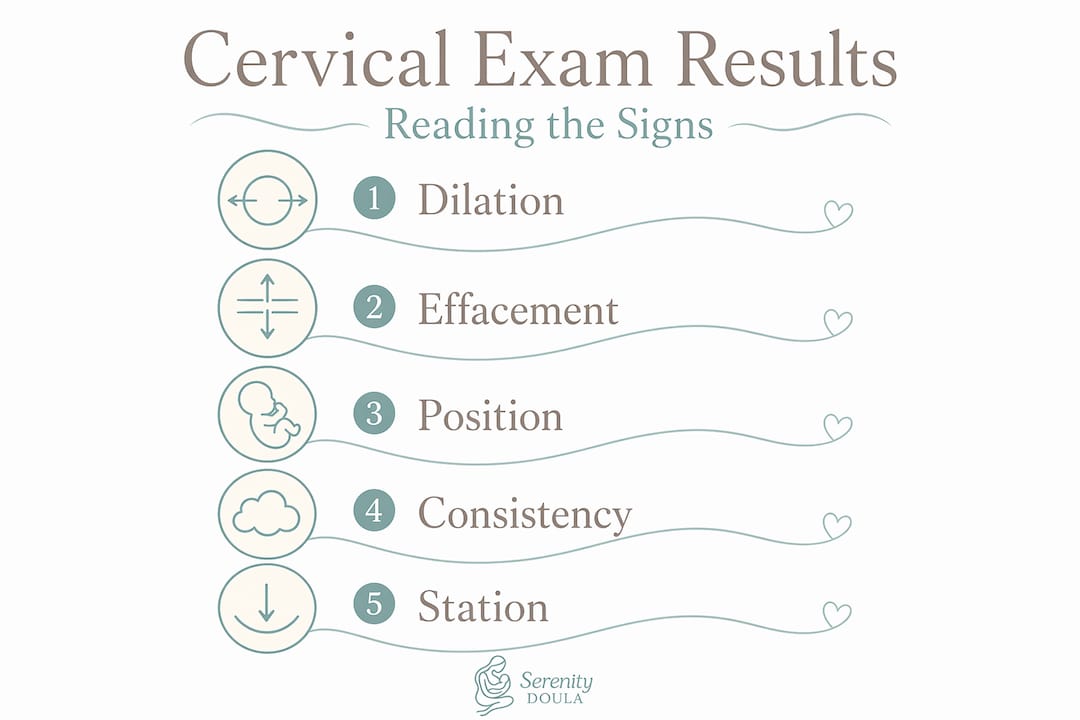
- Dilation: How many centimeters your cervix has opened
- Effacement: How thin or “ripened” the cervix has become, expressed as a percentage
- Station: How far down the baby’s head has descended into your pelvis
- Consistency: Whether the cervix feels firm or soft
- Position: Whether the cervix is tilted toward your back or pointing forward
These five factors are combined into something called the Bishop score, which ranges from 0 to 13. A score of 8 or higher suggests your body is getting close to labor on its own. A score of 5 or below suggests labor is unlikely to start soon without medical support.
Providers typically perform exams after ruling out complications like placenta previa or ruptured membranes. The exam helps guide decisions about monitoring, timing, and whether any intervention might be needed. It is a tool for observation, not a lever that triggers a process.
Pro Tip: If you are feeling anxious about cervical exams, it is completely okay to ask your provider what they are looking for and what the results mean for you specifically. Understanding the purpose can make the exam feel much less intimidating.
Does a cervical exam cause labor to start?
This is where things get really interesting, and honestly, really reassuring. Labor is defined by regular uterine contractions combined with measurable cervical change. The exam itself does not create either of those things. It detects them.
Think about it this way: a thermometer does not give you a fever. It reads one. A cervical exam works the same way. If you go in for a check and your provider finds significant dilation and effacement, it means your body was already working in that direction before you ever climbed onto the table.
“What often feels like the exam ‘starting’ labor is actually the exam catching labor that was already beginning.” This distinction matters more than people realize, because it shifts the credit for all that hard work back where it belongs — to your body.
That said, there is a nuance worth knowing. Manipulation of a ripe cervix can occasionally cause mild, temporary contractions. Think of it like nudging a door that was already cracked open. If your cervix is very favorable and your body is primed and ready, an exam might produce some short-lived cramping or irregular contractions. But this is very different from active labor. Labor begins spontaneously based on hormonal and physical changes happening deep within your body over days and weeks, not from a two-minute check at your prenatal appointment.
Understanding what your cervical exam results actually tell you
Getting a result like “you’re 2 centimeters dilated” can send your mind racing. But here is what the research actually says: cervical dilation alone does not confirm that labor is about to start. You can be dilated for days, sometimes even a couple of weeks, without going into active labor.
This table shows how cervical signs compare to what they actually mean for labor timing:
| Cervical finding | What it means | What it does not mean |
|---|---|---|
| 1-2 cm dilated | Your cervix is beginning to open | Labor is starting today |
| 50% effaced | The cervix is thinning and softening | Active labor is imminent |
| Baby at -1 station | Baby has begun to drop | Delivery is hours away |
| Bishop score 8+ | Body is highly ready for labor | Labor was caused by the exam |
Other signs that labor may genuinely be approaching include:
- Losing your mucus plug or noticing a bloody show
- Feeling more pelvic pressure as the baby drops lower
- Experiencing irregular “practice” contractions that pick up in frequency
- A sudden burst of energy or the nesting urge
Your cervical exam results are one piece of a bigger picture. They are most useful when combined with these other signs, your gestational age, and your overall clinical history. For a deeper look at what cervical exam findings mean at different stages, the cervical exam guide at Myserenitydoula walks you through what to expect.
Practical ways to approach cervical exams with confidence
Knowing the facts is one thing. Feeling calm about them is another. Here are some practical steps that can help you approach your exams and your labor preparation with a sense of control:
- Ask if the exam is necessary. Cervical exams late in pregnancy are not always required at every visit. You have the right to ask about timing and to understand why an exam is being recommended.
- Limit frequency when possible. Frequent cervical exams carry a small but real infection risk, particularly if your membranes have ruptured. Providers balance the information gained against that risk.
- Track non-invasive signs at home. Notice your contractions, any changes in discharge, and how the baby is moving. These give you useful information between appointments without any discomfort.
- Talk about your concerns out loud. Your provider cannot reassure you about something they do not know is worrying you. Bring your questions to every appointment.
- Prepare your mind, not just your body. Emotional readiness is a real part of labor preparation. Breathing practices, birth education, and having a support person in place can make you feel calmer walking into any appointment.
Pro Tip: If you want to feel more prepared for how labor may progress, learning how to help labor progress naturally can give you a sense of agency while you wait.
My honest take on cervical exams and labor timing
I have sat with so many families who came into a consultation convinced that a cervical exam at 38 weeks was what “set things off.” And I understand why it feels that way. Labor followed the exam, so the exam must have caused it. But in my experience supporting families through birth, what I see over and over is that the body has its own timeline. The exam just happened to land at the right moment.
What I believe most strongly is this: cervical exams are valuable information. They are not a verdict, and they are not a trigger. A score of 2 centimeters at 37 weeks does not mean you will be in labor by Friday. A score of 4 centimeters at 39 weeks does not mean the exam pushed you there. I encourage every person I work with to receive those results with curiosity rather than panic.
What actually matters is how supported you feel as you approach labor, regardless of what any single exam shows. Having someone in your corner who can help you process the information, ask the right questions, and stay steady when the anxiety spikes, that is what makes the real difference.
— Alexis Wallace
Support that carries you through every part of this

At Myserenitydoula, the work of supporting you does not begin when labor starts. It begins right now, in moments exactly like this one, when you are trying to make sense of a cervical exam result or calm a worried mind between appointments. Whether you want someone to help you interpret what your provider is telling you, prepare for birth with real confidence, or simply feel less alone in the process, the team at Myserenitydoula is here for that. Explore pregnancy and birth support options or learn how childbirth education can help you feel genuinely ready for whatever comes next.
FAQ
Can a cervical exam start labor on its own?
No. Labor requires regular contractions plus measurable cervical change. A cervical exam detects these signs but does not cause them.
Why do I feel cramping after a cervical exam?
Mild cramping after an exam is normal. Manipulation of a favorable cervix can cause temporary contractions, but this is not the same as active labor starting.
Does being dilated mean labor is coming soon?
Not necessarily. Dilation alone does not confirm labor is imminent. You can be several centimeters dilated for days or weeks before labor truly begins.
What is a Bishop score and why does it matter?
The Bishop score combines five cervical and fetal factors on a scale of 0 to 13. A score of 8 or higher indicates your body is likely close to labor or ready for induction.
How often should I have cervical exams near my due date?
Exam frequency should be individualized. Frequent exams carry a small infection risk, so it is reasonable to ask your provider whether each exam is necessary and what information it will add to your care.