

Personalized doula care, built around your specific needs, consistently produces better birth outcomes than standard hospital support alone. Bespoke birth support services are individualized doula and postpartum care packages designed around your birth preferences, medical history, cultural values, and family goals. A Cochrane review involving 15,858 women found that continuous one-to-one labor support reduces cesarean rates, shortens labor, and lowers the likelihood of a newborn with a low five-minute Apgar score. These aren’t small margins.
Here’s what tailored maternity support typically includes:
- Prenatal visits (usually 2–3 sessions) to build your birth plan and address fears
- On-call labor support beginning around 36 weeks
- Continuous birth attendance from active labor through the first hour postpartum
- Postpartum visits in the first 1–3 weeks for physical and emotional recovery
- Partner coaching so your support person feels confident, not overwhelmed
- Newborn care guidance and breastfeeding encouragement
Families who work with Serenity Doula in Bucks County, from Newtown to Doylestown, gain a dedicated partner who collaborates directly with their care team at Trinity Health St. Mary and other local hospitals.
What do bespoke birth support services actually include?
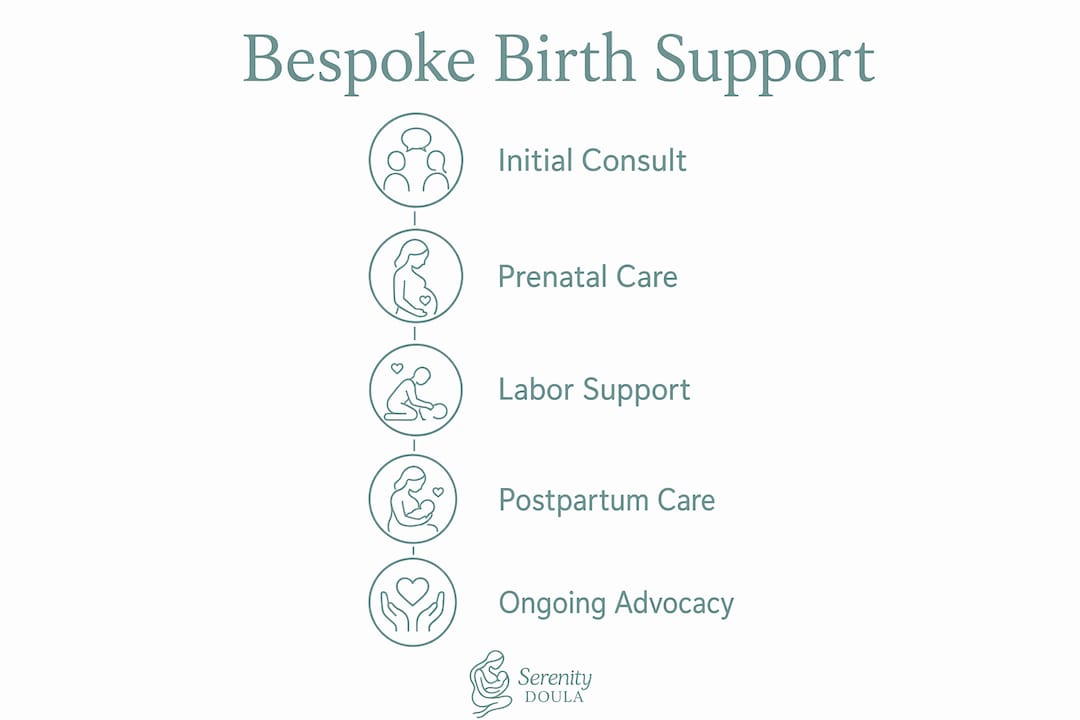
The range of childbirth support types is broader than most parents expect. Birth doulas focus on labor: positioning, counterpressure, hydrotherapy, breathing coaching, and emotional grounding through every contraction. Postpartum doulas shift the focus to recovery, newborn care, and the emotional weight of those first weeks at home. Antepartum doulas support families navigating high-risk pregnancies or extended bed rest.

A truly personalized care plan starts well before labor. Prenatal visits cover your birth preferences, any previous birth experiences, and specific concerns, whether that’s a planned VBAC, a cesarean, or an unmedicated birth. Your doula learns what calms you, what language feels supportive, and how involved your partner wants to be. That knowledge shapes everything that happens in the birth room.

Physical comfort techniques are adapted to you in real time. Counterpressure on the sacrum, warm water immersion, movement encouragement, and position changes aren’t applied by formula. They’re offered, adjusted, and sometimes set aside entirely based on what your body needs at that moment.
Pro Tip: Book your first prenatal consultation before 20 weeks. The earlier your doula knows your history and preferences, the more genuinely tailored your care plan becomes, and the more trust you’ll have built before labor begins.
Postpartum support is where many families are surprised by how much they needed it. Recovery visits cover physical healing, infant feeding, sleep, and the emotional terrain of new parenthood. A strong postpartum support network is one of the most protective factors for maternal mental health in the weeks after birth.
How do you choose the right birth support provider?
Credentials matter, but they’re only the starting point. Because there is no single national certifying body for doulas, you’ll need to verify each provider’s training individually. Look for certifications from recognized organizations and ask specifically about experience with your birth scenario, whether that’s multiples, trauma-informed care, or a planned cesarean.
Key questions to ask any prospective doula:
- What certifications do you hold, and through which organization?
- How many births have you attended, and what types?
- Who is your backup if you’re unavailable when I go into labor?
- What does your on-call window look like, and when does it begin?
- Can I see your service agreement and refund policy in writing?
Geography is a practical factor that often gets overlooked. A doula who lives within 30–45 minutes of your birth location is far more reliable for in-person support than one who is farther away. For Bucks County families, proximity to Trinity Health St. Mary or your chosen birth center matters.
Red flags worth noting: vague contracts with no refund terms, reluctance to discuss backup coverage, or a doula who can’t clearly describe her scope of services. The rapport you feel in an interview is also real data. Choosing a doula often comes down to cultural fit and connection as much as credentials, so trust your instincts after a thorough conversation.
Book early. Most experienced doulas in the Philadelphia metro area fill their calendars 3–4 months in advance. Waiting until the third trimester limits your options.
What does the research say about personalized doula care?
The evidence is clear and growing. ACOG’s 2026 guidance on partnering with doulas states that continuous support lowers the length of labor, decreases cesarean deliveries, improves breastfeeding initiation rates, and increases feelings of birth satisfaction.
Statistic spotlight: The Cochrane review found that women with continuous labor support were 25% less likely to have a cesarean birth (RR 0.75) and had labors that were, on average, 0.69 hours shorter.
ACOG also highlights the equity dimension. Doulas help patients navigate complex hospital environments, improve communication with clinicians, and support self-advocacy, particularly for families who have historically been marginalized. At Serenity Doula, that commitment to evidence-based labor support shapes every care plan, from a first-time parent in Newtown to a family planning a VBAC in Doylestown.
Ready to feel genuinely supported through every stage of your birth? Serenity Doula offers a free consultation to talk through your needs, your birth setting, and how a personalized care plan can be built around you. Explore birth support services or reach out to book your first conversation.

Key Takeaways
Continuous, personalized doula support reduces cesarean rates, shortens labor, and improves birth satisfaction, making it one of the most evidence-backed investments expectant families can make.
| Point | Details |
|---|---|
| Evidence-backed outcomes | Cochrane data shows lower cesarean rates and shorter labor duration with continuous support. |
| Book early | Most experienced doulas in the Philadelphia area fill calendars 3–4 months ahead. |
| Verify credentials individually | No single national certifying body exists; ask each doula directly about training and specializations. |
| Proximity matters | A doula within 30–45 minutes of your birth location provides more reliable in-person support. |
| Insurance coverage is expanding | Medicaid covers doulas in many states; typical packages cost a few hundred to a few thousand dollars depending on services and location. |
FAQ
What is the 4-1-1 rule for labor contractions?
The 4-1-1 rule suggests heading to the hospital when contractions are 4 minutes apart, lasting 1 minute each, for at least 1 hour. Experienced doulas recommend adapting this guideline to your individual labor intensity and your provider’s specific instructions rather than following it rigidly.
Does insurance typically cover a doula?
Medicaid covers doula services in more than 15 states as of 2026, and private coverage is growing through employer fertility benefits like Carrot and Maven. Coverage varies widely, so contact your insurer directly to confirm your specific benefits.
What does a birth doula package typically cost?
Typical birth doula packages in the U.S. range from $800–$2,500 in 2026, depending on location, experience, and included services. Premium packages with extended postpartum care or lactation support can run higher.
What is the 3-3-3 rule for postpartum?
The 3-3-3 rule is a general postpartum recovery guideline suggesting 3 days in bed, 3 days on the bed, and 3 days near the bed to allow for physical healing. It’s a helpful framework, though your postpartum doula will adapt recovery support to your actual needs and circumstances.
Do I still need a doula if I have a doctor or midwife?
Yes. Doulas fill a different role than clinical providers. As ACOG notes, they offer the continuous emotional and physical support that clinicians often can’t provide while managing medical responsibilities. Learn more about what a doula does and how that complements your medical team.