

TL;DR:
- Expectant parents have the right to refuse cervical checks during pregnancy and labor, emphasizing patient autonomy and informed consent. Alternatives like the purple line and behavioral cues can monitor labor progress without internal examinations, which some individuals find uncomfortable or traumatic. Preparing clear communication with healthcare providers and having support persons can help ensure respectful, informed, and confident decision-making throughout childbirth.
Refusing cervical checks during pregnancy is something many expectant parents don’t realize they can do. Cervical checks are offered routinely in prenatal appointments and during labor to assess dilation and effacement, but they are never mandatory. You have the right to say no. Whether you’re feeling anxious about discomfort, processing past trauma, or simply want more say in your care, your feelings are valid and your choices deserve respect. This article walks you through your legal rights, practical alternatives, and how to have honest, confident conversations with your care team so you feel grounded every step of the way.
Table of Contents
- Key takeaways
- Refusing cervical checks during pregnancy: your legal rights
- Why people decline cervical checks and what the alternatives are
- How to talk to your provider about your preferences
- What labor looks like when you decline cervical checks
- My personal take on consent and birth
- How Myserenitydoula can support your birth choices
- FAQ
Key takeaways
| Point | Details |
|---|---|
| You can legally refuse | Patients have a fundamental right to decline any medical procedure, including cervical exams. |
| Informed consent is required | Your provider must explain the purpose and method of any exam before performing it. |
| Alternatives exist | Non-invasive options like the purple line and fetal movement tracking can monitor labor progress. |
| Documentation protects you | Requesting written refusal in your medical record helps prevent repeated pressure from staff. |
| Support changes everything | Having a doula or partner present during provider conversations strengthens your ability to advocate for yourself. |
Refusing cervical checks during pregnancy: your legal rights
Here is something that surprises many pregnant people: you can refuse any medical procedure, including pelvic exams, at any point during your pregnancy or labor. This is not a loophole. It is a foundational principle of medical ethics called patient autonomy.
Informed consent is the core of this principle. Before any cervical check, your provider is legally and ethically obligated to tell you what the exam involves, why they are recommending it, and what the alternatives are. Without that explanation, and without your explicit agreement, the exam should not happen. Exams done without permission are considered done to a patient rather than with them, and that distinction matters enormously for your sense of safety and trust.
Declining cervical exams is not non-compliance. It is an informed choice, and it deserves the same respect as any other medical decision you make. That said, how your refusal is handled depends a lot on your care environment. This is why documentation is so powerful.
Here is what you can do to protect your autonomy:
- Ask for an explanation first. Before any exam, ask your provider to explain why it is being recommended and what the findings would change about your care.
- Request documentation. If you decline, ask your provider to note your refusal in your medical records. Documenting your refusal helps prevent repeated pressure from different staff members during labor.
- Revisit your birth plan. Make sure your preferences around cervical checks are clearly written in your birth plan so your whole care team is aware from the start.
- Know that timing matters. Cervical checks are performed more frequently after 36 weeks, but shared decision-making should guide whether and when they happen.
Pro Tip: When setting up your prenatal appointments, ask your provider directly: “What is your practice around obtaining consent before cervical checks?” Their answer will tell you a lot about how well they honor patient autonomy.
Why people decline cervical checks and what the alternatives are
There are so many reasons a person might want to avoid or limit cervical checks, and none of them need justification. Discomfort is real. For some people, the sensation ranges from pressure to significant pain. For others, a history of trauma, sexual assault, or medical anxiety makes internal exams feel deeply unsafe. Cultural or personal privacy values also play a role. And sometimes, people simply want to experience labor with fewer interruptions.
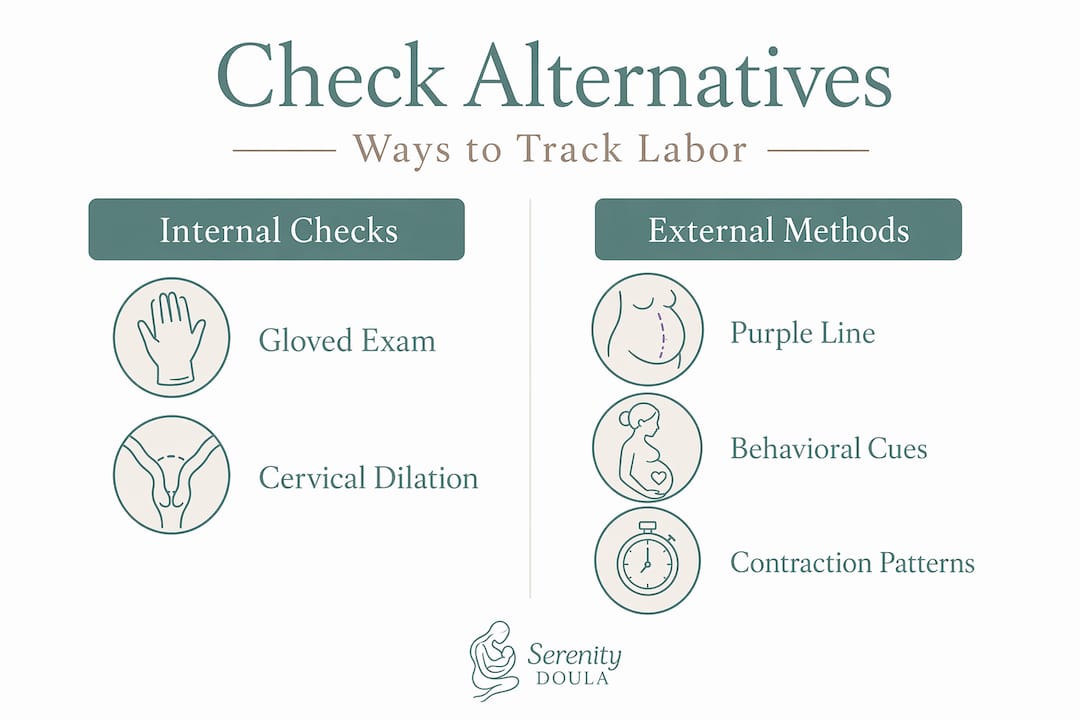
The good news? Labor can often be assessed without a gloved hand. The purple line is one lesser-known alternative. As labor progresses, a line may appear at the base of the tailbone and extend upward, with its length corresponding roughly to cervical dilation. It is not universally visible, but it works for many people. Fetal movement patterns, changes in vocalization and behavior during contractions, and overall labor rhythm can all give experienced care providers meaningful information about where you are in the process.

Here is a comparison of common monitoring approaches:
| Monitoring method | Invasiveness | What it shows |
|---|---|---|
| Manual cervical check | Internal | Dilation, effacement, station |
| Purple line observation | External | Approximate dilation |
| Fetal movement tracking | External | Baby’s wellbeing |
| Behavioral cues and contraction patterns | Non-contact | Labor progression |
If you have specific clinical circumstances, like cervical abnormalities during pregnancy, your provider may want to monitor more closely with less invasive surveillance rather than routine internal checks. Always ask what your specific situation requires and why.
Pro Tip: If you are worried about how your birth team will respond to your preferences, look for providers who are known for honoring birth plans. Choosing providers who respect consent is one of the most protective steps you can take for your birth experience.
How to talk to your provider about your preferences
Many people know what they want but struggle to find the words in the moment. The exam is already starting, there is time pressure, and speaking up feels hard. The best thing you can do is prepare for those conversations long before labor begins.
Start at a prenatal visit. Tell your provider that you want to discuss cervical checks and your preferences around them. You can say something as simple as: “I would like to decline routine internal exams unless there is a specific medical reason. Can we talk about what that would look like for my care?” That one sentence opens the door. It signals that you are thoughtful, informed, and expecting a collaborative relationship.
Here is a simple framework for these conversations:
- State your preference clearly. “I prefer to avoid cervical checks unless medically necessary.”
- Ask for the reasoning. “Can you help me understand why this check is being recommended right now?”
- Request documentation. “I would like it documented in my records that I am declining this internal exam.”
- Revisit as needed. Consent is ongoing. You can agree to one check and decline the next, depending on how you feel in the moment.
Your partner or doula can play a huge role here. Having someone in the room who knows your preferences and feels comfortable speaking up on your behalf can make these conversations much calmer for you. Consider practicing these phrases together before your due date. Role-playing might feel a little silly, but it genuinely helps. Learning effective communication strategies before labor starts gives you and your support person real confidence.
What labor looks like when you decline cervical checks
Choosing to avoid internal exams during labor does not mean your care team will be flying blind. Many people labor comfortably and safely without frequent or any cervical checks. Your body gives off clear signals of progress, and attentive providers know how to read them.
That said, there are a few situations where your team may strongly encourage a check:
- Concerns about labor stalling. If your contractions slow significantly, a check may help clarify what is happening.
- Before an epidural. Some hospitals have protocols around baseline dilation before placing an epidural, though you can still ask questions and negotiate.
- Monitoring specific risk factors. If you have a history of rapid labor or preterm birth, your provider may feel checks are clinically helpful.
In each of these situations, the conversation still belongs to you. You can ask, “What would change based on the result of this exam?” If the answer does not change the plan for your care, you have every reason to continue declining.
For managing discomfort and anxiety during labor more broadly, hypnobirthing breathing techniques can help ease tension whether or not you accept a check. Deep breathing, visualization, and focused relaxation support your nervous system and help you stay present. A doula supporting you in real time can make these tools easier to access when things get intense. You can read more in our cervical exams during pregnancy guide for a fuller picture of your choices.
My personal take on consent and birth
I have supported many families through labor, and the moments that stay with me most are the ones where someone finally felt heard. Not managed. Not moved through a checklist. Heard.
In my experience, routine cervical checks are often performed without a full explanation or a genuine pause for consent. That troubles me deeply. When care is done to you without your explicit agreement, it chips away at your confidence and your trust. I have seen that pattern create real anxiety during labor, and it does not have to happen.
What I know for certain is that informed consent in birth is not a formality. It is the foundation of a positive birth experience. Every person deserves to understand what is happening to their body and to say yes or no on their own terms. Choosing a birth team that genuinely shares that value, and preparing yourself with education and support, is the most grounding thing you can do. You are not asking for too much. You are asking for exactly what you deserve.
— Alexis Wallace
How Myserenitydoula can support your birth choices

At Myserenitydoula, we believe every birth should feel like your birth. Our doulas are trained to help you prepare for exactly these kinds of conversations, whether you are thinking about declining cervical exams, writing a birth plan, or simply wanting someone in your corner who knows how to speak up respectfully with your care team. We offer pregnancy and birth support that includes hands-on advocacy during labor, and our childbirth education classes equip you and your partner with the knowledge to make informed, confident choices. You do not have to navigate this alone. Reach out to schedule a consultation and find out how we can support the birth experience you are hoping for.
FAQ
Can I refuse a cervical check at any point during pregnancy?
Yes. Patients have the right to refuse any medical procedure, including cervical exams, at any stage of pregnancy or labor. Your provider cannot perform an exam without your informed consent.
Will refusing cervical checks affect my labor care?
In most cases, no. Experienced providers can monitor labor progress through behavioral cues, contraction patterns, and external observation. There are some situations where a check may be clinically recommended, but the choice remains yours.
How do I stop repeated pressure from staff during labor?
Ask your provider to document your refusal in your medical record. This creates a clear record that all care team members can see, reducing the likelihood of being asked repeatedly.
What are alternatives to cervical checks for tracking labor?
The purple line is one external method that can approximate dilation. Fetal movement tracking and observation of contraction intensity and behavior are other non-invasive ways to assess progress.
Does a doula help with refusing cervical checks?
Absolutely. A doula can help you prepare your birth preferences in advance, support you in communicating them clearly, and advocate alongside you during labor. Learn more about what a doula does and how that support plays out in real birth scenarios.