

TL;DR:
- Childbirth coaches, primarily doulas, provide emotional and physical support during pregnancy, labor, and postpartum.
- Continuous doula support can significantly reduce cesarean rates and increase breastfeeding success.
- Doulas complement medical care by managing the birthing experience and emotional well-being.
Most parents spend months choosing the right OB or midwife. That makes sense. But there’s another person on your birth team who can quietly change everything: a childbirth coach. Research shows that continuous labor support reduces cesarean rates, preterm births, and labor duration while increasing breastfeeding success. Yet many families in the Philadelphia suburbs have never heard of a doula, or aren’t sure how one fits into their birth plan. This article breaks it all down. We’ll cover what a childbirth coach actually does, how they differ from your doctor or midwife, what labor support looks like in real time, and how that support continues long after your baby arrives.
Table of Contents
- What is a childbirth coach (doula)?
- How childbirth coaches support families during labor
- Childbirth coaches, midwives, and doctors: What’s the difference?
- Beyond birth: How coaches support postpartum recovery
- The reality: What most parents don’t realize about childbirth coaches
- Ready to experience the difference? Find your Philadelphia region coach
- Frequently asked questions
Key Takeaways
| Point | Details |
|---|---|
| Childbirth coaches lower risks | Having a coach like a doula reduces interventions, pain, and may shorten labor. |
| Doulas are non-medical | Doulas work alongside doctors and midwives to offer emotional, physical, and informational support. |
| Support continues postpartum | Childbirth coaches help parents recover and adapt after birth with practical and emotional backing. |
| Choose the right fit | The connection and approach of your coach matter as much as their credentials. |
What is a childbirth coach (doula)?
The term “childbirth coach” is a broad one. It can describe anyone who provides guidance and encouragement during pregnancy and birth. But the most recognized professional in this space is a doula, and understanding what a doula does is the best place to start.
A doula is a trained, non-medical professional who offers emotional, physical, and informational support to families before, during, and after birth. They don’t deliver babies. They don’t perform medical procedures. What they do is stay by your side, keep you calm, help you communicate with your care team, and make sure your voice is heard when things get intense.
There are two main types of doulas:
- Birth doulas support you through labor and delivery, from early contractions to the moment your baby is born.
- Postpartum doulas step in after birth to help with newborn care, breastfeeding, emotional recovery, and family adjustment.
Some doulas specialize in one area; others offer both. You can explore the full range of childbirth support types to find what fits your family’s needs.
Doula training varies. Some complete certification programs through organizations like DONA International or CAPPA. Others have years of hands-on experience without a formal certificate. There’s no universal licensing requirement in Pennsylvania, which is why choosing someone you genuinely connect with matters just as much as their credentials.
“A doula is not a luxury. She is a necessity.” The evidence backs this up: doulas reduce cesarean rates, preterm births, labor duration, and pain, and they increase breastfeeding initiation across diverse birth settings.
Think of a doula as your anchor when everything else feels like a whirlwind. Your medical team manages the clinical side. Your doula manages you, your comfort, your confidence, and your peace of mind.
How childbirth coaches support families during labor
Knowing the definition is one thing. Seeing it in action is another. Here’s what a birth coach actually does when labor begins.
Before labor: Your doula meets with you during pregnancy to understand your birth preferences, fears, and goals. They help you build a birth plan, explain what to expect at each stage, and make sure you feel prepared rather than panicked.
During labor: This is where the real magic happens. Your doula arrives when contractions pick up and stays with you continuously. They use breathing techniques, positioning, massage, and calm reassurance to help you manage pain. They also help you communicate with nurses and doctors so your preferences are respected.
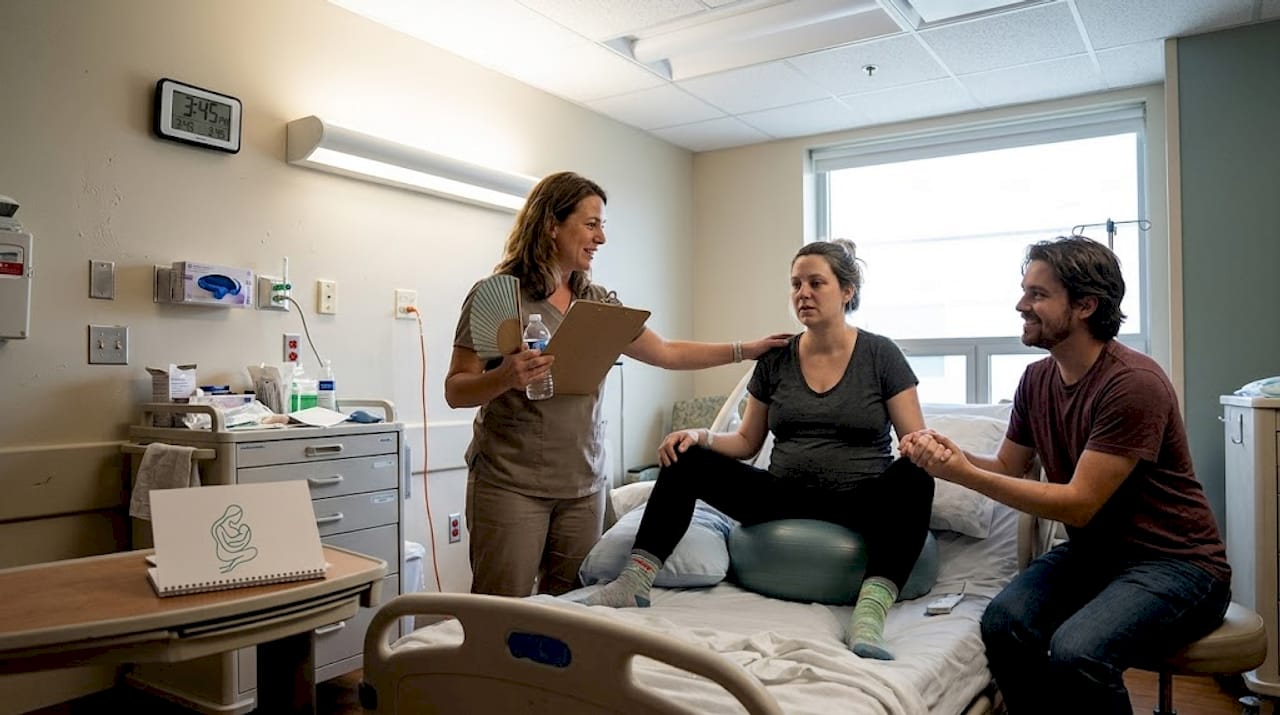
After birth: Your doula supports immediate skin-to-skin contact, helps with the first breastfeeding attempt, and makes sure you feel settled before they leave.
Here’s a simple breakdown of how that support unfolds:
- Early labor: Doula arrives, assesses your comfort level, and begins hands-on support.
- Active labor: Continuous presence, position changes, breathing cues, and emotional grounding.
- Transition: Doula stays close, offers encouragement, and helps you stay focused.
- Pushing: Guidance on breathing and positioning, steady reassurance.
- After birth: Support with baby’s first latch, emotional processing, and family bonding.
The numbers behind this support are striking. One RCT found continuous doula support reduced cesarean from 25% to 13%, and epidural use dropped from 76% to 65% among middle-class couples.
Families with continuous labor support saw cesarean rates cut nearly in half compared to those without a doula present.
| Outcome | Without a doula | With a doula |
|---|---|---|
| Cesarean rate | 25% | 13% |
| Epidural use | 76% | 65% |
| Breastfeeding initiation | Lower | Higher |
These aren’t small differences. They represent real outcomes for real families. Learn more about doula care benefits and how comfort measures in labor can be personalized for your birth.
Pro Tip: Talk to your doula about your biggest fear during labor, whether that’s pain, losing control, or unexpected interventions. Naming it out loud helps your doula prepare the right support strategy just for you.
Childbirth coaches, midwives, and doctors: What’s the difference?
This is one of the most common questions we hear. And it’s a fair one, because the roles can seem to overlap from the outside.
Here’s the clearest way to think about it: doctors and midwives manage your medical care; your doula manages your experience.
Doulas provide non-medical support, while midwives provide clinical care and can deliver babies. An OB (obstetrician) is a physician who specializes in pregnancy and delivery, handles complications, and performs cesareans when needed. A certified nurse-midwife (CNM) provides clinical care with a more holistic approach, often supporting natural birth. A doula holds your hand, reads the room, and makes sure you never feel alone or unheard.
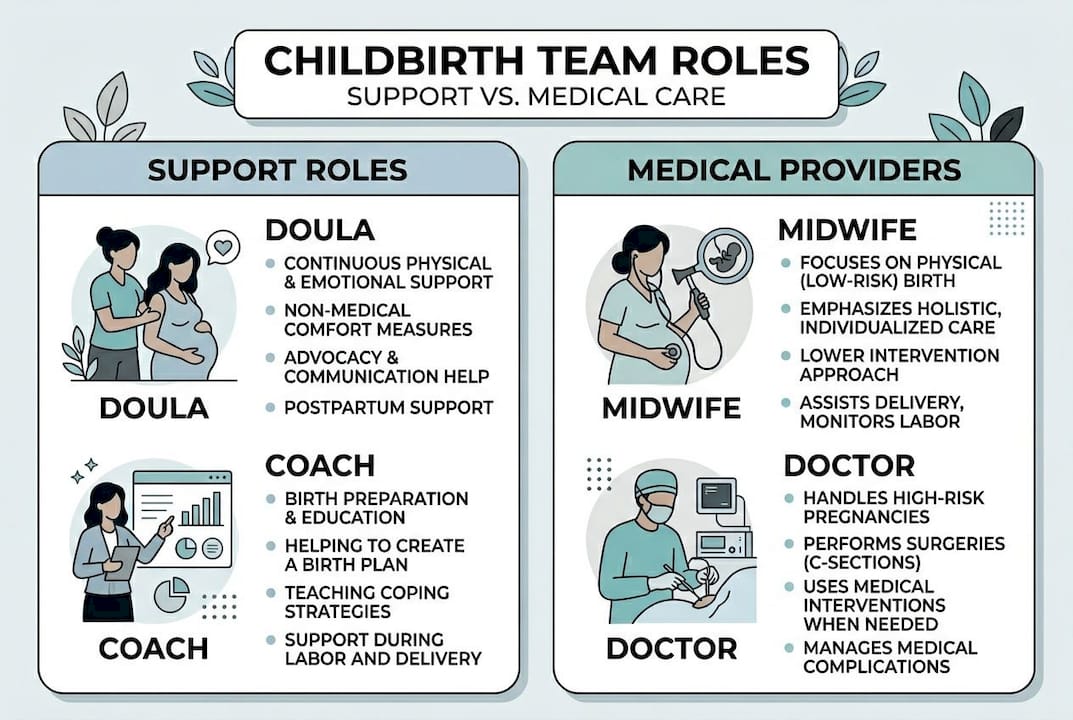
| Professional | Training | Medical authority | Support style |
|---|---|---|---|
| OB/Physician | Medical degree | Full clinical authority | Clinical and procedural |
| Midwife (CNM) | Nursing + midwifery | Can deliver, prescribe | Clinical with holistic elements |
| Doula | Varies (certification programs) | None | Emotional, physical, informational |
These roles don’t compete. They complement each other beautifully. A doula who understands what a doula does in relation to the medical team can actually make your OB’s job easier by keeping you calm, informed, and cooperative during high-pressure moments.
Here’s why having both matters:
- Your OB monitors fetal heart rate and manages complications. Your doula monitors you.
- Your midwife checks your dilation. Your doula helps you breathe through the next contraction.
- Your nurse documents vitals. Your doula reminds you of your birth preferences when you forget.
The family-centered birth benefits of having a full team are well documented. When everyone knows their role, you feel supported on every level, medically, emotionally, and practically.
Beyond birth: How coaches support postpartum recovery
The baby is here. You’re exhausted, emotional, and suddenly responsible for a tiny human. This is exactly when a postpartum doula earns their place on your team.
The “fourth trimester” is real, and it’s hard. Your body is healing. Your hormones are shifting. Your sleep is nonexistent. A postpartum doula steps in to make this transition gentler for everyone in the family.
Postpartum doulas aid recovery with newborn care, mental health education, and meal support, making them essential for holistic care during those early weeks. Their support goes far beyond holding the baby so you can nap, though that alone is priceless.
Here’s what postpartum doula support can look like in practice:
- Breastfeeding guidance: Helping with latch, positioning, and supply concerns.
- Newborn soothing: Teaching you swaddling, calming techniques, and sleep cues.
- Emotional check-ins: Watching for signs of postpartum depression or anxiety and connecting you with resources.
- Meal prep and light household tasks: So you can focus on healing and bonding.
- Partner support: Helping your partner feel confident and included in newborn care.
- Sleep strategies: Creating realistic routines that help the whole family rest more.
The mental health piece is especially important. Postpartum mood disorders affect up to 1 in 5 new mothers. Having a doula who recognizes the signs and knows how to respond can make a real difference in how quickly families get the help they need.
Explore what postpartum care support looks like, and how your partner can play an active role in your recovery too.
Pro Tip: Book your postpartum doula before your due date. Many families wait until they’re overwhelmed to reach out, and availability fills up fast in the Philadelphia suburbs.
The reality: What most parents don’t realize about childbirth coaches
Here’s something I want to be honest with you about. The research on doulas is mostly positive, but it’s not perfect. Some studies show no effect or even longer hospital stays, and doula training varies widely with no universal regulation in place. That means the quality of support you receive depends heavily on the individual.
The doula’s greatest strength isn’t a technique or a certification. It’s the relationship. A doula who truly listens to you, understands your fears, and shows up with calm confidence will do more for your birth experience than any credential on paper.
We always tell families: trust your gut as much as you trust the research. If a doula feels right in your consultation, that connection is data too. Learning about the benefits of childbirth education alongside doula support helps you walk into birth feeling genuinely prepared, not just informed.
Choose someone who makes you feel seen. That’s the real standard.
Ready to experience the difference? Find your Philadelphia region coach
If this article has you thinking “I want that kind of support,” we’re here for you. At Serenity Doula, we work with families across the Philadelphia suburbs to provide warm, personalized, evidence-based care from pregnancy through postpartum.

Whether you’re curious about pregnancy and birth support doula services, want to understand what a doula does before committing, or are searching for doulas in Levittown, PA and surrounding areas, we’d love to connect. Reach out to schedule a free consultation. Let’s talk about your birth, your goals, and how we can support your family every step of the way.
Frequently asked questions
Are childbirth coaches and doulas the same thing?
Most childbirth coaches are doulas, but some coaches may not have formal doula training. Doulas offer hands-on, non-medical support throughout pregnancy and labor, though doula training varies with no universal regulation.
Do I need a childbirth coach if I already have a doctor or midwife?
Yes. Childbirth coaches provide emotional and physical support that doctors and midwives aren’t trained to offer, and their roles are complementary, not overlapping.
How much difference does a childbirth coach really make during labor?
The evidence is clear: continuous doula support reduced cesarean from 25% to 13% in one controlled trial, alongside lower epidural use and higher satisfaction.
Do childbirth coaches help after the baby is born?
Absolutely. Postpartum doulas help with newborn care, breastfeeding, and emotional support, and doulas aid recovery with mental health education and practical household support.
Is doula support covered by insurance in Pennsylvania?
Some insurance plans and Medicaid programs in Pennsylvania may cover doula services, so it’s worth calling your provider directly to ask about your specific benefits.