

TL;DR:
- A postpartum care plan provides structure and support during the challenging “fourth trimester.”
- Building a multidisciplinary team ensures comprehensive physical, emotional, and infant care.
- Customizing and evolving your plan helps meet your family’s unique recovery needs.
The days after birth can feel like a beautiful blur mixed with real exhaustion, unexpected emotions, and more questions than answers. You’re healing, bonding, and learning all at once. That’s a lot. A structured postpartum care plan gives you something solid to hold onto when everything feels uncertain. It maps out your medical follow-ups, your support team, your daily self-care, and your warning signs, so nothing slips through the cracks. In this guide, we’ll walk you through why planning matters, who belongs on your team, how to build your plan step by step, and what to watch for every single day.
Table of Contents
- Why a postpartum care plan matters
- Who should be on your postpartum care team
- Step-by-step: Building your personalized postpartum care plan
- Key elements of daily postpartum self-care and safety
- Why one-size-fits-all postpartum care plans often fall short
- Next steps: Get expert help for your postpartum journey
- Frequently asked questions
Key Takeaways
| Point | Details |
|---|---|
| Start planning early | Develop your postpartum care plan during the third trimester to ensure support is ready when you need it. |
| Build a strong team | Include healthcare providers, family, and community resources to cover all aspects of your well-being. |
| Follow a personalized plan | Customize your care plan to fit your circumstances, and update it as your needs change. |
| Monitor for warning signs | Track your recovery and seek help promptly for symptoms like heavy bleeding or severe pain. |
| Integrate emotional support | Prioritize mental health screening, support networks, and open conversations about your feelings. |
Why a postpartum care plan matters
Most people spend months preparing for the birth itself. The nursery is ready. The hospital bag is packed. But what about the weeks after? That window, often called the “fourth trimester,” is when many families feel the most lost. Having a clear plan changes that completely.
Think of a postpartum care plan as your anchor when everything else feels like a whirlwind. It’s not just a list of doctor’s appointments. It’s a living document that covers your physical healing, your emotional well-being, your baby’s care, and the support network holding all of it together.
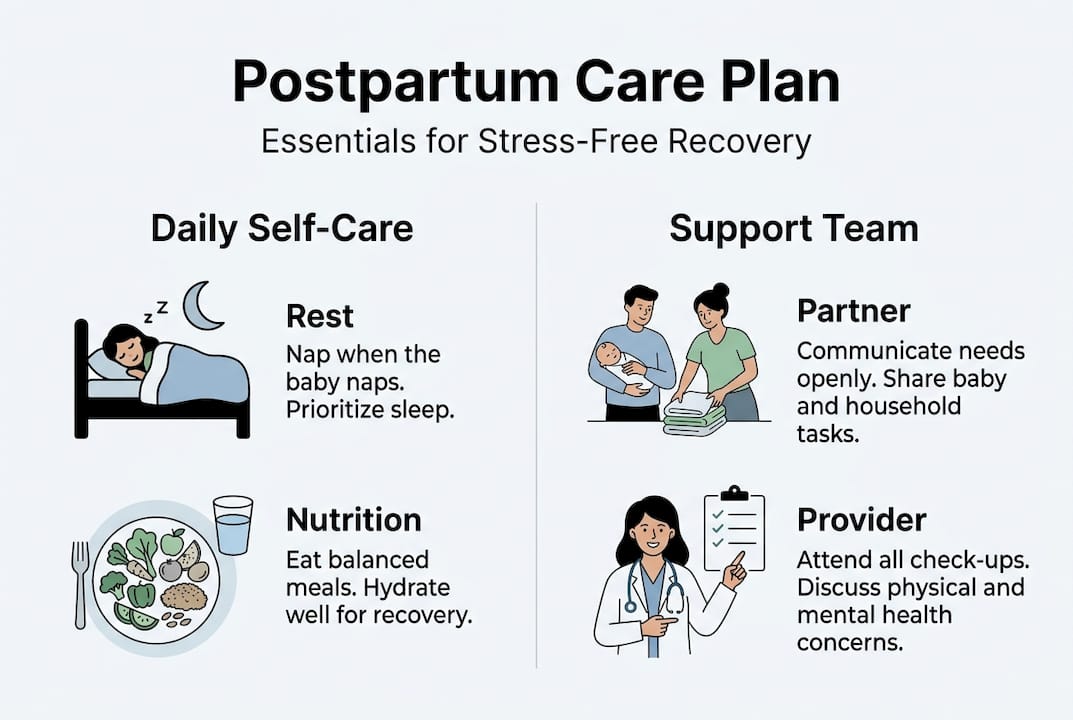
Research backs this up. Postpartum care should be ongoing, person-centered, and involve family for the best outcomes. That means one quick six-week checkup isn’t enough. Real recovery is a process, not a single visit.
Here’s what a solid plan helps you avoid:
- Missed warning signs that escalate into serious complications
- Falling through the cracks between providers
- Feeling isolated or unsupported at home
- Confusion about when to call for help
- Overlooking your own mental health in the chaos of newborn care
Families who plan ahead also tend to feel more confident and less reactive. Instead of scrambling when something feels off, you already know who to call and what to do.
The American College of Obstetricians and Gynecologists recommends you develop a postpartum care plan with your provider during prenatal care, identifying care team members for both mother and infant. This isn’t optional advice. It’s a clinical best practice.
| Without a plan | With a plan |
|---|---|
| Reactive, stressful decision-making | Proactive, calm responses |
| Unclear roles for support people | Everyone knows their job |
| Missed follow-ups | Scheduled check-ins in place |
| Emotional struggles go unaddressed | Mental health is part of the plan |
| Uncertainty about warning signs | Clear action steps ready |
Exploring postpartum care plans before your baby arrives is one of the most grounding things you can do for your whole family.
Who should be on your postpartum care team
You were never meant to do this alone. Building the right team before birth means you’re not scrambling to find help when you’re exhausted and overwhelmed.
A strong postpartum care team is multidisciplinary. That’s a fancy way of saying it includes people from different areas of your life, not just your OB. A postpartum care plan should identify the care team including your obstetrician, primary care provider, and infant support.
Here’s who belongs on your team and what they do:
- Obstetrician or midwife: Manages your physical recovery, screens for complications, and handles medical concerns
- Pediatrician: Monitors your baby’s growth, feeding, and development from day one
- Primary care provider: Supports your ongoing health, especially if you have chronic conditions
- Partner or co-parent: Your daily anchor at home, sharing night feeds, household tasks, and emotional support
- Postpartum doula: Offers hands-on help with newborn care, breastfeeding support, and emotional reassurance
- Mental health professional: Available for postpartum depression screening, anxiety support, or simply processing the transition
- Lactation consultant: Invaluable if you’re breastfeeding and hitting roadblocks
- Community or family support: Neighbors, friends, or family who can bring meals, run errands, or sit with baby so you can rest
| Team member | Primary role | When they’re most needed |
|---|---|---|
| OB or midwife | Physical recovery | First 12 weeks |
| Pediatrician | Baby’s health | Birth through first year |
| Postpartum doula | Practical and emotional support | First 6 weeks |
| Mental health provider | Emotional well-being | Ongoing as needed |
| Partner | Daily home support | Every single day |
Understanding the partner’s support role before birth helps set realistic expectations for both of you. Partners who know what’s coming are better equipped to show up in the ways that matter most.

Pro Tip: Designate one person as your point of contact for urgent questions. This prevents confusion and makes sure nothing gets lost when you’re too tired to track who said what.
When you connect with expert postpartum guidance early, you give your whole team time to prepare alongside you.
Step-by-step: Building your personalized postpartum care plan
The best time to build your plan is during your third trimester. You have the mental bandwidth, your provider is accessible, and you still have time to fill any gaps in your support network.
Here’s how to do it:
- Start with your medical follow-ups. Know when your first postpartum contact should happen. Schedule postpartum contacts within 3 weeks, with a comprehensive visit by 12 weeks. The WHO recommends at least four check-ins in the first six weeks.
- Identify your risks. Do you have a history of anxiety or depression? A high-risk pregnancy? A planned C-section? Your plan should reflect your specific situation, not a generic template.
- Map out practical help. Who is bringing meals? Who is staying overnight in the first week? Who can you call at 2 a.m. when you’re crying and don’t know why?
- Write down warning signs. Know what’s normal and what’s not. Include this in your plan so everyone around you knows when to escalate.
- Schedule mental health check-ins. Don’t wait until you’re struggling. Build them in from the start.
- Plan for physical recovery goals. Rest, gentle movement, pelvic floor care, and nutrition all belong in your plan.
- Share your plan with your team. Everyone should have a copy or at least know their role in it.
Using a third trimester checklist alongside your postpartum plan helps you stay organized in the final stretch. And if you’re still figuring out the birth itself, a solid birth preparation guide can help you feel ready on both fronts.
Pro Tip: After every provider contact or check-in, update your plan. Needs change fast in the postpartum period. A plan that stays static quickly becomes irrelevant.
Stat to know: The WHO recommends at least four postpartum contacts in the first six weeks. Many families receive far fewer, which is exactly why advocating for your own care schedule matters.
Key elements of daily postpartum self-care and safety
Your plan is only as strong as the daily habits that support it. Once you’re home with your baby, the real work of recovery begins. Knowing what to monitor each day, and what to do when something feels wrong, keeps you safe and grounded.
Here’s what to check and record daily:
- Bleeding: Is it slowing down or getting heavier?
- Pain levels: Is healing progressing or worsening?
- Mood and energy: Are you feeling supported or increasingly withdrawn?
- Feeding: Is your baby eating well and gaining weight?
- Your own hydration and nutrition: Are you eating enough to heal?
Monitor vital signs, bleeding, and pain, and know the warning signs: heavy bleeding, fever over 100.4°F, or severe pain all require immediate attention. Don’t wait to see if it gets better on its own.
For your emotional health, the line between baby blues and postpartum depression matters. Baby blues are common and typically resolve within two weeks. Postpartum depression is more intense and lasting. Up to 70 to 80 percent of new mothers experience baby blues and should be counseled on available support.
“Your emotional health is just as real as your physical health. Both deserve attention, care, and a plan.”
If you had a C-section or a high-risk pregnancy, your daily monitoring needs extra attention. Incision care, mobility limitations, and signs of infection all require specific awareness. Lean on your care team and don’t minimize what you’re feeling.
Exploring natural postpartum remedies can also complement your medical care with gentle, supportive tools for healing.
Self-care isn’t selfish. It’s what allows you to show up for your baby. Rest when you can. Accept help when it’s offered. And trust that healing takes time.
Why one-size-fits-all postpartum care plans often fall short
Here’s something we don’t say enough: most generic postpartum plans were not built for your family. They were built for an average that doesn’t really exist.
I’ve seen families follow every standard recommendation and still feel completely unprepared, because the plan didn’t account for their cultural expectations around rest, their extended family dynamics, or a partner who travels for work. A checklist can’t hold all of that.
Real postpartum recovery is messy and non-linear. Your needs at two weeks postpartum will look completely different from your needs at eight weeks. A plan that doesn’t evolve with you becomes a source of guilt rather than support.
Emotional support, responsive communication, and honoring your family’s culture matter just as much as clinical best practices. When you work with customized postpartum care, you get a plan that actually fits your life, not someone else’s.
Keep re-evaluating. Keep personalizing. Your plan should grow with you.
Next steps: Get expert help for your postpartum journey
You’ve done the reading. You understand why planning matters, who belongs on your team, and what to watch for each day. Now it’s time to put real support in place.

At Serenity Doula, we specialize in building personalized postpartum plans that actually reflect your family’s needs. Our postpartum care services remove the guesswork, monitor warning signs, and bring genuine peace of mind during one of life’s biggest transitions. Whether you’re also looking for pregnancy and birth doula support or navigating birth trauma recovery, we’re here to walk alongside you every step of the way. Reach out today and let’s build your plan together.
Frequently asked questions
When should I start creating my postpartum care plan?
Begin outlining your postpartum care plan in the third trimester so you have time to involve your provider and support team. Develop your plan during prenatal care with your healthcare provider for the best results.
Which warning signs should I watch for after childbirth?
Call your provider right away if you experience heavy bleeding, a fever over 100.4°F, or severe pain, as these may indicate serious complications that need prompt care.
How often should I have postpartum checkups?
Schedule a contact within 3 weeks postpartum and a comprehensive visit by 12 weeks. High-risk cases, including C-section recoveries, may need more frequent check-ins.
What should be included in a postpartum care plan for emotional health?
Your emotional health section should include mental health screening, awareness of baby blues versus postpartum depression, and a list of support contacts. Screen for postpartum depression at every provider contact during the postpartum period.
Is a postpartum care plan still useful after a C-section?
Absolutely. A care plan is especially important after a C-section to monitor incision healing, support pelvic floor recovery, and catch postpartum warning signs early before they become serious complications.