
TL;DR:
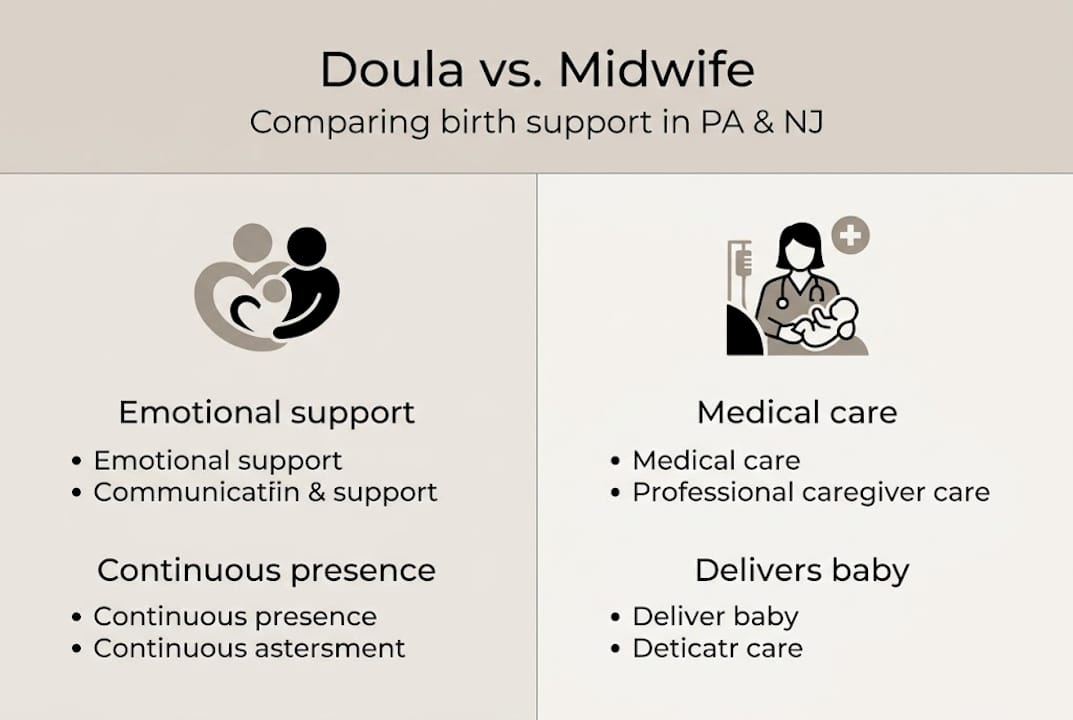
- Doulas provide emotional support, while midwives offer clinical medical care during pregnancy and birth.
- Training differs: doulas complete short certification programs, midwives require extensive medical education and licensing.
- Families often benefit from having both a doula and a midwife for comprehensive support.
If you’ve ever Googled “doula vs. midwife” at midnight while pregnant, you’re not alone. So many families in Pennsylvania and New Jersey assume these two roles are basically the same thing. They’re not. A doula and a midwife each bring something completely different to your birth experience, and understanding that difference could genuinely change how supported you feel on the biggest day of your life. In this article, we’ll walk you through what each role actually does, how they’re trained, what happens in the delivery room, and how to decide what’s right for your family.
Table of Contents
- What doulas and midwives actually do
- Training and credentials: How doulas and midwives prepare
- Labor and birth: Roles in the delivery room
- Benefits, outcomes, and choosing the right support
- A fresh perspective: Why families deserve both personalized and clinical support
- Connect with trusted support for your journey
- Frequently asked questions
Key Takeaways
| Point | Details |
|---|---|
| Distinct roles | Doulas offer non-medical support while midwives provide clinical pregnancy care. |
| Training differences | Midwives hold advanced medical degrees and licenses; doulas receive specialized non-clinical training. |
| Complementary support | Many families benefit by including both a doula and a midwife in their birth team. |
| Local access | Most hospitals in PA and NJ allow both support types, and Medicaid options are expanding. |
What doulas and midwives actually do
Let’s start with the basics, because this is where most of the confusion lives.
A doula is your emotional anchor. She’s the person beside you through every contraction, helping you breathe, helping your partner feel less helpless, and making sure your wishes are heard. She does not perform medical tasks. No checking dilation, no prescribing anything, no clinical decisions. Her entire focus is on you as a whole person. Think of her as your birth-side bestie who knows exactly how to keep you calm and grounded when things get intense.
A midwife, on the other hand, is a trained medical professional who provides clinical care throughout pregnancy, labor, and delivery. She can monitor fetal heart rates, manage low-risk deliveries, prescribe medications, and handle complications within her scope. She is licensed, regulated, and clinically accountable.
Here’s what a doula does:
- Provides continuous emotional and physical comfort during labor
- Uses massage, positioning, and breathing techniques
- Offers types of childbirth support tailored to your birth plan
- Advocates for your preferences with the medical team
- Supports your partner so they can be present and confident
- Stays with you from early labor through postpartum
Here’s what a midwife does:
- Conducts prenatal exams and monitors fetal development
- Manages labor and oversees delivery
- Performs medical checks and interprets results
- Prescribes medications and handles low-risk complications
- Provides postpartum medical follow-up
The most important thing to remember: doulas are not medical providers. Midwives are. Both matter, but for very different reasons.
The doula care benefits are rooted in presence and personalization. A doula stays with you continuously, while a midwife may be managing multiple patients and stepping in and out as your clinical needs arise. That’s not a criticism of midwives. It’s simply how clinical care works. Understanding this distinction helps you build a birth team that covers all your bases.
With these primary differences in mind, it’s important to explore how each path to becoming a doula or midwife shapes their expertise.
Training and credentials: How doulas and midwives prepare
Knowing who trained your birth support team matters. A lot.
Doulas typically complete short certification programs through organizations like DONA International or CAPPA. These programs cover labor support techniques, comfort measures, and advocacy skills. Importantly, doulas are not state-licensed in Pennsylvania or New Jersey. The title is not legally protected, which means anyone can technically call themselves a doula. That’s why asking about certification is so important when you’re interviewing candidates. Doula training in PA is evolving, with the state’s Doula Advisory Board working to expand Medicaid coverage and set clearer standards.
Midwives follow a much longer and more regulated path. Certified Nurse-Midwives (CNMs) must hold a nursing degree, complete a graduate-level midwifery program, pass the AMCB certification exam, and hold a state RN license. In Pennsylvania, CNMs must complete an approved midwifery program, pass the national exam, and maintain an active RN license. New Jersey has similar requirements.
| Feature | Doula | Certified Nurse-Midwife |
|---|---|---|
| Education required | Short certification course | BSN + graduate midwifery degree |
| Certification body | DONA, CAPPA, others | AMCB |
| State license required | No | Yes (RN + CNM license) |
| Can perform medical tasks | No | Yes |
| Regulated by state | No (PA advisory board forming) | Yes |
| Medicaid coverage | Expanding in PA and NJ | Typically covered |
This table makes it clear: these are two very different levels of training with two very different scopes of practice. Neither is better. They’re just built for different purposes.
Pro Tip: Always ask a doula for her certification details and a midwife for her state licensure number before you hire either one. A confident, qualified professional will be happy to share both. You can also check out this guide to doulas in PA for more on what to look for locally.
Understanding training highlights the legal and practical scope of each role. Next, let’s look at how their presence and responsibilities differ during labor.
Labor and birth: Roles in the delivery room
Okay, so you’re in labor. What actually happens, and who does what?
In New Jersey, 91% of hospitals allow personal doulas, and 84% offer midwifery services. That means in most NJ birth settings, you can have both. Pennsylvania hospitals vary more, but access is growing.
Here’s how the timeline typically looks when you have both:
- Early pregnancy: Your midwife begins prenatal care. Your doula connects with you to learn your birth preferences and build your plan.
- Late pregnancy: Your doula helps you prepare emotionally and practically. Your midwife monitors your health and baby’s development.
- Early labor at home: Your doula is available by phone or in person, helping you manage contractions. Your midwife is on call.
- Active labor at the hospital or birth center: Your doula stays by your side continuously, offering comfort, position changes, and encouragement. Your midwife checks in for exams, monitors progress, and manages clinical decisions.
- Delivery: Your midwife manages the birth medically. Your doula supports you emotionally and helps your partner stay engaged.
- Postpartum: Your doula helps with the first hours after birth, breastfeeding support, and emotional processing. Your midwife handles medical follow-up.
One of the most underappreciated things a doula does is support your partner so they can actually be present. Partners often feel lost in the delivery room. A doula gives them something to do, shows them how to help, and keeps everyone grounded. Your midwife’s focus is on clinical safety, which is exactly where it should be. The partner’s role in childbirth becomes so much richer when a doula is there to guide the way.
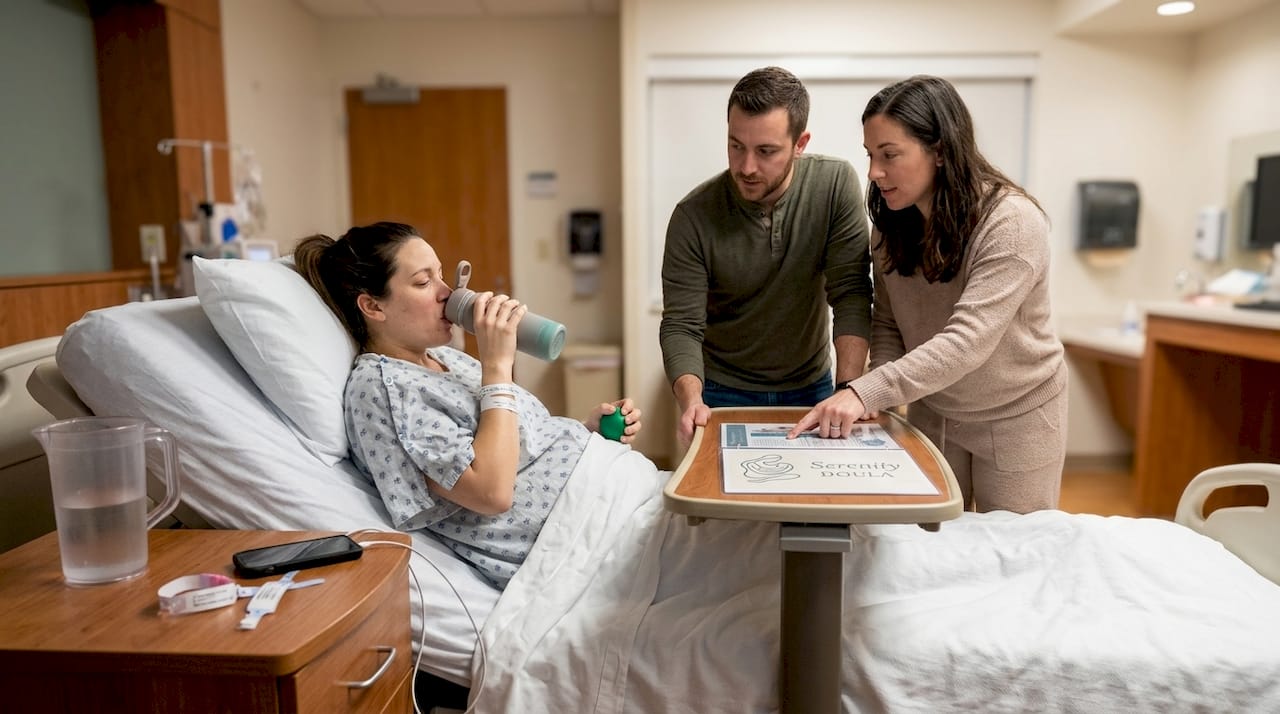
The continuous personalized support that doulas provide is something clinical staff simply cannot replicate in a hospital setting. It’s not about skill. It’s about availability and focus.
Now that you know who does what in the delivery room, it’s time to see how these roles impact health outcomes and family experience.
Benefits, outcomes, and choosing the right support
Research backs up what many families already feel intuitively: having the right support matters.
Midwifery care is associated with fewer interventions, lower C-section rates, and higher satisfaction among low-risk pregnancies. Doulas, meanwhile, reduce stress, increase feelings of empowerment, and improve the overall birth experience. Community doulas have shown particular impact for Black families and other communities facing systemic barriers in maternity care.
| Support type | Key benefit | Best for |
|---|---|---|
| Doula | Emotional support, advocacy, partner coaching | All births, high-stress situations |
| Midwife | Clinical management, fewer interventions | Low-risk pregnancies |
| Both together | Maximum support, better outcomes | Families wanting full coverage |
So how do you choose? Here are the factors worth thinking through:
- Your medical risk level: If you have a high-risk pregnancy, an OB is your primary provider. A doula still adds enormous value alongside that care.
- Your emotional support needs: If you’re anxious, have had a previous traumatic birth, or your partner needs guidance, a doula is a game-changer.
- Your cultural background: Culturally matched doulas can make a profound difference in how safe and heard you feel.
- Your birth setting: Home births and birth centers often use midwives as the primary provider. Hospital births may involve both.
- Your insurance and budget: Check what’s covered. Medicaid coverage for doulas is expanding in both PA and NJ.
Pro Tip: Many families combine both a doula and a midwife for maximum support. Ask your provider early whether your hospital or birth center allows both, and explore your choosing childbirth support options before your third trimester.
Understanding outcomes makes it clear that each role offers unique advantages, but what do the experts and hospital policies say in our local context?
A fresh perspective: Why families deserve both personalized and clinical support
Here’s something I think gets lost in the doula vs. midwife conversation: it’s not really a competition.
The conventional framing says “pick one.” But that framing serves institutions, not families. Clinical care and emotional support are not interchangeable. They fill different gaps. A midwife cannot hold your hand through every contraction. A doula cannot catch your baby. When you have both, something shifts. You feel safer. Your partner feels more capable. Your birth story becomes something you own.
I also want to name something real: access is still unequal. Systemic barriers mean that not every family in PA or NJ can easily access a culturally competent doula or a CNM who takes their insurance. That’s changing, slowly. Medicaid expansion is helping. But until it’s fully equitable, I encourage you to ask questions, push for what you deserve, and explore what a childbirth coach does as another layer of support.
Verify training. Consider cultural fit. And remember: titles matter less than how supported you feel walking into that delivery room.
Connect with trusted support for your journey
You don’t have to figure this out alone. Whether you’re still deciding between a doula and a midwife, or you’re ready to build your full birth team, we’re here to help you take that next step with confidence.
At Serenity Doula, we support families across Pennsylvania and New Jersey with compassionate, personalized care. From pregnancy and birth support to childbirth education and postpartum guidance, our goal is to make sure you feel grounded and empowered every step of the way. Curious about doula benefits even with a midwife? We’d love to talk. Explore all our doula and education services and reach out when you’re ready.
Frequently asked questions
Can I have both a doula and a midwife at my birth in Pennsylvania or New Jersey?
Yes, many families choose to have both. 91% of NJ hospitals allow personal doulas alongside midwifery care, and many PA hospitals do too.
Are doulas and midwives covered by insurance or Medicaid in PA or NJ?
Midwives are typically covered as medical providers, and Medicaid doula coverage is expanding in both PA and NJ. Always verify your specific plan details before assuming coverage.
What is the main difference between a doula and a midwife?
A doula provides emotional and physical support without performing medical tasks, while a midwife is a medical professional who manages clinical care through pregnancy, labor, and delivery.
Do doulas need certification or a license in Pennsylvania or New Jersey?
Doulas do not require state licenses in PA or NJ, but many hold national certifications through organizations like DONA or CAPPA. Always ask before hiring.
When should I hire a doula or midwife during pregnancy?
Connecting early, ideally in the first or second trimester, gives you the most time to build a relationship and create a birth plan that truly reflects your needs and values.