

TL;DR:
- Laborade is a natural, homemade isotonic drink supporting hydration and energy during labor.
- It helps stabilize blood sugar and electrolytes without prolonging low-risk labor.
- Preparation involves simple ingredients like water, citrus, honey, and salt, easily made in advance.
Labor is intense, physical, and deeply demanding on your body. Many expectant mothers worry about staying energized and comfortable without relying on medical interventions alone. That’s where laborade comes in. This homemade isotonic drink, made with simple natural ingredients, has been embraced by doulas, midwives, and birthing families as a gentle way to support hydration and steady energy throughout labor. Research shows that isotonic drinks reduce maternal ketosis and help stabilize glucose and electrolytes without prolonging labor in low-risk women. This guide will walk you through everything you need to know.
Table of Contents
- What is laborade and why use it during labor?
- Ingredients, tools, and customizations for your laborade
- How to make laborade step by step
- Troubleshooting, safety tips, and personalizing your laborade experience
- A doula’s wisdom: What truly matters with laborade in labor
- Get holistic support for your pregnancy and birth
- Frequently asked questions
Key Takeaways
| Point | Details |
|---|---|
| Hydration boosts comfort | A well-made laborade helps maintain comfort, energy, and hydration during labor. |
| Science-backed safety | Research shows moderate, carbohydrate-rich drinks are safe for low-risk mothers without prolonging labor. |
| Personalize for best results | Customize laborade ingredients and intake based on your preferences and your provider’s advice. |
| Partners can help | Involve your birth partner to support, mix, and encourage regular hydration in labor. |
What is laborade and why use it during labor?
Laborade is a homemade isotonic beverage designed to support hydration, energy, and electrolyte balance during labor. Think of it as a gentler, more natural alternative to commercial sports drinks, made with ingredients you can actually pronounce and customize to your needs. It typically combines water, a natural sugar source like honey or fruit juice, a pinch of sea salt for sodium, and citrus juice for flavor and potassium.
Labor is physical work. Your body burns through energy stores, loses fluids through sweat and breathing, and works incredibly hard to bring your baby into the world. Without proper hydration and fuel, you may experience fatigue, low blood sugar, and muscle weakness, all of which can make your labor feel more difficult. Laborade is designed to address exactly that.
Why does hydration matter so much during labor?
Research confirms that isotonic drinks stabilize blood sugar, reduce ketosis (a state where the body breaks down fat for energy due to low glucose), and do not increase labor duration or the risk of vomiting. This is meaningful for low-risk mothers who want to support their bodies naturally.
It is equally important to understand what laborade is not. Evidence shows that no strong evidence supports laborade for labor induction, so if you have heard that it triggers labor, that is a myth. Its real value lies in preparation and comfort, especially in the early and active phases of labor.
You can explore more about how food and fluids support you in our labor nutrition guide, or learn how laborade fits alongside other comfort measures during labor.
Who is laborade a good fit for?
- Low-risk pregnancies where the care provider has approved oral intake
- Mothers planning unmedicated or minimally medicated births
- Those who want to avoid sugary commercial sports drinks with artificial additives
- Partners and support people looking for a tangible way to care for the birthing person
Who should check with their care provider first?
- Mothers with gestational diabetes or blood sugar concerns
- Those with a high-risk pregnancy or a planned cesarean
- Anyone with severe nausea or hyperemesis gravidarum
- Those under hospital restrictions regarding oral intake during labor
| Benefit | How laborade supports it |
|---|---|
| Hydration | Replenishes fluids lost through labor |
| Blood sugar stability | Natural glucose from honey or juice |
| Electrolyte balance | Sodium from salt, potassium from citrus |
| Comfort | Gentle on the stomach, customizable taste |
| Energy support | Provides quick, accessible fuel |

Pro Tip: Talk to your midwife or OB before labor begins about your plan to drink laborade. Getting that green light early means you will not be second-guessing yourself when labor gets intense.
Now that you understand laborade’s potential, let’s look at what you’ll need to make your own.
Ingredients, tools, and customizations for your laborade
One of the best things about laborade is how simple it is to put together. You probably already have most of the ingredients at home. The key is choosing quality, whole-food ingredients that are easy on your stomach and effective at keeping you fueled.
Core ingredients you will need:
- Water: The base of your drink. Use filtered water if possible for the cleanest taste.
- Fresh citrus juice: Lemon, lime, or orange juice provides natural potassium, vitamin C, and bright flavor.
- Natural sweetener: Raw honey is the most popular choice because it contains trace minerals and natural sugars. Coconut water also works beautifully as a partial substitute since it is naturally rich in electrolytes.
- Sea salt or Himalayan pink salt: A small pinch provides sodium, which helps your body retain and use fluids effectively.
- Optional add-ons: Fresh ginger for nausea relief, magnesium powder for muscle support, or herbal teas (like raspberry leaf) as a water base.
Research confirms that moderate oral intake of carbohydrates and isotonic drinks helps stabilize glucose and electrolytes during labor, which is exactly what these simple ingredients do together.
Equipment list:
- A glass pitcher or large mason jar for mixing and storing
- A handheld citrus juicer
- Measuring spoons for accuracy
- A BPA-free water bottle or insulated cup for sipping during labor
- Ice cubes or frozen citrus slices for keeping it cold and refreshing
For mothers thinking about complementary nourishment during pregnancy and labor, our piece on bone broth for pregnancy offers another evidence-informed perspective on nutrient-dense hydration.
| Feature | Classic laborade | Electrolyte-boosted laborade |
|---|---|---|
| Base liquid | Water | Coconut water + water |
| Sweetener | Raw honey | Raw honey + trace minerals |
| Electrolyte source | Sea salt + citrus | Sea salt + magnesium powder |
| Add-ons | None | Fresh ginger, herbal tea |
| Best for | General labor support | Long or intense labors |
| Taste profile | Mild, citrusy | Richer, slightly earthy |
Customization ideas based on your needs:
- Nausea-prone: Add a 1-inch piece of freshly grated ginger or use ginger tea as part of the water base.
- Longer labors: Double the batch and add a scoop of unflavored electrolyte powder (check with your provider).
- Sensitive to sweetness: Reduce honey to 1 teaspoon and use more coconut water for subtle natural sweetness.
- Prefer fruity flavor: Swap lemon for orange or add a few muddled raspberries for color and flavor.
Pro Tip: Make a small test batch during your third trimester so you can adjust the recipe to your taste preferences before labor day arrives. Your future self will thank you.
With your ingredients and tools ready, let’s walk through preparing the recipe step by step.
How to make laborade step by step
This recipe is simple, quick, and easy to double or triple for a longer labor. Keep the process calm and organized, ideally prepping a batch in the days before your due date so it is ready to grab when labor begins.
Basic laborade recipe (makes approximately 32 oz):
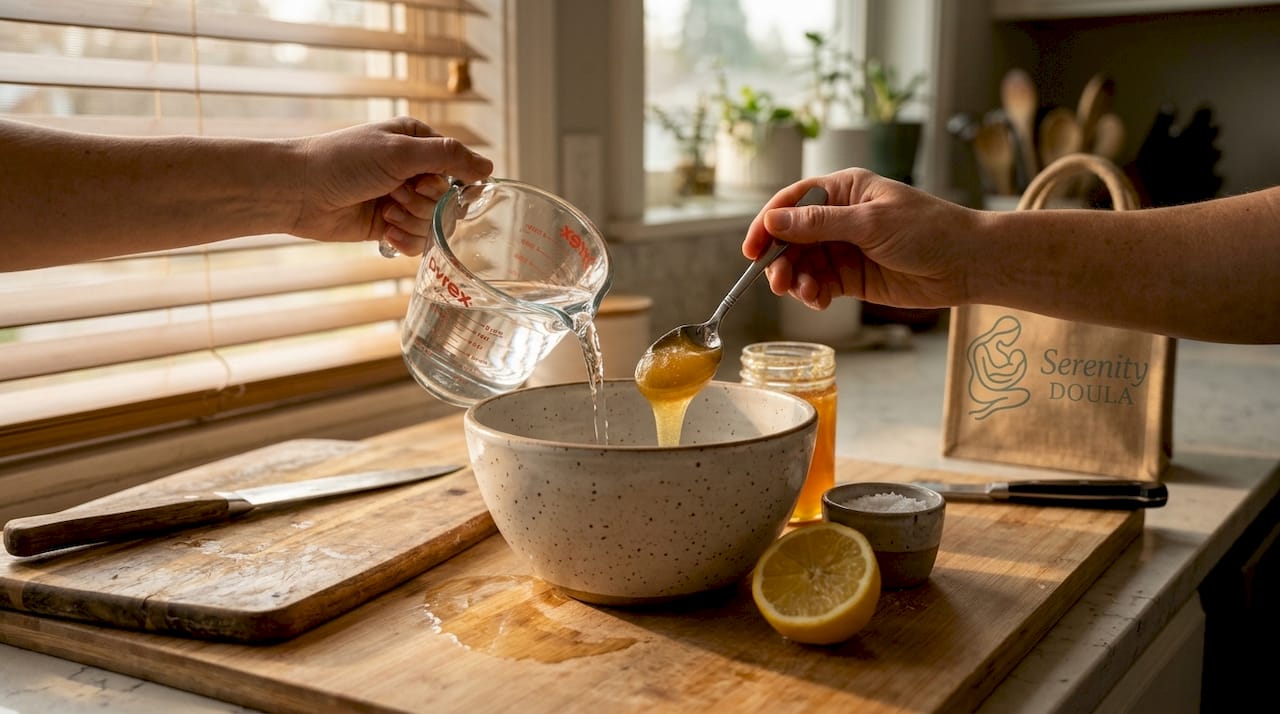
- Gather your ingredients. You will need 3 cups of filtered water, 1 cup of coconut water (or an additional cup of water), 3 tablespoons of fresh lemon or lime juice, 1 to 2 tablespoons of raw honey, and 1/4 teaspoon of sea salt.
- Warm a small amount of water. Gently warm about 1/4 cup of the water in a mug or small saucepan. This helps the honey dissolve fully without leaving clumps.
- Mix the honey and salt into the warm water. Stir until both are completely dissolved. This creates your electrolyte base.
- Add the citrus juice. Squeeze fresh lemon or lime into the mixture and stir well.
- Combine with the remaining water and coconut water. Pour everything into your pitcher and stir gently.
- Taste and adjust. If it is too tart, add a touch more honey. If it tastes flat, a tiny additional pinch of salt often brightens the flavor.
- Chill and store. Transfer to a sealed glass jar or BPA-free bottle and refrigerate until labor begins.
Statistic spotlight: A clinical study found that sport drinks prevented harmful metabolic markers from rising compared to water during labor, with no increase in vomiting. That is reassuring news for any mother considering this option.
Serving suggestions:
- Sip small amounts frequently rather than drinking large quantities at once. Around 4 to 6 ounces every 30 to 60 minutes works well for most mothers.
- Offer it chilled with ice during warm labors or at room temperature if you feel cold or shivery.
- Your partner can keep track of when you last sipped and gently offer it between contractions.
Storage and batch prep tips:
- Laborade stays fresh in the refrigerator for up to 48 hours. Make a batch the night before or early in early labor.
- For longer labors, prepare a second batch before you head to the hospital or birth center so your support person can bring it when supplies run low.
- Freeze individual portions in ice cube trays. During active labor, ice chips are often easier to manage than sipping.
Reading about ways to prepare your mind and body for labor alongside making your laborade can help you approach birth feeling ready and grounded.
Pro Tip: Label your bottle clearly in the birth bag with your name and “laborade” so your support team knows exactly what it is and can offer it to you without hesitation.
Making laborade is easy, but what if things don’t go as planned? Here’s how to adapt.
Troubleshooting, safety tips, and personalizing your laborade experience
Even a well-prepared laborade can have its challenges. You might find the taste too sweet when labor intensifies, or you may feel too nauseous to sip anything at all. Knowing what to watch for, and how to adapt, makes the whole experience smoother for you and your support team.
Common mistakes to avoid:
- Wrong ratios: Too much honey can make the drink heavy and overly sweet, which may increase nausea. Too much salt can make it unpleasant. Stick close to the recipe and adjust gently.
- Skipping the storage step: Room-temperature laborade left out for more than 2 hours can harbor bacteria. Always refrigerate and transport in an insulated bag.
- Over-consuming: Drinking laborade in large quantities too quickly can upset your stomach, especially in active labor. Small, frequent sips are always better.
- Using it as a meal replacement: Laborade supplements hydration; it does not replace light snacks if your care team approves food during labor.
Safety tips every mother should know:
- Always share your laborade plan with your midwife, OB, or care team before labor. Certain conditions may require strict NPO (nothing by mouth) restrictions.
- If you have gestational diabetes, talk to your provider about modifying the honey content or using a low-glycemic alternative.
- Be mindful of allergies. If honey is not safe for you, pure maple syrup or agave are reasonable substitutes.
- Watch for signs of nausea worsening. If laborade is making you feel worse, set it aside and return to plain water or ice chips.
“The goal is always individualized care. What works beautifully for one mother may not suit another, and that is perfectly okay.”
Research reinforces this approach. Evidence confirms that individualized use is important, with moderate intake being safe for low-risk mothers and the focus remaining on preparation and hydration rather than any one specific formula.
How partners can help:
- Prepare the laborade in advance so the birthing person does not have to think about it.
- Offer small sips proactively, especially between contractions when the birthing person may not think to ask.
- Keep track of how much has been consumed and share that information with the care team if asked.
You can read more about how to show up fully for your loved one in our guide on how to support your partner during labor.
Understanding the principles behind evidence-based birth also helps you and your partner ask informed questions and make confident decisions together.
You’re ready to make and adapt your own laborade. Here’s what makes this approach truly worth adding to your birth plan.
A doula’s wisdom: What truly matters with laborade in labor
Here is something I have seen across many births: laborade is rarely just about hydration. It becomes a small ritual of care. A partner carefully prepared it the night before. A mother sipped it between contractions and felt, for a moment, like she had something steady to hold onto. That matters more than any perfect recipe.
We sometimes get caught up chasing the “right” formula, the precise ratio of honey to salt, the exact ounces per hour. But the truth is, laborade is about empowerment. It is a way to say, “I prepared for this. I am taking care of myself.” That mindset shift can be incredibly powerful during the unpredictability of labor.
What I encourage every family to remember is that no comfort tool, laborade included, works in isolation. Open communication with your birth team is everything. Be flexible. If the drink you prepared does not appeal to you mid-labor, that is completely valid. Your needs will shift, and that is normal.
The most meaningful births I have witnessed are the ones where families feel seen, informed, and supported, not because everything went according to plan, but because they walked in prepared and stayed adaptable. Laborade is one small, beautiful piece of that preparation.
Get holistic support for your pregnancy and birth
Preparing laborade is a wonderful act of self-care, but it is just one piece of the picture.

When you have knowledgeable, compassionate support walking beside you, every stage of your pregnancy and birth feels more manageable. Our pregnancy and birth support services are designed to give you personalized guidance, physical comfort strategies, and emotional reassurance from early pregnancy through postpartum. You can also explore our childbirth education classes to learn evidence-based tools, comfort techniques, and how to build a birth plan that truly reflects your needs. We would love to be part of your journey.
Frequently asked questions
Is laborade safe for everyone in labor?
Laborade is generally safe for low-risk pregnancies, but always consult your care provider if you have any medical conditions, since moderate intake is safe specifically for low-risk mothers.
Can laborade make labor go faster?
No, there is no evidence that laborade induces or speeds up labor, as no strong evidence supports laborade for induction; its benefits are focused entirely on hydration and comfort.
How much laborade should I drink during labor?
Drink moderate amounts based on your thirst and your care provider’s guidance, since moderate oral intake stabilizes glucose and electrolytes most effectively as part of a balanced labor hydration plan.
What are the most important ingredients to include in laborade?
The essentials are filtered water, a natural glucose source such as raw honey or fruit juice, and electrolytes from sea salt and fresh citrus juice.
Can I make laborade ahead of time?
Yes, you can prepare and refrigerate laborade for up to 48 hours before labor begins, making it a convenient addition to your birth preparation checklist.