

TL;DR:
- Cluster feeding in bottle-fed newborns is a normal, temporary pattern driven by growth spurts and developmental leaps, often lasting 1 to 3 days. Responding with paced bottle-feeding, reading hunger and fullness cues, and sharing caregiving duties help manage these phases effectively. Support from healthcare professionals and caregivers alleviates exhaustion, emphasizing responsive care over rigid schedules.
Cluster feeding in bottle-fed newborns is defined as a pattern where your baby wants to feed multiple times within a short window, often every 10 to 60 minutes for a few hours at a stretch. This is not a sign that something is wrong with your formula, your baby, or your feeding routine. Cluster feeding is normal for both breastfed and bottle-fed infants, and it typically signals a growth spurt, a developmental leap, or simply a need for comfort and closeness. Understanding what drives these frequent feeding episodes, and how paced bottle-feeding can support your baby through them, makes the whole experience far less overwhelming.
What triggers cluster feeding in bottle-fed newborns?
Cluster feeding in infants follows a predictable rhythm tied to your baby’s development. Growth spurts occur at roughly 2 to 3 weeks, 6 weeks, 3 months, and 6 months. During these windows, your baby’s appetite surges, and the usual feeding intervals simply stop working. Most cluster feeding periods last around 1 to 3 days before settling back into a more predictable pattern.
Here is what typically triggers a cluster feeding phase in bottle-fed babies:
- Growth spurts. Your baby’s stomach is growing, and caloric needs spike quickly over a short period.
- Evening “witching hour.” Many newborns cluster feed in the late afternoon and evening, often between 5 p.m. and 10 p.m. This is one of the most common newborn feeding patterns and catches a lot of parents off guard.
- Comfort and security needs. Feeding is not purely about calories. Sucking is deeply soothing for newborns, and cluster feeding sometimes reflects a need for closeness rather than hunger alone.
- Developmental leaps. As your baby’s brain and body change rapidly in the early weeks, feeding more frequently is one way they process and respond to those changes.
Formula-fed babies do cluster feed, though the pattern can look slightly different. Formula digests more slowly than breast milk, so formula-fed babies may space feeds a little further apart during clusters. Still, feeding on demand remains the right approach regardless of what is in the bottle.
How to recognize hunger and fullness cues during cluster feeding
Reading your baby’s cues is the most practical skill you can develop during a cluster feeding phase. The CDC advises parents to respond to hunger and fullness cues rather than pushing a baby to finish a bottle or waiting for a set interval. This approach, called responsive feeding, protects your baby’s natural ability to self-regulate intake.
Hunger cues to watch for:
- Rooting (turning head side to side, opening mouth)
- Bringing hands to mouth repeatedly
- Lip smacking or sucking motions
- Fussing or light crying (crying is a late hunger cue, not an early one)
Fullness cues to watch for:
- Turning head away from the bottle
- Slowing down or stopping sucking
- Pushing the bottle away or going limp and relaxed
- Falling asleep mid-feed after a good stretch of active sucking
Forcing your baby to finish a bottle when they are showing fullness cues overrides their natural hunger regulation. Over time, this can contribute to overfeeding and discomfort. Trust what your baby is telling you, even if there is formula left in the bottle.
Pro Tip: If your baby pulls away from the bottle but still seems unsettled, try burping them first. Sometimes trapped gas mimics hunger, and a good burp can reset the whole feeding.
For more on reading your baby’s signals, the newborn soothing guide at Myserenitydoula walks through cue recognition in detail.
Paced bottle-feeding techniques to manage cluster feeding
Paced bottle-feeding is the single most effective bottle feeding technique for managing cluster feeding in infants. It mimics the natural rhythm of breastfeeding, giving your baby control over the flow and pace of milk. Paced feeding reduces overfeeding and the discomfort that often makes cluster feeding phases feel more intense than they need to be.
Here is how to practice paced feeding step by step:
- Choose a slow-flow or newborn nipple. Nipple flow rate matters more than most parents realize. Too fast overwhelms your baby and leads to gulping, gas, and overfeeding. Too slow can frustrate them and trigger more frequent feeds. Start with the slowest flow and adjust only if your baby is working very hard to get milk.
- Hold the bottle horizontally. Rather than tipping the bottle at a steep angle, keep it nearly parallel to the floor. This limits the milk flow and lets your baby control how much they take in with each suck.
- Let your baby latch onto the nipple. Do not push the nipple into their mouth. Tickle their upper lip and wait for them to open wide and draw it in.
- Pause every 20 to 30 seconds. Tip the bottle down so milk is no longer flowing. Let your baby rest, breathe, and decide if they want to continue. This suck-swallow-pause rhythm is what paced feeding mimics from breastfeeding.
- Burp frequently. Aim for a burp break at least once mid-feed, especially during cluster feeding when your baby may be feeding quickly and taking in more air.
- Stop at fullness cues. Put the bottle down when your baby signals they are done, regardless of how much formula remains.
| Technique | Why it helps during cluster feeding |
|---|---|
| Slow-flow nipple | Prevents milk from overwhelming baby and reduces gulping |
| Horizontal bottle position | Limits flow and gives baby control over intake |
| Pause every 20 to 30 seconds | Mimics natural breastfeeding rhythm and reduces overfeeding |
| Stop at fullness cues | Protects baby’s self-regulation and prevents discomfort |
Pro Tip: During a cluster feeding window, treat the bottle as a pacing tool rather than a calorie delivery device. The goal is comfort and responsiveness, not finishing a set amount.

Strategies to manage feeding schedules and your own wellbeing
Cluster feeding is exhausting, and that is worth saying plainly. Managing a bottle-fed newborn schedule during a cluster phase requires flexibility, support, and letting go of the idea that feeds should happen on a fixed clock.
Here are practical strategies that actually help:
- Feed on demand, not on the clock. Feeding on demand during cluster windows is healthier than enforcing rigid intervals. Trying to stretch time between feeds during a growth spurt often leads to an overtired, overhungry baby who is harder to settle.
- Keep feeds smaller and more responsive. Rather than offering large volumes hoping to “tank up” your baby, offer smaller amounts more frequently. This aligns with paced feeding and reduces the risk of spit-up and gas.
- Rotate with your partner or a caregiver. One of the real advantages of bottle feeding is that anyone can feed the baby. Use that. Partners can take a full feeding shift, especially overnight, so you can sleep. The newborn care guide for dads at Myserenitydoula is a great resource to share with your co-parent.
- Hydrate and eat regularly. Your own physical needs matter. Skipping meals or fluids while managing a cluster feeding phase depletes your energy faster and makes everything feel harder.
- Know when to call your pediatrician. Cluster feeding is normal, but poor weight gain, consistent refusal to feed, or signs of dehydration in your baby are reasons to seek medical advice. A comprehensive feeding guide can help you track patterns and flag concerns early.
Cluster feeding should not be viewed as a formula problem or a feeding failure. Adjustments in technique and responsive care almost always resolve it within a few days.
Key takeaways
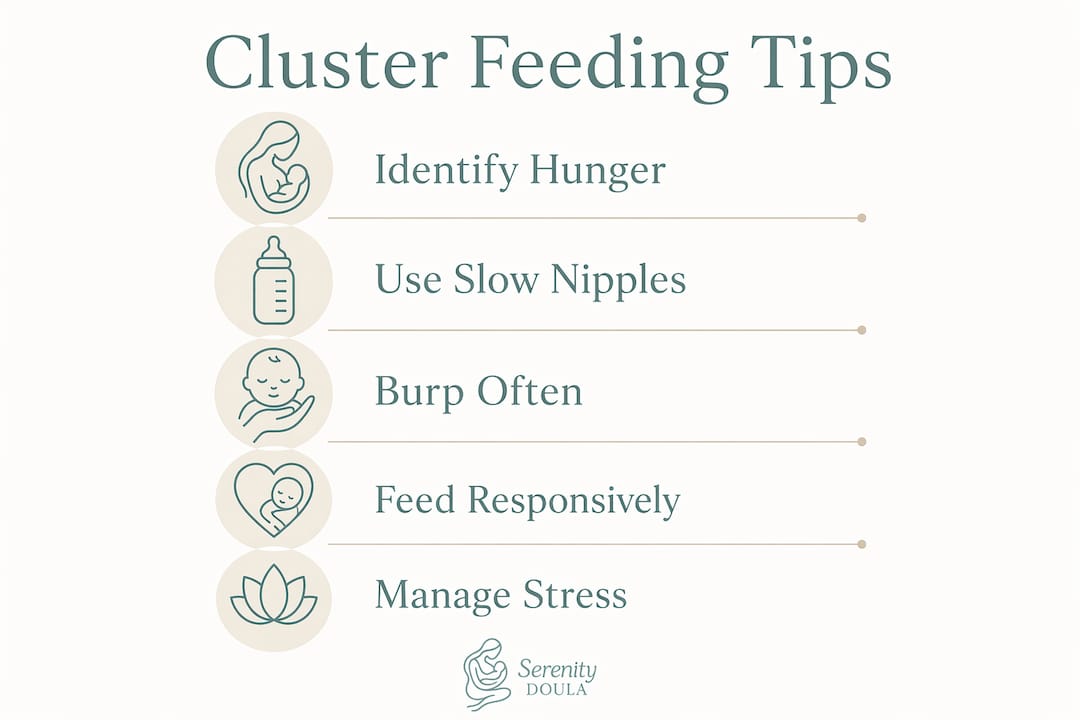
Cluster feeding in bottle-fed newborns is a normal, temporary pattern best managed through paced bottle-feeding, responsive cue reading, and caregiver support rather than rigid schedules.
| Point | Details |
|---|---|
| Cluster feeding is normal | It occurs in both formula and breastfed babies, typically lasting 1 to 3 days. |
| Growth spurts drive clusters | Expect increased feeding at 2 to 3 weeks, 6 weeks, 3 months, and 6 months. |
| Paced feeding is the key technique | Slow-flow nipples, horizontal positioning, and pauses help baby self-regulate intake. |
| Read cues, not the clock | Stopping at fullness cues protects your baby from overfeeding and discomfort. |
| Caregiver rotation matters | Sharing feeding duties during cluster phases protects parental wellbeing and rest. |
What I’ve learned from supporting families through cluster feeding
I have sat with a lot of exhausted parents at 2 a.m. who were convinced something was wrong because their baby wanted to feed again 20 minutes after finishing a bottle. The relief on their faces when they realize this is normal, and temporary, is something I never get tired of seeing.
Here is what I want you to hold onto: cluster feeding is not your baby rejecting your routine. It is your baby doing exactly what they are supposed to do. Their body is growing fast, and feeding is how they meet that demand.
What I have found makes the biggest difference is not a specific product or a perfect schedule. It is the shift in mindset from “I need to manage this” to “I need to respond to this.” Paced bottle-feeding is the practical tool that supports that shift. When you slow down the feed, pause, and watch your baby’s face, you stop being a person delivering calories and start being a parent in a conversation with your child.
The other thing I always tell parents: let someone else hold the bottle sometimes. You do not have to carry cluster feeding alone. Lean on your partner, your family, your doula. Rest when you can. This phase passes, and you will get through it feeling more confident than you expect.
— Alexis Wallace
How Myserenitydoula supports you through the newborn phase

Cluster feeding is one of those postpartum moments that can feel isolating, especially in the middle of the night when you are not sure if what you are experiencing is normal. At Myserenitydoula, we are here to hold you through exactly those moments. Our postpartum doula support includes hands-on guidance for newborn feeding, help reading your baby’s cues, and the kind of calm, reassuring presence that makes the early weeks feel manageable. You do not have to figure this out alone. Reach out to learn how our doula services can support your family from birth through those first tender, tiring, beautiful weeks.
FAQ
What is cluster feeding in bottle-fed babies?
Cluster feeding is when your bottle-fed newborn wants to feed multiple times within a short period, sometimes every 10 to 60 minutes. It is a normal newborn feeding pattern tied to growth spurts and developmental changes.
How long does cluster feeding last in newborns?
Most cluster feeding episodes last 1 to 3 days before your baby returns to a more predictable feeding pattern. It can feel longer in the moment, but it is genuinely temporary.
Should I put my baby on a schedule during cluster feeding?
No. Feeding on demand during cluster feeding windows is more effective than enforcing fixed intervals. Rigid timing during a growth spurt often leads to an overtired, hungry baby who is harder to settle.
Does paced bottle-feeding help with cluster feeding?
Yes. Paced bottle-feeding slows milk flow, allows your baby to self-regulate intake, and reduces the gas and discomfort that can intensify cluster feeding phases.
When should I call the pediatrician about cluster feeding?
Contact your pediatrician if your baby shows poor weight gain, consistent feeding refusal, or signs of dehydration. Cluster feeding itself is normal, but those specific signs warrant a professional evaluation.