

TL;DR:
- A cervical check at 38 weeks assesses how open and thin the cervix has become to gauge labor readiness. This brief exam measures dilation and effacement, but results vary and do not precisely predict labor onset. You have the right to decline the check, and understanding its benefits and limitations can support informed decision-making.
A cervical check at 38 weeks is a brief vaginal exam where your provider uses two gloved fingers to assess how open and thin your cervix has become as your body prepares for labor. Clinically, this exam is called a vaginal examination, and it measures two key things: cervical dilation (how many centimeters your cervix has opened, from 0 to 10) and effacement (how much the cervix has thinned, expressed as a percentage). Understanding what this exam involves, what the results actually mean, and what your options are can make a real difference in how grounded and confident you feel walking into that appointment.
What to expect during a cervical check at 38 weeks
The 38 weeks pregnant cervical exam takes less than a minute in most cases. Your provider will ask you to lie on your back, and they will gently insert two gloved fingers into the vagina to feel the cervix. They are checking how open it is, how soft and thin it feels, and where your baby’s head is sitting in relation to your pelvis.

Most women describe the sensation as pressure or mild discomfort rather than sharp pain. If you feel tense, that can make it feel more uncomfortable, so slow breathing really does help. If at any point you want your provider to pause, you can absolutely say so. Consent is emphasized before each exam, and you have every right to ask questions or request a moment.
Here is what typically happens during the exam:
- Your provider explains what they are about to do before starting
- The exam lasts seconds to a couple of minutes at most
- They assess dilation, effacement, fetal station, and cervical position
- They share findings with you right away and explain what they mean
- You can ask how the results will affect your care plan
Pro Tip: If cervical check pain at 38 weeks is a concern for you, let your provider know beforehand. Relaxing your jaw and breathing out slowly during the exam genuinely reduces tension in your pelvic floor, which makes the exam more comfortable.
Providers also limit how often these exams are done. Frequent exams increase discomfort and infection risk, so your care team will only perform one when it gives them information that changes or informs your care. If your water has already broken, your provider will typically avoid internal exams altogether to protect against infection.
How to read your cervical check results
Cervical dilation and effacement are estimates, not precise measurements. Two providers examining the same cervix on the same day can come up with slightly different numbers. That is completely normal, and it does not mean anyone made a mistake.
Here is what the numbers generally mean and how they connect to next steps:
| Cervical status | What it means | Possible next steps |
|---|---|---|
| Closed, 0% effaced | Cervix is firm and not yet preparing | Continued monitoring, routine appointments |
| 1–2 cm, 50% effaced | Early ripening, body is beginning to prepare | Watchful waiting, discuss birth preferences |
| 3–4 cm, 70–80% effaced | Active early changes, labor may be approaching | Membrane sweep may be discussed |
| 5+ cm, 80–100% effaced | Significant progress, labor likely near or active | Admission or induction planning considered |
The most important thing to understand is that these numbers are a snapshot, not a countdown clock. Some women dilated at 3 cm at 38 weeks deliver two weeks later, while others who are completely closed go into labor the next day. Your cervix is not a reliable calendar.
What your provider is really doing with these results is building a picture alongside your symptoms, your baby’s position, and your overall health. Membrane sweeping and cervical ripening are typically considered after 39 weeks based on cervical favorability and clinical context, not just one number from one exam.
Pro Tip: Ask your provider directly: “How will this result change what we do next?” That one question shifts the conversation from anxiety-inducing numbers to a clear care plan you can actually work with.
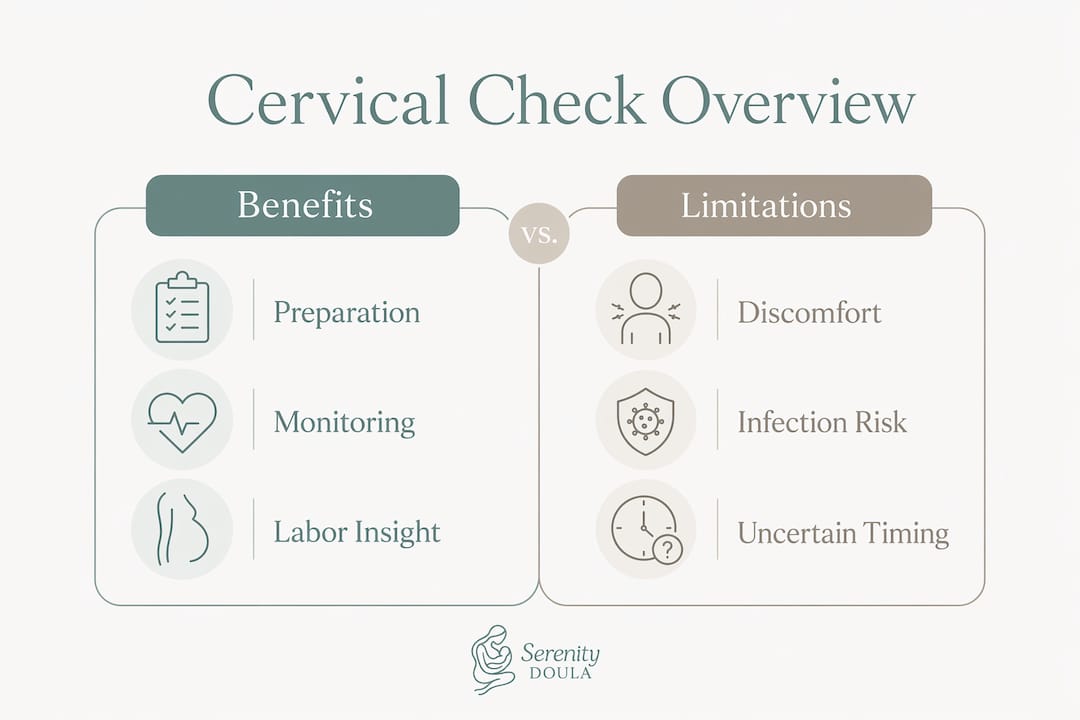
Benefits and limitations of cervical checks at 38 weeks
Understanding both sides of this exam helps you make an informed choice about whether and how often you want one.
The benefits:
- Helps your provider assess labor readiness and plan timing if induction becomes necessary
- Gives you and your care team a shared starting point for conversations about your birth plan
- Can offer reassurance if you are experiencing signs of labor at 38 weeks and wondering whether things are progressing
- Vaginal exams inform care planning including decisions about admission, pain management, and induction timing
The limitations:
- Results vary between providers and cannot precisely predict when labor will start
- Repeated exams carry a small but real infection risk, especially if membranes are already thinning
- A “good” result can create false urgency, and a “disappointing” result can cause unnecessary worry
- The emotional weight of the numbers can overshadow the bigger picture of how you and your baby are actually doing
The emotional impact of cervical check results is something that does not get talked about enough. Hearing “you’re only 1 centimeter” at 38 weeks can feel deflating, even though it means absolutely nothing about when your baby will arrive. Managing your expectations going in, and having someone in your corner to help process the results, makes a genuine difference.
Can you decline a cervical check at 38 weeks?
Yes, you can. Cervical checks are not mandatory, and your provider cannot perform one without your consent. This is your body and your birth experience, and you get to decide what feels right.
If you prefer to limit or decline exams, here are some practical ways to handle that conversation:
- Tell your provider at your next appointment that you would like to discuss the frequency and purpose of cervical checks
- Ask what specific decision the exam result would inform. If the answer is “nothing changes either way,” that is useful information
- Explore non-invasive labor monitoring options, including tracking contractions, fetal movement, and physical symptoms
- Request that exams only be done when there is a clear clinical reason
Your provider should respect your preferences and work with you to find a monitoring approach that feels safe and comfortable. Open communication is the foundation here. If you feel unheard or pressured, that is worth addressing directly or with the support of a doula or birth advocate.
For a deeper look at your rights around this topic, Myserenitydoula has a full guide on declining cervical exams that walks through how to have these conversations with confidence.
Key takeaways
A cervical check at 38 weeks measures dilation and effacement to guide clinical decisions, but it cannot predict exactly when labor will begin.
| Point | Details |
|---|---|
| What the exam measures | Cervical dilation in centimeters and effacement as a percentage of thinning. |
| Results are estimates | Numbers vary between providers and should not be treated as a precise labor timeline. |
| Clinical purpose | Results inform decisions about induction, membrane sweeping, and admission planning. |
| You can decline | Cervical checks require consent; open communication with your provider shapes your options. |
| Emotional context matters | Managing expectations around results reduces anxiety and supports clearer decision-making. |
What I really want you to know about cervical checks
I have sat with a lot of mothers at 38 weeks who walked out of appointments feeling either falsely hopeful or quietly crushed by a number. A “3 centimeters” can send someone into a frenzy of walking laps around the neighborhood, and a “still closed” can feel like a personal failure. Neither reaction is warranted, and that tells me we are not doing a good enough job preparing mothers for what these results actually mean.
The most useful shift I have seen is when a mother asks her provider, “What does this mean for my care plan?” rather than “Am I close?” The first question gets you real information. The second one opens the door to a number that will probably just sit in your head and worry you.
My honest take is this: the cervical check is a tool, not a verdict. It is one piece of data in a much larger picture that includes how you feel, how your baby is moving, what your contractions are doing, and what your instincts are telling you. Trust your body. Ask good questions. And know that being 0 centimeters dilated on a Tuesday does not mean you will not be holding your baby by Thursday.
— Alexis Wallace
How Myserenitydoula supports you through late pregnancy
Approaching labor brings up a lot of questions, and you deserve more than a quick answer at the end of a busy appointment. At Myserenitydoula, we work with expecting mothers through exactly these moments, helping you understand what exams like cervical checks mean, how to communicate your preferences, and how to feel genuinely prepared for what comes next.

Whether you are looking for one-on-one pregnancy and birth support or want to build your knowledge through childbirth education, we are here to walk alongside you. You do not have to carry the uncertainty of these final weeks alone. Reach out to Myserenitydoula and let us help you feel seen, informed, and ready.
FAQ
What does a cervical check at 38 weeks actually measure?
A cervical check measures dilation (how many centimeters your cervix has opened) and effacement (how much it has thinned), along with fetal station and cervical position. These findings help your provider assess labor readiness and plan next steps.
Does a cervical check at 38 weeks hurt?
Most women feel pressure or mild discomfort rather than sharp pain. Slow breathing and relaxing your pelvic floor during the exam can reduce the sensation significantly.
Can I be 3 cm dilated at 38 weeks and not go into labor for weeks?
Yes. Cervical dilation does not predict the exact timing of labor. Some women stay at 3 cm for two or more weeks, while others who are closed go into labor within 24 hours.
Do I have to have a cervical check at 38 weeks?
No. Cervical checks require your consent and are not mandatory. You can discuss your preferences with your provider and ask what specific care decisions the exam would inform before agreeing.
How does a cervical check affect decisions about induction?
Cervical check results, combined with your overall health and baby’s status, help your provider assess whether membrane sweeping or induction is appropriate, particularly as you approach or pass 39 weeks.