
Your fastest path to help is a phone call. Bucks County’s Maternal Child Health home visiting program serves Levittown families free of charge at 267-580-3510, and Choice One offers free, confidential pregnancy support nearby. If you need lactation help, most ACA-compliant plans cover it without cost-sharing. For hands-on, personalized birth or postpartum support, book a free consultation with Serenity Doula.
TL;DR:
- Bucks County offers free home visiting programs that provide practical support for breastfeeding, safety, and child development during pregnancy and postpartum.
- Choosing a doula requires evaluating credentials, experience supporting different birth types, and ensuring a backup plan to avoid clinical hierarchy confusion.
- Public resources like WIC, Choice One, and county support services cover specific needs, but ongoing, personalized labor and postpartum support often come from doulas or paid postpartum caregivers.
- Insurance generally covers breastfeeding equipment and counseling without cost-sharing, but verifying specific plan coverage early avoids unexpected bills.
- Most families benefit from layering county clinical visits, lactation support, and continuous doula care for an optimal postpartum experience.
Table of Contents
- Local Birth Resources in Levittown PA: Public and Community Services
- How Do I Find and Vet a Doula or Midwife Near Levittown?
- What Childbirth Classes Are Available Near Levittown?
- Does Insurance Cover Breastfeeding Support in Pennsylvania?
- What Postpartum Support Is Available After Birth in Levittown?
- A Bucks County Doula’s Take on Making These Resources Work Together
- What Actually Matters When You’re Piecing This Together
- How Serenity Doula Fits Into Your Levittown Birth Plan
- Sources
- FAQ
Local Birth Resources in Levittown PA: Public and Community Services
Levittown families have more free support available than most people realize. The trick is knowing which door to knock on first, because county programs, community centers, and hospital systems each cover different pieces of the puzzle.
Maternal Child Health home visiting
The Bucks County Maternal Child Health program sends a nurse or health professional into your home during pregnancy and after birth, at no cost. The Levittown contact line is 267-580-3510, and the visits typically cover:
- Breastfeeding support and troubleshooting
- Maternal depression screening
- Child safety guidance (car seats, sleep environment, home hazards)
- Growth and development checks for your baby
This program exists precisely because clinical appointments happen every few weeks, but questions come up daily. A home visitor fills that gap with practical, in-person guidance you cannot always get in a fifteen-minute checkup.
Choice One and community pregnancy support
Choice One’s pregnancy support services are free and confidential for Levittown residents, available through walk-in visits or scheduled appointments. These centers typically help with pregnancy confirmation, options counseling, and connecting you to material resources like baby supplies. If cost or insurance status is worrying you early in pregnancy, this is often the first call to make.
WIC, diaper pantries, and county resource lists
Bucks County’s Parenting and Maternity Care page lists several community organizations worth saving in your phone, including Maternity Care Coalition (215-972-0700) and local diaper pantries operated through Family Services Association. WIC (Women, Infants, and Children) provides nutrition support and formula assistance for income-eligible families, and eligibility is broader than many parents assume. Call ahead, since hours and walk-in policies vary by location and season.
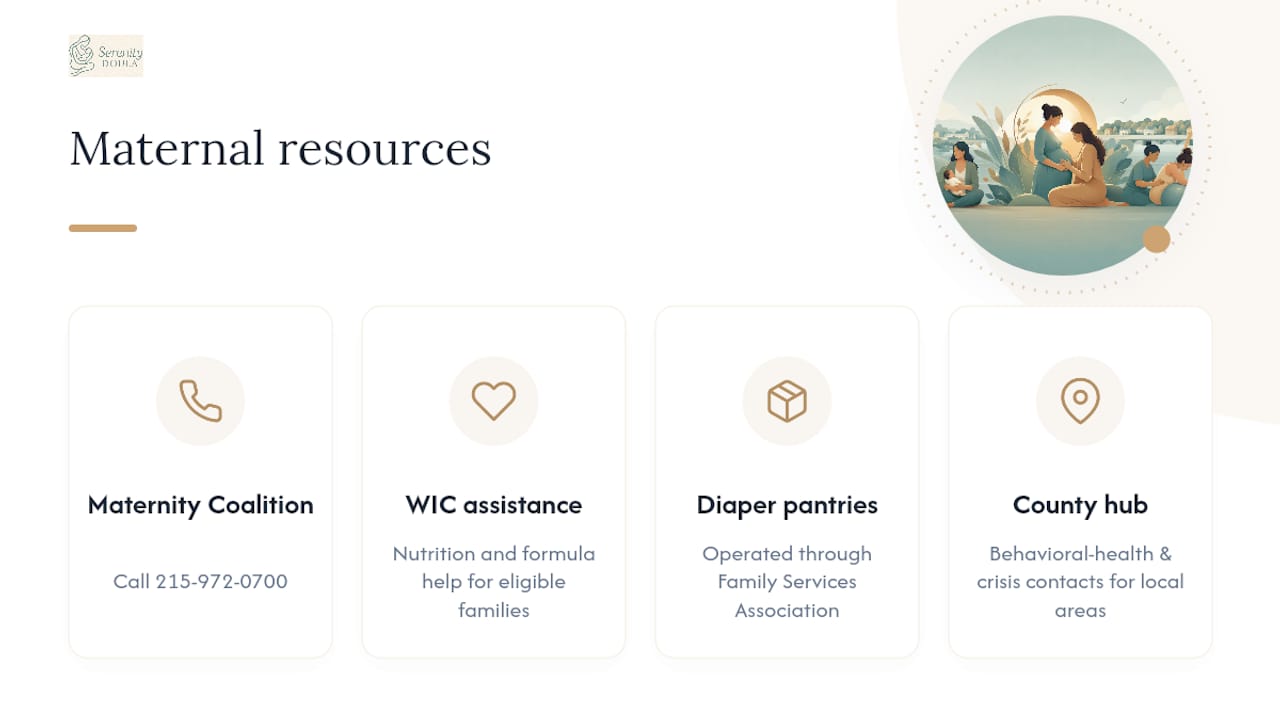
A county-maintained resource hub also lists behavioral health and crisis contacts for the Levittown, Bristol, and Doylestown areas, useful if you or a partner need mental health support during pregnancy or postpartum.
Knowing who to call first
Here is the practical breakdown:
- Clinical concern (bleeding, reduced fetal movement, severe pain): call your OB, midwife, or Trinity Health St. Mary’s labor and delivery line, not a support program.
- Need for baby supplies, food assistance, or pregnancy confirmation: call Choice One or WIC.
- Ongoing home support, feeding help, or a wellness check after birth: call Maternal Child Health at 267-580-3510.
- Want personalized, continuous labor support or postpartum care: book a consultation with a doula.
Public programs are excellent at covering specific, defined needs. What they are not designed to do is provide the continuous, one-on-one relationship many Bucks County families want throughout labor and the fourth trimester. That gap is where a doula’s role becomes clearer.
How Do I Find and Vet a Doula or Midwife Near Levittown?
Start with credentials, not just a warm feeling from a website. A doula’s training tells you how they handle labor support, but their fit with your birth preferences matters just as much.
Where to look
Professional doula organizations maintain searchable directories by certification and service area, and Bucks County’s own maternal health pages sometimes list community referral contacts. Local parenting groups on Facebook or Nextdoor are also a reasonable starting point, though take reviews there with a grain of salt. If you want a curated look at what holistic, Bucks County-based doula support actually involves, this local guide to Levittown doula care breaks down what to expect from an initial consultation.
The interview checklist
Ask every doula candidate the same questions so you can compare answers fairly:
- What is your availability around my due date, and do you have a backup doula if you are unavailable?
- What is your model of care, meaning how many prenatal and postpartum visits are included?
- What are your total fees, and what specifically is included versus billed separately?
- Which local hospitals or birth centers do you have experience supporting, including Trinity Health St. Mary?
- How do you support unmedicated, medicated, and cesarean births differently?
Pro Tip: Ask a doula to walk you through how they supported a client who ended up needing an unplanned cesarean. Their answer tells you more about flexibility than any certification ever could.
Credentials that matter, and extras that do not
Certifications from recognized doula training organizations (DONA International, CAPPA, and similar bodies) signal a baseline of education in labor support and comfort techniques. Births attended matters more than raw years in practice. Someone certified two years ago who has supported forty births brings more pattern recognition than someone certified a decade ago who works occasionally.
Red flags and a simple booking script
Be cautious of a doula who cannot name a backup plan, who pressures you to book immediately, or who cannot clearly separate her role from your medical provider’s. A doula supports you physically and emotionally. She does not diagnose, prescribe, or make clinical decisions, and any provider who blurs that line is worth a second look.
To start the conversation, try this script: “I’m due in [month] at [hospital], due for a [birth type if known]. Can we schedule a free consultation to see if we’re a good fit?” A confident, established provider says yes without hesitation.
What Childbirth Classes Are Available Near Levittown?
Formats vary widely, and the right one depends on your learning style, your partner’s availability, and how much individual attention you want.
Hospital-based classes, like those offered through Penn Medicine’s childbirth education program, are often taught by certified nurse educators and tend to focus heavily on hospital procedures, pain management options, and what happens during a typical admission. Community classes, sometimes run through county health programs, cover similar ground at lower or no cost but may have larger group sizes. Private sessions, taught one-on-one or with a small group in your home, allow the curriculum to bend around your specific birth plan and questions. Virtual options have become common for families juggling work schedules or older children at home.
Regardless of format, a solid childbirth class should cover:
- Labor stages and comfort measures (breathing, positioning, hydrotherapy)
- Common interventions and what questions to ask if one is recommended
- Newborn care basics: feeding cues, diapering, safe sleep
- The partner’s or support person’s specific role during labor
Timing and cost
Most instructors recommend enrolling between 28 and 34 weeks, early enough to practice techniques before labor but late enough that the information stays fresh. Ask your OB or midwife what they recommend given your due date and any risk factors.
Cost ranges widely. Hospital classes sometimes run free with delivery there, while private, personalized instruction costs more but offers depth and flexibility public classes cannot match. If budget is tight, ask Maternal Child Health or Choice One about free or subsidized class options before assuming private instruction is out of reach. For families who want a class built entirely around their own birth plan and questions, private childbirth education fills that gap without the one-size-fits-all pacing of a group setting.
Does Insurance Cover Breastfeeding Support in Pennsylvania?
Yes, in most cases. The Pennsylvania Insurance Department confirms that ACA-compliant plans must cover breastfeeding equipment, lactation counseling, and supplies without cost-sharing, meaning no copay, deductible, or coinsurance for those specific services.
Statistic Spotlight: Under the Affordable Care Act, Healthcare classifies maternity and newborn care, which includes lactation support, as an essential health benefit that every Marketplace and Medicaid plan must cover.
The catch is that “covered” does not mean identical across every plan. The type of breast pump, the number of lactation counseling visits, and whether a prescription is required can all vary. That is why calling your insurer directly, early in pregnancy, saves you from a surprise bill later.
Where to get lactation help locally
- Hospital lactation clinics, including those affiliated with Trinity Health St. Mary, often see patients shortly after discharge.
- WIC provides lactation counseling alongside its nutrition benefits for eligible families.
- Bucks County’s Maternal Child Health home visitors screen for feeding difficulties during regular visits and can refer you onward.
- Private lactation consultants (IBCLCs) offer in-home visits, which some insurance plans reimburse, depending on your specific coverage.
If you get billed for something that should be covered
Keep every receipt and explanation of benefits. Call your insurer’s member services line first and ask them to explain the denial in writing. If the answer still does not match what Pennsylvania law requires, the Pennsylvania Insurance Department’s Consumer Services division can intervene on your behalf. Most families never need to go that far, but knowing the escalation path removes a layer of stress you do not need while recovering from birth.
What Postpartum Support Is Available After Birth in Levittown?
Public home visiting and paid postpartum care solve different problems, and understanding the difference helps you plan realistically for the weeks after delivery.
Bucks County’s Maternal Child Health nurses check on clinical markers: your recovery, your baby’s growth, feeding progress, and screening for postpartum depression. Visits are typically brief and spaced out, which makes sense given how many families the program serves. A paid postpartum doula or night nurse, by contrast, works within your home for extended shifts, helping with newborn care, light household tasks, and emotional support during the disorienting early weeks. Many Bucks County families use both, treating the county visit as a clinical checkpoint and the doula as daily, hands-on continuity. Our guide to postpartum doula tasks in the first two weeks outlines exactly what that support looks like day to day.
To prepare for a home visit or hire postpartum help:
- Schedule your first postpartum home visit within the first week after delivery, when feeding and recovery questions are most urgent.
- Have your pediatrician’s contact information ready in case a home visitor flags a concern.
- Set up a comfortable, accessible space for feeding and diaper changes before baby arrives.
- Ask your OB or midwife what warning signs should prompt an earlier follow-up.
If you or a partner are struggling emotionally, Bucks County’s community resource listings include behavioral health referral numbers. Postpartum mood changes are common enough that screening for them is now routine, and asking your provider directly, “What does normal versus concerning look like for me?”, is always a fair question.
A Bucks County Doula’s Take on Making These Resources Work Together
Families often call me overwhelmed by choices they did not know they had. Here are two scripts I hand to clients constantly.
For Maternal Child Health: “Hi, I’m due [date] and live in Levittown. I’d like to sign up for home visiting, prenatal and postpartum.” That is the whole call. They take it from there.
For your insurer, regarding lactation coverage: “Is breastfeeding equipment and lactation counseling covered without cost-sharing under my plan? What’s the process to request a pump, and is a prescription required?” Write down the representative’s name and the date. You will want it if anything gets billed incorrectly later.
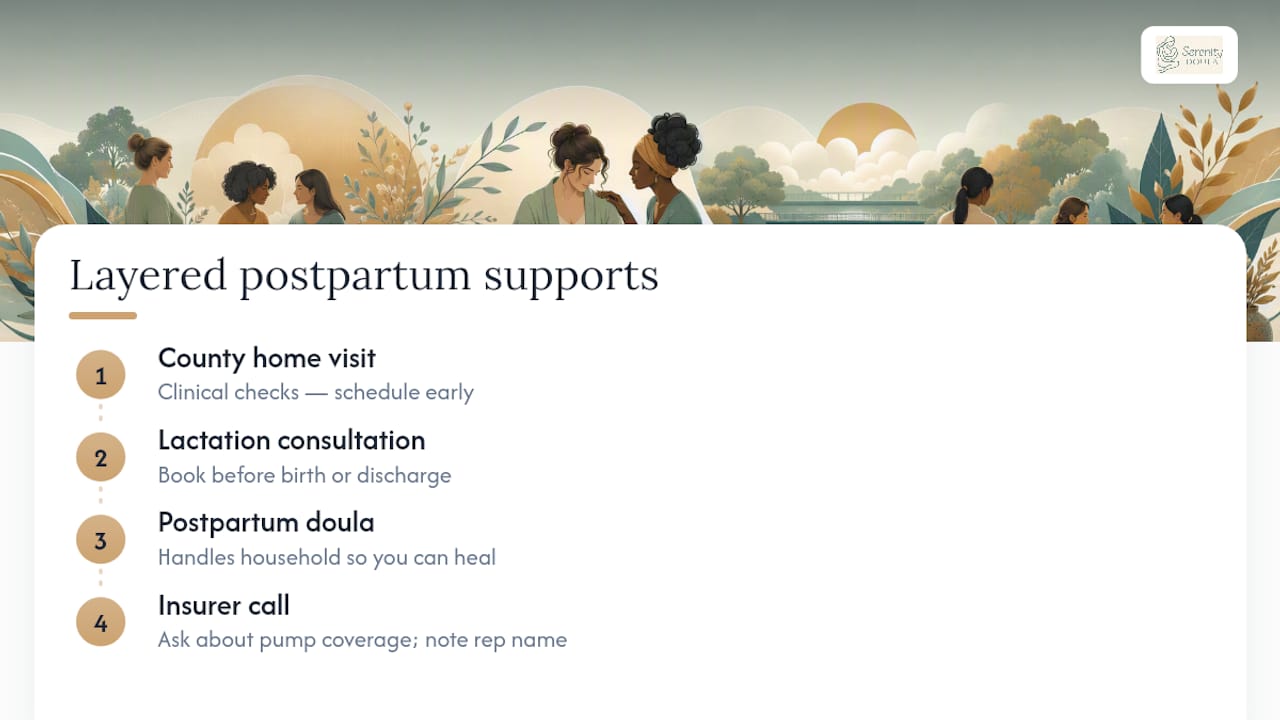
The families who feel most prepared in that first week are not the ones with the fanciest gear. They are the ones who scheduled their county home visit early, lined up lactation support before birth, and had a postpartum doula who could handle the household while they focused on healing and feeding.
I layer these supports deliberately: the county visit for clinical checks, lactation consultation booked before discharge, and a doula’s presence for the daily, hour-by-hour texture of adjusting to a newborn. In the first two weeks, expect your body and your baby to need more rest and more feeding sessions than any schedule predicts, following a helpful new mom self-care checklist to support your postpartum recovery. Frameworks like the 5-5-5 postpartum guideline are useful starting points, not strict rules. Listen to your body, and bring any concerns back to your provider rather than pushing through discomfort that feels wrong.
— Alexis Wallace
What Actually Matters When You’re Piecing This Together
Most guides treat public programs and paid doula support as competing options. They are not. The families who navigate this best use county resources for what they do well, clinical screening, nutrition assistance, and referrals, while reserving personalized attention for the moments that need continuity: labor itself, the first disorienting days home, feeding struggles that need patience rather than a fifteen-minute appointment.
The conventional advice tends to overweight the class you take and underweight who is physically with you during labor and those first two postpartum weeks. A class teaches concepts. A support person adapts to your actual birth in real time. If you take one thing from this article, prioritize lining up your continuous support, whether that is a home visitor, a doula, or both, before your due date arrives, not after.
— Alexis Wallace
How Serenity Doula Fits Into Your Levittown Birth Plan
Serenity Doula gives Bucks County families the piece public programs cannot: one dedicated person who knows your birth plan, shows up during labor, and stays close through the fourth trimester. Our services include birth doula support, personalized childbirth education, and in-home postpartum care for families across Bucks, Montgomery, Philadelphia, and Burlington Counties.
A typical package pairs prenatal visits to build your birth plan with continuous labor support at your chosen hospital or birth location, followed by postpartum visits focused on feeding, recovery, and newborn care. It is designed to complement, not replace, the county and insurance resources covered above. Many clients use Maternal Child Health home visiting alongside our postpartum support, layering free clinical checks with hands-on daily help.
If you are wondering whether a doula is right for your specific situation, this overview of what a doula actually does walks through the role even when you already have a supportive OB or midwife. Ready to talk it through? Book a free consultation and we will map out a plan around your due date, your hospital, and your family’s needs.
This article is general information, not a substitute for advice from a qualified doctor. Consult a qualified healthcare professional about your own circumstances before acting on anything here.
Sources
- Maternal Child Health | Bucks County, PA
- Benefits and support available to pregnant and breastfeeding women | Pennsylvania Insurance Department
- Healthcare
- Pregnancy Support Services – ChoiceOne – Findhelp
FAQ
What is the 3-3-3 rule for postpartum recovery?
There is no single medical standard behind this phrase, and definitions vary online. Most versions suggest limiting yourself to short stretches of light activity in the early weeks, but ask your OB or midwife what pacing makes sense for your specific delivery and recovery.
What assistance is available for pregnant mothers in Pennsylvania?
Pregnant Pennsylvania residents can access free home visiting through Bucks County Maternal Child Health, WIC nutrition benefits, Medicaid or Marketplace coverage for prenatal and delivery care, and community pregnancy centers like Choice One for confidential support and supplies.
Does insurance cover 100% of childbirth costs?
Not entirely. Marketplace and Medicaid plans must cover maternity and newborn care as an essential health benefit, but your out-of-pocket costs still depend on your specific plan’s deductible, copays, and coinsurance structure.
What free resources can I get while pregnant in Bucks County?
You can access free home visiting through Maternal Child Health, free confidential pregnancy support through Choice One, WIC nutrition assistance, and diaper pantries listed on Bucks County’s Parenting and Maternity Care page.
Should I hire a doula in addition to using county programs?
Many Levittown families do both. County home visiting covers clinical screening and referrals, while a doula from Serenity Doula provides continuous labor support and daily postpartum help that public programs are not structured to offer.