

Lightning crotch is a sudden, electric-like jolt of pain in your vagina or pelvis that typically lasts only a few seconds, and it’s almost always a normal part of late pregnancy rather than a sign labor is starting. It happens when your baby presses on pelvic nerves. Call your provider if the pain lasts longer than a minute, comes with bleeding or fever, or settles into a steady, rhythmic pattern.
TL;DR:
- Most lightning crotch episodes happen in the third trimester, typically between weeks 28 and 40, often as the baby drops lower into the pelvis.
- Episodes are brief, usually lasting only seconds, and are triggered by movements like rolling over, standing up quickly, or walking.
- Lightning crotch feels like sudden, electric shocks deep in the pelvis or vagina, whereas contractions or sciatica have different patterns and sensations.
- It is normal for lightning crotch to occur frequently during late pregnancy without signaling imminent labor, which is characterized by rhythmic, longer-lasting contractions.
- Tracking episodes, noting triggers, and consulting your provider are crucial, especially if pain lasts over a minute, or if symptoms include bleeding, fever, or fluid leakage.
Table of Contents
- What Lightning Crotch Feels Like and How Common It Is
- Symptoms and What Tends to Trigger Them
- Why Does Lightning Pregnancy Pain Happen?
- When It Usually Happens and Whether It Means Labor Is Near
- Lightning Crotch vs. Braxton Hicks, Sciatica, and SPD
- What You Can Try Now and Longer-Term Relief Strategies
- Red Flags That Mean It’s Time to Call Your Provider
- A Doula’s Perspective on Lightning Crotch
- Our Take: What Actually Matters Here
- How Serenity Doula Supports You Through Late-Pregnancy Discomfort
- Sources
- FAQ
What Lightning Crotch Feels Like and How Common It Is
The name fits: patients describe it as a lightning bolt, a sharp electric zap, or a stabbing jolt that hits without warning and vanishes almost as fast. It’s most often felt deep in the vagina or pelvis, though some feel it radiate into the rectum or down an inner thigh. The Cleveland Clinic describes it as brief, usually lasting only seconds, and sporadic rather than continuous.
You’re not imagining things, and you’re not alone in this. Estimates suggest between roughly 33% and 50% of pregnant people experience these sensations at some point, most commonly as the third trimester wears on.
A few patterns show up again and again in how people describe it:
- A sharp, electric or “shock” sensation deep in the pelvis or vagina
- Sudden onset with no warning, gone within a few seconds
- Occasional radiation into the rectum, groin, or inner thigh
- Episodes that come and go unpredictably, sometimes several times a day, sometimes not for a week
Symptoms and What Tends to Trigger Them
Lightning crotch rarely comes out of nowhere. It usually has a trigger, even if that trigger is something as small as shifting your weight.
- Baby’s movement or a kick landing at just the wrong angle against a nerve
- Rolling over in bed, especially turning quickly from one side to the other
- Standing up too fast after sitting for a while
- Changing position during a workout, a stretch, or even a sneeze
- Walking or climbing stairs, which shifts pressure through the pelvis
Alongside the classic zap, you might notice pins-and-needles tingling, a brief burning sensation, or pain that shoots down toward your rectum or inner thigh. What it should not feel like is a slow, building cramp that tightens and holds. That steady, gripping quality points somewhere else entirely, which is exactly why the difference matters so much once you hit the third trimester.
Why Does Lightning Pregnancy Pain Happen?
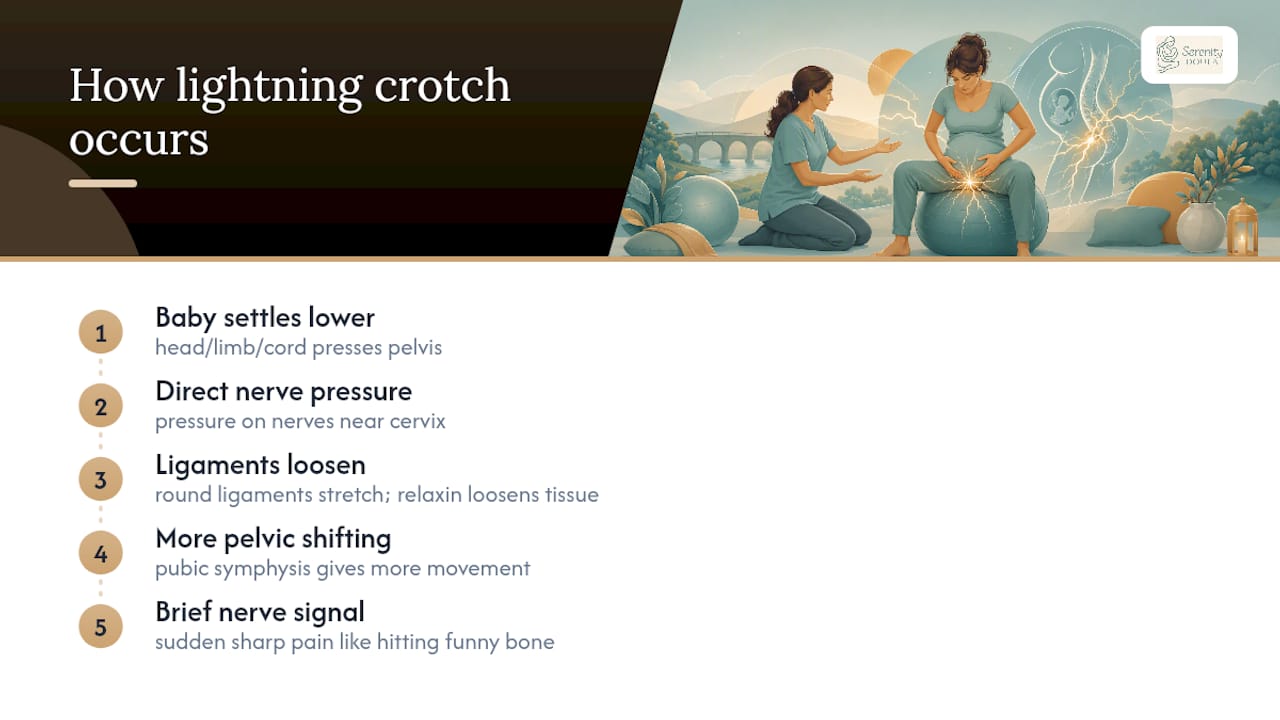
The mechanics are simpler than the sensation suggests. As your baby grows and settles lower into your pelvis, the head, a limb, or even the umbilical cord can press directly against nerves near your cervix or pelvic floor. That pressure fires off a nerve signal that reads as sudden, sharp pain, similar to hitting your funny bone, just lower and far less funny in the moment.
Ligaments play a role too. Your round ligaments stretch to support your growing uterus, and the hormone relaxin loosens connective tissue throughout your pelvis, including the pubic symphysis, the joint at the front where your pelvic bones meet. That loosening helps your body prepare for birth, but it also means more give, more shifting, and more chances for a nerve to get pinched for a split second.
It’s worth being honest about the limits here: lightning crotch is a symptom, not a formal diagnosis. There’s no single test that confirms it, and no clinician can point to the exact nerve involved in your specific case. What’s understood is the general mechanism, and that general mechanism is reassuring precisely because it’s mechanical, not pathological.
When It Usually Happens and Whether It Means Labor Is Near
Most people notice lightning crotch in the third trimester, somewhere between weeks 28 and 40, though a smaller number feel it earlier. Episodes often pick up once your baby “drops,” or engages lower into the pelvis in preparation for birth. Lower positioning means more direct pressure on the nerves running through that area, so more frequent zaps make sense at this stage.
Here’s the question every third-trimester patient asks me: does this mean labor is close? Usually, no. Lightning crotch and labor contractions feel and behave very differently:
- Pattern: Labor contractions build in a regular, repeating rhythm; lightning crotch strikes once and disappears.
- Duration: A lightning crotch episode lasts seconds; contractions last closer to 30 to 90 seconds each.
- Progression: Contractions get closer together and more intense over time; lightning crotch does not follow any pattern of escalation.
- Accompanying signs: Real labor often comes with lower back pressure, a bloody show, or your water breaking; a lightning jolt typically arrives alone.
If what you’re feeling repeats on a timer and gets stronger, that’s your cue to start timing contractions and call your provider, not wait it out.
Lightning Crotch vs. Braxton Hicks, Sciatica, and SPD
Pregnancy produces a strange menu of pains, and it helps to know which one you’re actually dealing with.
- Braxton Hicks contractions feel like your whole belly tightening into a ball, then releasing. That’s uterine muscle, not a vaginal zap, and it’s usually painless or mildly uncomfortable rather than sharp.
- Sciatica tends to stay on one side, tracing a line from your lower back through your buttock and down the back of your leg, following the path of the sciatic nerve. It’s more of an ache or burn than a jolt, and it rarely shows up in the vagina itself.
- Symphysis pubis dysfunction (SPD) shows up as a deep, aching instability right at the front pubic joint, often worse with walking, climbing stairs, or turning over in bed. It lingers, where lightning crotch does not.
A quick way to sort it out: ask yourself where it hit, whether it repeated in a pattern, and what you were doing right before it happened. A single, sharp, here-and-gone zap after you rolled over points toward lightning crotch. A dull ache that’s been building all day points somewhere else, and that’s worth mentioning at your next appointment.
What You Can Try Now and Longer-Term Relief Strategies
When a zap hits, your first move is simple: stop, breathe, and shift your weight. Small, slow position changes often interrupt the pressure fast enough to end the episode within moments, since you’re essentially giving your baby a little room to move off the nerve.
- Pause and change position slowly. Sudden twisting is often what triggered it, so reverse it gently rather than quickly.
- Try a warm bath to ease general pelvic tension between episodes.
- Wear a maternity support band, fitted low across your belly rather than high, to redistribute some of the weight.
- Practice seated pelvic tilts and diaphragmatic breathing, which physical therapists commonly recommend to build pelvic stability and ease nerve pressure over time.
- Add gentle hip flexor stretches to your daily routine, especially if you sit for long stretches at work.
- Ask about a referral to pelvic floor physical therapy if episodes are frequent enough to interfere with your day.
Getting in and out of bed matters more than people expect. Roll onto your side first, then push up with your arms rather than twisting through your core. That one adjustment prevents a lot of middle-of-the-night jolts.
For pain that’s more than a passing nuisance, acetaminophen is generally considered acceptable in pregnancy, but check the timing, dose, and whether it’s right for you with your provider before taking anything regularly.
Pro Tip: Keep a small note in your phone every time it happens: what you were doing, how long it lasted, and where you felt it. Patterns that seem random in the moment often make a lot more sense once you look back at a week of notes, and it gives your provider something concrete to work with instead of “it just hurts sometimes.”

Support garments and posture changes won’t guarantee you’ll never feel another zap, but the combination of movement mechanics and pelvic support tends to bring real relief for most people. For a deeper look at pelvic girdle pain specifically, a physiotherapy-focused guide on tracking and easing pelvic girdle pain walks through additional exercises worth asking your PT about.
Red Flags That Mean It’s Time to Call Your Provider
Most lightning crotch needs nothing more than a shift in position and a little patience. But a few signs mean it’s time to pick up the phone rather than wait it out.
- Pain that lasts longer than a minute, especially if it feels like it’s building
- Any bleeding or unusual discharge
- Fever, chills, or a severe headache
- Fluid leaking, which could mean your water has broken
- Regular, rhythmic contractions that keep coming closer together
- Dizziness, lightheadedness, or a noticeable drop in your baby’s usual movement
If you’re under 37 weeks, call sooner rather than later. When you do reach out, have a few details ready: when it started, what you were doing, how long it lasted, and whether anything else has changed, including your baby’s movement pattern that day.
A Doula’s Perspective on Lightning Crotch
I’ve sat with plenty of Bucks County clients in their third trimester who called me convinced labor was starting, only to realize what they’d felt was one sharp zap that came and went in a breath. Once we walked through the timing together, they usually relaxed almost instantly. That relief is worth as much as any explanation.
A few phrases I encourage clients to use with their care team, because specific language gets you a faster, more useful answer than “it hurts down there”:
- “It’s a single sharp jolt, gone in a few seconds, not a building cramp.”
- “It happens when I move a certain way, like rolling over or standing up fast.”
- “It’s not rhythmic. There’s no pattern to it.”
Keep a running note of when it happens and what triggers it, then bring specific questions to your next visit rather than searching for a diagnosis on your own. Your provider knows your pregnancy; your job is to hand them clear, accurate information.
Our Take: What Actually Matters Here
The conventional advice on lightning crotch tends to stop at “it’s normal, don’t worry,” which is technically true and not very helpful. What actually matters is teaching people the difference between a zap and a contraction, because that distinction is what determines whether you call your provider at 2 a.m. or go back to sleep.
Where I think the standard advice falls short is in treating this as a symptom to endure rather than a signal worth tracking. A pattern of frequent, intense episodes deserves a conversation with your provider about pelvic floor physical therapy, not just reassurance that it will pass. The PT-backed exercises that ease this pain also tend to help with labor positioning later, so the effort pays off twice.
If you take one thing from this: track what you feel, ask your provider specific questions instead of vague ones, and don’t let anyone, including yourself, dismiss pain that’s actually changing in character. That difference is what clinical guidance is built around.
— Alexis Wallace
How Serenity Doula Supports You Through Late-Pregnancy Discomfort
Serenity Doula gives Bucks County families something a quick phone consult with your OB can’t: real time to sit with your questions, one on one, before you’re in the exam room wondering if what you felt was normal. Between symptom tracking, comfort strategies, and knowing exactly what language to use with your care team, that support fills a real gap in late pregnancy.

Our birth doula services help you sort out what a new sensation means, when it’s worth a call to your provider at Trinity Health St. Mary or your practice in Doylestown or Newtown, and how to build a comfort plan around the aches that come with the third trimester. We also help translate what you’re feeling into the kind of specific, clear detail your clinician actually needs. Pair that with our childbirth education classes, and you walk into labor knowing the difference between a passing zap and the real thing, rather than guessing at 3 a.m.
If you’re navigating lightning crotch, pelvic pressure, or just want a steadier hand through these final weeks, book a free consultation and let’s build a plan around what your body is actually telling you.
Sources
For a clear clinical definition, the Cleveland Clinic’s overview is a solid starting point. American Pregnancy Association covers labor differentiation in plain language, ACOG offers the clinical standard for spotting real labor, Hinge Health provides PT-backed exercises, and Medical News Today rounds out home relief options.
This article is general information, not a substitute for advice from a qualified doctor. Consult a qualified healthcare professional about your own circumstances before acting on anything here.
- Lightning Crotch
- Lightning Crotch in Pregnancy: Causes and Relief Tips
- Lightning crotch: Causes, remedies, and how it feels
- How to tell when labor begins
FAQ
What Does Lightning Mean in Pregnancy?
“Lightning crotch” refers to a sharp, brief, electric-feeling pain in the vagina or pelvis, usually caused by your baby pressing on a nerve. It’s distinct from “lightening,” an older term some providers use for the baby dropping lower into the pelvis before birth.
What Month of Pregnancy Does Lightning Crotch Occur?
It’s most common in the third trimester, generally from around month seven through month nine, though some people notice it earlier as their pregnancy progresses.
Does Lightning Crotch Mean Labor Is Near?
Not usually. Lightning crotch is a brief, isolated jolt, while labor involves regular contractions that build in intensity and frequency over time.
How Long After Lightning Crotch Does Labor Start?
There’s no set timeline. Lightning crotch can occur weeks before labor or show up and go away repeatedly without any connection to when labor actually begins.
Should I Track My Lightning Crotch Episodes?
Yes. Noting when it happens, what triggered it, and how long it lasted gives your provider useful detail and helps you and your Serenity Doula team spot any pattern worth discussing at your next visit.