
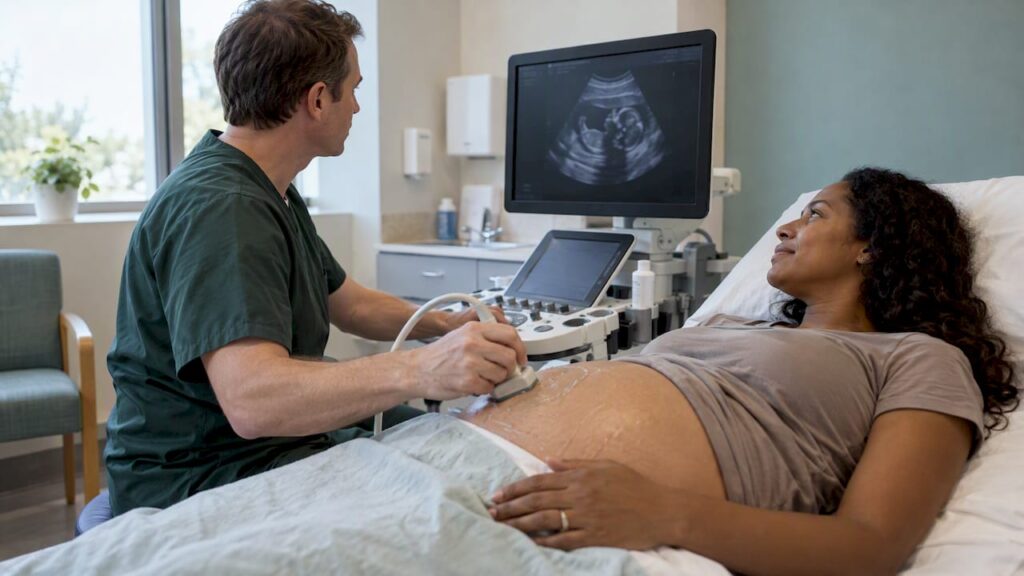
Hearing “your baby is breech” at a 36-week appointment can knock the wind out of you. You were picturing the final stretch, and now the plan feels uncertain. Take a breath. A breech baby at 36 weeks is common enough to have well-worn paths forward, and you still have time to learn your options, ask good questions and decide what feels right for your family.
TL;DR
- Breech means your baby’s bottom or feet are positioned to come out first. It happens in 3 to 4% of full-term births.
- Babies are considered unlikely to turn on their own after 36 weeks, so this is the time to talk through options with your provider.
- Options include an external cephalic version (ECV), a planned cesarean, or in limited settings a planned vaginal breech birth.
- Call your provider and head to the hospital right away if your water breaks.
- A doula can help you gather information, prepare for any route and feel steady along the way.
Table of Contents
- What breech at 36 weeks actually means
- Will my baby turn on their own after 36 weeks?
- Your options at a glance
- External cephalic version (ECV)
- Cesarean or vaginal breech birth
- What about moxibustion and other home approaches?
- Is my baby head-down now?
- When to call right away
- A doula’s perspective
- How we can support you from here
- FAQ
- Sources
What breech at 36 weeks actually means
A breech presentation means the baby’s buttocks, feet, or both are lowest, ready to come out first, instead of the head. According to ACOG, a provider can identify the presenting part by feeling your abdomen and can confirm it with an ultrasound or a pelvic exam.
You may have noticed little kicks low in your belly or pressure under your ribs. Those clues can be suggestive, but there is no reliable way to tell position just by looking at your bump, which is why confirmation matters. If your baby’s position doesn’t feel typical to you, MedlinePlus notes you may need an ultrasound, and if it shows breech, your provider will go over your options.
Nothing you did caused this. Position is not a result of how you moved, slept or carried your baby.

Will my baby turn on their own after 36 weeks?
Most babies settle head-down by around 36 to 37 weeks. ACOG notes that during week 36 or 37, most fetuses turn to a head-down position for birth. For babies still breech at this point, the odds of a spontaneous flip shrink: the Guy’s and St Thomas’ NHS guidance (a UK source) describes it as unlikely after 36 weeks because most babies have settled into their final position.
Unlikely is not impossible, and it doesn’t mean you have to wait passively. It means this is a good week to schedule a conversation about the next steps rather than hoping the question resolves itself.
Pro tip: Before your next visit, write down three questions. Our favorites: What is my baby’s exact breech position? Is an ECV an option for me? What does our hospital offer if the baby stays breech?
Your options at a glance
Here is a simple way to hold the choices in your mind. Your own provider decides what is medically appropriate for you, so use this as a conversation guide.
| Option | What it involves | Questions to ask your provider |
|---|---|---|
| ECV (external cephalic version) | Firm, manual pressure on your abdomen to try to turn the baby head-down | Am I a good candidate? Who performs it and where? What happens if it doesn’t work? |
| Planned cesarean | A scheduled surgical birth | When would it be scheduled? What does recovery and baby’s first hour look like? |
| Planned vaginal breech birth | Vaginal delivery with a baby presenting bottom or feet first | Does this facility have protocols and experienced providers for it? |
| Complementary approaches (such as moxibustion) | Herb-based warmth near an acupuncture point | Is it safe for me, and who would guide it? |
External cephalic version (ECV)
ECV is an attempt to turn the baby into a head-down position by applying firm, manual pressure to your abdomen. ACOG’s practice bulletin recommends that providers offer ECV to people with a term, single-baby breech pregnancy and no contraindications, because it can improve the likelihood of a vaginal birth.
A few things worth knowing:
- Timing: ECV is typically offered at 36 to 37 weeks, and can be attempted up until labor begins.
- Comfort measures: the same bulletin says neuraxial analgesia combined with a medication that relaxes the uterus can be considered to increase success. Ask what pain relief is available.
- Who may not be a candidate: ACOG lists carrying more than one baby, concerns about the baby’s well-being, certain uterine abnormalities, placenta previa and placental abruption as contraindications.
If your baby is footling breech, with one or both feet lowest, ask your provider directly whether ECV is appropriate for that position and what their experience is. It is a fair, practical question, and a good provider will welcome it.
Cesarean or vaginal breech birth
If the baby stays breech, ACOG describes the options as ECV, a planned cesarean, or, in limited situations, a planned vaginal breech delivery where a facility has the right protocols and expertise. Because experience with vaginal breech delivery has declined, cesarean remains the preferred mode for most US physicians. ACOG also says that planned vaginal breech birth may be reasonable with full counseling and consent, depending on provider expertise.
Here in Bucks County, you can ask your practice and your delivery hospital, whether that is Trinity Health St. Mary or another, what their approach to breech is and who on the team has the relevant experience. Their answer may shape where you choose to give birth.
If a cesarean becomes your plan, it can still be a calm, connected birth. Our guides on skin-to-skin after a cesarean and a 48 to 72 hour breastfeeding plan after cesarean show what to ask for ahead of time. If you hope for a vaginal birth in a future pregnancy, see our piece on doula support for VBAC.
What about moxibustion and other home approaches?
Moxibustion burns a herb near the BL67 acupuncture point, on the little toe. Reviews have reported fewer non-head-down presentations at birth, but the results are inconsistent and better-designed studies are needed. An earlier Cochrane-style review likewise found limited supporting evidence. Side effects such as odor or nausea are generally considered minor.
So the honest answer is: some families find it a gentle thing to try, and the evidence is not strong either way. Run it by your provider first, and don’t let it delay a conversation about ECV, which has a clearer evidence base and a time window.
Is my baby head-down now?
If you’ve been told the baby turned, or you suspect it, here are clues people mention: the head feels low, the bottom or legs sit above your belly button, bigger movements near the ribs, smaller movements low in the pelvis, or hiccups felt low. Healthline notes that some people notice nothing, and that an exam or ultrasound is what confirms position. Your provider can also tell you how far the baby has dropped, since doctors use ultrasound or a physical exam for that.
When to call right away
If your baby is breech and your water breaks, contact your provider and go to the hospital right away. With a breech baby the umbilical cord is more likely to come out before labor begins. Don’t wait to see if contractions start. Also have your hospital bag and a ride plan ready a little earlier than you otherwise might.
A doula’s perspective
When a client tells me her baby is breech at 36 weeks, the first thing I notice is how fast her shoulders rise. She’s been planning for weeks, and suddenly the plan has a question mark.
Here is what we do at Serenity Doula. We slow things down. We help you turn a swirl of worry into a short list of questions for your provider, we point you to evidence-based resources, and we make sure your partner knows how to support you in whichever direction the road goes. Our care is built around your preferences, whether you hope for an ECV, are leaning toward a cesarean, or are exploring something else with your care team.
In more than ten years of attending births across Bucks County, I’ve seen that parents feel strongest when they feel informed and unrushed, not when the baby does exactly what the book says. A calm, well-prepared cesarean can be every bit as empowering as any birth. You deserve to feel seen and held between appointments, not carrying this alone.
Our evidence-based birth framework explains how we approach informed decisions.
Alexis Wallace
How we can support you from here
A breech diagnosis is a moment where a steady, knowledgeable companion helps. Our Pregnancy & Birth Doula support covers prenatal check-ins, help preparing questions for your provider, comfort and presence in labor or during a cesarean, and guidance for your partner. If you want to walk into the next few weeks with more clarity, our Childbirth Education classes can be tailored to your situation, including planning for different birth paths.

Afterward, our Postpartum Care offers in-home and virtual support, which many families find especially valuable after a cesarean. We’d love to talk it through with you in a free consultation.
FAQ
Can a baby still turn after 36 weeks?
It is possible, but it’s considered unlikely without help, since most babies have settled into position by then. An ECV can be attempted up until labor begins. Ask your provider whether you are a candidate.
Does a breech baby at 36 weeks mean I will need a cesarean?
Not necessarily. ECV may turn the baby, and in limited settings with experienced providers a planned vaginal breech birth may be an option. Cesarean is the most common route in the US, so ask your practice what they offer.
Can I give birth at 36 weeks if my baby is breech?
Breech position alone doesn’t mean early delivery. Pregnancy at 36 weeks is still just before full term, and scheduling usually depends on your overall health and your provider’s plan. Ask what timing they recommend for you and why.
How is a doula helpful if I end up with a cesarean?
A doula helps you prepare questions, understand the steps, and feel supported before, during and after surgery. We also help you plan for skin-to-skin and feeding. If you’d like to explore this, book a free consultation with us anytime.
Sources
- If Your Baby Is Breech | ACOG
- ECV for turning your breech baby | Guy’s and St Thomas’ NHS
- Changes During Pregnancy | ACOG
- Breech birth | MedlinePlus
- ACOG Practice Bulletin: External Cephalic Version
- External Cephalic Version | ACOG
- Mode of Term Singleton Breech Delivery | ACOG
- Effectiveness and Safety of Acupuncture and Moxibustion in Breech Presentation
- Cephalic version by moxibustion for breech presentation
- Signs your baby has moved head-down | Healthline
- Head Engagement in Pregnancy | WebMD