
TL;DR:
- Many mothers can successfully have a VBAC with proper support and individualized care.
- Doula support reduces C-section rates and improves emotional and physical birth outcomes.
- Early planning, choosing a VBAC-friendly provider, and hospital readiness are essential for a successful VBAC journey.
A repeat C-section can feel like the only path forward after a previous cesarean, but that’s simply not true. Many mothers are surprised to learn that doula support lowers C-section rates and increases the likelihood of a vaginal birth, even after a cesarean. VBAC, or vaginal birth after cesarean, is more common and more achievable than most people realize. With the right care team, honest information, and personalized support, you can make a grounded, confident decision about your birth. This article walks you through the evidence, the real risks, and exactly how a doula can be your anchor through the whole process.
Table of Contents
- What is VBAC and why choose it?
- VBAC success rates, risks, and edge cases
- How doulas support VBAC: Evidence and practical care
- Personalizing your VBAC journey: Planning with a doula
- A holistic view: What most VBAC guides miss about doula support
- Explore doula support and VBAC-friendly care
- Frequently asked questions
Key Takeaways
| Point | Details |
|---|---|
| VBAC is widely feasible | Most expecting mothers with one prior C-section can attempt a VBAC with strong chances of success. |
| Doula support boosts outcomes | Doula-assisted births significantly lower C-section rates and increase satisfaction and comfort. |
| Know the risks and options | Uterine rupture is rare but important; prior vaginal births greatly improve success. |
| Personalize your plan | Working with a doula empowers you to create a birth plan tailored to your needs and safety. |
| Holistic care matters | Emotional support and evidence-based education make VBAC not only safer, but more fulfilling. |
What is VBAC and why choose it?
VBAC simply means giving birth vaginally after having had at least one cesarean section. It’s not a niche option or a risky experiment. It’s a medically recognized path that thousands of families choose every year, and for good reason.
So who is it for? Most people with one prior low-transverse uterine incision are considered candidates. Your care provider will look at your overall health, your previous birth history, and your current pregnancy to help you decide if VBAC is right for you. You can also review VBAC safety guidance to understand the medical criteria involved.
Here’s something that often surprises people: VBAC success rates range from 60 to 80% overall, and climb as high as 92 to 97% for those who have already had a successful VBAC. Having a prior vaginal birth is one of the strongest predictors of success. That’s genuinely encouraging news.
Why do mothers choose VBAC? There are several meaningful reasons:
- Faster recovery. Vaginal births typically involve shorter hospital stays and quicker return to daily life, which matters a lot when you have other children at home.
- Lower complication risks. Avoiding repeat surgery reduces risks like infection, blood loss, and complications in future pregnancies.
- More family-centered experience. Many mothers describe feeling more present and empowered during a vaginal birth.
- Emotional significance. For some, VBAC is about healing from a previous birth experience that felt out of their control.
“I wanted to feel like my body could do this. Having a doula who believed in me made all the difference.” This kind of emotional grounding is something that what doulas do goes far beyond just physical support.
A doula brings layers of support that your medical team simply doesn’t have time to provide. They help you process information, stay calm during labor, and advocate for your preferences. Understanding the full range of types of childbirth support available to you is a great starting point when planning your VBAC.
The bottom line? VBAC is a real, valid, and often highly successful option. And with the right support around you, it becomes even more achievable.
VBAC success rates, risks, and edge cases
Let’s get into the numbers, because knowing the real statistics helps you have better conversations with your care team and feel more confident in your choices.
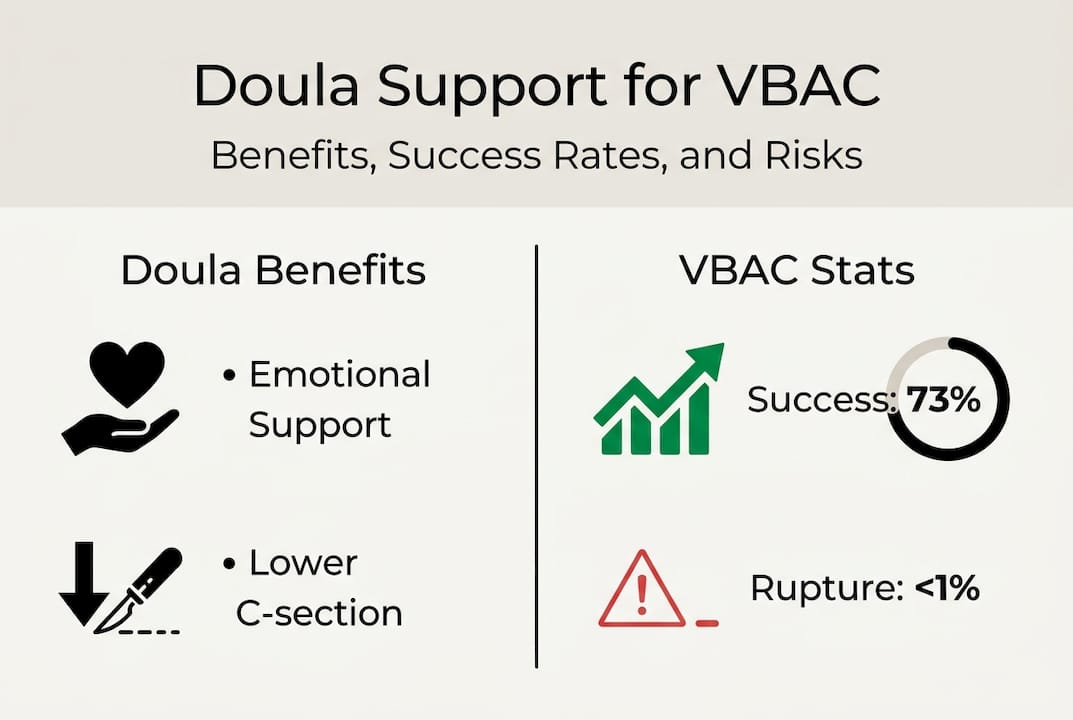
Overall, the VBAC success rate on a first attempt sits at about 73.2%. For those who have had a previous successful VBAC, that number climbs above 92%. These are strong odds, and they reflect what’s possible when you’re well-prepared and well-supported.
| Scenario | Approximate success rate |
|---|---|
| First VBAC attempt | ~73.2% |
| VBAC with prior vaginal birth | 80%+ |
| VBAC after previous successful VBAC | 92-97% |
| VBAC after 2 cesareans (VBAC-2) | ~30.8% |
Now, let’s talk about risks honestly. The most discussed risk is uterine rupture. Uterine rupture occurs in 0.5 to 1% of VBAC attempts, and that risk increases when labor is induced. ACOG supports VBAC attempts, called TOLAC (trial of labor after cesarean), for most people with one prior low-transverse C-section, provided the hospital has emergency capabilities.
Key risk factors to be aware of:
- Induction. Certain induction methods, especially prostaglandins, raise the risk of uterine rupture. Spontaneous labor is generally safer.
- Short inter-delivery interval. Less than 18 months between your C-section and the next birth increases risk.
- Unknown or classical uterine incision. A vertical incision type significantly raises rupture risk.
- Multiple prior cesareans. VBAC after 2 C-sections carries a success rate of about 30.8% under strict non-induction protocols and requires careful evaluation.
Pro Tip: If you’re hoping for VBAC, talk to your provider early about avoiding induction. Ask specifically what their induction policies are and whether your hospital has 24-hour surgical and anesthesia coverage. That conversation can shape your entire birth plan.
For edge cases, like VBAC-2 or VBAC with an unknown scar type, the protocols are stricter and the conversations with your provider need to be more detailed. This is exactly where natural birth support and evidence-based birth care from a knowledgeable doula become especially valuable. A doula can help you prepare the right questions and understand the answers. You can also explore childbirth support options to see how different types of support fit your specific situation.
How doulas support VBAC: Evidence and practical care
Here’s where things get really interesting. Because it’s not just about having someone hold your hand. Doula support has measurable, documented effects on birth outcomes.

Research shows that doula-supported births have C-section rates of 13 to 22%, compared to 25 to 27% without doula support. That’s a meaningful difference. The same research links doula care to lower preterm birth rates and better breastfeeding outcomes. For VBAC specifically, those numbers matter a lot.
| Outcome | With doula support | Without doula support |
|---|---|---|
| C-section rate | 13-22% | 25-27% |
| Vaginal birth rate | Higher | Lower |
| Breastfeeding initiation | Improved | Standard |
| Emotional satisfaction | Higher | Variable |
So what does a doula actually do during a VBAC?
- Physical comfort. Position changes, counter-pressure, breathing guidance, and movement support during labor.
- Emotional steadiness. They stay calm so you can stay calm. That regulated energy matters more than people realize.
- Advocacy. They help you communicate your preferences to your medical team, especially if things move fast.
- Evidence-based information. A good doula helps you understand your options without steering you toward any one outcome. They support your informed choice.
This is especially important in communities where birth disparities exist. Doula support has shown the strongest impact in underserved and disadvantaged populations, helping to close gaps in birth outcomes.
Pro Tip: Interview at least two or three doulas before choosing one. Ask specifically about their VBAC experience. A doula who has supported multiple VBAC births will know how to help you navigate the unique emotional and physical terrain of that experience.
Exploring childbirth education benefits alongside doula care creates a powerful combination. When you understand what’s happening in your body, you feel less fear and more trust. And a family-centered birth approach means your partner is included, informed, and supported too. The doula role is really about making sure no one in your birth space feels lost or alone.
Personalizing your VBAC journey: Planning with a doula
Knowing the evidence is one thing. Putting it into action is another. Here’s a practical roadmap for planning your VBAC with doula support.
-
Choose a VBAC-supportive care provider. Not all OBs or midwives have the same attitude toward VBAC. Ask directly: “What is your VBAC rate?” and “Under what circumstances would you recommend a repeat C-section?” Their answers will tell you a lot.
-
Confirm hospital capabilities. Your birth facility needs to have 24-hour surgical and anesthesia coverage to safely support a VBAC attempt. This is non-negotiable. VBAC safety guidance outlines these requirements clearly.
-
Interview doulas early. Ideally in your second trimester. Ask about their VBAC experience, their approach to advocacy, and how they handle situations where a C-section becomes necessary. You want someone who supports your process, not just your preferred outcome.
-
Build your birth plan together. Work with your doula and provider to create a written plan that includes your preferences for labor, pain management, monitoring, and emergency scenarios. Clarity reduces stress in the moment.
-
Include your partner. Your support network matters. Make sure your partner knows the plan, understands their role, and has connected with your doula before labor begins.
-
Take a childbirth education class. Childbirth education designed for VBAC families covers what to expect, how to manage labor, and how to communicate with your care team. Knowledge is genuinely calming.
Pro Tip: Ask your doula for evidence-based resources on VBAC. A good one will point you toward reputable sources and help you build a realistic picture of your options. Reviewing an informed birth framework together is a great way to align your expectations.
Fear and misinformation are real barriers to VBAC. Many people are discouraged by well-meaning friends or outdated advice. While VBAC is safe for many, it’s not guaranteed for everyone, and a good doula will never promise a specific outcome. What they will do is make sure you feel informed, heard, and supported no matter how your birth unfolds.
A holistic view: What most VBAC guides miss about doula support
Most VBAC articles focus heavily on statistics. Success rates, rupture percentages, induction risks. And yes, those numbers matter. But they don’t tell the whole story.
What we see again and again is that emotional readiness and feeling genuinely supported are just as important as the clinical factors. A mother who feels calm, informed, and trusted is more likely to labor effectively. Fear and tension, on the other hand, can stall labor and increase the likelihood of interventions.
Doulas bridge the gap between medical data and human experience. They translate the clinical into the personal. Doula support improves emotional outcomes and helps families make decisions that align with their values, not just their statistics.
We also believe that VBAC empowerment isn’t just about getting the birth you wanted. It’s about feeling respected and informed throughout the process, whatever the outcome. That’s the heart of an informed birth perspective. Don’t just count the odds. Invest in the relationship, the preparation, and the support that will carry you through.
Explore doula support and VBAC-friendly care
If you’re considering VBAC, you don’t have to figure it out alone. At Serenity Doula, we specialize in personalized, holistic birth support that meets you exactly where you are, whether you’re just starting to explore your options or already deep in planning mode.
Our pregnancy and birth support services are designed to walk alongside you from early pregnancy through postpartum. We also offer childbirth education classes specifically suited for families navigating VBAC decisions. Want to understand more about what we do? Explore our full doula services overview and reach out to schedule a consultation. Your birth story deserves thoughtful, experienced support.
Frequently asked questions
What are the main risks of VBAC?
The primary risk is uterine rupture, which occurs in under 1% of VBAC attempts; this risk increases when labor is induced, so spontaneous labor is generally preferred.
Does having a doula improve my chances of a successful VBAC?
Research links doula support to lower C-section rates and higher vaginal birth outcomes, making doula care a meaningful advantage for anyone planning a VBAC.
Who qualifies for VBAC with a doula?
Most people with one prior low-transverse C-section are eligible for VBAC; your care provider and hospital’s emergency capabilities will help determine if it’s the right fit for your specific situation, as outlined in ACOG’s TOLAC guidance.
Can you attempt VBAC after more than one C-section?
Yes, but success rates drop to about 30.8% after two cesareans, and strict non-induction protocols along with close provider oversight are essential.
What should I ask a doula when planning for a VBAC?
Ask about their specific VBAC experience, how they approach emergency scenarios, and what evidence-based education and emotional support they provide throughout the labor process.