
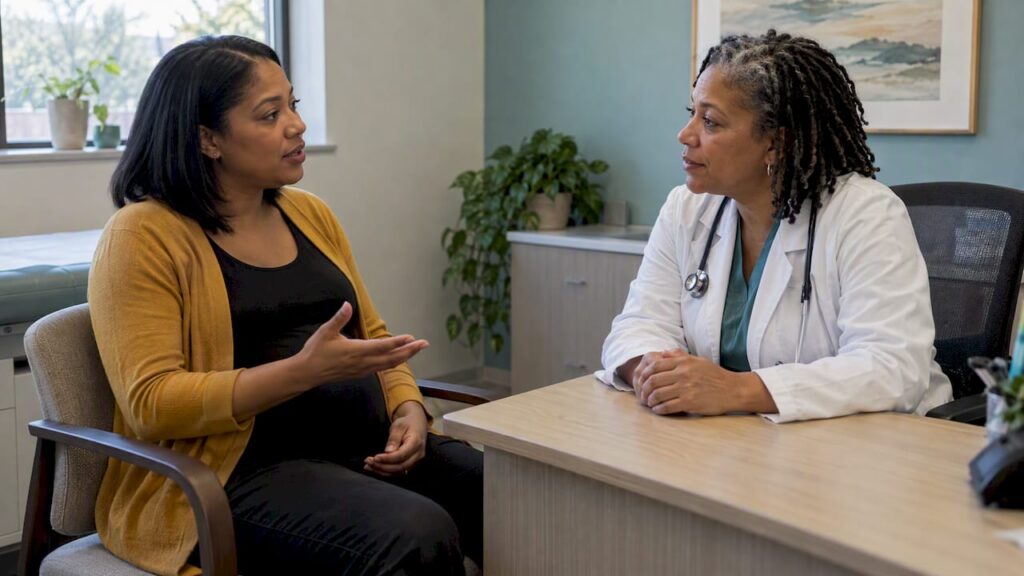
A second cesarean often feels more familiar and more daunting at once. You know the operating room, the recovery, and the tiredness, and now you also have a toddler or older child waiting at home. The best preparation has three parts: getting clear answers from your provider, setting up the day itself, and building a recovery plan that works with a child already in your life. This guide walks through all three.
TL;DR
- Ask your provider about your prior uterine incision, why your first cesarean happened, and how this birth is planned.
- Follow your hospital’s written instructions on fasting, pre-surgery soap, and shaving; they differ by hospital.
- Plan for a hospital stay of a few days and about six weeks of limited lifting at home.
- Line up help for your older child, meals, and nights before the surgery date.
- Know which symptoms mean calling your ob-gyn right away.
Table of Contents
- Start with the conversation about your first cesarean
- What to expect that’s different the second time
- Your pre-surgery checklist
- In the hospital: the first days
- Recovery at home with a child already in the house
- A note on spacing future pregnancies
- Our perspective: what a second cesarean really needs
- How we support planned cesarean families
- FAQ
- Ready for calm, personal support?
- Sources
Start with the conversation about your first cesarean
Before you plan anything else, make sure you and your provider are looking at the same history. ACOG suggests the choice between a VBAC and a repeat cesarean is individual, and it depends on factors such as the type of uterine incision you had before and the circumstances of that birth.
You might bring these questions to your next prenatal visit:
- What type of uterine incision did I have last time, and where can I see it documented?
- Why was my first cesarean needed, and does that reason apply now?
- Am I a candidate for a VBAC, or is a repeat cesarean the better plan for me?
- Are there any health conditions that affect my options?
- What emergency resources does this hospital have if something changes?
ACOG notes that with a high vertical (classical) incision, the risk of uterine rupture is highest, and a trial of labor is usually not recommended. That is exactly why asking about your incision matters. If you are still weighing a VBAC, our guide to doula support for VBAC lays out the evidence, and VBAC preparation in Bucks County covers what to line up if you choose it.
There is no wrong answer here, only an informed one. A planned repeat cesarean is a valid, thoughtful birth.
What to expect that’s different the second time
Many parents tell me the second surgery felt calmer because they knew the steps. A few things are worth knowing ahead of time.
The surgery itself. Your surgeon usually works through your original scar, and may take extra care around scar tissue inside. Ask your provider whether they expect anything different for you. Don’t be surprised if the overall timeline feels slightly different from last time, and ask what that means for your plan.
The risks. ACOG describes a repeat cesarean as major surgery whose risks add up with each cesarean. That is not a reason for fear. It is a reason to ask your provider how many cesareans they would consider safe for your situation, and what your own personal risks are.
The timing. According to Boston Medical Center’s guidance, many planned cesareans happen at 39 weeks, and a provider may schedule one earlier if needed. Ask which date is being proposed and why.
Your preferences. A cesarean can still be gentle and family-centered. Ask about a clear drape, having your partner beside you, music, delayed cord clamping if appropriate, and when the baby can be placed on your chest. We cover what to ask in skin to skin after a cesarean.
Your pre-surgery checklist
Your hospital will give you its own instructions, and those come first. Typical items, as described by Boston Medical Center, include:
- Agreeing on a date and time with your provider.
- Following the fasting instructions for food and drink.
- Using the special soap the night before and the morning of surgery.
- Not shaving within 24 hours of surgery.
On top of that, here is the practical list I walk clients through in the final weeks. Our third trimester checklist goes deeper.
- Pack for a longer stay. High-waisted underwear or a loose nightgown, a long phone charger, lip balm, and slip-on shoes.
- Confirm who is driving and who is staying. Write down your older child’s schedule for whoever steps in.
- Put your hospital paperwork in one place. Insurance card, ID, and any pre-registration forms.
- Ask about anesthesia. Request a pre-op conversation with the anesthesia team if you have questions or worries.
- Plan for your first night home. Set up a station with water, snacks, pads, and any medicine your provider recommends.
If you are delivering at a local hospital such as Trinity Health St. Mary in Langhorne, ask your provider’s office what the pre-admission steps and visitor policies are for planned cesareans.
In the hospital: the first days
After surgery, ACOG explains that staff regularly check your blood pressure, pulse, breathing, bleeding, and abdomen, and the catheter is removed soon after surgery. A stay is usually 2 to 4 days, depending on why you had the cesarean and how recovery goes.
Walking early is part of the plan. Canada’s healthcare guide to cesarean delivery advises moving around as soon as you can and taking oral pain medication as needed. Ask your nurses when they will help you get up for the first time.
If you plan to breastfeed, start asking about positions that keep pressure off your incision. Our 48 to 72 hour breastfeeding plan after cesarean is built for exactly this stretch.

Recovery at home with a child already in the house
The second recovery has a particular challenge: you cannot pick up your toddler the way you used to. MedlinePlus advises not lifting anything heavier than your baby for the first 6 to 8 weeks, avoiding strenuous activity, and not driving while taking narcotic pain medicine or if you feel weak or unsafe.
Some ways families make that work:
- Teach your older child to climb into your lap on their own, or sit beside you for reading.
- Set up changing and snack stations at your level, not on the floor.
- Let your partner or a helper do bath time, car seats, and laundry baskets.
- Ask about your own care too: our 6 to 8 week cesarean recovery timeline shows what the weeks may look like, and the first 48 to 72 hours after discharge plan helps you prepare for the homecoming.
Once your provider clears you, some parents explore gentle bodywork. If that interests you, read about chiropractic care after pregnancy and ask your ob-gyn whether and when it suits you.
Sibling adjustment is real, too. Our guide on supporting sibling bonding postpartum offers ideas.
Symptoms that need a call
This is the place for caution. ACOG says to call your ob-gyn right away for fever, chills, leg pain, incision drainage or leakage, heavy bleeding, worsening pain, or shortness of breath. MedlinePlus adds a persistent fever over 100°F, heavy bleeding like a period after more than 4 days or large clots, and incision redness, warmth, or swelling. Keep your provider’s after-hours number somewhere visible before you go to the hospital.
A note on spacing future pregnancies
If you think you may have another baby later, bring it up at your postpartum visit. ACOG recommends waiting at least 6 months, and says the most benefit comes from waiting at least 18 months, partly because the uterine scar heals more slowly than the skin.
Our perspective: what a second cesarean really needs
After more than ten years supporting Bucks County families, we have noticed that parents expecting a second cesarean often feel they should “already know what to do.” You don’t have to. A repeat cesarean is still a birth, and it deserves the same preparation, respect, and care as any other.
We believe the strongest support is high-touch and personal. That means helping you gather your questions before appointments, shaping a plan that honors your preferences inside your hospital’s protocols, and being there as a steady presence, in the room where your hospital allows it and at home afterward. We can’t tell you what is medically right for you. Your provider does that. What we do is help you feel prepared, heard, and grounded.
The families who tell us they felt calmest were not the ones with the longest list. They were the ones who had help lined up for the toddler, a plan for the first night home, and someone to text at 2 a.m.
Alexis Wallace
How we support planned cesarean families
At Serenity Doula, we support families across Bucks, Montgomery, Philadelphia, and Burlington Counties through pregnancy and birth doula services, private childbirth education, and in-home and virtual postpartum care. Our care is designed to be personalized, evidence-based, and nonjudgmental, whether your birth is natural, medicated, or surgical.

If you want to talk through your repeat cesarean plan, we would be glad to meet you.
FAQ
Is a second C-section harder to recover from?
It can feel different, mostly because you are caring for another child while healing. Your recovery is individual, so ask your provider what to expect for you. Help at home makes a real difference.
When are planned repeat C-sections usually scheduled?
Many planned cesareans happen at 39 weeks, though a provider may schedule one earlier if needed, according to Boston Medical Center. Ask your provider why they recommend a specific date.
How long will I be in the hospital?
ACOG says a stay after cesarean is usually 2 to 4 days, depending on the reason for the surgery and your recovery. Your care team will tell you when you are ready to go home.
Can I still have a VBAC instead?
Some people can, and some cannot. It depends on your prior incision type and birth history, so ask your provider for a personal assessment. Our VBAC preparation guide can help you shape your questions.
Ready for calm, personal support?
If you would like a steady guide for your second cesarean, we invite you to book a free consultation and tell us about your plans.
Sources
- Preparation for Scheduled C-Section, Bump & Beyond
- Deciding Between a VBAC and a Repeat Cesarean, ACOG
- Cesarean Birth, ACOG
- Going home after a C-section, MedlinePlus
- A Guide to Cesarean Delivery, Healthcare Excellence Canada
- Planning Your Next Pregnancy? Here’s How Long to Wait, ACOG