

Fetal station tells your provider how far your baby’s head (or presenting part) has descended into your pelvis, measured against a fixed landmark called the ischial spines. The scale runs from negative numbers (higher up) through zero (level with the spines) to positive numbers (lower, closer to birth). It’s one useful marker of descent, not a countdown clock. Station always gets read together with dilation, effacement, and contraction pattern before it means much for your labor.
TL;DR:
- Most clinicians use a -3 to +3 scale for fetal station, making it more consistent and easier for patients to understand their progress.
- Station readings can vary between examiners due to subjective judgment, swelling, or fetal positioning, and should be viewed as part of a broader clinical picture.
- A station of zero indicates the baby’s head is engaged, but significant descent may still require dilation and contractions to progress efficiently.
- Multiple factors like dilation, contraction strength, and fetal position influence how station numbers translate into labor stages or timing.
- Asking providers clear questions about their scale and what the station number means can help you better interpret labor progress and plan next steps.
Table of Contents
- What Is Fetal Station and How Does the Scale Work?
- How Do Providers Check Station During an Exam?
- What Do Specific Station Numbers Actually Mean?
- How Does Station Fit Into the Bigger Labor Picture?
- When Are Cervical Exams Done, and What Are the Risks?
- What Should You Ask Your Provider About Station?
- Why Do Different Providers Read the Same Exam Differently?
- A Doula’s Take on Station Numbers and What They Really Tell You
- How Serenity Doula Helps You Make Sense of the Numbers
- Sources
- FAQ
What Is Fetal Station and How Does the Scale Work?
Your ischial spines are two bony points inside your pelvis, and your provider’s finger locates them during a cervical check. When your baby’s head is level with those spines, that’s called “zero station” or “engaged.” Above that point, the numbers go negative (-1, -2, -3); below it, they go positive (+1, +2, +3), with some hospitals still using an older -5 to +5 scale. This is why one nurse might say “-2” and another says “high and floating” about the exact same baby.
Here’s a quick way to picture it:
- -3 station: baby is still floating, not yet settled into the pelvic inlet
- 0 station: the head has “engaged,” lined up with the ischial spines
- +2 station: well descended, getting close to the pelvic floor
- +4/+5: typically means crowning is near
The -5 to +5 scale is the version most often cited in clinical literature, though many labor and delivery units now use the simpler -3 to +3 version. Ask your provider which one they use so the numbers on your chart actually make sense to you.
How Do Providers Check Station During an Exam?
A cervical check focused on station is a manual, gloved exam. Your provider slides two fingers into the vagina, feels for the cervix to check dilation and effacement, then reaches slightly further to locate the ischial spines and estimate where the baby’s head sits relative to them. It takes less than a minute in most cases, though it can feel longer if you’re mid-contraction.
Ultrasound sometimes supplements this. When a manual exam is inconclusive, especially with a swollen cervix or an unclear presenting part, a bedside ultrasound can give a clearer read on head position and descent.
Here’s the part most people never hear: station assessment is genuinely subjective. A Cureus study on simulation-based training found that clinicians who trained on simulation models were noticeably more accurate estimating both dilation and station than those trained the traditional way. Skill and repetition matter here as much as the exam itself.
Pro Tip: If two providers give you different station numbers within the same hour, that’s not necessarily a red flag. Ask what changed, whether it’s positioning, swelling, or just normal variation between examiners, before assuming something is wrong.
What Do Specific Station Numbers Actually Mean?
A station of -2 usually means the baby hasn’t engaged yet. Your provider might mention it at a prenatal visit weeks before labor starts, and that’s completely normal for a first pregnancy where engagement often happens later.
Zero station means the head has entered the pelvic inlet. Some laboring people reach this point days before contractions start; others arrive at the hospital already there.
Positive stations get more specific:
- +1 with a closed cervix often signals early labor or even prelabor descent, not much of anything urgent
- +1 with a cervix dilated to 8 or 9 cm suggests the second stage (pushing) is close
- +2 or +3 generally means the baby is low enough that pushing may begin soon, especially paired with strong dilation
The same station number can mean very different things depending on dilation and contraction strength. Station alone doesn’t reliably predict minutes or hours until birth. A baby can sit at +2 for a while if contractions space out or the parent needs rest before pushing.
How Does Station Fit Into the Bigger Labor Picture?
Providers rarely look at station in isolation. The Bishop score, a scoring system that combines dilation, effacement, station, cervical position, and cervical consistency, gives a fuller snapshot of labor readiness, particularly before an induction.
ACOG’s 2024 guidance on first and second stage labor management treats 6 centimeters as the start of active labor rather than the older 4 centimeter marker, which shifts how providers interpret slow progress earlier in labor. ACOG also states cervical exams should happen when clinically indicated, not on a fixed schedule.
Two quick scenarios show why context matters so much:
- Scenario A: 5 cm dilated, station -1, contractions every 6 minutes. Provider likely encourages movement, hydration, and time rather than intervention.
- Scenario B: 6 cm dilated, station -1, contractions strong and close but no descent over several hours. Provider may discuss options like position changes, an epidural to help relaxation, or, less commonly, augmentation.
Same station, very different plans, because dilation and contraction pattern changed the story. This is exactly why understanding what a cervical exam checks beyond just the station number gives you a clearer read on what’s actually happening.
When Are Cervical Exams Done, and What Are the Risks?
Exams typically happen at a few predictable moments:
- On admission, to establish a starting point
- When labor seems to stall, to check for changes
- If there’s concern about fetal position or well-being
- Before decisions like an epidural placement or augmentation
Practice varies widely by hospital and even by shift. Evidence cited in ACOG’s guidance shows no clear link between how many exams you get and the risk of intrapartum fever, which is reassuring if you’re worried about infection risk from frequent checks. Exams are typically avoided with placenta previa or unexplained bleeding.
You can always ask, “What will this change about my care?” before agreeing to an exam, and you can decline or delay a check if it isn’t changing your plan.
What Should You Ask Your Provider About Station?
A few short scripts go a long way at the bedside:
- “What station am I at, and what scale are you using?”
- “Does this number change what we’re planning next?”
- “Can we wait until between contractions for this check?”
For partners, listen for the number and the tone. A calm “+1, looking good” means something different than a hesitant one, and it’s fine to ask the provider to say more in plain language. Jot down each station update with the time and dilation next to it. That simple log, kept in your birth plan or notes app, helps you track labor progress without needing to remember every detail under stress. Parents who like tracking milestones closely sometimes find a simple tracker useful for organizing updates like these alongside other pregnancy milestones.
Why Do Different Providers Read the Same Exam Differently?
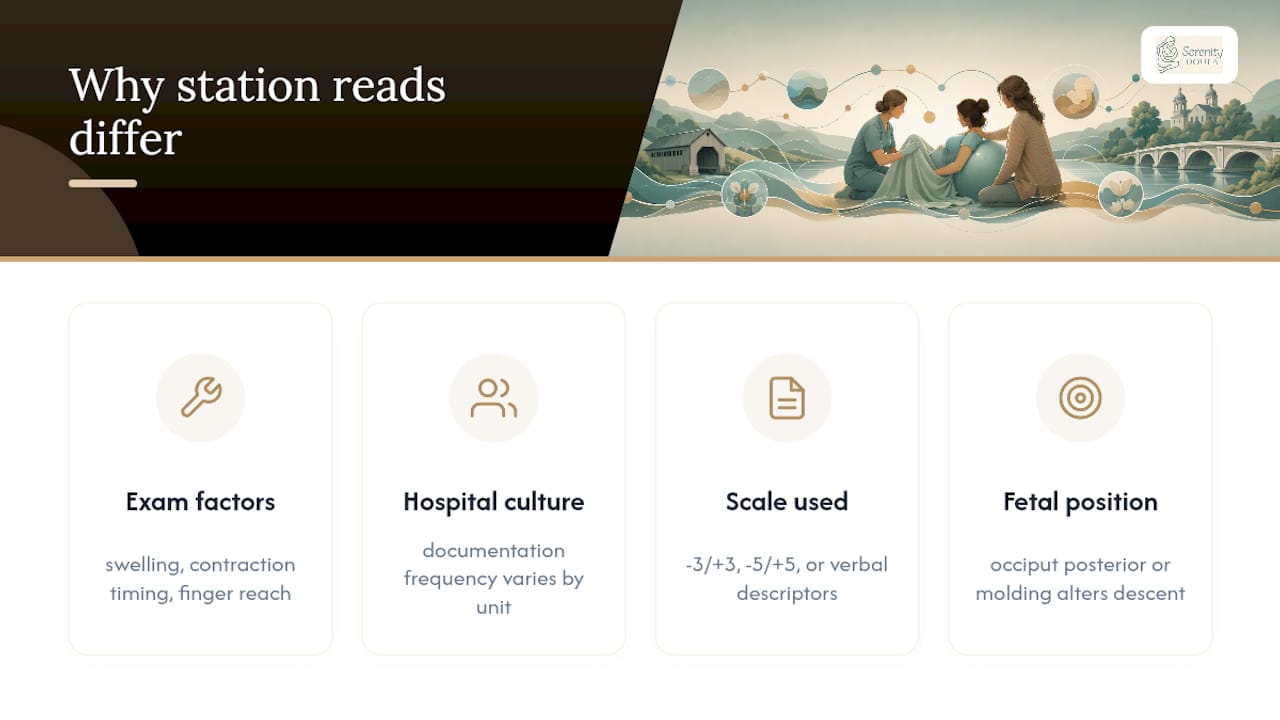
Two nurses can examine the same laboring person twenty minutes apart and report different stations, and neither one is necessarily wrong. Cervical swelling, contraction timing, and even how far the examiner’s fingers reach all shift the read. A PubMed-indexed clinical review on fetal station notes that station is best treated as one data point in a broader clinical picture rather than a fixed, objective measurement.
Hospital culture plays a role too. Some units document station at every check; others only note it when it’s clinically relevant to a decision. Some use -3 to +3, some still use -5 to +5, and some providers describe it in plain terms like “high,” “mid,” or “low” instead of numbers at all.
Fetal position adds another layer. A baby who is occiput posterior (facing up rather than down) or has some head molding can seem to descend more slowly even when labor is progressing normally. If a station reading feels inconsistent with how things feel to you, it’s fair to ask whether position or molding might explain it, according to patient education resources on fetal station.
None of this means the exam was done wrong. It means station is a skilled estimate, not a lab result with a decimal point, and the right questions can help you understand exactly what a cervical check is measuring in your specific labor.
A Doula’s Take on Station Numbers and What They Really Tell You
Clients ask me about station numbers more than almost anything else in labor prep. My honest answer: it’s one data point, and I watch how you’re feeling and moving at least as closely as the number on the chart. I coach partners to repeat the number back calmly, ask one clarifying question, and let it go rather than spiraling over it. I’ve sat with a client stuck at +1 for hours who delivered within forty minutes once she changed position. Numbers move; so do babies.
— Alexis Wallace
How Serenity Doula Helps You Make Sense of the Numbers
Serenity Doula gives Bucks County families the one thing a clinical chart cannot: a calm, informed person in the room who translates what “station +1” actually means for your specific labor, in real time. Our birth doulas support families through Newtown, Doylestown, and the wider Bucks County area, including hospitals like Trinity Health St. Mary, and our childbirth education classes walk you and your partner through exactly the scripts covered here, so you’re never guessing what to ask at the bedside.

A free consultation covers your birth preferences, your provider relationship, and how continuous labor support fits your specific situation, no pressure, no obligation. If you’re picturing a birth where you understand every update instead of just nodding along, book a free consultation with our birth support team and start that conversation now.
Sources
- Fetal station measures and clinical context (PMC article)
- First and second stage labor management | ACOG
- Does simulation training improve the accuracy of vaginal assessment of labour progress? (Cureus, 2021)
This article is general information, not a substitute for advice from a qualified doctor. Consult a qualified healthcare professional about your own circumstances before acting on anything here.
FAQ
What Does Station Mean in a Cervical Check?
Station describes how far your baby’s head has descended relative to the ischial spines, using a scale where 0 means the head is engaged and level with those bony landmarks.
What Does +1 Station Mean During Labor?
A +1 station means the baby’s head has moved just past the ischial spines toward the pelvic floor; paired with a closed cervix it may just mean early positioning, but with strong dilation it often signals labor is progressing well.
What Does +2 Station Mean in Labor?
At +2 station, the baby is fairly low in the pelvis and getting close to the pushing stage, though the exact timing still depends on dilation and contraction strength rather than the station number alone.
What Does Minus 1 Station Mean in Pregnancy at 37 Weeks?
A -1 station simply means the baby hasn’t fully engaged in the pelvis yet, which is common and not a sign of a problem close to term, especially in a first pregnancy.