
Perineal massage offers modest, evidence-backed protection against certain kinds of tearing and episiotomy, particularly for people having their first vaginal birth. Start in the late third trimester, usually around 34 to 36 weeks, and check with your provider before you begin. The rest of this guide walks you through the research, the technique, and how to build it into a routine that feels doable instead of one more thing on your list.
TL;DR:
- Perineal massage can nearly halve the risk of severe tears during first-time vaginal births and reduces episiotomy rates based on recent large studies.
- Starting between 34 and 36 weeks is most effective, with 2 to 4 sessions weekly lasting 5 to 10 minutes, though later starts still provide some benefit.
- Proper technique involves gentle, slow U-shaped stretches with lubrication, preferably after warm baths, and should never cause sharp pain or bleeding.
- Partner involvement is optional but can help improve comfort and communication, provided safety signals are established beforehand.
- The practice doesn’t reliably lower instrumental delivery or incontinence risk but helps many reduce postpartum perineal pain and trauma.
Table of Contents
- Does Perineal Massage Really Work for Birth?
- When Should You Start and How Often?
- How to Do Perineal Massage: Step-by-Step Technique
- Can a Partner Help With Perineal Massage?
- When Should You Avoid or Stop Perineal Massage?
- Building a Simple Weekly Practice Plan
- What Perineal Massage Can and Can’t Promise You
- A Doula’s Take on Body Literacy and Birth Prep
- How Serenity Doula Can Guide Your Practice
- Sources
- FAQ
Does Perineal Massage Really Work for Birth?
The strongest evidence on this comes from a Cochrane systematic review pooling four trials with roughly 2,480 women. It found that antenatal perineal massage reduced perineal trauma requiring stitches, with a relative risk of 0.91, and lowered the chance of needing an episiotomy, with a relative risk of 0.84. The benefit showed up most clearly in people without a prior vaginal birth. That distinction matters for how you plan: if this is your first vaginal delivery, you have more to gain from consistent practice than someone who has already stretched that tissue once before.
A separate 2022 meta-analysis pooling 16 studies and 6,487 participants found something even more striking. Prenatal perineal massage cut the rate of severe, third and fourth degree tears by nearly half, with a relative risk of 0.56, according to the meta-analysis published in PMC. That same analysis found a relative risk of 0.64 for perineal pain persisting at three months postpartum, meaning the practice’s benefits don’t stop at the delivery room door.
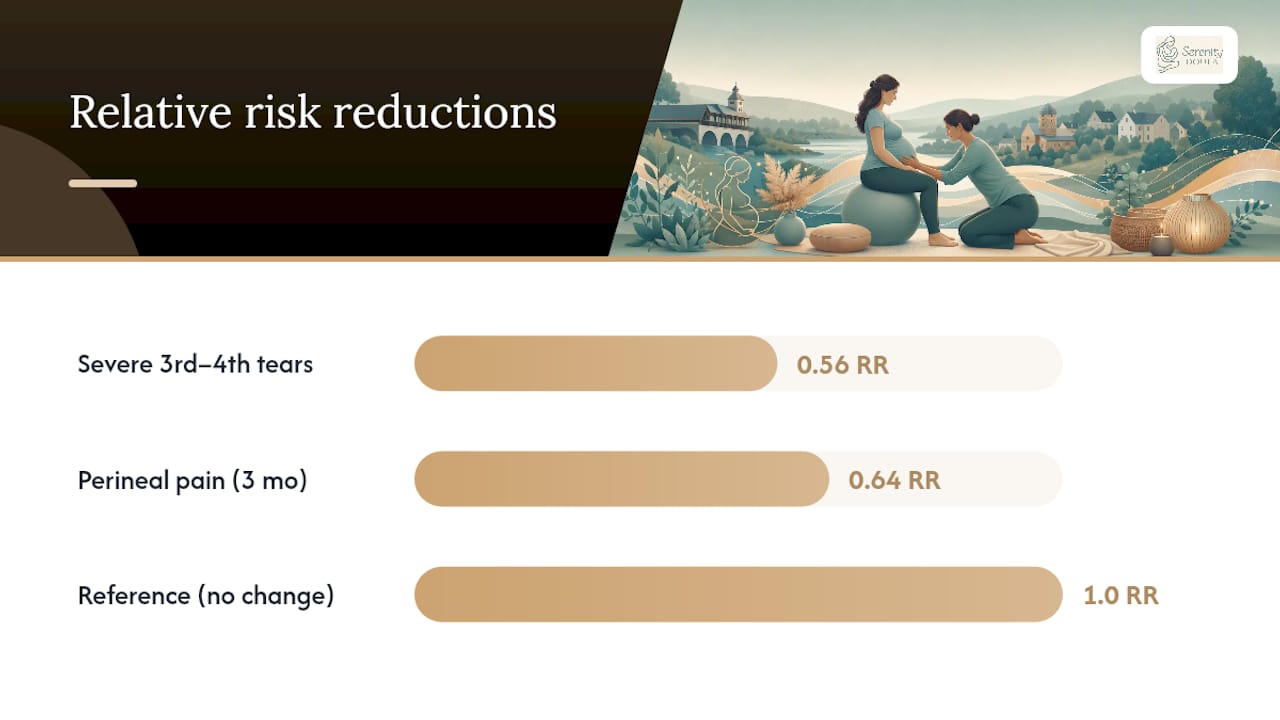
Statistic Spotlight: Across the Cochrane review’s four trials, antenatal massage reduced trauma severe enough to require suturing and lowered episiotomy rates, with these benefits most pronounced in first-time vaginal births.
Here’s where the evidence gets honest about its limits, and this is worth sitting with:
- It does not reliably reduce the chance of an instrumental delivery (forceps or vacuum).
- It has not been shown to change rates of urinary or fecal incontinence.
- Benefits for people who’ve already had a vaginal birth are smaller for trauma reduction, though Cochrane’s subgroup data suggests this group may still see less perineal pain afterward.
- Combining massage with pelvic floor exercises may enhance preparation, but device-based perineal training tools don’t have conclusive evidence behind them yet.
None of this means the practice is a guarantee. It means the odds shift in your favor, particularly around the outcomes that tend to worry first-time parents most: tearing and the pain that lingers after.
When Should You Start and How Often?
Most patient-facing clinical guidance points to a similar window: begin around 34 to 36 weeks, once you’ve cleared it with your midwife or OB. Starting earlier isn’t shown to add benefit, and tissue that isn’t yet responding to the hormonal softening of late pregnancy can feel more resistant and less rewarding to work with.
A workable rhythm looks like this:
- Frequency: 2 to 4 sessions per week
- Duration: 5 to 10 minutes per session
- Starting point: Around 34 to 36 weeks, per common clinical guidance
- If you’re starting later: Beginning at 37 weeks or beyond still appears to offer some benefit; just increase consistency rather than intensity to make up for lost time
If a session feels uncomfortable in a way that doesn’t ease with a slower pace or a few slow breaths, that’s your cue to pull back, not push through.
How to Do Perineal Massage: Step-by-Step Technique
This is where body literacy comes in. Perineal massage is as much about learning your own anatomy and practicing relaxation through sensation as it is a mechanical stretch. Here’s a straightforward sequence to follow.
- Wash your hands and trim your nails. Short, smooth nails prevent small nicks to sensitive tissue.
- Warm the area first. A warm compress or a few minutes in a warm bath increases blood flow and makes the tissue more pliable, a tip echoed in most clinical guidance on perineal massage.
- Choose a comfortable position. Sitting propped against pillows, semi-reclined with knees bent and open, or a supported squat all work. A mirror can help the first few times so you can see what you’re feeling.
- Apply lubricant. A water-based lubricant or a plain edible oil like almond or olive oil reduces friction. Skip anything scented, which can irritate delicate tissue.
- Insert your thumbs (or one thumb) about an inch or two into the vagina. Press downward, toward the rectum, and outward toward the sides in a slow U-shape.
- Hold and stretch gently for 30 to 60 seconds, breathing slowly. You’re aiming for a firm stretch sensation, similar to the pressure of the baby’s head crowning, not sharp pain.
- Repeat the U-shaped motion for 5 to 10 minutes, easing pressure any time it feels like too much.
- Stop immediately if you notice sharp pain, burning, or any bleeding. Clean up gently afterward and note anything unusual.
Pro Tip: Practice right after a warm shower or bath, when the tissue is naturally more relaxed. Many clients find their first few sessions go far more smoothly once they stop trying to do it “correctly” and instead just get curious about the sensation.
Can a Partner Help With Perineal Massage?
Partner involvement is entirely optional, and plenty of people prefer to practice alone. But for couples who want to do this together, it can become a meaningful, low-pressure way to prepare as a team.
- Have your partner sit or kneel comfortably at a height that doesn’t strain their wrist or back.
- Use one or two index fingers with the same downward, outward motion you’d use yourself.
- Set a simple comfort scale before starting: 1 to 10, with a clear stop word if anything crosses your line.
- Check in verbally every 30 seconds or so: “How does that feel? Too much, or okay to continue?”
- Treat it as practice for the kind of communication you’ll need in labor itself, not a performance to get right the first time.
Learn more about building this kind of partnership into your birth prep.
When Should You Avoid or Stop Perineal Massage?
Perineal massage is generally well tolerated, and the Cochrane review found no evidence that it increases adverse outcomes when practiced appropriately. That said, there are clear situations where it’s not the right choice.
Statistic Spotlight: The same Cochrane analysis that found reduced trauma and episiotomy rates also confirmed the practice carries no signal of increased harm across its four pooled trials, which is part of why it’s so widely recommended by midwifery and obstetric providers.
Avoid perineal massage, or pause and call your provider, if you have:
- An active vaginal infection, such as herpes or thrush
- Unexplained vaginal bleeding
- A diagnosis of placenta previa
- Sudden severe pain, heavy bleeding, fever, or unusual discharge during or after a session
- A history of pelvic surgery or a high-risk pregnancy (worth a direct conversation with your provider before starting)
If any of these apply, ask your midwife or OB whether perineal massage is appropriate for your specific situation, and when.
Building a Simple Weekly Practice Plan
You don’t need a complicated system, just consistency. A basic structure that fits into most weeks:
- Monday or Tuesday: One 5 to 10 minute session after a warm shower.
- Wednesday or Thursday: A second session, noting your comfort level on a simple 1 to 10 scale.
- Weekend: A third session, gradually increasing hold time toward the 60 second mark if things feel easy.
- Ongoing: Jot down session length, comfort rating, and any bleeding or unusual signs in a notes app or journal.
Increase pressure or duration only when the previous level felt fully comfortable, never on a schedule. If two sessions in a row feel harder rather than easier, that’s information, not failure.
What Perineal Massage Can and Can’t Promise You
Realistic expectations matter here. Perineal massage can lower your odds of needing an episiotomy, reduce the risk of severe tearing if this is your first vaginal birth, and ease perineal pain that might otherwise linger three months after delivery.
What it can’t do is guarantee an intact perineum, change your odds of an instrumental delivery, or prevent pelvic floor issues down the road. Genetics, baby’s position, pushing technique, and the skill of your birth support all play a role too.
- Likely to help: Lower episiotomy rates, reduced severe tearing risk for first vaginal births, less perineal pain at three months
- Not shown to change: Instrumental delivery rates, incontinence risk, guaranteed prevention of any tearing
Positioning during labor, warm compresses applied by your support team, and steady, skilled coaching through crowning all matter just as much as the prep work you do beforehand. Perineal massage is one piece of a larger picture, not the whole picture.
A Doula’s Take on Body Literacy and Birth Prep
People often ask me whether perineal massage is really worth the awkwardness of the first few tries. My honest answer: the physical benefit is real, but it’s not even the part I care most about.
What I’ve noticed working with families across Bucks County is that perineal massage teaches something harder to measure. It teaches you what stretching actually feels like before you’re in the middle of pushing a baby out and encountering that sensation for the first time. That familiarity changes how people respond in the moment. Instead of tensing against an unfamiliar feeling, which tends to make tearing worse, you recognize it and can breathe through it.
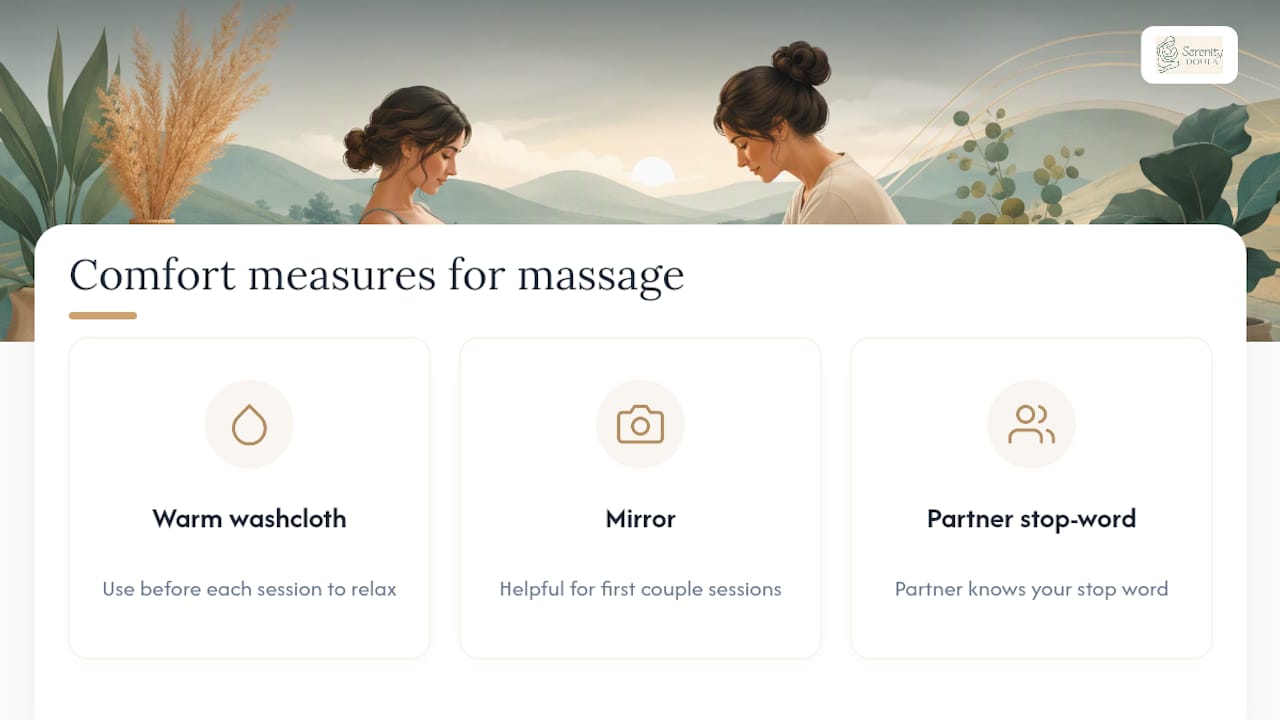
A warm washcloth before you start, a mirror for the first couple of sessions, and a partner who knows your stop word: those three small things make the biggest difference in how comfortable this practice feels. It’s not about perfect technique. It’s about getting curious about your own body ahead of time, so labor holds fewer surprises.
— Alexis Wallace
How Serenity Doula Can Guide Your Practice
Reading about technique is one thing. Having someone walk through it with you, answer your specific questions, and coach your partner on pacing and pressure is another. That hands-on layer is exactly what a private childbirth education session with Serenity Doula adds: personalized instruction on perineal massage technique, timing tailored to your due date, and partner coaching built around your comfort, not a generic script.
If you’re already thinking ahead to labor support, our pregnancy and birth doula services extend that same guidance into the delivery room, from positioning to warm compress application to steady encouragement through crowning. And for the weeks after, our postpartum care supports your physical recovery, perineal healing included. Book a free consultation to build a preparation plan around your specific pregnancy, whether you’re in Newtown, Doylestown, or anywhere else across Bucks County.
Sources
For readers who want to dig into the primary evidence themselves, the Cochrane review on antenatal perineal massage is the most rigorous summary available, pooling four randomized trials on trauma and episiotomy outcomes. The 2022 meta-analysis in PMC offers a larger, more recent pooled dataset focused on severe tearing and postpartum pain. For step-by-step practical guidance, Milton Keynes University Hospital’s patient information leaflet is a clear, clinically grounded starting point.
This article is general information, not a substitute for advice from a qualified doctor. Consult a qualified healthcare professional about your own circumstances before acting on anything here.
- Antenatal perineal massage for reducing perineal trauma | Cochrane
- Effect of Prenatal Perineal Massage on Postpartum Perineal Injury and Postpartum Complications: A Meta-Analysis
- Perineal Massage in Pregnancy – Advice and Information – Milton Keynes University Hospital
FAQ
When Should I Start Perineal Massage During Pregnancy?
Most clinical guidance recommends starting around 34 to 36 weeks, after confirming with your provider that it’s appropriate for your pregnancy. Starting earlier hasn’t been shown to add benefit, since tissue responds better once your body’s later pregnancy hormones have begun softening it.
Is 37 Weeks Too Late to Start Perineal Massage?
No, 37 weeks is not too late. You’ll get less total practice time than someone starting at 34 weeks, so focus on consistency, aiming for a session every other day, rather than trying to compress a full routine into a short window.
What Happens if I Don’t Do Perineal Massage?
Skipping it doesn’t guarantee you’ll tear or need an episiotomy. Many people give birth without ever practicing it and have straightforward deliveries. The evidence simply shows that people who do practice it see somewhat lower rates of severe tearing and episiotomy, particularly with a first vaginal birth.
How Painful Is Perineal Massage?
Done correctly, perineal massage should feel like a firm, sustained stretch, similar to the sensation of crowning, not sharp or burning pain. If you experience sharp pain, bleeding, or discomfort that doesn’t ease with slower pressure and breathing, stop and check in with your provider.