
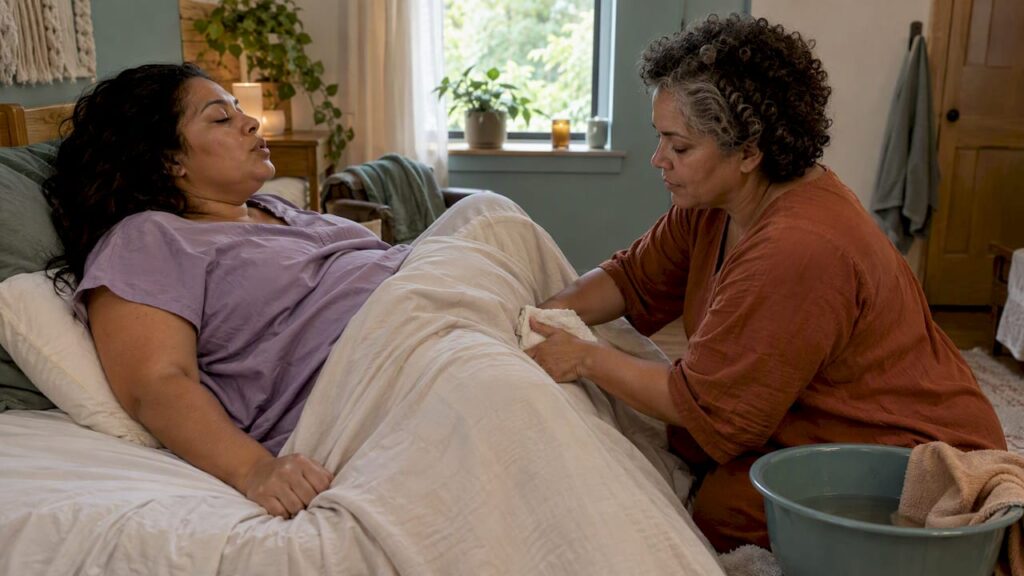
Most people worry about tearing at some point in pregnancy, and it is a fair thing to wonder about. No one can promise you won’t tear. But a few practices have real research behind them: perineal massage in late pregnancy, warm compresses while you push, slow and steady pushing, and a birth position that works with your body. Here is what each one can and can’t do, so you can talk it through with your provider and feel more grounded.
TL;DR
- Tears are common: up to 9 in 10 first-time mothers who have a vaginal birth have a tear, graze or episiotomy, and most are minor.
- Perineal massage from about 35 weeks may reduce trauma needing stitches and later perineal pain, especially in a first vaginal birth.
- During birth, warm compresses and slow, controlled pushing may help reduce serious tears.
- Position matters: side-lying, all-fours or kneeling may be gentler than lying flat on your back.
- Ask your provider which of these fit your pregnancy before you start.
Table of Contents
- How common is tearing, and what affects it?
- Perineal massage: what it does and doesn’t do
- What may help during labor
- A quick plan to bring to your next appointment
- If you do tear: recovery basics
- Our perspective as a doula
- Support that goes beyond the checklist
- FAQ
- Sources
How common is tearing, and what affects it?
The Royal College of Obstetricians and Gynaecologists says up to 9 in 10 first-time mothers who give birth vaginally experience a tear, graze or episiotomy. Most of these are small and heal well. Severe tears are more likely with a first vaginal birth, a baby over 4 kg, a long pushing stage, shoulder dystocia or an instrumental birth (forceps or vacuum).
Some of those factors you can’t control, and that is worth saying out loud. If you tear, it does not mean you did something wrong. What you can do is stack the odds a little in your favor.
Perineal massage: what it does and doesn’t do
This is the most-searched tip, so let’s be precise. A Cochrane review of antenatal perineal massage found it reduced trauma that needed suturing, mainly by reducing episiotomies, and it reduced ongoing perineal pain. The benefit was clearest for women without a previous vaginal birth. It did not reduce third- and fourth-degree tears in that review, although a separate meta-analysis did find a lower risk of those tears and less perineal pain at three months postpartum.

So the honest summary: it may help, the strongest signal is for first-time vaginal births, and the research does not agree on severe tears. We go deeper on technique in our guide to perineal massage in pregnancy.
How to do it
The RCOG suggests starting around 35 weeks, daily or whenever you can. You or your partner can do it:
- Wash your hands and trim your nails. Get comfortable, propped up or reclined.
- Use a lubricant.
- Press your thumbs down toward the anus and the sides of the vaginal walls.
- Gently massage the lower vagina in a U shape.
- Stop if anything hurts. It should feel like stretching, not pain.
Pro tip: Pair it with a warm bath and a few slow breaths. Many of our clients find the routine becomes a calm, ten-minute pause rather than a chore.
When to check with your provider first
Perineal massage is generally considered safe, but Australia’s pregnancy and birth guidance advises against it if you have vaginal bleeding, an active infection such as herpes or thrush, a low-lying placenta, a short cervix or severe blood pressure problems. Good questions for your OB or midwife:
- Is perineal massage appropriate for me, given my history?
- Is there anything about my placenta, cervix or blood pressure that means I should wait?
- If I have a pelvic floor condition or pain, should I see a pelvic floor therapist first?
What may help during labor
The Mayo Clinic notes that warm, damp cloths held to the perineum during pushing and gentle, slow, controlled pushing may help reduce serious tears. It also notes that episiotomy is no longer done routinely.
Warm compresses
Warmth may improve blood flow and make tissue more pliable. Your doula can prepare and hold the compress, which frees your partner to focus on you. Ask your provider ahead of time: Do you routinely offer warm compresses during pushing?
Slow, controlled pushing
Pushing slowly gives tissue time to stretch rather than give way suddenly. Many families find a gentler approach feels natural once they have practiced it. Our article on open glottis pushing explains how it works, and a childbirth education class is a good place to rehearse it.
Position
The RCOG guidance on reducing your risk points to some evidence that kneeling, all-fours or side-lying positions may be better than the lithotomy position (flat on your back with legs raised). If you have an epidural, ask whether a side-lying position is possible with your setup. At Bucks County hospitals, including Trinity Health St. Mary, it is reasonable to ask your provider in the third trimester how they support position choice while you push.
A quick plan to bring to your next appointment
| When | What to do | What to ask your provider |
|---|---|---|
| About 35 weeks | Start perineal massage if cleared | Is this safe for me? |
| Third trimester | Practice slow, open-throat pushing | How do you coach pushing? |
| Birth plan | Note warm compresses and position preferences | Do you support these in labor? |
| Labor | Your doula reminds you of your choices | Can we talk through options if things change? |
If you do tear: recovery basics
If you tear, healing is well understood. ACOG lists cold packs for 10 to 20 minutes at a time, especially in the first 24 to 72 hours, a squeeze bottle of warm water to clean the area, and asking your ob-gyn about a stool softener. Contact your ob-gyn if pain does not go away or gets worse.
Some people notice discomfort with intimacy afterward. ACOG says tears may cause pain during sex for several months. If it lingers, speak with your provider, and know that painful sex therapy is one route people explore alongside medical care. For a wider look at healing, see our postpartum recovery essentials.

Our perspective as a doula
In more than ten years of supporting families in Newtown, Doylestown and across Bucks County, we have seen that preventing tears is not about doing everything perfectly. It is about feeling informed and supported enough to make calm choices when things move quickly.
We do not treat any technique as a guarantee. We talk through the evidence, help you frame questions for your provider, and practice pushing and positions before labor so they feel familiar. During birth, we are there to hold the compress, remind you of your choices and steady the room. If a tear happens anyway, we help you heal without blame.
— Alexis Wallace
Support that goes beyond the checklist
If you want someone beside you who knows these options well, our Pregnancy & Birth Doula service offers personalized, evidence-based support through pregnancy and labor, and Childbirth Education classes let you and your partner practice pushing and positions together. Afterward, our Postpartum Care helps you recover, in your home or virtually.
FAQ
Can you completely prevent perineal tearing?
No. Many factors, such as baby’s size, how fast labor moves and whether it is your first vaginal birth, are outside your control. Massage, warm compresses, position and slow pushing may lower your risk, but none can promise a tear-free birth.
When should I start perineal massage?
The RCOG suggests around 35 weeks, daily or when you can. Check with your provider first, especially if you have bleeding, an infection or a low-lying placenta.
Does perineal massage work for everyone?
The Cochrane review found the clearest benefit for people without a previous vaginal birth. It reduced trauma needing stitches and later perineal pain, but did not reduce severe tears in that analysis.
How do I care for a tear afterward?
ACOG suggests cold packs for 10 to 20 minutes, warm water from a squeeze bottle to clean the area, and asking your ob-gyn about a stool softener. Call your provider if pain does not go away or gets worse.
When you are ready to talk about what birth support could look like for your family, we would love to meet you. Book a free consultation and let’s start there.
Sources
- Perineal tears during childbirth, RCOG
- Reducing your risk of perineal tears, RCOG
- Antenatal perineal massage for reducing perineal trauma, Cochrane
- Effect of Prenatal Perineal Massage on Postpartum Perineal Outcomes, PMC
- Perineal massage, Pregnancy Birth and Baby (Australia)
- Can vaginal tears during childbirth be prevented? Mayo Clinic
- Postpartum Pain Management, ACOG
- When Sex Is Painful, ACOG