
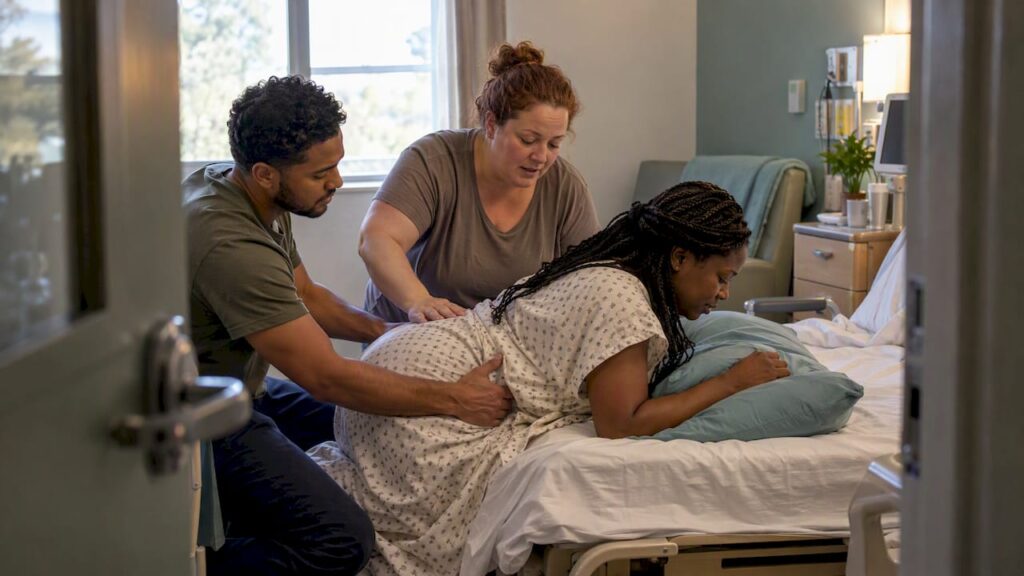
A doula does not take your place in the delivery room. She makes it easier for you to be there fully: calmer, better informed, and free to focus on the person you love. If you’re an expectant dad or non-birthing partner wondering whether you need a doula, or whether a doula would push you aside, this guide walks through what really happens.
TL;DR
- A birth doula supports both parents. DONA International describes doulas as support for fathers too, meeting the partner’s physical and emotional needs.
- She adds to your role. She shows you comfort measures, explains what’s happening, and steps in so you can eat, rest, or take a breath.
- Involved dads matter. The American Academy of Pediatrics notes that paternal involvement begins before birth.
- Preparation helps most. A class for dads and a postpartum plan make the first weeks feel less overwhelming.
Table of Contents
- What people mean by “doula for dads”
- Will a doula take over my job?
- What the research says about doula support
- Why dads who feel prepared stay more present
- Getting ready together: a simple dad checklist
- Bonding with your newborn after the birth
- Our perspective: the dad is part of the birth team
- How Serenity Doula supports dads and partners
- FAQ
- Sources
What people mean by “doula for dads”
The phrase gets used two ways, and it helps to separate them.
The first is a birth doula who supports the whole couple. She is a trained, nonmedical professional who gives continuous physical and emotional support in labor. The DONA position paper on the birth doula’s role describes her as someone who provides continuous support and helps clients and their partners gather information.
The second is a “dad doula”: a man, often a father himself, trained to coach new fathers through the fourth trimester. These programs exist around the country and can be a lovely addition.
At Serenity Doula, we work in the first category. We support dads, partners, and the birthing parent as one team.
Will a doula take over my job?
This is the worry we hear most from dads, so let’s be direct: no.
Your partner knows her own fears, humor, and rhythms. A doula doesn’t. What a doula brings is experience with hundreds of labors and a calm, steady presence. ACOG describes a doula as someone who works alongside your doctor and nurses to help make sure emotional and physical needs are met. She is not a replacement for you, and she isn’t part of the medical team.
In practice, the division looks like this:
| Moment in labor | What you do | What your doula does |
|---|---|---|
| Early labor at home | Stay close, time contractions together, pack the car | Helps you both decide when to head to the hospital or birth center |
| Active labor | Hold hands, offer water, speak softly | Shows you counterpressure and positions, suggests changes when labor stalls |
| Hospital decisions | Hear the options, ask questions with your partner | Helps you understand terms and think of questions to ask your provider |
| Long stretches | Rest, eat, step out for a minute | Stays with your partner so she is never alone |
| After birth | Welcome your baby, skin-to-skin | Helps with the first feeding and settling in |
If you want to go deeper on your part in the room, our guides on the partner’s role in childbirth and how to support your partner during labor are a good next read.
What the research says about doula support
The largest review is a Cochrane analysis of continuous support in childbirth, which included 27 trials, with 26 of them providing usable data on 15,858 women. Continuous support was linked to benefits such as more spontaneous vaginal births and fewer cesareans, and women valued having a support person with them. A Cochrane summary is also available if you want the short version.

In July 2026, ACOG released new guidance for ob-gyns on partnering with doulas, noting that doulas are nonmedical professionals who provide emotional, physical, and educational support and advocacy. Its related committee statement says strong partnerships between clinicians and doulas can benefit patients and clinicians alike.
One caution: this evidence is about doula support in general. It doesn’t promise any particular birth. Ask your own provider how a doula would fit with your care plan.
Why dads who feel prepared stay more present
Most dads we meet aren’t short on love. They’re short on a script. Labor is loud, long, and unfamiliar, and it’s hard to feel useful when you don’t know what comes next.
The AAP’s report on fathers points out that mothers with involved fathers are more likely to get early prenatal care and less likely to deliver prematurely. A CDC-linked analysis of paternal involvement and maternal perinatal behaviors also associates involvement with better infant and maternal outcomes. Involvement matters, and preparation is how it turns into confidence.
Pro Tip: Before the third trimester, ask your partner two questions: “What helps you when you’re stressed?” and “What do you want me to say when things get hard?” Write the answers down. Your doula can build your plan around them.
Getting ready together: a simple dad checklist
- Take a class built for you. Our doula-led childbirth class for dads uses weekly rehearsals so you practice comfort measures before you need them.
- Learn the stages of labor so a long early phase doesn’t feel like an emergency.
- Pack for yourself too: snacks, a charger, a change of clothes, something to sleep on.
- Talk through preferences for natural, medicated, or cesarean birth, and write questions for your provider.
- Plan the first two weeks: who cooks, who visits, who sleeps when.
Our step-by-step labor guide for birth partners turns that into a workflow you can keep on your phone.
Bonding with your newborn after the birth
Dads often tell us they feel a step behind in the early days, especially if mom is nursing. Bonding doesn’t need hours. Skin-to-skin contact, bath time, diaper changes, and quiet talking all count. If you want ideas that fit a tired schedule, these daily newborn bonding ideas for dads show how short, regular moments add up.
A postpartum doula can help here too. She shows you how to swaddle, soothe, and read your baby’s cues, so you can take real ownership of care instead of waiting to be handed the baby.

Our perspective: the dad is part of the birth team
In more than ten years of attending births in Bucks County, I’ve watched the same thing happen again and again. A dad walks in nervous, holding a bag he over-packed and a list he’s afraid to forget. By the middle of labor, once he’s learned a hip squeeze or how to breathe along with his partner, his shoulders drop. He’s no longer watching. He’s doing something that matters.
We don’t see doula care as a replacement for a partner. We see it as holding both of you between appointments and through the long hours of labor. We teach evidence-based comfort measures, we help you form questions for your doctor or midwife, and we stay nonjudgmental whether your birth is natural, medicated, or a cesarean. Whether you deliver in Newtown, Doylestown, or at Trinity Health St. Mary, our job is the same: you feel seen, and your partner feels held.
— Alexis Wallace
How Serenity Doula supports dads and partners
Our Pregnancy & Birth Doula service includes partner guidance, so you aren’t left guessing. Our Childbirth Education classes are personalized, and we offer in-home and virtual Postpartum Care for families in Bucks, Montgomery, Philadelphia, and Burlington Counties.
Not sure what a doula covers? Start with what a doula does, even if you already have a doctor or midwife. When you’re ready, we’d love to talk with you both: book a free consultation, bring your questions, and bring the dad’s questions especially.
FAQ
What is a daddy doula?
A daddy doula, or dad doula, is usually a father trained to give educational and emotional support to new dads, often in the fourth trimester. It’s different from a birth doula, who supports the whole family during labor. Many families benefit from both kinds of support.
Does a doula replace the partner in the delivery room?
No. A doula works alongside you and the medical team. She shows you how to help, and steps in so you can rest or breathe. DONA describes doulas as supporting fathers as well.
What can dads do to support their partner during labor?
Stay close, offer water, speak calmly, and advocate for her preferences by asking questions. Learn counterpressure and positions ahead of time in a class. Ask your provider what is appropriate for your specific situation.
Should we hire a doula if this is our first baby?
Many first-time parents do, because everything is new. A doula brings continuity and experience, and helps you ask your provider good questions. A free consultation is a no-pressure way to see whether it feels right.
Sources
- DONA International: Dads & Doulas, Myths & Resources
- DONA: The Birth Doula’s Role in Perinatal Care
- ACOG: An Ob-Gyn on why she had a doula
- ACOG: New guidance for ob-gyns on partnering with doulas
- ACOG: Partnering With Doulas in Clinical Settings
- Cochrane review on continuous support (PMC)
- Cochrane: Continuous support for women during childbirth
- Paternal Involvement and Maternal Perinatal Behaviors (PMC)
- AAP HealthyChildren: Childhood Looks Better When Dad is in It