

TL;DR:
- Partner support during labor improves birth outcomes and increases maternal satisfaction.
- Partners provide emotional reassurance, physical comfort, and advocacy continuously throughout labor.
- Ongoing postpartum involvement helps prevent maternal trauma and supports recovery.
You might think the doctors and nurses run the show during labor. But here’s what most people don’t realize: your presence as a partner can actually change the outcome of birth. Continuous labor support through emotional reassurance, physical comfort, and advocacy reduces cesareans, lowers epidural use, and increases birth satisfaction. You are not just a bystander in that room. You are your partner’s anchor when everything else feels like a whirlwind. This guide will walk you through the research, the practical steps, and the emotional realities of showing up fully, so you can step into that birth space with confidence and purpose.
Table of Contents
- Why partner support during childbirth matters
- What partners actually do: core support roles in labor
- Navigating challenges: partner emotions, anxiety, and inclusion
- Partners, doulas, and the birth team: working together
- The partner’s role in postpartum and recovery
- A fresh perspective: the partner’s true power in childbirth support
- Get support: education and guidance for every step
- Frequently asked questions
Key Takeaways
| Point | Details |
|---|---|
| Continuous presence matters | A partner’s support during labor improves outcomes and satisfaction for both parent and baby. |
| Practical support is key | Physical comfort, advocacy, and reassurance are the most impactful ways to help in childbirth. |
| Preparation boosts confidence | Taking classes and preparing emotionally helps partners overcome nerves and be effective. |
| Teamwork enhances support | Partners and doulas work together to ensure the birthing parent feels heard and cared for. |
| Support continues postpartum | Emotional and practical help from partners reduces trauma risk after birth and strengthens family bonding. |
Why partner support during childbirth matters
Let’s start with the science, because it’s genuinely surprising. Most people assume the birth team handles everything and the partner is just there for moral support. The data tells a very different story.
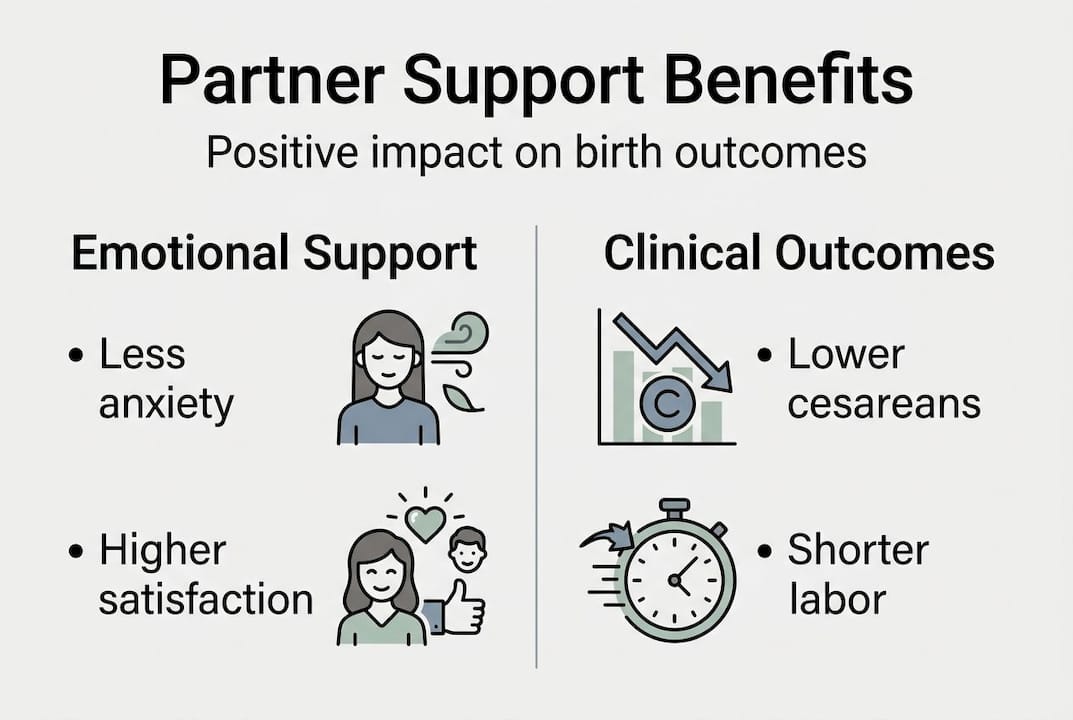
Research shows that continuous support raises spontaneous vaginal birth rates (RR 1.08) and cuts cesarean rates (RR 0.69). Labor is shorter. Satisfaction is higher. Those aren’t small wins. That’s a meaningful shift in how birth unfolds, and your presence is a direct contributor.
Beyond the numbers, gaps in partner support predict maternal trauma and depression. Doula-like continuous support can cut preterm births by 3 to 4 per 100 births. These outcomes matter deeply for your growing family.
Here’s a quick look at how support shapes birth outcomes:
| Type of support | Impact on birth outcomes |
|---|---|
| Emotional reassurance | Lower anxiety, higher satisfaction |
| Physical comfort measures | Shorter labor, fewer pain medications |
| Informational guidance | Fewer unnecessary interventions |
| Advocacy | Respect for birth preferences |
The types of childbirth support available to families go beyond just having someone in the room. It’s about intentional, consistent presence.
What does that look like in practice? Think of it this way:
- Emotional support: Staying calm, offering words of encouragement, and simply being present
- Physical support: Massage, counter-pressure, helping with positioning and hydration
- Informational support: Helping the birthing parent understand their options
- Advocacy: Speaking up for their preferences when they can’t
“The partner’s role isn’t passive. It’s one of the most powerful forces in the birth room, and the research backs that up completely.”
Your presence is not a courtesy. It’s a clinical advantage and an emotional lifeline.
What partners actually do: core support roles in labor
Knowing the ‘why’ is energizing. Now let’s get practical. What will you actually do during labor?
Partners provide emotional reassurance, physical comfort, informational guidance, and advocacy throughout the labor process. That covers a lot of ground, so let’s break it down into a clear sequence.
- Early labor: Keep the environment calm. Offer snacks, water, and distraction. This phase can last hours, so your steady energy matters.
- Active labor: This is where physical support becomes critical. Learn comfort measures during labor like hip squeezes, counter-pressure on the lower back, and helping your partner change positions.
- Transition: The most intense phase. Your job is to stay grounded even when things feel chaotic. Eye contact, a calm voice, and a firm hand can be everything.
- Pushing: Encouragement, counting, and being a steady presence as your partner works hard.
- After birth: Skin-to-skin, photos, and emotional grounding for both of you.
You’ll also serve as an informational filter. Medical teams move fast and use clinical language. You can ask questions, slow things down, and make sure your partner’s wishes are heard and respected. That’s a powerful role.
Prenatal emotional support starts long before labor begins. Talking through fears, discussing the birth plan, and understanding your partner’s preferences ahead of time multiplies your impact in the moment.
Pro Tip: Take a childbirth education class together before the birth. Knowing what to expect reduces your anxiety and makes you a far more effective support person. Look into childbirth education methods like Lamaze or HypnoBirthing to find what fits your family.
The more prepared you are, the more present you can be. Preparation isn’t just helpful. It’s transformative.

Navigating challenges: partner emotions, anxiety, and inclusion
Here’s something most birth books skip over entirely: you have feelings too. And that’s completely valid.
Many partners, especially first-timers, feel anxious, out of place, or unsure of what they’re supposed to do. Male partners may feel sidelined or underprepared, and cultural expectations can add extra pressure. You’re not alone in feeling this way.
Common emotional hurdles partners face include:
- Fear of doing or saying the wrong thing
- Feeling helpless when the birthing parent is in pain
- Uncertainty about when to speak up versus step back
- Anxiety about the unexpected, especially for first-time parents
- Navigating family expectations or cultural norms around who belongs in the birth room
The good news? Preparation is the antidote to almost all of these. Attending a childbirth support options class, touring the birth facility, and having honest conversations with your partner ahead of time all build real confidence.
Cultural context also matters. Different families have different traditions around who supports the birthing parent. What’s most important is that the birthing parent’s preferences are centered, and that you communicate openly about roles before labor starts.
Staying engaged during labor also means knowing your own limits. If you need a moment to breathe, eat, or reset, that’s okay. A depleted partner can’t support anyone well.
Pro Tip: Before labor, create a simple coping plan for yourself. Identify one or two grounding strategies, like slow breathing or a mantra, that you can use if you feel overwhelmed. Taking care of yourself is not selfish. It’s how you stay present for the person who needs you most.
Partners, doulas, and the birth team: working together
One question we hear often is: “If there’s a doula, what’s my role?” The answer is simple. You each bring something the other can’t fully replace.
ACOG supports continuous support during labor as a quality improvement strategy, and notes that doulas complement partners rather than replace them. Think of it as a team, not a competition.
Here’s how the roles break down:
| Role | Primary focus | Unique strength |
|---|---|---|
| Partner | Emotional presence, love, advocacy | Irreplaceable personal bond |
| Doula | Continuous physical and emotional support | Training, experience, calm under pressure |
| Medical staff | Clinical care, monitoring, interventions | Safety, medical expertise |
A doula can coach you on comfort techniques, give you a break without leaving your partner unsupported, and help you both navigate medical decisions. Understanding what a doula does can help you see how well these roles work side by side.
“Having a doula doesn’t mean stepping back. It means your partner has two people fully in their corner.”
In hospital and birth center settings, medical staff are focused on clinical safety. They’re not always able to provide the continuous emotional presence that changes birth outcomes. That’s where you and a doula fill the gap.
Exploring doula care benefits or connecting with doulas in Levittown can help your family build the right birth team from the start.
The partner’s role in postpartum and recovery
The baby is here. Labor is over. And your role? It’s just entering a new chapter.
Many partners assume their support job ends at birth. But emotional and informational gaps post-birth are directly linked to maternal trauma and depression. Your continued presence matters more than you might think.
Consider this: a significant number of birthing parents report experiencing birth trauma. Partner involvement in the days and weeks after birth is one of the most protective factors against that outcome.
Here’s what practical postpartum support looks like:
- Watch for warning signs: Know the symptoms of postpartum depression, including persistent sadness, withdrawal, difficulty bonding, and extreme fatigue
- Take on household tasks: Meals, laundry, and managing visitors so the birthing parent can rest and recover
- Encourage professional help: If you notice signs of postpartum depression or anxiety, gently encourage your partner to reach out to a provider
- Protect rest: Newborns wake often. Sharing nighttime duties, even partially, makes a real difference
- Stay emotionally available: Check in, listen without trying to fix, and validate what your partner is feeling
Exploring a postpartum care guide can give you a clearer picture of what recovery looks like and how to support it well.
The postpartum period is tender and often overwhelming. Showing up consistently, even in small ways, is how you help your family heal and bond.
A fresh perspective: the partner’s true power in childbirth support
I’ve seen a lot of partners walk into a birth room feeling like they’re just there to hold a hand and stay out of the way. And I want to gently challenge that.
The research is compelling, yes. But there’s something the studies can’t fully quantify: the specific, irreplaceable comfort of being supported by the person who loves you most. No doula, no nurse, no midwife can replicate that bond. It’s yours alone to offer.
What most birth books miss is this: birth is a relationship experience, not just a clinical one. The way a partner shows up, whether nervous, imperfect, or unsure, but present and trying, shapes how the birthing parent feels about the entire experience. Intentionality outweighs perfection every single time.
You don’t have to be flawless. You just have to show up, stay engaged, and let your love be active rather than passive. That’s the real power of the partner in the birth room.
Get support: education and guidance for every step
Feeling inspired but want more hands-on preparation? That’s exactly what we’re here for.

At Serenity Doula, we work with partners just like you, people who care deeply and want to show up well. Our pregnancy and birth support services are designed to include and empower partners at every stage. We also offer childbirth education classes that give you real skills, not just theory. Whether you’re looking for personalized guidance, a birth team that includes you, or simply more confidence going into labor, we’d love to connect. Reach out to schedule a consultation and let’s build your support plan together.
Frequently asked questions
What is the most important thing a partner can do during childbirth?
Stay present and offer continuous emotional and physical support, while advocating for the birthing parent’s wishes throughout labor. Showing up consistently, even in small ways, has a measurable impact on outcomes.
How does partner involvement affect birth outcomes?
Continuous support reduces cesarean and epidural rates, shortens labor duration, and significantly increases the birthing parent’s overall satisfaction with the birth experience.
What if I feel nervous or unprepared as a birth partner?
That’s completely normal. Taking classes like Bradley or Lamaze and talking openly with your partner beforehand builds real confidence and helps you feel included and ready.
Can both a partner and a doula be present during childbirth?
Absolutely. Doulas complement partners by providing additional trained support, which actually frees you to be more emotionally present rather than managing every logistical detail.
What is the partner’s role after the baby is born?
Your support continues to matter deeply. Emotional gaps post-birth are linked to higher rates of maternal trauma and depression, so staying present, watching for warning signs, and sharing practical responsibilities all make a real difference.