
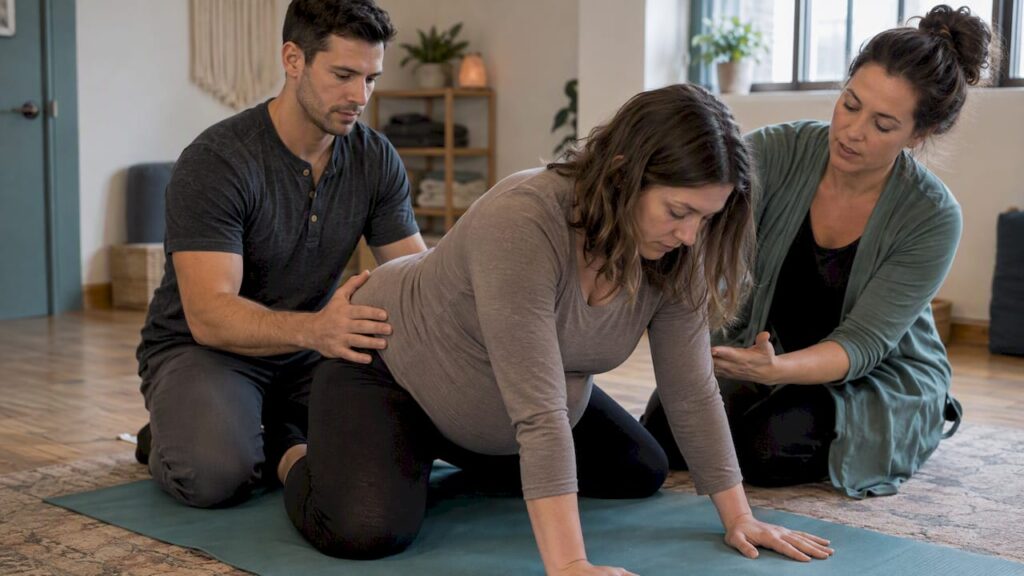
Yes, a childbirth class for dads gives partners concrete skills and confidence they need to support labor, advocate for their partner, and handle early newborn care. You can find this kind of preparation through dad-only workshops, partner modules inside couples’ classes, online courses, or private doula-led sessions built around your family’s birth plan.
TL;DR:
- In-person private doula-led classes offer tailored coaching and real-time correction, especially useful for complex birth plans or first-time fathers.
- Practicing hands-on skills like counterpressure, positioning, and advocacy three to four times weekly builds confidence and muscle memory before labor.
- Smaller group classes provide more individual attention and dedicated partner content, whereas online courses are more flexible but less practical for physical skills.
- Choosing instructors with verified credentials and confirming the inclusion of physical rehearsal are key factors for effective preparation.
- Insurance coverage varies, so verifying reimbursement options before booking helps ensure affordability of professional childbirth education.
Table of Contents
- Types of childbirth classes for dads and what each format offers
- Core skills dads learn in class: comfort measures, advocacy, and newborn basics
- How to choose the right childbirth class for you
- Practice drills and a short rehearsal plan for the last weeks
- Why a private, doula-led partner class works for some dads
- What fathers worry about most, and what actually helps
- Book a private childbirth class built around your birth plan
- FAQ
- Sources
Types of childbirth classes for dads and what each format offers
Not every class fits every schedule, and not every dad learns the same way. Some want a room full of other nervous fathers-to-be; others want one-on-one coaching with a doula who already knows their birth plan.
- Dad-only workshops: Usually a single evening or weekend session focused on labor support, advocacy, and newborn basics, often scheduled in the third trimester.
- Partner modules in couples’ classes: Woven into a broader childbirth education series, these cover the same ground but split time between mom’s labor prep and dad’s support role.
- Online or self-paced courses: Flexible and often less expensive, though they tend to offer less hands-on practice than an instructor-led session.
- Private, doula-led sessions: Scheduled around your due date and tailored to your specific birth plan, with direct practice and feedback.
Dad-only and couples’ classes typically run a few hours and work best in the later weeks of pregnancy, early enough to practice before labor starts but late enough that the information is fresh. If hands-on rehearsal matters most to you, in-person or private formats beat online ones every time, since a video cannot correct your hand placement during counterpressure. If flexibility matters more than touch-based practice, self-paced courses fill the gap.
Core skills dads learn in class: comfort measures, advocacy, and newborn basics
A good class does not just explain labor. It teaches you what to physically do with your hands, your voice, and your judgment when the moment arrives.
- Comfort measures: counterpressure on the lower back, hip squeezes, and guided position changes that ease common labor pain.
- Labor recognition: how to time contractions, spot the shift from early to active labor, and know when to call the care team.
- Advocacy and communication: short, direct phrases you can use with clinicians, like “Can you walk us through our options before we decide?”
- Newborn basics: safe holding, diapering, swaddling, and simple soothing techniques for the first hours after birth.
Lamaze’s guidance on partner-focused education points out that a partner’s active, informed presence is tied to safer, healthier birth experiences. That is the whole point of these classes: turning a well-meaning bystander into someone who knows exactly what to do next. Our guide to the partner’s role in childbirth walks through more of these scripts in detail.
Pro Tip: When practicing counterpressure, apply steady, sustained pressure rather than rubbing, and check in with your partner every 30 to 60 seconds to confirm it still feels right.

How to choose the right childbirth class for you
Picking a class should take less time than picking a stroller. A short checklist keeps you focused on what actually matters.
- Instructor credentials: ask who is teaching and what certification or clinical background they bring.
- Hands-on practice: confirm the class includes physical rehearsal, not just slides.
- Class size: smaller groups mean more individual coaching time.
- Partner-specific content: make sure dads get dedicated material, not an afterthought bolted onto mom’s curriculum.
- Timing and refund policy: check that the schedule fits your due date and that you can reschedule if labor comes early.
When you call or email a provider, ask directly: “What will I actually practice doing with my hands?” and “What happens if my partner goes into labor before our scheduled class?” Ask your insurance provider or employer benefits coordinator whether childbirth education is covered, since policies vary widely and some employer wellness plans reimburse part of the cost.
Specialized father and partner classes consistently earn strong feedback because they give dads concrete tools and real practice time, according to Lamaze’s review of father-focused programs. That is the outcome worth paying for: a class that leaves you with muscle memory, not just notes.
A red flag worth noting: any class that promises to cover labor support and newborn care in under an hour with no practice time. That is not enough time to build the skills you came for.
Practice drills and a short rehearsal plan for the last weeks
Classes teach the skills. Repetition is what makes them reliable when you are tired, stressed, and it is 3 a.m.
- Positioning practice (10 minutes): walk through hands-and-knees, side-lying, and standing positions together.
- Counterpressure drill (5 minutes): practice steady hip and lower-back pressure, checking in on comfort.
- Breathing coaching (5 minutes): rehearse calm verbal cues that match her breathing pattern, not your own.
- Advocacy role-play (5 minutes): say your key phrases out loud, like “What are our options right now?”
- Diaper and swaddle practice (10 minutes): use a doll or stuffed animal to build hand confidence before the real thing.
A workable cadence is three or four short sessions a week, 10 to 15 minutes each, worked into an evening routine rather than crammed into one long session. Our step-by-step birth support workflow is a useful companion for structuring these drills night by night.
Pro Tip: Stop any physical practice immediately if your partner says it’s uncomfortable, and loop in your doula or care team with questions rather than guessing.

Why a private, doula-led partner class works for some dads
Group classes are useful, but some dads want coaching built entirely around their own birth plan, their own worries, and their own pace. A private, doula-led class offers that.
- Custom pacing: sessions built around your specific concerns, whether that is a planned cesarean, a VBAC, or a first birth with a lot of unknowns.
- Direct, hands-on coaching: real-time correction on counterpressure, positioning, and communication scripts.
- Postpartum framing: guidance that extends past labor into the first days home with a newborn.
ACOG’s guidance on labor management recognizes continuous support from a partner or doula as linked to better labor outcomes and more informed, shared decisions, which is the foundation Serenity Doula builds its private sessions around. A private class tends to suit first-time dads, anxious partners, or families with complex birth plans who want more one-on-one time than a group format allows. Our evidence-based labor support guide covers more of the research behind continuous support.
What fathers worry about most, and what actually helps
I’ve sat with a lot of nervous dads in my decade of doula work, and the worry is almost always the same: “What if I freeze?” One father I worked with practiced counterpressure every night for two weeks before his son arrived, and when active labor hit, his hands already knew what to do. He told me afterward that the practice, not the information, was what carried him through.
Three things fathers consistently report after taking a class: they feel less afraid of saying the wrong thing, they trust their hands during contractions, and they feel like an active part of the birth instead of a spectator.
— Alexis Wallace
Book a private childbirth class built around your birth plan
If you want hands-on, personalized coaching rather than a crowded classroom, private sessions can be tailored around your birth plan, questions, and pace, and are based on evidence-based practices for continuous partner support.

A free consultation call is the easiest next step: we’ll talk through your due date, your concerns, and what a private session would cover for your family. From there, you can schedule the class with enough time to practice before labor begins. Learn more about our Childbirth Education sessions and find a time that works for you.
FAQ
Is Lamaze class still a thing?
Yes, Lamaze classes are still widely taught and have evolved to include partner-focused content alongside traditional breathing and relaxation techniques. Many instructors now build in dedicated time for dads to practice comfort measures and advocacy skills.
What are 20 things dads can do to support their wife during labor?
There is no single official list, but common categories include physical comfort measures like counterpressure and position changes, verbal encouragement, timing contractions, communicating with the care team, and handling practical tasks like packing bags or managing visitors. A good partner-focused class breaks these into specific, practiced actions rather than a generic checklist.
Does insurance cover childbirth classes?
Coverage varies by plan, so the best step is calling your insurance provider or checking with your employer’s wellness benefits to see if childbirth education is reimbursed. Some plans cover part or all of the cost, while others do not cover it at all.
What is depleted dad syndrome?
The term describes the exhaustion and emotional strain some new fathers experience as they adjust to reduced sleep, new responsibilities, and shifting identity after a baby arrives. The CDC’s work on perinatal mental health notes that paternal mental health is often under-screened, so raising it with your own provider is a reasonable step if you’re struggling.
Sources
- Fathers play a key role in a safe and healthy birth — Lamaze
- First and Second Stage Labor Management — ACOG
- CDC: perinatal mental health / paternal considerations