

Not feeling instantly connected to your baby is common, and for most parents, it passes within weeks. ACOG confirms that a slow start to bonding is normal, not a warning sign about your character as a parent. A 2026 PLOS ONE study backs this up, finding bonding is shaped by dozens of overlapping factors, not a switch that flips at birth.
If you’re in the first 72 hours and feeling numb, flat, or oddly disconnected, here’s what tends to help:
- Get skin-to-skin contact with your baby, even for 15 to 20 minutes at a time.
- Sleep when you can, in real blocks, and let someone else handle a feeding or two.
- Accept help. Let someone bring food, hold the baby while you shower, or run a load of laundry.
- Keep your interactions low pressure. Talk, hum, or just look at your baby without expecting a wave of emotion.
Give it time before you worry. But if the disconnection, dread, or numbness is still there after two to three weeks, that’s your cue to call your provider. Serenity Doula works alongside families through exactly this stretch, and it’s one of the most common concerns clients bring to us in the early postpartum weeks.
Key Takeaways
Delayed bonding is common, usually resolves within weeks through small consistent actions and support, and warrants professional evaluation if it persists past two to three weeks.
| Point | Details |
|---|---|
| Delayed bonding is normal | Most parents bond gradually over weeks, not instantly at birth, per ACOG. |
| Try small daily rituals | Skin-to-skin, narrating care, and babywearing build connection without pressure. |
| Watch the two to three week mark | Persistent numbness or dread beyond this window means it’s time to call your provider. |
| Support lowers barriers to bonding | Partner involvement and household help ease stress, a protective factor per PLOS ONE research. |
| Serenity Doula offers hands-on help | In-home and virtual postpartum support and partner coaching ease exhaustion and isolation. |
Where to learn more
For deeper reading beyond this guide, a few sources stand out for their clarity and credibility.
ACOG and Mayo Clinic offer clinical grounding, PLOS ONE provides current research, and Postpartum Support International connects you to peer and professional networks.
- ACOG: clinical guidance on timing and when to seek help.
- Mayo Clinic: postpartum depression symptoms and screening.
- Postpartum Support International: peer support and provider referrals.
- Serenity Doula’s postpartum archive: local, practical resources for Bucks County families.
This article is general information, not a substitute for advice from a qualified doctor. Consult a qualified healthcare professional about your own circumstances before acting on anything here.
Table of Contents
- What If I Don’t Feel Connected to My Baby Right Away?
- Why You Might Not Feel Connected Right Away
- Small Daily Steps That Help Attachment Grow
- How Partners Can Support Bonding, Too
- When Should You Contact a Provider About Bonding?
- What Research and Professional Support Can Offer
- Sources
- FAQ
What If I Don’t Feel Connected to My Baby Right Away?
Feeling nothing, or feeling less than you expected, in the first days after birth does not predict how you’ll feel in a month. Bonding is a process that unfolds on its own timeline for every parent, and research increasingly supports what doulas have observed for years: instant attachment is the exception, not the rule.
For some parents, connection arrives in a rush during the first skin-to-skin hold. For others, it builds slowly over weeks of feedings, diaper changes, and 3 a.m. rocking, until one day it’s just there. Both are normal. What matters more than the timing is whether the feeling is trending in the right direction, even slowly, and whether you’re getting support along the way.
If you’re comparing yourself to a highlight reel of instant baby love from friends or social media, that comparison is working against you. It’s worth separating what you’re feeling from what you think you’re supposed to feel. That gap is often where the real distress lives, not in the disconnection itself.
Why You Might Not Feel Connected Right Away
Delayed bonding almost always has a physical or emotional explanation behind it, not a mysterious flaw in your maternal or paternal instinct.
Hormonal shifts are one of the biggest drivers. Oxytocin, often called the bonding hormone, surges during labor and breastfeeding, but its timing and intensity vary widely from person to person. A hard labor, an epidural, or a cesarean birth can all shift how and when that surge happens.
Exhaustion compounds everything. Sleep deprivation dulls emotional response in ways that mimic depression, and new parents are often running on a fraction of their normal rest within days of delivery.
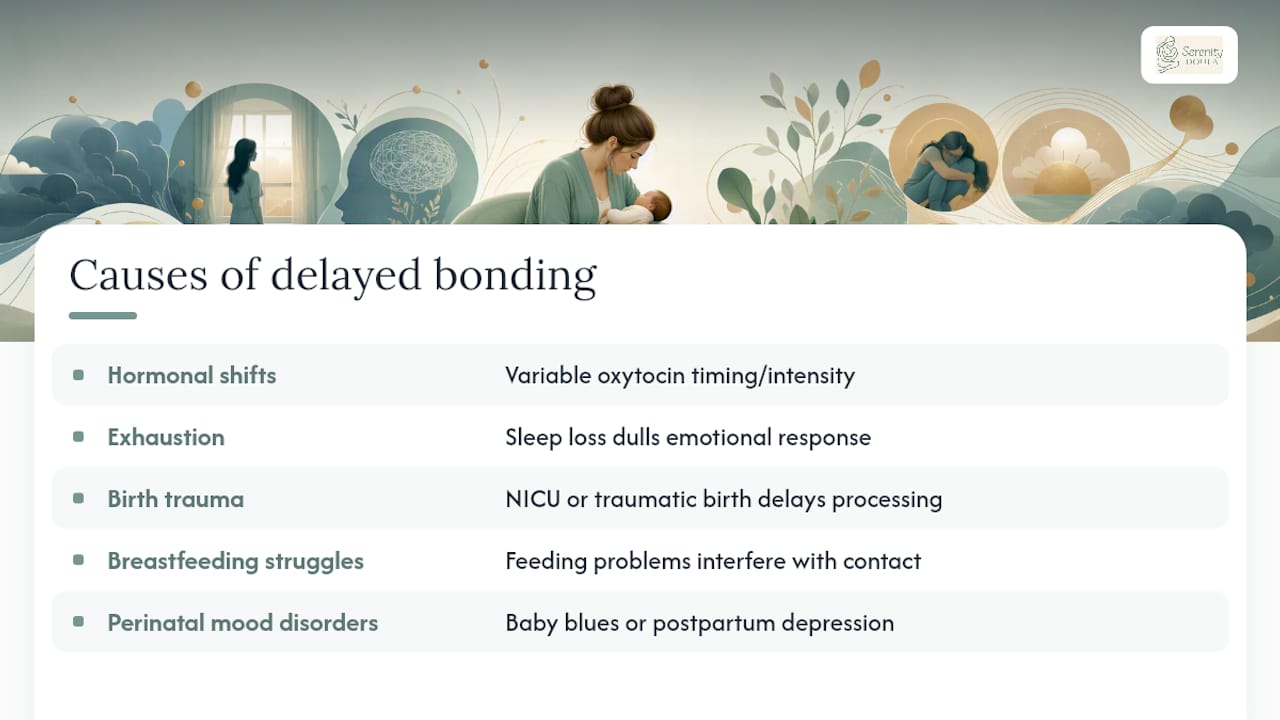
Birth trauma or separation plays a real role too. If your baby needed NICU time, or your birth didn’t go the way you planned, the emotional processing from that experience can crowd out space for bonding. ACOG’s guidance notes that missing the so-called golden hour after birth does not doom long-term attachment. What matters more is the repeated, calm contact that follows in the days and weeks after.
Breastfeeding struggles and perinatal mood disorders round out the list. Healthychildren reports that baby blues affect many new parents, while a smaller but significant portion develop postpartum depression, a condition strongly linked to bonding difficulty.
Bonding is not a single event that happens or doesn’t. It’s a relationship that gets built through hundreds of small, repeated moments, many of which don’t feel significant at the time.
Small Daily Steps That Help Attachment Grow
You don’t need a grand gesture to build connection. Small, repeatable rituals tend to work better than trying to force a big emotional moment, and they fit into a day that’s already exhausting.
- Skin-to-skin, daily. Aim for 10 to 20 minutes, ideally at a calm point in the day, like after a feeding when your baby is drowsy but not asleep.
- Narrate ordinary moments. Talk through diaper changes, feedings, and baths. Your voice and your baby’s growing recognition of it does more bonding work than it seems.
- Try babywearing. A wrap or carrier keeps your baby close during chores or a short walk, and the proximity itself builds familiarity over time.
- Watch for and respond to cues. Responding consistently to hunger, discomfort, or overstimulation cues, even imperfectly, is what builds trust and, eventually, attachment.
- Create one small ritual just for you and your baby. Five to ten minutes of quiet holding, singing, or eye contact at the same point each day gives you something predictable to return to.
If your baby is in the NICU or otherwise separated from you, scent exchange works surprisingly well: leave a worn shirt or blanket near your baby, and bring something of theirs back to you. Practice-based research on perinatal attachment supports scent and voice exposure as meaningful substitutes when physical closeness isn’t possible yet.
Pro Tip: Don’t wait for a wave of love before you start these rituals. In my years supporting Bucks County families, the parents who bond fastest are usually the ones who keep showing up with small, predictable actions, not the ones waiting to feel ready.
Give any single practice at least a week before judging whether it’s helping. Attachment tends to build in increments too small to notice day to day, but visible in hindsight.
How Partners Can Support Bonding, Too
Bonding isn’t only the birthing parent’s job, and partners often carry more influence over the household’s emotional climate than they realize. Taking over night feeds, diaper runs, or a stretch of solo baby time gives the birthing parent room to rest, and rest is directly tied to emotional capacity. Lower stress in the household functions almost like a protective buffer around bonding, easing the load on whoever gave birth.

Partners build their own connection through the same low-key rituals: a chest-to-chest hold before bed, a short narrated walk around the block, or taking full ownership of one caregiving task, like bath time, from day one. Consistency matters more than duration.
Serenity Doula’s partner support workflow and newborn care guide for dads both walk through exactly how to divide these responsibilities in the first few weeks. For couples who want to keep their relationship steady while adjusting to new roles, these connection-building exercises offer a practical starting point too.
When Should You Contact a Provider About Bonding?
Most disconnection eases naturally within a few weeks. Clinical guidance often highlights this early postpartum period as a time when ordinary adjustment leads to improvement. If symptoms persist beyond this period, it’s advisable to reach out for support.
Watch for these red flags beyond the two to three week mark:
- Persistent numbness, dread, or resentment toward your baby that isn’t easing.
- Intrusive thoughts about harming yourself or your baby.
- Difficulty meeting your baby’s basic needs, like feeding or diaper changes, most days.
- Severe anxiety, panic, or avoidance around caring for your baby.
If you notice thoughts of self-harm or harming your baby, treat that as urgent. Contact your OB-GYN, midwife, or pediatrician immediately, or call or text 988 for the Suicide and Crisis Lifeline.
For everything short of an emergency, Mayo Clinic recommends bringing it up plainly at your next appointment. Try saying, “I feel emotionally disconnected from my baby, and it’s not improving,” rather than downplaying it. That phrasing tends to get providers to take the concern seriously right away.
What Research and Professional Support Can Offer
The 2026 PLOS ONE study found that postpartum depression is one of the strongest predictors of impaired bonding at three months, while social support consistently protects against it. That combination, treatable illness plus meaningful support, explains most delayed bonding cases better than any single cause on its own.
Social support isn’t a nice add-on to postpartum recovery. In studies like this one, it functions as a genuine protective factor against bonding difficulty.
ACOG and Postpartum Support International both recommend screening for perinatal mood disorders as a first step, followed by referrals to lactation consultants, perinatal therapists, or parent-infant dyadic therapy when needed.
This is where a doula’s role fits in. With more than ten years supporting Bucks County families through postpartum recovery, I’ve seen how bedside coaching on skin-to-skin, coordinating partner involvement, and flagging concerns early for a client’s OB-GYN can ease the path back to connection, working alongside your medical team, never in place of it.
A doula’s note: reassurance from practice
Missing that instant rush of love doesn’t tell you anything about your capacity to parent well. I’ve supported families at Trinity Health St. Mary and across Bucks County who felt nothing for weeks, and went on to build deep, steady bonds with their babies. Every trajectory looks different, and slow is not the same as broken.
How Serenity Doula supports you through this
Serenity Doula exists for exactly this stretch, when you need someone steady beside you, not another set of milestones to hit. Our in-home and virtual postpartum support gives you hands-on help with newborn care, feeding, and rest, so the exhaustion driving so much of the disconnection gets addressed directly instead of just endured.
We also coach partners through practical roles from day one, so the emotional and physical load doesn’t sit on one person alone, and our childbirth education classes prepare families for this exact transition before the baby arrives. If you’re in Bucks County, Newtown, or Doylestown and want a plan that fits your specific situation, schedule a free consultation with our pregnancy and birth support doula team to talk through what personalized support could look like for you.
Sources
- PLOS ONE (2026) study on bonding
- ACOG — Bonding with your newborn: What to know if you don’t feel connected right away
- MedlinePlus — Bonding with your baby
- Healthychildren
- Mayo Clinic — Postpartum depression: symptoms and causes
FAQ
How long does it take to feel connected to your baby?
It varies widely. Many parents notice growing connection within days to a few weeks, while others take longer, and both patterns fall within the normal range described by ACOG.
Is it normal to not feel connected to my pregnancy?
Yes. Some parents feel a strong connection during pregnancy, while others feel little until after birth, and neither pattern predicts how bonding will unfold once the baby arrives.
Why am I not feeling attached to my baby?
Common causes include hormonal shifts, exhaustion, a difficult birth, breastfeeding struggles, and perinatal mood disorders, according to MedlinePlus. If it persists past two to three weeks, talk to your provider.
Why is my partner not feeling connected to the baby?
Partners often bond more gradually since they don’t experience the hormonal shifts of pregnancy and birth directly. Hands-on caregiving tasks, like solo diaper changes or skin-to-skin time, tend to speed that process along.
Can a doula help if I’m struggling to bond with my baby?
Yes. Serenity Doula provides in-home and virtual postpartum support that addresses exhaustion, coaches partners into active caregiving roles, and helps flag concerns early for your medical provider.