
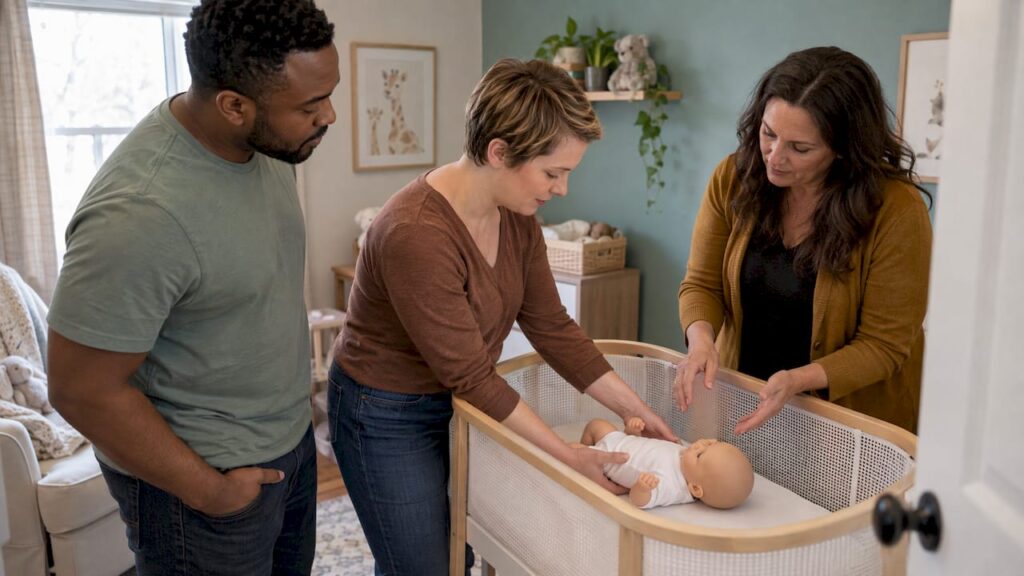
You have a car seat, a crib and a stack of tiny onesies. What you may not have yet is the quiet confidence of having held a swaddle in your own hands, in your own living room, with someone beside you who can say “yes, just like that.” A newborn care class at home gives you that: practical skills practiced in the space where you will actually use them, with your partner or a grandparent right next to you. At Serenity Doula, our childbirth education and postpartum care are built around this idea, for families in Bucks, Montgomery and Burlington Counties and the Philadelphia suburbs.
TL;DR
- A good newborn class covers feeding, diapering, swaddling, soothing, bathing, safe sleep and when to call the pediatrician.
- The third trimester, or the first weeks after birth, is the time most hospitals suggest for infant care classes (Penn Medicine).
- Learning at home means practicing in your real space, with your real partner, and asking questions about your own routines.
- Safe sleep and knowing when to call your provider are the two topics worth rehearsing most.
- We offer private childbirth education and in-home and virtual postpartum care, and your first consultation is free.
Table of Contents
- What a newborn care class actually teaches
- Why learning at home changes things
- When to take it
- How to prepare your home
- Safe sleep: the lesson worth repeating
- Know when to call: questions for your pediatrician
- Perspective from a working doula
- Support that continues after the class
- Book your newborn preparation with us
- FAQ
- Sources
What a newborn care class actually teaches
Most newborn classes share the same backbone. Expect hands-on time with the everyday tasks that feel enormous at 2 a.m.:
- Feeding: hunger cues, how often newborns eat, and where to turn for feeding questions.
- Diapering: what a normal diaper pattern looks like, and what to mention to your pediatrician.
- Swaddling and soothing: wrapping a baby snugly, holding, rocking and skin-to-skin contact.
- Bathing and cord care: sponge baths, nail care and keeping the umbilical area clean.
- Safe sleep: how to set up the sleep space and place your baby down.
- Knowing when to call: which symptoms mean a call to your provider and which mean 911.
These topics appear across hospital programs. For example, a BabyCare class from a New Jersey midwifery practice lists diapering, bathing, cord care, swaddling, soothing and skin-to-skin care among its subjects. If you are building your own list, they make a solid checklist.
Why learning at home changes things
A classroom shows you a technique. Your home shows you where the technique has to work: the changing spot that is a little too low, the glider where you will feed at night, the stairs between the nursery and the kitchen.
There are quieter benefits too:
- Your partner or support person learns beside you. Penn Medicine notes that classes can be attended alone or with a supportive partner, and that many attendees value comparing experiences with other parents (Penn Medicine). At home, that support person is already in the room.
- Grandparents can join. Advice has changed since they raised babies, and learning current practices together prevents friction later. Our partner guide shows how involved partners can be.
- Questions stay personal. Your layout, your pets, your older children and your family’s plans are all fair game.
- No evening commute. In the last weeks of pregnancy, that matters.
When to take it
Penn Medicine recommends infant care and parenting classes in the third trimester or in the first few weeks after birth (Penn Medicine). Many of our families schedule the session in the weeks before their due date, once the nursery is mostly ready, so you can practice with the real equipment. If your baby has already arrived, a postpartum visit lets you learn while you care for the baby you actually have.
How to prepare your home
A little setup makes the session feel smooth rather than staged:
- Gather practice supplies. A baby doll or stuffed animal, a receiving blanket, a washcloth, a onesie and a diaper are plenty.
- Choose the spaces you will use. Have the changing area and sleep space set up, so you can practice there.
- Write down your questions. Night waking, visitors, pets, feeding plans. Jot them on your phone as they come up.
- Invite your support person. Partner, grandparent or anyone who will help in the first weeks.
- Clear a calm hour or two. Silence the phones and let yourself be a beginner.
Our article on practicing five newborn care skills before discharge goes deeper on what to rehearse first.
Safe sleep: the lesson worth repeating
If you remember only one part of your class, make it this one. The American Academy of Pediatrics’ 2022 recommendations call for placing your baby on their back for every sleep, on a firm, flat sleep surface that is not inclined, with soft objects and loose bedding kept out. The AAP also advises that babies sleep in the parents’ room, on a separate surface, ideally for at least the first six months (AAP, 2022).

Pennsylvania families may find this local figure sobering: Penn Medicine reports that in Pennsylvania, sudden unexpected infant death claims the life of one baby every four days, most commonly during sleep (Penn Medicine). That is why it is worth practicing, not just reading about. Walk through our eight steps to set up a safe sleep space before the baby comes, and ask your pediatrician anything specific to your baby.
Know when to call: questions for your pediatrician
One of the most calming things a class can do is turn “Is this normal?” into a plan. Ask your pediatrician for their own thresholds, and compare them with what major health systems publish:
| Situation | What health systems say |
|---|---|
| Fever of 100.4°F (38°C) or higher | Mayo Clinic lists this as a reason to seek emergency care for a newborn (Mayo Clinic) |
| Blue or pale skin, blue lips, trouble breathing | Call 911 (NYU Langone) |
| Yellowish skin or eyes, poor feeding | Call your baby’s provider (NYU Langone) |
| No stool for 48 hours | Contact the pediatrician (Mercy) |
| Redness or a foul odor at the umbilical cord | Contact the pediatrician (Mercy) |
NYU Langone also notes that every newborn should be seen by a pediatric provider within one to three days after discharge. Ask your provider what applies to your baby, and keep their number on the fridge.
Perspective from a working doula
Almost every first-time parent I meet says some version of the same thing: “I’m ready for the birth, but I’m not sure I’m ready for the baby.” That is completely normal, and it is exactly where a class at home helps.
What I love about teaching in your own space is that nothing stays abstract. We swaddle in the spot where you will swaddle. We talk about the 3 a.m. feeding in the chair where it will happen. Partners and grandparents practice too, so no one is left guessing.
Our approach is evidence-based, nonjudgmental and shaped around your family’s choices, whether your birth is natural, medicated or surgical. After more than ten years supporting families in Bucks County, from Newtown to Doylestown, I have seen how much calmer a first week feels when you have already held the skills in your hands.
The goal is not perfection. It is feeling grounded, seen and a little less alone.
Alexis Wallace
Support that continues after the class
A single lesson is a strong start, and the first weeks bring new questions every day. Our postpartum care is available in your home or virtually, so help can meet you where you are. If you are weighing how many visits make sense, our guides to the first two weeks of postpartum doula tasks and the postpartum doula schedule lay it out.
The emotional side deserves attention too. If you ever feel persistently low or anxious after birth, tell your provider promptly; resources on postpartum depression support can help you understand what you are feeling.
Book your newborn preparation with us
We offer private childbirth education, birth doula support and in-home or virtual postpartum care for families in Bucks, Montgomery, Philadelphia and Burlington Counties. Learn more about childbirth education with Serenity Doula, or see how our postpartum care supports you after your baby arrives.
If you would like a plan for the weeks before and after your due date, we would love to talk it through with you.
FAQ
Do I need a newborn care class if I have already taken a childbirth class?
Childbirth classes focus on labor and birth, while newborn care classes focus on life with the baby afterward. Penn Medicine notes that parents are not required to take classes, but it strongly recommends one or several. Many families pair the two for a complete picture.
Who should attend with me?
Your partner, a grandparent or any support person who will help in the early weeks. Learning together means everyone uses the same, current techniques and the same safe sleep rules.
What should I have ready for a class at home?
A doll or stuffed animal, a blanket, a washcloth, a onesie and a diaper are plenty, along with the spaces you plan to use for changing and sleeping. A list of your own questions is the most useful item of all.
Can I take a class after the baby is born?
Yes. Penn Medicine suggests the third trimester or the first few weeks after birth for infant care classes. Postpartum visits at home let you practice with your own baby and ask about what you are seeing day to day.
Sources
- Childbirth Classes and Parenting Education, Penn Medicine
- BabyCare Class, The Midwives of New Jersey
- Infant Deaths in the Sleep Environment, AAP 2022
- Caring for Your Newborn, Mayo Clinic
- Taking Your Baby Home After Giving Birth, NYU Langone
- Newborn Care Guide, Mercy