
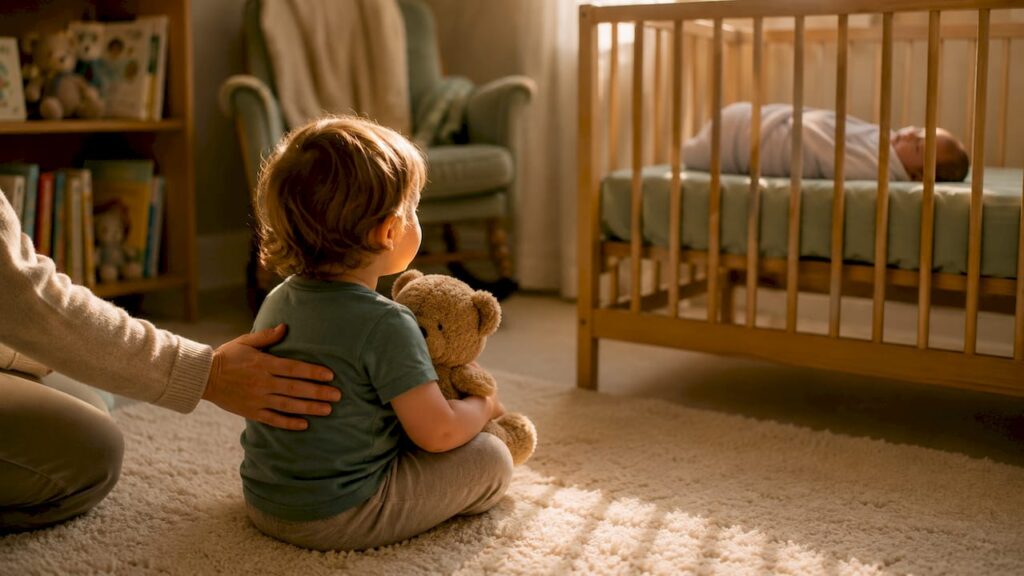
Most toddlers respond to a new sibling with a mix of jealousy, clinginess, regression, and sudden bursts of curiosity, often within the same afternoon. The single best thing you can do is validate those feelings out loud and protect a small, predictable pocket of one-on-one time every day. Watch for these common signs:
- Tantrums that seem to come out of nowhere
- Regression in potty training or sleep
- Increased attention-seeking or “baby talk”
- Clinginess with the primary caregiver
- Curiosity mixed with wariness around the baby
Almost every toddler struggles some, and almost every toddler comes through it closer to their sibling than before, if you keep reading for the age-specific playbook.
Key Takeaways
Toddlers typically respond to a new sibling with jealousy, regression, and attention-seeking that peaks within the first six months and resolves faster when parents validate feelings and protect daily one-on-one time.
| Point | Details |
|---|---|
| Expect a mix of emotions | Jealousy, curiosity, grief, and confusion often show up together, not one at a time. |
| Age changes the response | Toddlers under 2 show clinginess with little language; ages 2 to 4 show the most hitting and regression. |
| Regression is connection-seeking | Potty or sleep setbacks usually mean your toddler needs reassurance, not punishment. |
| Daily rituals reduce rivalry | A consistent 10 to 15 minute one-on-one block is one of the most effective, low-effort tools available. |
| Extra hands help both children | Serenity Doula’s in-home postpartum support frees up time so parents can protect that one-on-one ritual. |
Table of Contents
- How Toddlers Respond to New Siblings Emotionally and Behaviorally
- What Do Toddlers of Different Ages Do When a Sibling Arrives?
- How to Prepare a Toddler Before the Baby Arrives
- How Should You Introduce the Baby for the First Time?
- What to Do When a Toddler Hits or Acts Out After a New Baby
- Why Does My Toddler Want to Breastfeed Too?
- How Do You Help Toddlers Bond With a New Sibling?
- How Long Does It Take a Toddler to Adjust to a New Sibling?
- What I’ve Learned Watching Toddlers Meet Their Siblings
- How Serenity Doula Supports Families Through the Sibling Transition
- Sources
- FAQ
How Toddlers Respond to New Siblings Emotionally and Behaviorally
Toddlers feel displaced before they can name the feeling, and that gap between emotion and vocabulary is where most of the hard behavior comes from. They are grieving the loss of undivided attention even while they are curious about the baby, and both things are true at once. Confusion shows up as questions asked ten times a day; grief shows up as a toddler suddenly wanting to be carried again.
The behaviors you will likely see connect directly to what is underneath:
- Jealousy often shows up as interrupting feedings or “accidentally” bumping the baby’s bassinet.
- Confusion shows up as repetitive questions like “Is the baby staying?”
- Grief over lost routine shows up as clinginess or refusing to be put down.
- Attention-seeking shows up as exaggerated whining or acting like a baby themselves.
The fix is nearly always the same sequence: name the feeling, stay calm, then redirect toward connection. A toddler who hears “You wish it was just you and me again” often settles faster than one who is told to “be a big kid.”
What Do Toddlers of Different Ages Do When a Sibling Arrives?
Age changes everything about what a toddler can understand, and it should change how you respond.
Ages 1 to 2
At this age, toddlers cannot grasp the concept of a sibling arriving; they only register that mom is less available. Expect clinginess, disrupted sleep, and a spike in tantrums with little verbal explanation attached. Do keep physical routines (naps, bedtime songs) exactly the same. Don’t over-explain with long conversations, since simple, repeated reassurance (“Mommy’s here”) works better than reasoning.

Ages 2 to 4
This is often the most reactive age band because toddlers have enough language to express jealousy but not enough regulation to manage it. You will likely see hitting, regression in potty training, and possessive behavior over toys or parents. Do give them a job (holding a diaper, choosing a onesie); don’t punish regression, since regression at this stage is frequently a connection-seeking behavior rather than defiance.

Ages 4 and Up
Older toddlers and preschoolers can process more complex explanations and often show pride alongside jealousy. Expect questions about fairness (“Why does the baby get more hugs?”) and occasional testing of boundaries. Do involve them in naming, reading to the baby, or picking out clothes; don’t compare their behavior to the baby’s, since it fuels rivalry rather than reducing it.
How to Prepare a Toddler Before the Baby Arrives
Preparation works best when it starts early and stays concrete rather than abstract. Age-appropriate preparation and maintaining routines reduce anxiety far more reliably than a single “big talk.”
- Tell your toddler in simple language once the pregnancy is visible or close to due date, not months in advance.
- Keep every existing routine (bedtime, snack time, weekend rituals) exactly as it is.
- Read books about becoming a big sibling together, several times, not just once.
- Practice caregiving on a doll: diapering, swaddling, gentle touches.
- Let them help pick out one item for the baby, like a blanket or toy.
A few scripts you can borrow directly:
- “Our family is growing, and you’ll always be my [child’s name], no matter what.”
- “The baby will cry a lot at first. That’s just how babies talk.”
- “When I’m at the hospital, you’ll be with [caregiver], and I’ll call you every day.”
How Should You Introduce the Baby for the First Time?
The first meeting sets a tone, so keep it low pressure and let your toddler lead the pace. Meet in a familiar space, whether that’s home or a hospital room, rather than a crowded waiting area. Have your partner or a support person hold the baby first so your arms are free to hug your toddler the moment they walk in.
- Do let your toddler decide whether to touch or hold the baby.
- Do bring a small “big sibling” gift so the moment isn’t only about the baby.
- Don’t force a kiss or hug if your toddler hesitates.
- Don’t leave the baby and toddler alone together, even for a moment, in these early weeks.
In the days that follow, protect your toddler’s naps and bedtime as fiercely as you protect the baby’s feeding schedule, and ask a grandparent, friend, or postpartum helper to supervise so you can rest without worrying about unsupervised contact.
What to Do When a Toddler Hits or Acts Out After a New Baby
Hitting, throwing toys near the baby, or sudden potty regression are common, and they call for a calm, repeatable response rather than panic. Here’s a sequence you can memorize:
- Protect the baby first, physically, without yelling.
- Get down to eye level and name the feeling: “You’re mad the baby is here. That’s okay to feel.”
- State the boundary simply: “Hitting isn’t safe. Hands are for gentle touches.”
- Offer a brief, related consequence, like stepping away from the baby for a minute, not a long time-out.
- Reconnect immediately after, with a hug or a shared activity.
Pro Tip: Narrate what you see them doing right, out loud, several times a day. “You handed me the wipe so gently” does more to reduce hitting than any lecture about being gentle.
Sleep and potty regressions respond best to patience paired with mild structure. Keep the potty routine available without pressure, and expect some backsliding for a few weeks. What to avoid matters as much as what to do: skip shaming language (“big kids don’t act like babies”), skip harsh punishment for regression, and skip comparing siblings. Descriptive praise and “catching them being good” reduces attention-seeking misbehavior far more effectively than punishment does.
Why Does My Toddler Want to Breastfeed Too?
Curiosity about breastfeeding is developmentally normal, not a sign something is wrong. Toddlers watch you feed the baby and want the same closeness, sometimes literally asking to nurse again even if they weaned long ago.
- Validate first: “You want to be close to me like the baby is. Let’s snuggle.”
- Offer a substitute ritual during feeds: a snack, a short book, or a lap spot next to you.
- Use a carrier for the baby during some stretches so your arms and lap stay free for your toddler.
- If you need a firm boundary, keep it simple: “Nursing is just for the baby right now, but you and I still get special time.”
How Do You Help Toddlers Bond With a New Sibling?
Security comes from predictability, not from constant excitement about the baby. A short, consistent one-on-one ritual is one of the lowest-effort, highest-impact tools available to you right now.
- Set a daily 10 to 15 minute block that is just for your toddler, at the same time each day if possible.
- Give them a “big sibling job,” like fetching a diaper or picking the burp cloth color.
- Use descriptive praise: “You were so gentle stroking the baby’s foot.”
- Read to both children together so the toddler associates the baby with connection, not competition.
- Sing the same lullaby you used to sing solo, now with the baby included, so the ritual expands rather than disappears.
Fair treatment does not mean identical treatment. Responsive, need-based care helps toddlers accept that a newborn needs more hands-on care without feeling replaced, as long as they still get their own dedicated moments.
Pro Tip: If a 15 minute daily ritual feels impossible some days, protect just 5 uninterrupted minutes. Consistency matters more than duration.
How Long Does It Take a Toddler to Adjust to a New Sibling?
Most families see the sharpest behavioral shifts, tantrums, regression, and attention-seeking, within the first one to six months after birth. Encouragingly, longitudinal research on sibling adjustment found little evidence of long-term maladjustment, and early spikes in aggression tended to fade back to baseline within a few months.
Contact your pediatrician or a family therapist if you notice:
- Aggression that intensifies rather than fades after a few months
- Withdrawal or flat mood lasting more than several weeks
- Severe sleep or eating disruption
- Any behavior that raises safety concerns for either child
What I’ve Learned Watching Toddlers Meet Their Siblings
I’ve sat in enough nurseries to notice a pattern: the toddlers who adjust fastest aren’t the ones who seemed most “ready.” They’re the ones whose parents kept one tiny ritual sacred, no matter how chaotic the week got. One family I worked with kept a five-minute “flashlight reading” ritual going every single night, even during the newborn’s roughest sleep regression, and their toddler’s tantrums dropped noticeably within weeks.
Try this tonight: pick one activity that takes under ten minutes, do it at the same time every day, and let your toddler choose part of it. Consistency, not perfection, is what tells a toddler they still matter exactly as much as they did before.
How Serenity Doula Supports Families Through the Sibling Transition
Sibling adjustment rarely happens in isolation. It happens while you’re also recovering physically, managing feeds, and running on fragmented sleep, which is exactly where in-home postpartum support changes the math. Serenity Doula’s postpartum team can hold the baby, manage a feeding stretch, or handle a load of laundry so you have your hands and attention free for that daily one-on-one ritual your toddler needs.

Our approach stays evidence-based and family-centered, drawing on the same research this article cites rather than guesswork. If you’re in Bucks, Montgomery, Philadelphia, or Burlington County and want extra hands during this transition, book a free consultation to talk through what postpartum support could look like for your family.
Sources
- Ask an expert: From only child to oldest child — helping firstborns adjust to a new sibling
- New siblings
- Chapter XI. General Discussion: Children’s Adjustment and Adaptation Following the Birth of a Sibling – PMC
- Preparing Your Family for a New Baby
FAQ
How long does it take for a toddler to adjust to a new sibling?
Most toddlers show the biggest behavioral shifts within the months following a sibling’s birth, and research shows little evidence of lasting problems beyond that period.
How do I help a 2 to 4 year old deal with a new sibling?
Give them a small caregiving job, keep their routines unchanged, and set aside a daily one-on-one block, since this age group reacts strongest to feeling replaced.
Why do some toddlers react negatively to a new sibling?
Negative reactions usually stem from feeling displaced from their primary caregiver’s attention combined with limited language to express that loss, which comes out as tantrums or regression instead.
My toddler is hitting my newborn sibling. What should I do?
Protect the baby immediately, calmly name the toddler’s feeling, state the safety boundary simply, and reconnect with your toddler right after, since punishment alone rarely reduces hitting.
Can professional support help with sibling adjustment?
Yes. In-home postpartum support from a team like Serenity Doula frees up parents’ time and energy so they can maintain the one-on-one rituals that ease a toddler’s transition.