
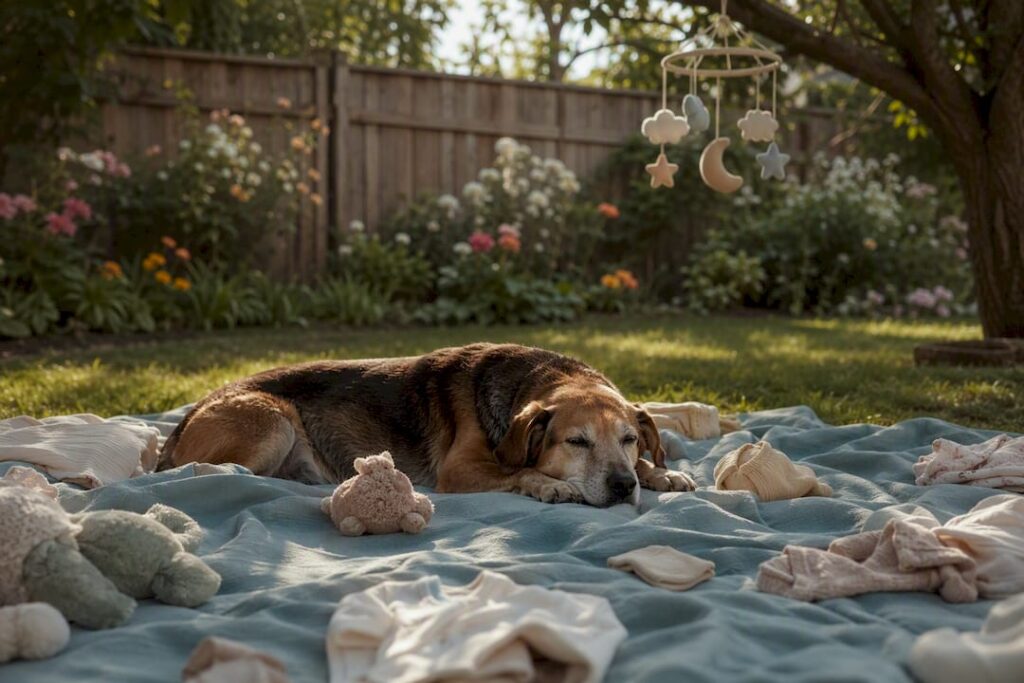
Start preparing your dog for a baby well in advance of your due date by desensitizing her to new sounds, smells, and gear, reinforcing “place” and “leave it,” booking a pre-arrival vet check, shifting daily routines gradually, and rehearsing a calm first meeting. Every piece works together: a dog who feels safe, exercised, and mentally engaged tolerates change far better than one who’s caught off guard.
Here’s your six-step starting checklist:
- Schedule a vet visit to rule out pain or health issues that could affect tolerance.
- Play recorded baby sounds at low volume during calm moments.
- Introduce a baby blanket or hospital-scented item before homecoming day.
- Practice “settle” on a mat and “leave it” daily, even in five-minute bursts.
- Set up gates or an exercise pen so they’re familiar, not alarming, on day one.
- Rehearse the first greeting with a helper holding the baby at a comfortable distance.
Groups like the ASPCA and PetMD both stress starting early and building positive associations, not just managing behavior after the fact. At Serenity Doula, we’ve watched this play out in dozens of Bucks County homes: the families who start months out have calmer homecomings than the ones who scramble the week before.
Pro Tip: Dogs read your body language before they hear your words. Practice slow breathing and loose shoulders during training sessions so your dog learns to associate baby prep with calm, not tension.
Key Takeaways
Preparing your dog for a baby works best when you start months in advance, combine vet care with gradual desensitization, and never leave dog and baby unsupervised.
| Point | Details |
|---|---|
| Start early | Begin desensitization and gear introduction about four months before your due date, per the ASPCA. |
| Book the vet visit | Confirm vaccinations and rule out pain that could reduce your dog’s tolerance for change. |
| Train core cues | Focus training on sit, stay, leave it, and a reliable go-to-place or settle command. |
| Introduce scent first | Send home a hospital blanket or worn item before the baby physically arrives. |
| Never skip supervision | Keep baby and dog supervised together at all times, using gates or an X-pen as safe zones. |
Table of Contents
- How Do You Prepare Your Dog for a Baby, Step by Step?
- Why Does the Pre-Baby Vet Visit Matter So Much?
- How Do You Get a Dog Used to Baby Sounds and Smells?
- Which Commands Actually Matter Once the Baby Arrives?
- How Do You Adjust Your Dog’s Routine Before the Baby Comes?
- What’s the Best Way to Introduce Your Dog to the Baby?
- What Household Rules Keep Both Baby and Dog Safe?
- What Are the Warning Signs You Shouldn’t Ignore?
- How Doula Home Visits Help Families Prepare Their Dogs
- A Practical Note on Preparing Your Dog and Your Household
- Sources
- FAQ
How Do You Prepare Your Dog for a Baby, Step by Step?
Preparing your dog for a baby works best as a staged process, not a single weekend project. The ASPCA recommends starting well before your due date, with routine adjustments beginning some time before the birth. That timing isn’t arbitrary. It gives your dog enough repetition to build genuine comfort instead of just tolerating something new under pressure.
Several months before baby arrives:
- Introduce baby gear (crib, swing, monitor) so it becomes part of the furniture, not a novelty.
- Start playing recordings of infant crying and cooing at low volume during meals or relaxed downtime.
- Begin handling exercises: gentle pokes, ear touches, and tail tugs paired with treats, since toddlers eventually deliver exactly this kind of unpredictable contact.
Some weeks before:
- Shift walk times, feeding schedules, and play windows to match what postpartum life will realistically look like.
- Start mat training in earnest if “settle” isn’t already reliable.
- Test out the stroller, empty, on real walking routes.
A few weeks before:
- Practice loose-leash walking alongside the stroller.
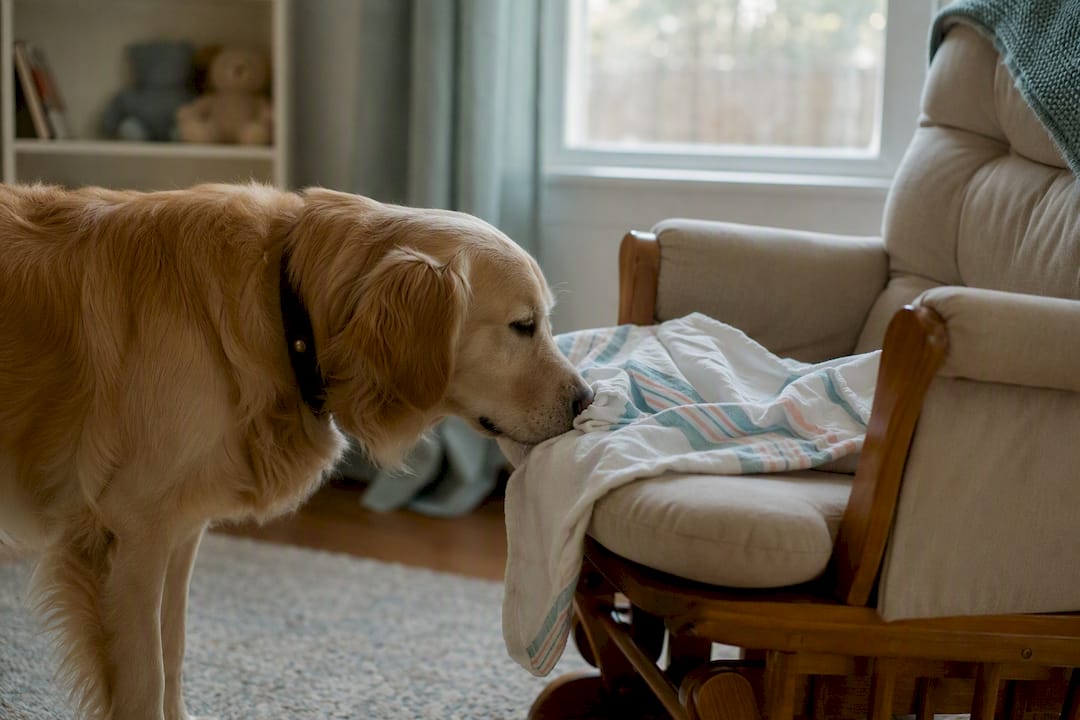
- Send home a hospital blanket or worn baby item once you’re at the hospital or birth center so your dog has time with that scent before the baby physically arrives, a step the University of Pennsylvania School of Veterinary Medicine specifically recommends.
The final days:
- Set up gates and safe zones in their permanent spots.
- Confirm who’s managing the dog during the actual homecoming.
- Keep routines as normal as possible. Dogs notice tension before they notice much else.
Pro Tip: Loop in grandparents, siblings, or a regular pet sitter during training. A dog who only follows rules for one person hasn’t actually learned them. Consistency across caregivers is what makes “place” or “leave it” reliable once you’re sleep-deprived and running on fumes.
Why Does the Pre-Baby Vet Visit Matter So Much?
A pre-arrival vet visit does more than update vaccines, though that matters too. VCA Animal Hospitals recommends confirming your dog is current on core vaccinations and parasite prevention well before the baby comes home, since a newborn’s immune system is fragile and household exposure risk goes up with more visitors and less predictable routines.
But the visit is also your chance to catch what you might be missing. Dogs in pain, whether from arthritis, dental disease, or something less obvious, often become more reactive or less tolerant of handling. A dog who snaps when a toddler grabs a sore hip isn’t being “bad.” He’s in pain and has no other way to communicate it. Bring up any changes in mobility, appetite, or temperament with your vet, and ask directly whether a referral to a veterinary behaviorist makes sense before, not after, a problem shows up.
A pre-baby vet visit isn’t only about shots. It’s a chance to rule out pain, flag behavioral concerns early, and ask what environmental adjustments might help your dog cope with the changes ahead.
Bring specific questions: Is my dog’s weight and mobility normal for her age? Are there any signs of anxiety I should be tracking? Would a trainer or behaviorist consult make sense given her temperament?
Pro Tip: Book this appointment early enough that a behavioral referral, if needed, has time to actually happen before your due date. Good behaviorists often have multi-week waitlists.
How Do You Get a Dog Used to Baby Sounds and Smells?
Desensitization works through graded exposure: small, manageable doses of a new stimulus paired with something your dog already loves. Rushing this step, or skipping the “graded” part, is the most common mistake I see in Bucks County homes.
- Start with sound at low volume. Play a recording of a baby crying or cooing for 30 to 60 seconds while your dog eats dinner or chews a favorite treat. If she stays relaxed, gradually increase volume and duration over several sessions.
- Introduce scent separately. Once you’re at the hospital, have a partner bring home a blanket or piece of clothing the baby has worn. Let your dog sniff it on her own terms, without forcing her nose toward it, as recommended by Ask A Vet.
- Stage the gear. Push the empty stroller through the house before you push it with a baby inside. Turn on the swing’s motion and sound. Let your dog investigate the car seat parked in the living room.
- Practice handling. The ASPCA suggests rehearsing gentle pokes, ear tugs, and sudden hugs, paired immediately with treats, four to eight times a day in short bursts. This mimics exactly what a curious toddler will eventually do.
- Watch for stress signals. Lip licking, yawning outside of tiredness, whale eye, or turning away all mean you’ve moved too fast. Back up a step and go slower next time.
Keep each session under five minutes. Short and frequent beats long and occasional, especially for a dog who startles easily.
Pro Tip: If you can get an actual hospital blanket or worn newborn item before delivery, use it. Generic “baby scent” products don’t replicate what your own baby will actually smell like, and that specificity is what builds real recognition.
Which Commands Actually Matter Once the Baby Arrives?
Not every trick your dog knows will matter much once you’re managing diaper changes with one hand. Four cues make the real difference: sit, stay or wait, leave it or drop it, and go to your place. PetMD points out that training should focus specifically on a reliable settle cue and these safety commands, because caregivers with a baby in their arms simply can’t manage a dog the way they used to.
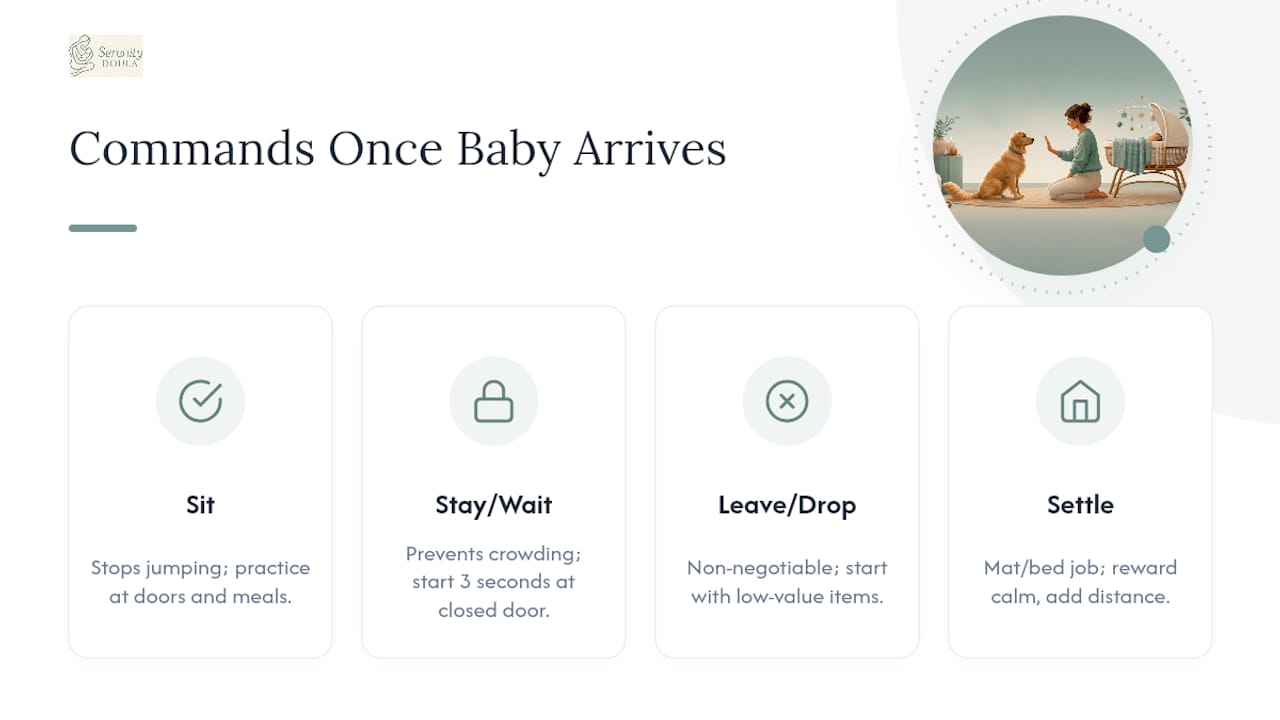
Sit interrupts jumping or overexcitement before it escalates. Practice it at the door, during feeding prep, and whenever your dog gets keyed up.
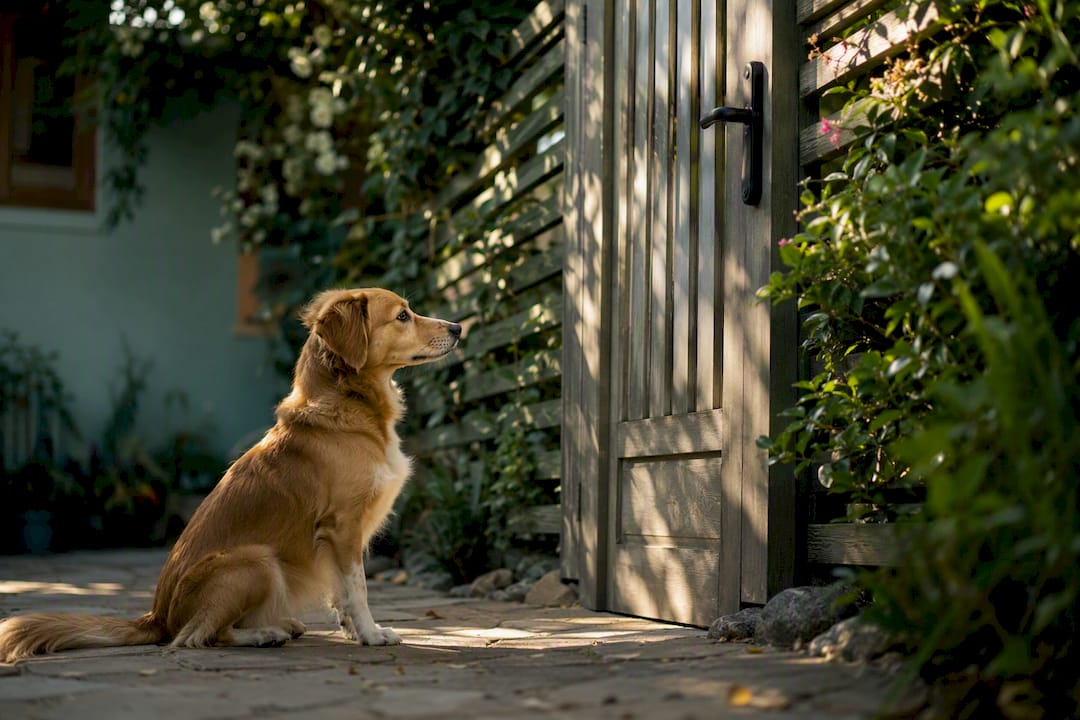
Stay or wait keeps your dog from crowding doorways, the changing table, or the crib. Start with three seconds at a closed door, then build duration and add distractions like a knock or the doorbell.
Leave it and drop it are non-negotiable safety cues. Practice with low-value items first, then work up to things your dog actually wants. You need this reliable before pacifiers, bottle nipples, and small toys start appearing on the floor.
Go to your place or settle gives your dog a job during chaos: a mat or bed she goes to and stays on, even with activity swirling around her. Build this by rewarding calm on the mat, then gradually add distance, duration, and distractions like a stroller rolling by, as PetMD also recommends for managing walks safely.
Run 5-minute micro-sessions two or three times a day rather than one long training block. Dogs, like the rest of us, learn better in short reps than marathon sessions.
Reward calm, not just correct. A dog who sits but is visibly tense hasn’t learned relaxation, only compliance. The goal is a dog who feels settled, not one who’s just following orders under pressure.
Watch for warning flags as you train: a recall that only works sometimes, any stiffening or freezing around resources, or resource guarding of toys, food, or resting spots. These aren’t cues to push through with more repetition. They’re signals to pause and consider a consult with a certified trainer, since PetMD notes that punishing anxiety or fear responses tends to mask warning signs rather than resolve them.
Pro Tip: Once the baby arrives, keep training sessions to one minute, not five. You won’t have five-minute blocks of free attention for a while, and that’s fine. Consistency in tiny doses beats ambition you can’t sustain.
How Do You Adjust Your Dog’s Routine Before the Baby Comes?
Dogs notice when their world changes, and they notice fastest when the change involves less attention or fewer walks. The ASPCA recommends adjusting routines one to two months before your due date specifically so the shift doesn’t get mentally filed under “the baby ruined everything.”
Try these gradual changes:
- Stagger walk times so they’re not always tied to the same clock windows you’ll lose once the baby’s schedule takes over.
- Introduce puzzle feeders or slow feeders so mealtime requires a little mental effort, not just fast consumption.
- Rotate toys weekly instead of leaving everything out at once. Novelty does a lot of the enrichment work for you.
- Practice short periods of independent time, like resting in another room while you’re home, so alone time doesn’t feel new and stressful later.
- Occasionally skip or shorten a walk on purpose now, so an unpredictable schedule later doesn’t feel like sudden neglect.
Enrichment tools worth having on hand include frozen food puzzles, long-lasting chews, and simple scent trails hidden around the house. These give your dog something to focus on that doesn’t require your direct involvement, which matters a lot in the newborn haze.
Pro Tip: Protect one daily walk or play session that’s just yours with the dog, even if it’s ten minutes. That consistent point of connection does more for the bond than almost anything else you’ll do this year.
What’s the Best Way to Introduce Your Dog to the Baby?
The first meeting sets a tone, so it’s worth rehearsing rather than winging it. Here’s the sequence that works:
- Greet your dog first, without the baby. Let her get her excitement about you coming home out of her system before the baby’s even in the room.
- Have a second adult carry the baby in while you manage the dog on a loose leash. This keeps hands free and reduces the odds of the dog jumping toward the baby out of excitement.
- Reward calm behavior immediately. The second your dog offers relaxed body language, sitting, loose tail, soft eyes, mark it with a treat and quiet praise.
- Let her sniff at a distance, on her own terms. Don’t hold the baby out toward the dog’s nose. Let curiosity close the gap naturally.
- Respect any hesitation. If your dog backs away or seems unsure, that’s information, not a problem to force past.
- Never force contact. A dog who chooses to approach is building a real, voluntary positive association. One who’s dragged toward the baby is just enduring it.
Have your supplies ready ahead of time: high-value treats, a leash even for indoor use, the mat you’ve been training on, a baby gate, and a second adult whose only job is managing the dog during those first minutes.
Pro Tip: Time the introduction for after a walk or play session, when your dog is tired and naturally calmer, not amped up from a full day of waiting by the window for you to come home.
Keep your language simple and consistent: a calm “good girl” for relaxed behavior, a neutral “that’s enough” if she needs to step back, and the same settle cue you’ve already built into muscle memory.
What Household Rules Keep Both Baby and Dog Safe?
Daily life with a dog and a newborn runs on a few unbending rules, plus a handful of judgment calls that get easier with practice. The University of Pennsylvania School of Veterinary Medicine is direct on this point: never leave a baby and dog alone together, full stop, regardless of how calm or trustworthy your dog seems.
Build your safe zones before you need them:
- Gate off the nursery so the dog can see in but not enter unsupervised.
- Use an exercise pen for the baby’s floor time so there’s a clear physical boundary.
- Decide where your dog sleeps and eats, away from high-traffic baby areas, and stick with it.
A few scenario-specific habits make daily life smoother:
- When the baby cries, resist the instinct to shoo the dog away in a panic. Redirect her to her mat calmly instead.
- During stroller walks, keep the leash short and predictable, especially near other dogs or distractions.
- When guests arrive, brief them before they walk in. A well-meaning aunt who lets the dog jump on her undoes weeks of training in seconds.
- At mealtimes, keep the dog in her designated spot so she’s not underfoot or eyeing food at baby’s reach.
Pro Tip: Label crates and gated areas with a short note for sitters and visitors, something like “Please don’t open, ask a parent first.” It sounds small, but it prevents the exact kind of well-intentioned mistake that undoes your setup.
What Are the Warning Signs You Shouldn’t Ignore?
Most dogs adjust well with preparation, but knowing the warning signs early means you can intervene before a small issue becomes a real one. Watch for stiffening, a sustained hard stare, growling, snapping, or resource guarding anywhere near the baby’s space. Sudden appetite changes or withdrawal from normal activities are quieter signals worth taking just as seriously.
If you see any of these, the short-term fix is simple: increase distance immediately, redirect your dog to her safe zone, and pause the interaction. Don’t punish the reaction itself. PetMD is clear that punishing fear or anxiety responses tends to suppress the warning signals without resolving the underlying stress, which raises risk rather than lowering it.
This is the point to call in help rather than push through alone:
- A certified applied animal behaviorist (CAAB) for complex behavioral patterns.
- A veterinary behaviorist if pain, anxiety, or a medical component might be involved.
- A CPDT-certified trainer for more general obedience and confidence building.
A good behavior consult starts with observation, not a quick fix. Expect questions about triggers, history, and household routine before any recommendations.
Pro Tip: Keep a simple log of any concerning incident: the date, what triggered it, and exactly what body language you saw. That record turns a vague “she’s been off lately” into something a professional can actually work with.
How Doula Home Visits Help Families Prepare Their Dogs
In-home visits often surface exactly what a family needs, and it’s rarely the same thing twice. One Bucks County family I worked with had a mellow older lab who needed almost nothing beyond scent introduction and a few settle sessions. Another family’s younger, more anxious rescue needed a full referral to a certified behaviorist before we ever got to the actual baby introduction, and that was the right call, not a setback.
During home visits, I coach parents through calm breathing before we even bring the dog into the room, because dogs pick up on tension faster than they pick up on words. I enlist partners early so training isn’t riding on one exhausted person, and I walk through safe-zone setup room by room, thinking through sightlines and traffic patterns most people don’t consider until something goes wrong.
The dogs who adjust best usually belong to parents who practiced their own calm first. Your dog is reading you, not just the baby.
If you’re navigating this alongside birth planning, Serenity Doula’s in-home support can help you fold pet preparation into your broader postpartum plan.
— Alexis Wallace
A Practical Note on Preparing Your Dog and Your Household
The families who handle this transition best treat it as one piece of a larger preparation puzzle, not an isolated project. Dog training doesn’t happen in a vacuum from birth planning, partner coordination, or postpartum logistics. It happens alongside them, often in the same overwhelmed weeks.
Where conventional pet advice tends to fall short is treating the dog’s adjustment as a checklist separate from the household’s broader transition. A dog senses stress in the home long before a baby arrives, whether that stress comes from sleep prep, birth anxiety, or a chaotic nursery setup. Addressing your own calm, and your partner’s, is part of preparing your dog, not a separate task.
If you’re building your birth and postpartum plan, working through breathing and relaxation techniques now serves double duty: it helps you and it helps your dog read a calmer household. Prioritize the vet visit and the scent introduction first. Everything else builds from there.
Serenity Doula supports Bucks County families through exactly this kind of full-picture preparation, birth, postpartum, and the small but real details like a dog who needs time to adjust. If you’d like help thinking through your household transition alongside your birth plan, schedule a free consultation and let’s talk through what your family and your dog actually need.
Sources
For vet-specific concerns, start with VCA Animal Hospitals on pre-baby health checks. For training and daily routines, PetMD covers core commands in depth. For gating, scent introduction, and safe zones, the University of Pennsylvania School of Veterinary Medicine handout is thorough and practical. For behavior emergencies, consult a certified behaviorist directly rather than relying on general articles.
- How To Prepare Your Dog for a New Baby: Everything a Pet Parent Should Know | PetMD
- Children and Pets – Infants and Dogs | VCA Animal Hospitals
- Dogs & Babies handout | University of Pennsylvania School of Veterinary Medicine
- Introducing the Dog to Your New Baby – Vet Edition 2025 | Ask A Vet
FAQ
What is the 3-3-3 rule with dogs?
The 3-3-3 rule generally refers to newly adopted dogs: three days to decompress, three weeks to learn routine, and three months to feel fully settled. It’s less about baby prep specifically and more a helpful mindset if you’re also adjusting to a new dog around the same time as a new baby.
How long does it take a dog to get used to a baby?
Most dogs adjust within a few weeks to a couple of months, though timing varies with temperament and how much desensitization work happened beforehand. Dogs who had months of gradual exposure to sounds, scents, and gear tend to settle faster than those introduced cold.
Is it a good idea to get a dog before having a baby?
This depends heavily on your household, your timeline, and the individual dog, and it’s worth discussing with a trainer rather than following blanket advice. If you already have a dog, the focus should shift entirely to preparation rather than the decision itself.
What do you feed newborn puppies without their mother?
This question applies to orphaned puppies, not to preparing an adult dog for a baby, and it requires guidance from a veterinarian since improper feeding can seriously harm newborn puppies. If you’re caring for orphaned puppies, contact your vet immediately for a proper feeding plan rather than following general online advice.