

Start including your older child in baby preparations today. Let them help set up the nursery, pick out a stuffed animal for their new sibling, or come to a prenatal appointment. This single shift, done consistently, reduces jealousy and builds the secure attachment that predicts a smoother transition. The American Academy of Pediatrics and the Child Mind Institute both point to the same core idea: inclusion and reassurance matter more than any single conversation or gift.
You don’t need a perfect script or a Pinterest-worthy sibling reveal. You need three things, started this week.
- Talk about the baby in concrete, repeated ways. Not one big announcement, but small mentions woven into daily life: “The baby will sleep in that crib,” “You’ll be a big sister soon.”
- Protect one-on-one time now, before the baby arrives. Fifteen minutes of undivided attention, daily, sets a pattern you can carry into the newborn weeks.
- Give your child a real job in the preparation. Choosing a going-home outfit, helping fold tiny clothes, or picking a stuffed animal for the hospital bag all count.
Pro Tip: Pick a phrase you’ll repeat all pregnancy, like “our family is growing.” Consistency helps young children hold onto an idea that otherwise feels abstract and far away.
At Serenity Doula, this is where families in Newtown, Doylestown, and across Bucks County usually start when they ask about sibling prep during a prenatal consult. The rest of this guide walks through the timing, the scripts, and the age-specific plan that make those three actions actually work.
Key Takeaways
Preparing an older sibling for a new baby works best when early honesty, hands-on rehearsal, and protected one-on-one time replace a single big announcement or gesture.
| Point | Details |
|---|---|
| Tell your child early | Share the news once you’re comfortable, giving your child time to adjust before the birth. |
| Rehearse with books and dolls | Practice gentle touch and feeding routines with a doll before the baby arrives. |
| Protect daily one-on-one time | Hold a five to fifteen minute ritual, like a bedtime story, every day without exception. |
| Expect and normalize regression | Respond to accidents or clinginess with reassurance, not discipline. |
| Consider a doula for sibling prep | Serenity Doula weaves sibling preparation into prenatal visits and postpartum support for Bucks County families. |
Table of Contents
- Preparing Older Siblings for a New Baby: When and How to Tell Them
- Age-by-Age Guidance for Introducing a Baby to Siblings
- Hands-On Activities to Rehearse Before the Baby Arrives
- Handling Regression, Jealousy, and Other Common Reactions
- Planning the Hospital Stay and the First Meeting With the Baby
- Keeping Older Siblings Connected After the Baby Comes Home
- What the Research Says About Preparing Kids for a New Baby
- A Doula’s Practical Note on What Actually Works
- How Serenity Doula Supports Your Whole Family Through This Transition
- Sources
- FAQ
Preparing Older Siblings for a New Baby: When and How to Tell Them
Tell your child as soon as you’re comfortable sharing the pregnancy more broadly, not right before the birth. Children who hear the news earlier in pregnancy tend to have more positive feelings about the baby, largely because they have time to process the idea before their world actually changes, according to Oklahoma State University Extension. Waiting until the third trimester or the hospital bag is packed leaves little runway for a child to adjust emotionally.
That said, timing depends on your child’s age and how they process time. A five-year-old benefits from a longer runway. A two-year-old has a shaky grasp of “in three months,” so shorter lead times work better for toddlers, with the concept reinforced closer to the due date.
Here’s how the conversation might actually sound, adapted to your child’s stage:
- For toddlers (ages 1 to 2): “There’s a baby growing in Mommy’s tummy. Soon we’ll have a new baby at our house.” Keep it short and repeat it often. Toddlers understand concrete, present-tense language far better than abstract future planning.
- For preschoolers (ages 3 to 5): “You’re going to be a big brother! The baby will need a lot of help at first, kind of like how you needed help when you were tiny. You’ll still be my big kid, and I’ll always have time for you.” This age benefits from reassurance about their own status alongside the news.
- For school-age children (ages 6 and up): “We wanted you to be one of the first to know. Babies take a lot of work in the beginning, so things at home might feel different for a while. What questions do you have?” Older children can handle more detail and often want to ask practical questions.
Avoid overloading any age with medical details they didn’t ask for, and don’t promise things you can’t guarantee, like “nothing will change.” Do give a general sense of the timeline. Mention the hospital stay in simple terms (“I’ll be at the hospital for a couple of days, and then we’ll all come home together”) so it doesn’t feel like a surprise later. The Child Mind Institute notes that pairing early disclosure with books, dolls, and hands-on involvement gives children multiple ways to absorb the news, not just one conversation.
Age-by-Age Guidance for Introducing a Baby to Siblings
What your child understands about “becoming a big sibling” depends heavily on their developmental stage, and matching your prep activities to that stage is what actually moves the needle. Clinical guidance from Mayo Clinic Press emphasizes tailoring both your messaging and your activities to your child’s cognitive development rather than using a one-size-fits-all approach.

A toddler under two mostly experiences the pregnancy through changes in your energy and attention, not through any real grasp of “sibling.” A preschooler, by contrast, can imagine the baby as a future playmate, even if their expectations are unrealistic. A school-age child understands the permanence of the change and may worry about logistics: Will I still get to do soccer? Will Mom still read to me at night?
| Age Group | Typical Understanding | Top Prep Activities | Common Reactions |
|---|---|---|---|
| Infant/young toddler (under 2) | Limited concept of “baby”; notices parent’s changing routine and body | Simple, repeated phrases; maintaining routines; extra physical affection | Clinginess, minor sleep changes, general fussiness |
| Toddler (2 to 3) | Understands “baby is coming” but not the timeline; may expect an instant playmate | Doll practice, picture books, helping pick out baby items | Regression (potty accidents, wanting a bottle), tantrums |
| Preschooler (3 to 5) | Grasps the concept but may have unrealistic expectations about play | Role-play feeding/holding, visiting a friend’s baby, prenatal appointment visits | Jealousy, acting out for attention, alternating excitement and resistance |
| School-age (6+) | Understands permanence and practical implications | Involvement in nursery setup, journaling or letter-writing to the baby, age-appropriate caregiving tasks | Worry about attention or schedule changes, occasional withdrawal |
Across every stage, the response that works best is the same: name the feeling, reassure the relationship, and keep routines as steady as you can. A toddler who bites out of frustration and a ten-year-old who goes quiet at dinner are both signaling the same underlying question: do I still matter here?
- Read your child’s cues rather than assuming a fixed timeline for “getting used to it.”
- Expect a wider emotional range in preschoolers than in either younger or older siblings.
- Revisit the same books and scripts throughout pregnancy. Repetition helps concepts land, especially for children under five.
Hands-On Activities to Rehearse Before the Baby Arrives
Reading, role-playing, and visiting real babies give your child a rehearsal space, so the actual arrival feels familiar rather than jarring. The Cleveland Clinic specifically recommends reading books about babies, practicing with a doll, and bringing your child to prenatal appointments as ways to build realistic expectations and a sense of connection to the pregnancy itself.
Books worth adding to the rotation:
- A simple “becoming a big sibling” picture book for toddlers, focused on concrete images of babies (feeding, crying, sleeping) rather than abstract emotions.
- A book that names feelings directly for preschoolers, since this age group benefits from vocabulary for jealousy or worry before they’re actually feeling it.
- A journal-style book for school-age kids, where they can write or draw their own thoughts about the upcoming change.
Doll and role-play practice:
- Give your child a baby doll of their own, separate from the real baby’s things, so they have full ownership over “their baby.”
- Model gentle touch and support for the head while narrating: “See how I hold the baby’s head? You’ll do that too when you’re ready.”
- Practice a simple feeding and diaper routine with the doll, using real props if you have them, so the motions feel familiar later.
- Rehearse what “gentle hands” means with actual physical practice, not just verbal instruction.
Visit ideas that build real-world context:
- Bring your child to a prenatal appointment when your provider allows it, even just to hear the heartbeat.
- Arrange a low-key playdate with a friend’s baby so your child sees a real newborn up close before the sibling reveal.
- If your childbirth education class or doula offers a sibling-prep session, use it as a dedicated, distraction-free rehearsal.
A short checklist you can keep on the fridge: pick a book, practice with the doll twice a week, schedule one prenatal visit or baby playdate before the due date. That’s the whole rehearsal plan, and it doesn’t need to be more complicated than that.
Handling Regression, Jealousy, and Other Common Reactions
Regression is normal, not a sign you’ve done something wrong. Toilet training accidents, a sudden request for a bottle, or a return to baby talk are among the most common ways older children respond to a new sibling. According to the American Academy of Pediatrics, these behaviors typically reflect a child’s need for reassurance about their place in the family, not defiance or a developmental setback.
Jealousy and acting out fall into the same category. Neither one predicts long-term sibling conflict, and both respond well to consistent attachment rather than punishment, according to reporting on sibling adjustment from Phys.org. The behavior is uncomfortable in the moment. It is not a crisis.
What tends to help:
- Descriptive praise: “You were so gentle with the baby just now. I noticed that.” Specific, immediate praise reinforces the exact behavior you want repeated.
- Naming the feeling before redirecting: “It’s hard to wait when I’m feeding the baby. You can sit with us or pick a toy while you wait.”
- Protecting a predictable daily block of one-on-one time, even five minutes, so your child doesn’t have to escalate to get your attention.
What tends to backfire:
- Harsh discipline or shaming language aimed at the acting-out behavior itself, which can deepen the anxiety driving it.
- Comparing your older child unfavorably to “how easy the baby is.”
- Dismissing regression as attention-seeking in a negative sense rather than a request for reassurance.
Most families see these behaviors ease within a few weeks to a couple of months as routines stabilize. If regression, aggression, or withdrawal is severe, prolonged beyond two to three months, or paired with signs of depression or anxiety, it’s worth raising with your pediatrician. Ask them directly: “Is this within the normal range for adjustment, or should we bring in additional support?” A family therapist who specializes in early childhood can also help if sibling conflict is affecting the whole household’s functioning.
Pro Tip: Keep a tiny notebook of your older child’s genuinely helpful moments during the newborn weeks. When a hard day hits, reading it back to them, in front of the family, does more for their sense of belonging than almost anything else.
Planning the Hospital Stay and the First Meeting With the Baby
A little logistics planning ahead of time keeps the hospital stay and homecoming from feeling chaotic to a child who’s already navigating a lot of change. Build the plan in three parts: who cares for your older child, what to pack for them, and how the first meeting will go.
- Decide the caregiver in advance. A grandparent, close family member, or trusted friend who your child already feels comfortable with should know the plan weeks ahead, not the night labor starts.
- Pack a small bag just for your older child. Include a comfort item, a couple of favorite books, and something new and small to open “from the baby” when they arrive for the first visit.
- Prep your child for what the hospital will look like. Mention the room, the wires and machines if applicable, and that Mom might look tired. Concrete descriptions prevent surprise.
- Time the first meeting when your child is rested, not right after a nap-skip or a long car ride. A hungry, tired child has less patience for a big emotional moment.
For the actual introduction, a few small choices make a real difference:
- Have someone other than the new baby “greet” your older child first, with a hug, so they don’t feel like they’re walking into a room where they’re secondary.
- Let the baby be already settled (not mid-cry) when your older child enters, if you can manage the timing.
- Offer supervised holding with support, and keep the moment short. A brief, positive interaction beats a long one that ends in overstimulation.
- Consider a small ritual, like the baby “giving” your older child a gift, though keep your expectations modest. This kind of gesture offers a nice short-term boost but isn’t a substitute for ongoing attention, based on findings summarized by Parenting Translator.
- Set clear, calm rules about touch: sitting hands, gentle fingers, no picking up the baby without an adult right there.
If you’re planning a first photo together, a family-focused photographer can help capture that meeting without adding pressure. Sessions built specifically around newborn and sibling milestones tend to move at a pace that respects a young child’s attention span.
Keeping Older Siblings Connected After the Baby Comes Home
The newborn weeks pull your attention in a dozen directions at once, which is exactly why small, protected rituals matter more than grand gestures. A predictable five to fifteen minutes of connection, held daily, does more for adjustment than an occasional big outing.
Simple rituals that hold up under pressure:
- A bedtime story that’s just for your older child, even on nights when the baby is fussy. Ask a partner or grandparent to cover the baby for those fifteen minutes if you can’t.
- A daily “snack date,” just the two of you, even five minutes at the kitchen table.
- A weekly one-on-one outing, however small, like a walk to get ice cream or ten minutes at the park.
Giving your older child a real, age-appropriate job also builds their sense of belonging in the new family structure:
- Toddlers can fetch a diaper or a burp cloth when asked.
- Preschoolers can help pick out the baby’s outfit for the day.
- School-age children can choose a lullaby, read to the baby, or help track feeding times on a chart.
- Any age can help decide on the baby’s “first” experiences, like which stuffed animal goes in the crib.
Pair every helper task with specific praise: “Thank you for grabbing that diaper so fast. You’re really helping our family.” That kind of descriptive praise reinforces the behavior far more effectively than a generic “good job.”
For the first two to twelve weeks, build a light routine checklist: protected one-on-one time daily, one small helper job per day, and one full “big kid only” outing per week. Enlist grandparents or a partner specifically to protect this time when things get hectic, since the newborn stage almost always includes at least a few days where everyone is running on empty. Consistency here matters more than intensity.
What the Research Says About Preparing Kids for a New Baby
The evidence on sibling preparation points in a consistent direction: timing, inclusion, and attachment matter more than any single tool or gesture. A few findings stand out for parents deciding where to focus their energy.
Parent-focused approaches outperform sibling-only strategies. Research on family interventions found that programs targeting parental discipline style, coparenting communication, and emotional-management skills produce more durable sibling adjustment than sibling-preparation classes aimed only at the older child, according to a study published in PMC. In practice, that means the work you do on your own parenting consistency matters as much as anything you teach your child directly.
Attachment is the real predictor. The strongest single predictor of a healthy sibling relationship is the existing security of the parent, child bond, which is why investing in connection during pregnancy pays off more than any last-minute prep, per guidance from HealthyChildren.org.
Timing transitions matters too. Finishing or postponing major changes, like potty training or moving out of a crib, so they don’t collide with the baby’s arrival reduces the total load of change your child has to absorb at once, according to the same AAP guidance.
| Finding | What It Means for Your Family | Source |
|---|---|---|
| Early disclosure improves attitudes | Tell your child as soon as you’re comfortable, not at the last minute | Oklahoma State University Extension |
| Parent-focused strategies outlast child-only classes | Your own consistency and coparenting matter more than a single sibling class | PMC study |
| Regression is common and temporary | Don’t panic at accidents or clinginess; respond with reassurance | Healthychildren |
Put together, the research supports one clear priority: build and protect the parent, child attachment during pregnancy, keep routines steady where you can, and involve your older child in real, hands-on ways rather than relying on a single big announcement or gift.
A Doula’s Practical Note on What Actually Works
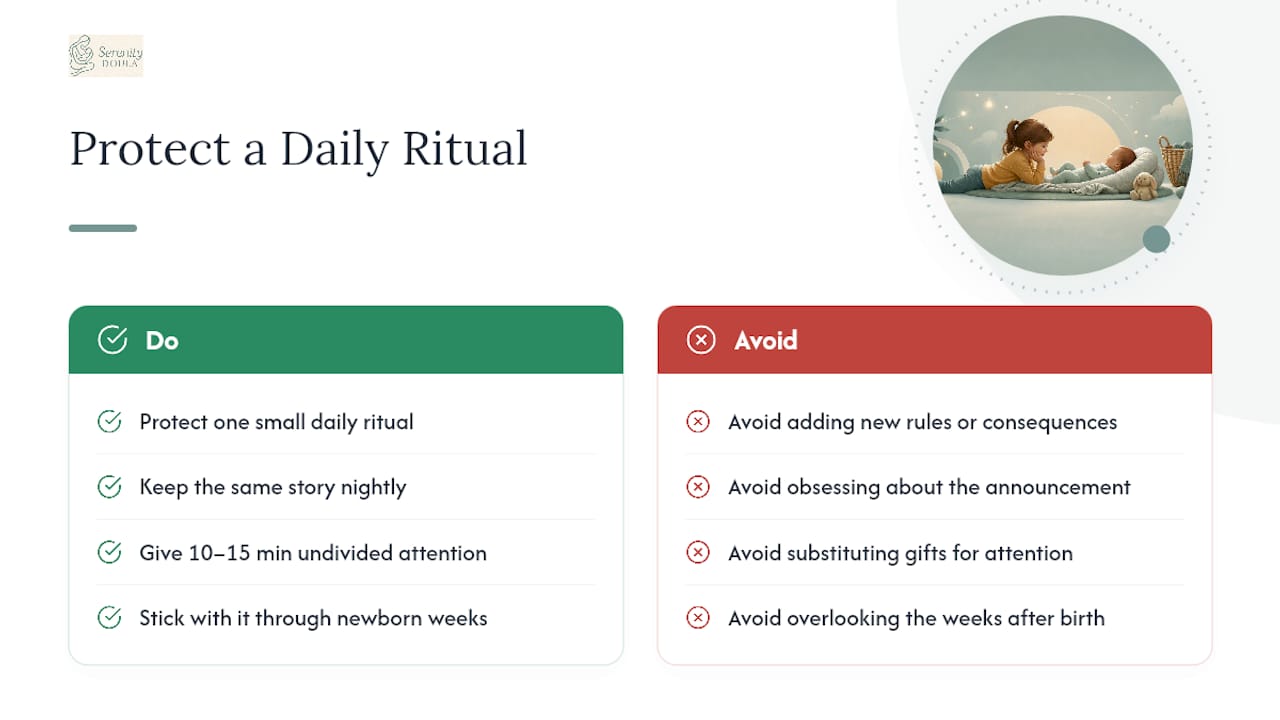
The families who navigate this transition most smoothly aren’t the ones with the most elaborate sibling-reveal plans. They’re the ones who protect a small daily ritual and stick with it, even on the hard days. I’ve watched a fifteen-minute bedtime story routine do more for a three-year-old’s adjustment than any big-sibling gift ever could.
One pattern shows up again and again in the families I’ve supported through this transition: the parents who worry the most about “getting the announcement right” often overlook the weeks-long stretch after the baby comes home, which is where the real adjustment work happens. A well-timed conversation matters, but it’s the sustained, boring consistency (the same story at the same time each night, the same fifteen minutes of undivided attention) that actually rebuilds a child’s sense of security.
I remember working with a family in Doylestown where the older child, about four years old, had a rough first week home, full of tantrums and a return to nighttime accidents. Instead of adding new rules or consequences, the parents doubled down on a single ritual: five minutes of “just us” time before the baby’s evening feeding, every single day, no exceptions. Within about ten days, the accidents stopped and the tantrums thinned out considerably. Nothing dramatic changed except that the child had proof, every single day, that they still mattered.
That’s the piece conventional advice tends to underweight. It’s not about finding the perfect words or the perfect gift. It’s about proving, in small repeated ways, that the relationship hasn’t been replaced. If you can commit to one honest ritual and hold it steady through the chaos of the newborn weeks, you’re doing the most important part of this work.
How Serenity Doula Supports Your Whole Family Through This Transition
Preparing an older sibling isn’t a solo project squeezed in around everything else on your to-do list. It’s part of the bigger picture of getting your whole household ready, and that’s exactly where a doula’s support changes the experience for Bucks County families. Serenity Doula builds sibling preparation directly into prenatal visits and childbirth education, so you’re not piecing together advice from a dozen sources on your own.

A typical prenatal consult with Serenity Doula includes time to talk through your specific child’s temperament and the scripts and rehearsal activities that fit them best, whether that’s a toddler who needs simple repetition or a school-age child who wants real answers. Our childbirth education classes can incorporate sibling-focused sessions, and postpartum in-home support means someone experienced is there during those first chaotic weeks to help you protect the one-on-one time your older child needs while you’re also caring for a newborn. Families near Newtown, Doylestown, and Trinity Health St. Mary often start with a free consultation to map out a plan for the whole family, not just the birth itself. If you’re weighing your options for support, our page on what a doula actually does is a good next stop, and booking that first conversation costs you nothing but a little time.
Sources
- Preparing your child for a new sibling (Child Mind Institute)
- Baby on the Way? Here’s How To Prepare Siblings for Their Arrival (Cleveland Clinic)
FAQ
How long does it take older siblings to adjust to a new baby?
Most children show noticeable improvement within a few weeks to two or three months, especially when parents maintain consistent routines and protected one-on-one time.
What should I say when my toddler acts out toward the new baby?
Name the feeling calmly, redirect gently, and reinforce with descriptive praise when they show gentle behavior, since regression and jealousy at this age are normal responses rather than defiance.
What is the 5-3-3 rule for babies?
This isn’t a term addressed by major pediatric sources covering sibling preparation, so it’s best to check directly with your pediatrician if you’ve seen it referenced elsewhere.
What is the 7-7-7 rule for parents?
Like the 5-3-3 rule, this isn’t a framework covered in the pediatric guidance on sibling adjustment, so treat any version you’ve encountered with caution and confirm specifics with your provider.
Which months are hardest for families after a new baby arrives?
The first few weeks after birth tend to be hardest for older siblings, since routines shift the most during that window, and most families see behaviors stabilize as a new normal takes shape.
Can a doula help with sibling preparation specifically?
Yes. Serenity Doula incorporates sibling prep into prenatal consultations and childbirth education, giving parents in Bucks County tailored scripts and rehearsal activities for their specific child.