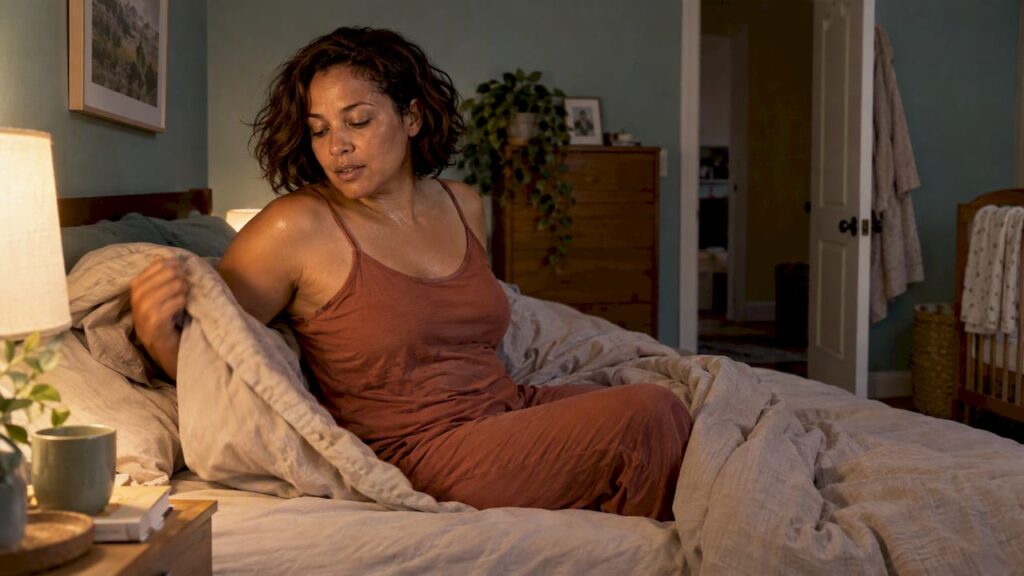
If you are waking up drenched, with damp pajamas and sheets that need changing at 3 a.m., you are not imagining it, and you are in very good company. Postpartum night sweats are a normal response to falling hormone levels and your body shedding pregnancy fluid. They usually fade on their own within a few weeks. Below, we walk you through why they happen, what makes nights more comfortable, and the specific signs that mean it is time to call your provider.
TL;DR
- Night sweats after birth come from a sharp drop in estrogen and progesterone, plus your body releasing extra fluid it held during pregnancy.
- They often peak in the first couple of weeks and typically settle within a few weeks. Breastfeeding can stretch that timeline.
- Light cotton, a cool room, a towel under you and plenty of water make nights easier.
- A fever of 100.4°F or higher, chills, severe pain or foul-smelling discharge is not “just sweat.” Call your OB-GYN or midwife right away.
- Sweating is not a weight-loss tool, so focus on hydration and rest.
Table of Contents
- Why you sweat so much at night after having a baby
- How common are they, and how long do they last?
- What actually helps you sleep more comfortably
- Do night sweats help with weight loss?
- When night sweats are not just hormones
- Our perspective: what we tell families in those first weeks
- Support that holds you between appointments
- FAQ
- Ready for calmer postpartum nights?
- Sources
Why you sweat so much at night after having a baby
Two things happen at once.
Your hormones drop fast. During pregnancy, estrogen and progesterone run high. After delivery they fall quickly. Your brain’s temperature control center, the hypothalamus, reads that change as overheating and sets off your cooling system: sweating. It is a short-term, menopause-like state while your body recalibrates. Cleveland Clinic describes this as a response to the rapid decline in those hormones.
Your body is letting go of fluid. Pregnancy increases the fluid in your tissues and bloodstream. Afterward, that extra fluid is pulled back into circulation and cleared through urine and sweat. Cleveland Clinic notes that about two liters of fluid are typically lost in the first five to seven days.
Why at night? Your body temperature naturally shifts while you sleep, and you are lying under blankets, often skin to skin with a warm baby. Sweat shows up when you are least able to do anything about it.

How common are they, and how long do they last?
Very common. The Sleep Foundation reports that research suggests about 29% of people experience nighttime hot flashes after giving birth.
Here is a realistic timeline:
| Timeframe | What you may notice |
|---|---|
| First 1 to 2 weeks | Often the heaviest sweating, as fluid and hormones shift fastest |
| Weeks 2 to 6 | Gradually lighter and less frequent as hormones settle |
| Beyond 3 weeks | Worth mentioning to your provider, mostly to rule out other causes |
| Months, while nursing | Can linger; some people still report hot flashes around a year out |
If you are breastfeeding, don’t be alarmed when sweats last longer. Prolactin, the hormone behind milk production, keeps estrogen lower than it would be otherwise, which can extend the sweats. The Sleep Foundation notes that about 10% of people still reported hot flashes a year after birth. If yours are still going strong at that point, it is a good question to bring to your provider rather than something to endure silently.
What actually helps you sleep more comfortably
You cannot prevent postpartum night sweats, but you can make them far less disruptive. These comfort measures come from Cleveland Clinic’s guidance:
- Dress light. Cotton or silk pajamas breathe better than synthetics.
- Choose breathable bedding. Cotton sheets and layers you can peel off.
- Protect the mattress. A waterproof mattress protector under your sheet saves you from a 3 a.m. crisis.
- Lay down a bath towel. It absorbs moisture, and you can swap it without remaking the whole bed.
- Cool the room. A fan or air conditioning makes a real difference, especially in a humid Pennsylvania summer.
- Drink water. You are losing fluid, so replace it.
Pro Tip: Set up a “night change station” before you need it: a spare pair of pajamas, a folded towel and a set of fresh sheets within arm’s reach of the bed. When you are exhausted, not having to hunt for anything feels like a gift. If you are building your list of newborn-stage supplies, this postpartum essentials guide is a handy place to start.
A note on hydration and nursing
If you are breastfeeding, you are replacing fluid through sweat and through milk. Research on nursing mothers shows that hydration habits are often poorly understood and worth paying attention to. A water bottle at every spot where you feed your baby is a simple habit. How much is right for you is a question for your provider or lactation consultant.

Do night sweats help with weight loss?
It is a common hope, and we understand why. But there is no evidence that the sweating itself drives meaningful weight loss. It is mainly your body balancing fluid. The number on the scale may drop early because of that fluid shift, but that is not the same as fat loss, and it is not a shortcut for recovery. Be gentle with yourself. Your body just did something enormous, and our guide to postpartum body changes covers what is typical in those early weeks.
When night sweats are not just hormones
Most of the time, sweating is simply part of healing. But it should never be the reason you wait if something else feels wrong. ACOG lists postpartum endometritis, a uterine infection, among the conditions to watch for after childbirth, alongside postpartum preeclampsia and hemorrhage.
Call your OB-GYN or midwife promptly if night sweats come with:
- A fever of 100.4°F or higher
- Chills
- Foul-smelling vaginal discharge
- Severe pain
If you feel you need immediate care, call 911 or go to the nearest emergency room. In Bucks County, that may mean Trinity Health St. Mary in Langhorne, or the hospital where you delivered.
Sweats that continue past about three weeks are also worth a mention at your visit, so your provider can rule out things like thyroid problems, infection or a medication side effect. Trust your instincts. If something feels off, call, whatever the timing.
Some questions to bring to your provider:
- “Does the pattern of my sweating sound typical for how many days postpartum I am?”
- “Should I be checking my temperature, and at what number should I call?”
- “Could any of my medications or my thyroid be playing a part?”
- “Is it normal for sweating to continue while I nurse?”
Our perspective: what we tell families in those first weeks
We meet parents in the thick of it, often at 2 a.m. on a video check-in or during an in-home visit, and night sweats are one of the things that catches them off guard. Nobody mentions them in most childbirth classes. So the first thing we offer is reassurance: this is your body doing its job. It is releasing fluid and resetting its thermostat.
The second thing is practical. Sweating compounds exhaustion, and exhaustion makes everything feel heavier. Small changes, like a towel on the bed, a fan pointed your way, water within reach, and a partner who handles the sheet change so you can go straight back to sleep, protect the rest you need. That is where partners can be a tremendous help, and it is a big part of the practical tasks a postpartum doula takes on in the first two weeks.
The third thing is the boundary. We are doulas, not medical providers, so we never diagnose. What we do is help you notice, name and report. If a fever of 100.4°F or higher, severe pain or foul-smelling discharge appears, your comfort takes a back seat to your safety, and we will encourage you to call your provider right away.
— Alexis Wallace
Support that holds you between appointments
Your six-week checkup can feel very far away when you are changing pajamas for the third time in a night. Our postpartum care is available in your home or virtually. It offers newborn-care guidance, rest-protecting routines and a calm, nonjudgmental person who knows what is typical and when to suggest a call to your provider. If you are still pregnant, you can also plan your postpartum support early alongside your birth team. You can read more in our postpartum recovery guide.
FAQ
How long do night sweats last after giving birth?
For most people they ease within a few weeks, and they are often strongest in the first two. Breastfeeding can keep them going longer. If they continue past about three weeks, or come with fever, chills or pain, ask your provider to check.
Is it normal to have night sweats a year after having a baby?
It can be. The Sleep Foundation reports that around 10% of people still had hot flashes about a year after birth. Still, bring it up with your provider, since thyroid issues, medications or other causes can be checked with simple questions and tests.
Is there anything you can do for postpartum night sweats?
You cannot stop them, but you can make them easier. Wear light cotton, use breathable bedding, put a towel and waterproof protector on the mattress, keep the room cool and drink water. Keep spare pajamas and sheets near the bed.
Do postpartum night sweats help with weight loss?
No. The sweating mostly reflects fluid balance, not fat loss. Focus on hydration, food, rest and support rather than treating sweat as a recovery shortcut.
Ready for calmer postpartum nights?
If you are expecting in Newtown, Doylestown or elsewhere in Bucks and Montgomery counties, we would love to talk about what support could look like for your family. Book a free consultation and we will build a plan around you, from birth through the fourth trimester.
Sources
- Postpartum Night Sweats: Causes & Treatments, Cleveland Clinic
- Postpartum Care, NCBI Bookshelf
- 3 Conditions to Watch for After Childbirth, ACOG
- Postpartum Night Sweats: Causes & Management, Sleep Foundation
- Water Balance in Breastfeeding, PMC