

TL;DR:
- Postpartum herbs support physical healing, mood balance, and lactation after childbirth.
- Safety includes consulting providers, starting with gentle herbs, and introducing one at a time.
- Herbs work best as part of a holistic recovery approach with rest, nutrition, and emotional support.
The weeks after giving birth can feel like a whirlwind. Your body is healing, your emotions are all over the place, and well-meaning advice comes at you from every direction. Many new mothers quietly wonder whether natural remedies, especially herbs, could offer real relief without adding more complexity. The good news is that postpartum herbs have been used for generations to gently support recovery, and modern research is beginning to back up what traditional wisdom has long suggested. This guide will walk you through what these herbs actually are, which ones are most helpful, how to use them safely, and how they fit into a fuller picture of postpartum wellness.
Table of Contents
- What are postpartum herbs and how do they help?
- Top postpartum herbs: Uses, safety, and benefits
- How to use postpartum herbs safely and effectively
- Integrating postpartum herbs into a holistic recovery plan
- The truth about postpartum herbs: Our holistic doula perspective
- Get personalized support for your postpartum journey
- Frequently asked questions
Key Takeaways
| Point | Details |
|---|---|
| Herbs support recovery | Postpartum herbs offer gentle support for physical healing and emotional wellness. |
| Safety comes first | Consult a provider, check for interactions, and start with single herbs for safe postpartum use. |
| Personalized routines work best | Herbs are most effective when paired with holistic recovery and community support. |
| Start slow | Try one herb at a time to track effects and avoid overwhelming your system. |
What are postpartum herbs and how do they help?
Postpartum herbs are plant-based remedies specifically chosen to support a mother’s body and mind in the weeks and months following childbirth. They are not miracle cures, but they are powerful allies when used thoughtfully. Think of them as gentle reinforcements, working quietly in the background while your body does its incredible work of healing.
On a physical level, certain herbs can support uterine recovery, reduce inflammation, ease perineal discomfort, and restore depleted nutrients. Many new mothers experience profound fatigue, and some herbs act as natural tonics to help rebuild energy stores. As herbal medicine research confirms, herbs aid healing, mood balance, and lactation after birth. That covers a remarkable range of postpartum needs in one category of support.
Emotionally, some herbs help calm the nervous system, support better sleep, and ease the anxiety that so many mothers experience in the early weeks. This matters deeply. The emotional landscape of new motherhood is real, and it deserves the same attention as physical healing.
Herbs come in several forms, and finding the right one for your lifestyle makes a difference:
- Teas and infusions: Gentle, soothing, and easy to prepare. Great for daily ritual.
- Tinctures: Concentrated liquid extracts. Convenient and fast-absorbing.
- Capsules: Measured doses with no preparation needed.
- Sitz baths: Herbal soaks for perineal healing. Incredibly comforting after a vaginal birth.
- Topical balms: For skin healing and sore muscles.
If you want to explore your postpartum care options, combining herbal support with professional guidance makes the biggest difference. You can also browse our postpartum wellness tips for practical ideas to layer into your recovery.
Pro Tip: When buying herbs, look for products that are certified organic, third-party tested, and clearly labeled with the Latin plant name. Quality matters more than price.
Top postpartum herbs: Uses, safety, and benefits
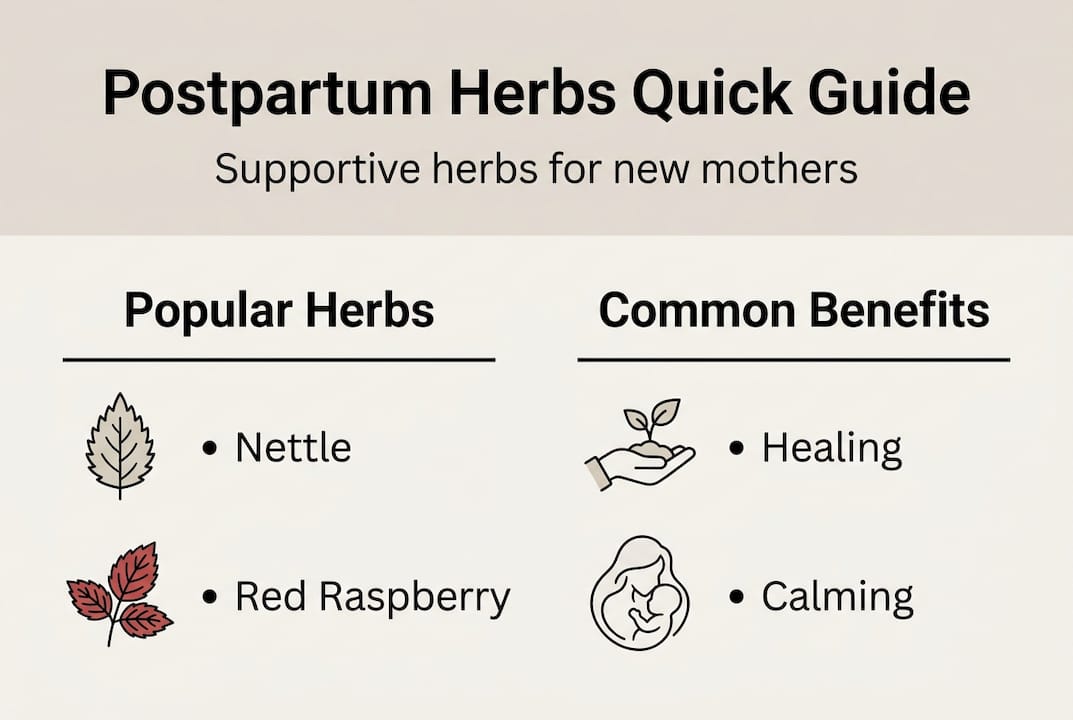
Not every herb is right for every mother, and that is actually good news. It means you can choose what fits your specific needs. As herbs for breastfeeding studies show, nettle, raspberry leaf, and fenugreek have well-documented postpartum support benefits, each in their own way.
Here is a helpful comparison to guide your choices:
| Herb | Primary use | Best form | Safety note |
|---|---|---|---|
| Red raspberry leaf | Uterine toning, iron support | Tea or capsule | Generally safe; avoid in first trimester |
| Nettle | Iron, energy, milk support | Tea or infusion | Very safe; a true postpartum staple |
| Fenugreek | Milk supply boost | Capsule or tea | Avoid with thyroid conditions |
| Chamomile | Sleep, anxiety relief | Tea | Use in moderation while breastfeeding |
| Ashwagandha | Stress, fatigue, hormone balance | Capsule or tincture | Consult provider before use |
| Moringa | Nutrition, milk supply | Powder or capsule | Well-tolerated; rich in vitamins |
| Motherwort | Uterine recovery, emotional calm | Tincture | Avoid with heart medications |
| Lavender | Relaxation, sitz bath healing | Bath or topical | External use is very safe |
A few important safety notes to keep in mind:
- Fenugreek can lower blood sugar, so mothers with diabetes should speak to their provider first.
- Motherwort interacts with certain heart and sedative medications.
- Ashwagandha is an adaptogen that can be powerful. Start slow and monitor how you feel.
- Some mothers have nut or pollen allergies that extend to herbal plants. Always check.
For deeper reading on holistic postpartum healing, we have resources that connect the dots between herbal support and full-body recovery. You can also explore herbal support with postpartum care through our professional services.
Pro Tip: Start with one single herb for at least a week before adding another. This way, you can clearly identify what is working and what is not.
How to use postpartum herbs safely and effectively
Knowing which herbs exist is just the starting point. Using them well requires intention, patience, and a little structure. Here are the steps we recommend:
- Talk to your care provider first. Before introducing any herb, check in with your midwife, OB, or a trained herbalist. This is especially important if you take any prescription medications.
- Start with the gentlest herbs. Nettle tea and red raspberry leaf are wonderful starting points. They are nourishing rather than stimulating.
- Introduce one herb at a time. Give each herb at least five to seven days before adding something new.
- Use the lowest effective dose. More is not always better with herbal medicine. Follow recommended guidelines and adjust based on how you feel.
- Watch your baby. If you are breastfeeding, observe your baby’s behavior, digestion, and sleep after you start a new herb.
- Keep a simple journal. Note what you took, when, and how you felt. This information is gold when troubleshooting or consulting a professional.
“Herb-drug interactions can occur and some botanicals are contraindicated during lactation.” This is why personalized, informed guidance is so essential for new mothers exploring herbal remedies.
As herb safety in postpartum research clearly shows, herb-drug interactions can occur, and some herbs are not appropriate while breastfeeding. Stop any herb immediately if you notice a rash, digestive upset, unusual fatigue, or changes in your baby’s mood or stool. These are your body’s signals to pause and reassess.
For tailored postpartum support that includes guidance on safe herbal use, working with a doula who understands integrative wellness can be transformative. And if you need emotional care guidance, we are here for that too, because healing is never just physical.
Pro Tip: Keep a postpartum journal that tracks your herb use, mood, energy, sleep, and any symptoms. You will be amazed how useful this becomes, both for your own awareness and for conversations with your care team.
Integrating postpartum herbs into a holistic recovery plan
Herbs work best when they are part of a bigger picture. As holistic postpartum research confirms, herbs support mothers best when combined with broader wellness practices. On their own, they can do a lot. But paired with good nutrition, rest, community, and movement, they can genuinely transform your postpartum experience.

Here is how different wellness pillars can work together:
| Wellness area | Herbal support | Complementary practice |
|---|---|---|
| Physical healing | Sitz baths, nettle tea | Rest, nutrient-dense meals |
| Milk supply | Fenugreek, moringa | Frequent nursing, hydration |
| Mood and stress | Chamomile, ashwagandha | Gentle movement, therapy |
| Sleep quality | Lavender, chamomile | Sleep when baby sleeps, dark room |
| Energy levels | Nettle, red raspberry leaf | Iron-rich foods, protein snacks |
A simple weekly rhythm might look like this:
- Morning: Nettle or red raspberry leaf tea with breakfast. Set a calm, intentional tone for the day.
- Midday: A nourishing meal with moringa powder stirred into a smoothie or soup.
- Evening: Chamomile tea before bed. A warm lavender sitz bath two to three times per week.
- Weekly: Check in with your support network, whether that is your partner, a friend, a postpartum group, or your doula.
Speak openly with the people around you. Let them know what you are trying and how you are feeling. Connection is medicine too. Isolation is one of the biggest challenges new mothers face, and no herb can replace the comfort of being truly seen and supported.
For holistic recovery strategies that go beyond herbs, and for complete postpartum support that wraps around your whole experience, we are here to help you build a plan that actually fits your life.
The truth about postpartum herbs: Our holistic doula perspective
Here is something most herb guides will not tell you: the herb itself is rarely the whole story. In our experience working with new mothers, the women who benefit most from herbal remedies are the ones who also feel supported, heard, and less alone. The herb becomes part of a ritual of self-care. And that ritual signals to the nervous system that it is okay to rest and heal.
We have seen mothers try every supplement on the market and still struggle, because what they really needed was someone to sit with them and help them make sense of this new chapter. Herbs are powerful. But they work best in a body that feels safe.
No single herb works for everyone. Your history, your birth experience, your emotional landscape, and your baby’s unique needs all shape what will serve you. That is why we always encourage individualized support over one-size-fits-all solutions. If you want to understand more about doula support perspectives, the conversation starts with your specific story, not a general protocol.
Get personalized support for your postpartum journey
You deserve more than a list of herbs and a good-luck wish. You deserve real, grounded support that meets you exactly where you are. At Serenity Doula, we combine evidence-based knowledge with genuine compassion to help you feel confident in your postpartum recovery.

Whether you are curious about integrating herbal remedies, navigating emotional ups and downs, or simply need someone in your corner, we offer pregnancy and birth support and resources to guide you every step of the way. Our childbirth education classes also touch on natural wellness strategies so you feel prepared, not overwhelmed. Visit Serenity Doula to learn how we can walk this journey with you.
Frequently asked questions
Are postpartum herbs safe while breastfeeding?
Many postpartum herbs are safe for breastfeeding mothers, but some can affect milk supply or pass compounds to your baby. Always consult your midwife or a trained herbalist before starting anything new, since as herb safety research confirms, some botanicals are contraindicated during lactation.
How soon after birth can I start using postpartum herbs?
Some gentle herbs like nettle tea can be introduced within days of birth, but timing really depends on your individual recovery. Your care provider can give you personalized herb guidance that accounts for your birth experience and current health.
What are signs I should stop taking a postpartum herb?
Stop use immediately if you notice a rash, digestive upset, unusual drowsiness, or changes in your baby’s behavior or digestion. As adverse reaction research shows, postpartum herb reactions are possible, so always contact your provider if something feels off.
Can I combine multiple postpartum herbs at once?
It is safest to introduce herbs one at a time, monitor your response for at least a week, and only then consider combining them carefully. Research on herbal galactagogues consistently recommends single herbs first before moving to blends.