

TL;DR:
- Prenatal emotional support is essential for reducing stress, anxiety, and feelings of isolation during pregnancy.
- Holistic methods like Reiki, reflexology, and essential oils complement medical care to promote wellness.
- Emotional support improves birth satisfaction and confidence, but does not guarantee specific physical outcomes.
Pregnancy is so much more than appointments, lab work, and ultrasounds.
Yes, your medical care matters deeply—but there’s a whole emotional and human side of this experience that often gets missed.
A lot of moms (and their partners) quietly feel overwhelmed, anxious, or even a little alone during pregnancy… and don’t always know where to put those feelings.
That’s where prenatal emotional support comes in.
This is the kind of support that holds you between appointments.
The kind that helps you feel grounded, seen, and actually prepared—not just medically, but emotionally too.
In this guide, we’ll walk through what that support really looks like, how holistic approaches can deepen it, and simple ways to feel calmer and more confident throughout your pregnancy.
Table of Contents
- What is prenatal emotional support?
- Holistic approaches to prenatal support
- Managing stress and anxiety in pregnancy
- Outcomes, effectiveness, and limits of emotional support
- A fresh perspective: What most guides miss about prenatal emotional support
- Explore personalized doula support and holistic resources
- Frequently asked questions
Key Takeaways
| Point | Details |
|---|---|
| Emotional support is vital | Non-clinical support reduces stress, anxiety, and feelings of isolation during pregnancy. |
| Holistic approaches enhance care | Integrating alternative therapies with emotional support promotes physical and mental well-being. |
| Partners play a key role | Prenatal emotional support includes partners, fostering confidence and advocacy for both. |
| Evidence is mixed but promising | Studies show higher satisfaction with emotional support, though not all birth outcomes change. |
| Personalization matters | Tailoring emotional support to individual needs is the best way to maximize its benefits. |
What is prenatal emotional support?
Let’s start here, because this matters:
Emotional support in pregnancy is not a “nice extra.” It’s foundational care.
Prenatal emotional support is everything that supports you as a whole person—not just your physical body.
It can look like:
- Having someone really listen when fears come up
- Learning what to expect so you’re not walking into the unknown
- Feeling reassured when your mind starts to spiral
- Knowing how to speak up for yourself in your care
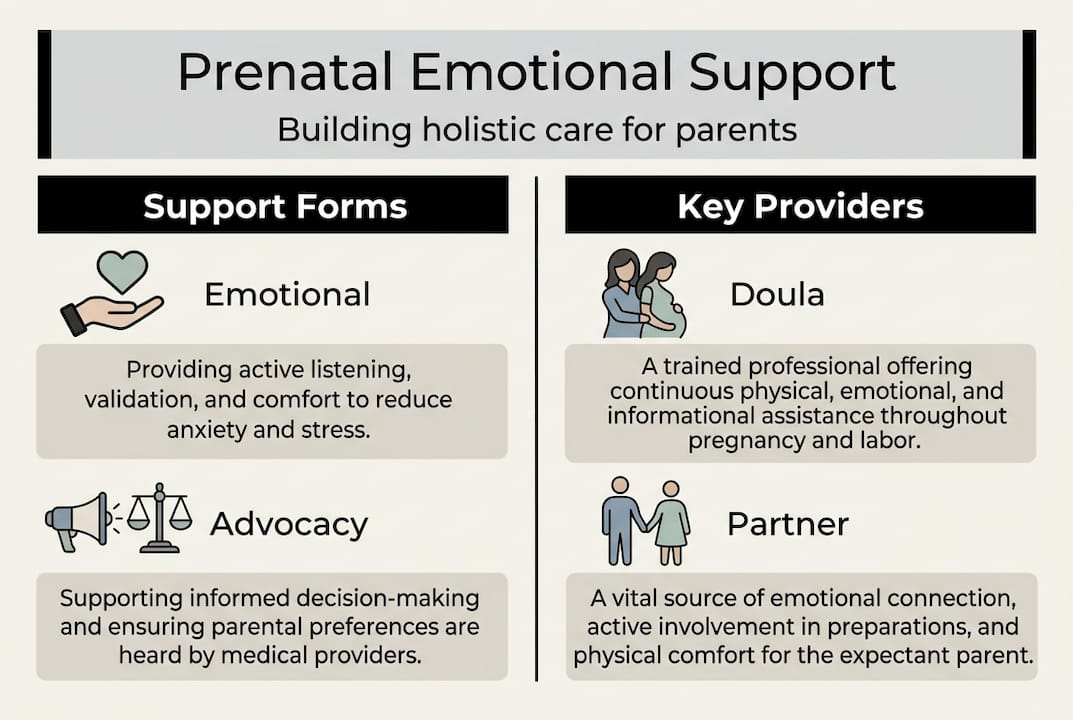
It’s the human side of pregnancy care. The part that says, “You don’t have to carry this alone.”
Because even when you’re surrounded by people who love you, pregnancy can still feel surprisingly isolating.
And here’s something powerful:
The more supported you feel, the lower your stress and anxiety tend to be. That emotional piece? It directly impacts your experience.
Here’s how support typically shows up:
- Emotional support – someone to talk to, process with, and lean on
- Physical support – comfort measures, positioning, breathing guidance
- Informational support – understanding your options and what’s ahead
- Advocacy support – feeling confident speaking up for your needs
“The presence of continuous social and emotional support during pregnancy is one of the most consistent predictors of lower prenatal distress and higher birth satisfaction.”
Different people can provide different pieces of this—your partner, a doula, a counselor—but having intentional support makes a huge difference.
You can explore what a pregnancy birth support doula does in practice, and learn more about the childbirth support types available to you. It is also worth noting that emotional health connects to physical health in surprising ways. Even something like pregnancy oral health can be affected by stress hormones, which is one more reason to take your emotional wellbeing seriously.
| Support type | Who provides it | When it helps most |
|---|---|---|
| Emotional | Doula, counselor, partner | Throughout pregnancy |
| Physical | Doula, physiotherapist | Labor and birth |
| Informational | Doula, childbirth educator | Prenatal period |
| Advocacy | Doula, birth partner | During labor and delivery |
Holistic approaches to prenatal support
Once you have that emotional foundation, holistic care can take it even deeper.
Holistic support is all about caring for your whole self—mind, body, and energy.
This might include:
- Reiki for deep relaxation and emotional balance
- Reflexology or acupressure to ease tension and discomfort
- Essential oils to help calm your nervous system
- Nutrition support to stabilize mood and energy
- Trauma-informed care if your past is showing up in your present
| Traditional prenatal support | Holistic prenatal support |
|---|---|
| Scheduled medical appointments | Ongoing personalized sessions |
| Medication-focused | Lifestyle and energy-based |
| Provider-led | Collaborative and client-centered |
| Symptom treatment | Whole-person wellness |
The goal isn’t to “fix” anything—it’s to help you feel safe, calm, and connected in your body.
And the beautiful part?
You don’t have to choose between medical care and holistic care. They work together.
Our early pregnancy holistic self-care guide walks through practical strategies for the first trimester specifically. And if you are considering an unmedicated birth, exploring natural birth doula benefits can help you understand how holistic support fits into that experience. Many families also find that pregnancy physiotherapy complements their emotional support plan beautifully.
Pro Tip: Do not try to adopt every holistic modality at once. Start with one or two that resonate with you and build from there. Your support journey should feel nourishing, not overwhelming.
Managing stress and anxiety in pregnancy
Let’s be real for a second—stress during pregnancy is normal.
Your life is changing. Your body is changing. Your identity is shifting. Of course feelings are going to come up.
But when stress starts to feel constant or overwhelming, that’s your cue to bring in more support.

One of the most effective approaches is psychoeducation, which simply means learning about what is happening in your body and why you feel the way you do. When you understand the stress response, it loses some of its power over you. Pairing that knowledge with doula guidance and mindfulness creates a strong foundation. Your doula role guide explains exactly how a doula supports this process.
Research from high-risk pregnancy settings is eye-opening. Early psychosocial interventions identified fears in 56.7% of participants, mental health concerns in 44%, social constraints in 36.7%, and experiences of violence in 25.9%. With 92% participation and 28% needing additional support, the data makes clear that emotional needs in pregnancy are widespread and real.
Here are a few simple, grounding ways to come back to yourself:
- Name what you’re feeling
Saying it out loud or writing it down takes some of the power out of it - Slow your breathing
Even a few minutes can shift your whole nervous system - Attend a childbirth education class.
Knowledge reduces fear. Our childbirth education support program is designed with this in mind. - Move your body gently.
Walking, stretching, swimming or prenatal yoga can do wonders - Use Grounding Tools
Touch something, focus on your senses, come back to the present moment
Statistic spotlight: In high-risk pregnancy programs, 28% of participants required additional psychosocial support beyond initial screening, highlighting how common unmet emotional needs are during pregnancy.
Pro Tip: If you notice anxiety that feels persistent or overwhelming, that is not a sign of weakness. It is a signal that you deserve more support. Reaching out to a doula, counselor, or midwife is always the right call.
What emotional support can (and can’t) do
I want to be honest with you here, because you deserve that.
Emotional support is incredibly powerful—but it’s not magic.
What it can do:
- Help you feel more confident going into birth
- Reduce anxiety and feelings of isolation
- Improve how you experience your birth overall
- Help your partner feel more involved and prepared
What it doesn’t always do:
- Guarantee specific birth outcomes
- Prevent every complication
- Control things that are outside of anyone’s hands
And that’s okay.
Because how you feel during your pregnancy and birth?
That matters just as much as the outcome.
“Evidence suggests that emotional and social support improves maternal satisfaction and the subjective birth experience, though causality remains difficult to establish given the largely observational nature of the data.”
Doulas complement medical care by filling gaps in continuous support, especially for marginalized groups who may face additional barriers in clinical settings. That gap-filling role is significant.
| Area | Emotional support effectiveness |
|---|---|
| Maternal satisfaction | Strong positive effect |
| Anxiety and stress reduction | Consistent improvement |
| Preterm birth prevention | Mixed or limited evidence |
| Birthweight outcomes | Inconsistent findings |
| Partner involvement | Notably improved |
Exploring the benefits of childbirth education alongside emotional support gives you the strongest possible foundation. And after birth, postpartum support options help ensure the care does not stop once your baby arrives.
What most guides miss about prenatal emotional support
Here’s the part that often gets missed:
The biggest impact of emotional support isn’t always something you can measure. They are often invisible.
It shows up in:
- The way you walk into your birth feeling steady instead of scared
- How you speak up for yourself when someone dismisses your concerns
- How you process and digest your experience afterward
That quiet confidence? That sense of “I’ve got this”?
That’s the real work.
And it looks different for everyone.
We believe strongly in personalization. Your birth journey is yours. Your journey isn’t meant to fit into a template. Your support shouldn’t either.
Do not wait until you are overwhelmed to seek emotional support. Build it into your prenatal routine from the start.
Explore personalized doula support and holistic resources
If you’re reading this and thinking, “I want that kind of support,”—trust that feeling.
You deserve to feel held, informed, and confident as you move through this season. That’s exactly what we create inside Serenity Doula.
Whether you’re looking for:
- One-on-one birth support
- Childbirth education that actually makes sense
- Need compassionate guidance through birth trauma recovery
We’re here for all of it! We meet you where you are, without judgment, and walk with you from there.
Frequently asked questions
What does emotional support from a doula actually look like?
It looks like having someone in your corner—answering your questions, calming your nerves, helping you prepare, and standing beside you during birth so you never feel alone in it.
Do holistic practices really help?
They can be incredibly supportive. Not because they “fix” everything, but because they help your body and mind relax—and that changes your entire experience.
What holistic therapies can help with prenatal emotional support?
Holistic therapies include Reiki, reflexology, acupressure, essential oils, nutrition guidance, and trauma-informed care, all of which can be integrated alongside standard prenatal care. The right combination depends on your personal needs and comfort level.
Will this change my birth outcome?
Not always in the clinical sense – but it often changes how you experience your birth, and that’s something that stays with you. The outcomes of birth weight, hospital stays, etc do not always change, but your satisfaction, your empowerment, your first steps into motherhood are stronger with emotional support in place.
Should emotional support be part of routine prenatal care?
Yes. Psychoeducation and doula services enhance confidence and reduce isolation, making them especially valuable for high-risk pregnancies and families seeking holistic care. Integrating emotional support early leads to better preparation and less fear.
Are partners included in prenatal emotional support?
Absolutely! This is a huge part of my philosophy. Prenatal emotional support extends to partners, helping them understand their role, manage their own anxiety, and show up fully during labor and birth. Your partner is part of this too – their lives are changing too – your life is changing together. When they feel supported and informed, everything flows better.
Recommended
- First trimester self-care: Holistic strategies for early pregnancy
- Birth trauma recovery: holistic approaches for lasting healing
- Postpartum Care – Serenity Doula
- Pregnancy & Birth Support Doula – Serenity Doula
- Types of physiotherapy for pregnancy in 2026
- Featured Mindfulness Course | Mindful Self Compassion in Support of Psychedelic-Assisted Therapy