

TL;DR:
- Supporting an adult child through pregnancy involves offering emotional encouragement, practical help, and respectful guidance. Being present and trustworthy increases her engagement in prenatal care and improves health outcomes for both mother and baby.
Supporting an adult child through pregnancy means offering balanced emotional encouragement, practical help, and respectful guidance that together lead to better health outcomes for both mother and baby. Research shows that pregnant women with involved family are 50% more likely to receive appropriate prenatal care, reducing infant mortality and preterm birth rates. That number tells you something powerful: your presence matters more than you might realize. The challenge is learning how to show up in a way that feels supportive rather than controlling. This guide gives you the tools to do exactly that.
How to support your adult child through pregnancy emotionally
The most important shift you can make is moving from “manager” to “advisor.” Parenting counselors emphasize that open-ended questions build dialogue, while unsolicited advice shuts it down. Ask “How are you feeling about your birth plan?” instead of “Have you decided on an epidural yet?” That small change in phrasing signals trust rather than control.

Your daughter needs to know she is not alone. Explicitly telling her “I am in your corner no matter what” reduces fear and encourages her to be honest with you. Parents who stay silent out of worry often create the opposite effect: their adult children pull away and stop sharing. Affirming your support out loud is not optional. It is the foundation everything else is built on.
You will have your own feelings about this pregnancy. That is completely normal. The key is to process those emotions privately so they do not spill into your conversations with her. Talk to a friend, a therapist, or your partner. When you walk into the room with her, bring calm. She will feel the difference.
Here are four ways to build a safe emotional environment:
- Ask before advising. Say “Would you like my thoughts on that?” before sharing opinions.
- Validate first. Reflect her feelings back before offering solutions. “That sounds really hard” goes a long way.
- Schedule non-pregnancy time. Making space for non-pregnancy activities helps preserve her identity and reduces stress.
- Set a regular check-in. A weekly call or coffee date creates predictability and safety.
Pro Tip: If a conversation gets tense, say “I want to understand your perspective better. Can we come back to this tomorrow?” Giving both of you space prevents small disagreements from becoming lasting distance.
Practical ways to help with prenatal care and logistics
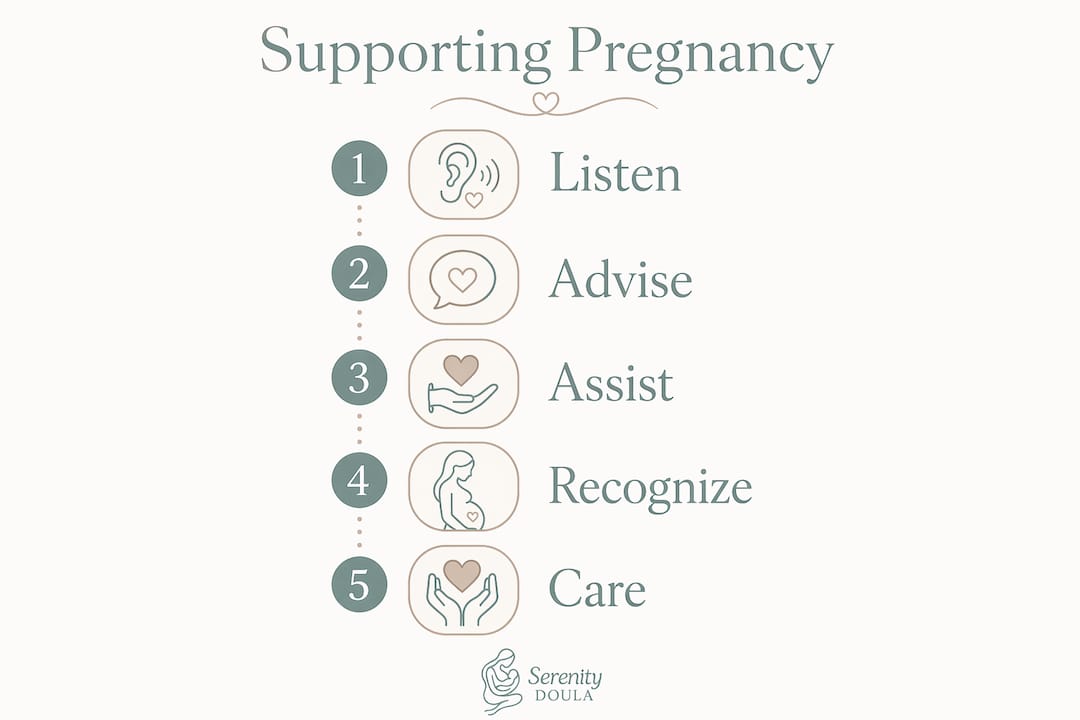
Practical support is where many parents feel most useful, and for good reason. Acting as a “second brain” during prenatal visits, taking notes and asking questions she may forget, reduces her stress and improves how well she follows through on medical guidance. You do not need to attend every appointment. Offer to come to the ones that feel big, like the anatomy scan or a specialist visit.
Here is a practical list of ways to help with pregnancy logistics:
- Track appointments. Offer to help organize her prenatal schedule and arrange transportation when needed.
- Take notes at visits. Write down the provider’s instructions so she can focus on the conversation.
- Manage the “external world.” Field calls from well-meaning relatives, filter conflicting advice, and protect her energy.
- Help prepare the nursery. Research car seat safety ratings, research stroller options, and help assemble gear without taking over the decisions.
- Encourage childbirth education. Childbirth education classes give her confidence and give you shared language to support her birth plan.
Pro Tip: Before any appointment, ask her: “Is there anything you want me to help you remember to ask the doctor?” This keeps her in the driver’s seat while you play a genuinely useful supporting role.
How do you recognize mental health struggles during and after pregnancy?
Approximately 1 in 7 birthing parents and 1 in 10 partners experience postpartum depression or anxiety. That means this is not rare, and it is not something to wait and see about. Knowing the signs puts you in a position to act early.
Watch for these warning signs in your daughter:
- Persistent sadness or crying that does not lift after a few days
- Withdrawing from the baby or from people she loves
- Expressing feelings of worthlessness or being a bad mother
- Difficulty sleeping even when the baby sleeps
- Anxiety that feels out of proportion to the situation
If you notice these signs, name what you see without judgment. Say “I’ve noticed you seem really exhausted and down. I’m not going anywhere. Would it help to talk to someone?” Then help her find prenatal emotional support through counseling, therapy, or a perinatal support group. Resources like Postpartum Support International offer free helplines and provider directories.
Your own mental health matters here too. Managing your own stress is not selfish. It is what allows you to stay present and calm for her over the long haul. If you are feeling overwhelmed, seek your own support. You cannot pour from an empty cup.
What does postpartum recovery actually look like for caregivers?
Physical recovery after birth takes longer than most people expect. Vaginal birth recovery takes 4–6 weeks, while cesarean recovery takes 6–8 weeks. During that window, your daughter needs rest above almost everything else.
| Recovery type | Timeline | Your role as caregiver |
|---|---|---|
| Vaginal birth | 4–6 weeks | Handle meals, laundry, and newborn care so she can rest |
| Cesarean birth | 6–8 weeks | Limit her lifting, manage visitors, and monitor wound healing |
| Emotional recovery | Ongoing | Watch for mood changes and encourage open conversation |
| Feeding support | First 4–6 weeks | Learn bottle prep or breastfeeding basics to assist her goals |
Active caregiver involvement in household tasks and visitor management directly reduces maternal stress and promotes healing. That means cooking meals, doing laundry, and gently telling Aunt Carol that now is not the best time to visit. These are not small gestures. They are the conditions that allow bonding and recovery to happen.
Feeding support is another area where you can make a real difference. Caregivers who learn breastfeeding basics and bottle preparation help their daughters meet their feeding goals more consistently. You do not need to become an expert. You need to be informed enough to help without second-guessing her choices. A postpartum care plan can help you organize all of this before the baby arrives.
Key takeaways
Supporting an adult child through pregnancy requires balancing genuine practical help with deep respect for her autonomy, especially in the critical postpartum weeks.
| Point | Details |
|---|---|
| Shift to an advisory role | Ask open-ended questions and wait for an invitation before sharing opinions. |
| Say your support out loud | Explicitly telling her “I’m in your corner” builds trust and keeps communication open. |
| Act as a second brain | Take notes at prenatal visits and manage outside pressures so she can focus on her health. |
| Know the mental health signs | 1 in 7 birthing parents experience postpartum depression; early recognition leads to faster help. |
| Protect her recovery time | Manage meals, laundry, and visitors during the 4–8 week postpartum window to support healing. |
What I’ve learned from watching parents show up for their adult children
The parents who do this well share one quality: they are willing to be uncomfortable. They sit with their own fear and grief and surprise, and they still show up with a calm face and an open heart. That is genuinely hard work.
The most common mistake I see is parents swinging between two extremes. Either they take over completely, scheduling every appointment and offering opinions on every decision, or they pull back entirely because they do not want to overstep. Both approaches leave the pregnant adult feeling alone. The sweet spot is consistent, quiet presence. You show up. You ask. You listen. You act when asked.
The second thing I want parents to know is that your daughter is watching how you handle this. If you model calm, she learns that this is manageable. If you model panic, she carries that weight on top of everything else. You have more influence than you think, and it flows through your tone, not your advice.
Seek your own support if you need it. Co-parenting communication strategies and family counseling can help you process your own emotions and show up better for her. That is not weakness. That is preparation.
— Alexis Wallace
How Myserenitydoula supports families through every stage
Myserenitydoula works with families exactly like yours, parents who want to show up well for their adult children but are not sure how to fill the gaps between medical appointments.

A birth doula from Myserenitydoula provides the continuous emotional and physical support that no one else in the room is trained to give. From pregnancy and birth support to postpartum care and childbirth education, Myserenitydoula helps your daughter feel grounded and prepared at every stage. When professional support and family support work together, the results are measurably better for both mother and baby. Schedule a consultation to learn how Myserenitydoula can complement everything you are already doing.
FAQ
How do I support my daughter without overstepping?
Ask before advising and follow her lead on decisions. Shifting to an advisory role means offering input only when invited, which preserves trust and keeps communication open.
What are the signs of postpartum depression I should watch for?
Persistent sadness, withdrawal from the baby, and disproportionate anxiety are key warning signs. 1 in 7 birthing parents experience postpartum depression, so early recognition and encouraging professional help makes a real difference.
Should I attend prenatal appointments with my daughter?
Offer to attend key appointments and ask if she wants you there. Taking notes and asking questions she may forget is one of the most practical ways to help without taking over her care.
How long does postpartum recovery take?
Vaginal birth recovery typically takes 4–6 weeks, while cesarean recovery takes 6–8 weeks. During this time, managing household tasks and limiting visitors are the most effective ways to support healing.
What if my daughter and I disagree about her birth plan?
State your concern once, clearly and calmly, then respect her decision. Her autonomy over her birth experience is non-negotiable, and long-term relational health depends on you honoring that boundary.