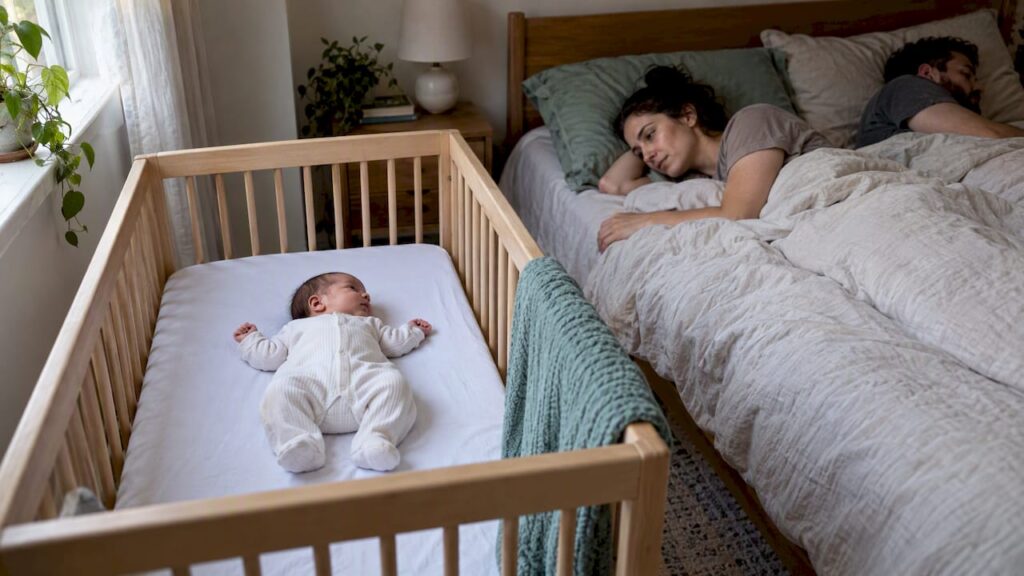
The safest sleep setup for a newborn is simple: baby on their back, alone, on a firm, flat infant sleep surface such as a crib, bassinet, or play yard, kept in your room for at least the first 6 months. This matters most between 2 and 4 months, the age window when sleep-related infant deaths peak. Both the American Academy of Pediatrics and the CDC stand behind this approach, and we will walk through exactly what it looks like in practice.
TL;DR:
- Most sleep-related infant deaths occur between 2 and 4 months, emphasizing the importance of strict adherence to safe sleep practices during this period.
- The baby’s sleep space must be free of pillows, loose blankets, toys, and bumpers, with the mattress fitting snugly and only a fitted sheet in place.
- Maintaining the baby’s sleep surface in the room but on a separate, firm, flat surface significantly reduces the risk compared to bed-sharing.
- Avoid using inclined sleepers, swings, or recalled products, and regularly check for product recalls to prevent suffocation and injury risks.
- Practicing safe sleep routines, like swaddling only until rolling begins and gradually transitioning to sleep sacks, helps build confidence and ensure safety during nighttime care.
Table of Contents
- The ABCs of safe sleep: alone, back, crib
- A step-by-step checklist to set up a safe sleep space tonight
- Room-sharing versus bed-sharing: what the evidence actually shows
- Products to avoid: inclined sleepers, swings, and recalled items
- Swaddling, sleep sacks, and keeping baby at a safe temperature
- When to loop in your pediatrician
- First day home: priorities and a simple rest plan
- Practical doula tips for your first week
- Our take: the gap between knowing the rules and living them
- How Serenity Doula supports safe, confident newborn sleep
- FAQ
- Sources
The ABCs of safe sleep: alone, back, crib
You have probably heard “ABC” tossed around at a pediatrician visit or in a hospital pamphlet, and it is a genuinely useful shorthand once you know what each letter protects against.
Alone means your baby’s sleep space holds nothing but your baby. No pillows, no bumper pads, no loose blankets, no stuffed animals, no nursing pillows left in the crib. A CDC analysis of sleep-related deaths found nursing pillows present in a subset of cases, which is part of why manufacturers added new warning labels in 2025. These products are wonderful for supported feeding while you are awake and alert. They have no place in the crib once you put baby down.
Back means every sleep, every time, for naps and overnight. Parents often worry that back-sleeping raises choking risk, but a baby’s airway anatomy and gag reflex actually make this the safer position, and back-sleeping is linked to lower SIDS risk rather than higher choking risk.
Crib stands in for any approved, firm, flat sleep surface, a crib, bassinet, or play yard that meets current federal safety standards, never an inclined surface. The mattress should feel solid under your hand, not springy, and should be covered only with a well-fitted sheet.
A few situations call for individualized guidance from your pediatrician rather than the general rule, which we will cover later. For almost every newborn, though, the ABCs are the whole answer.
- Alone: nothing else in the sleep space, no pillows, loose blankets, or toys.
- Back: supine positioning for every nap and every nighttime sleep.
- Crib: a firm, flat, non-inclined surface built for infant sleep.
A step-by-step checklist to set up a safe sleep space tonight
You do not need to overhaul a nursery before your baby comes home. You need these pieces in place.
- Place the crib, bassinet, or play yard flat on the floor, away from cords, blinds, and furniture your baby could later reach.
- Fit the mattress snugly with no gaps wider than two fingers along the sides.
- Cover the mattress with only a fitted sheet made for that exact model.
- Clear the space of pillows, blankets, bumpers, and stuffed animals before baby’s first nap there.
- Dress baby in a wearable sleep sack or one-piece sleeper instead of loose bedding.
- Pack a bedside night box with diapers, wipes, a burp cloth, and a spare sleeper so you are not fumbling in the dark.
- Swaddle only if your baby still shows the startle reflex and has not begun trying to roll, then switch to a sleep sack once rolling starts.
- Offer a pacifier at nap and bedtime once breastfeeding is well established, since it is associated with lower SIDS risk.
Pro Tip: Press your palm flat on the mattress before baby’s first night in it. If it gives like a sofa cushion, it is too soft, no matter what the label says.
Room-sharing versus bed-sharing: what the evidence actually shows
Room-sharing and bed-sharing sound similar but carry very different risk profiles, and the distinction is worth sitting with.
Keeping your baby’s crib or bassinet in your room, but on its own separate surface, is associated with a lower risk of sleep-related death, which is why AAP recommends it for at least the first 6 months. Sharing an adult bed with your baby raises risk meaningfully, especially when combined with soft bedding, a couch or recliner, or any parental use of alcohol, sedating medication, or smoking.
If closeness at 3 AM feels essential, and for most exhausted parents it does, there are ways to get it without compromising safety.
- Position the bassinet or crib within arm’s reach of your bed so you can see and reach your baby without leaving the room.
- If you use a bedside sleeper attached to the bed, confirm it meets current federal infant sleep product standards before buying.
- Nurse or bottle-feed sitting upright in bed or in a chair, then move baby back to their own firm surface before you drift off, rather than feeding while lying down together.
This routine protects the moments you actually want, skin contact, quiet middle-of-the-night check-ins, without the baby ending up tangled in your comforter at 4 AM.
Products to avoid: inclined sleepers, swings, and recalled items
Several popular baby products were never designed for unsupervised sleep, even though marketing sometimes blurred that line for years.
Car seats, swings, and inclined loungers are fine for supervised awake time or travel, but any surface angled more than 10 degrees changes how a small baby’s head and airway sit, and the Consumer Product Safety Commission’s safety standard now bans inclined infant sleep products for this reason. If your baby falls asleep in the car seat or swing during a car ride or a watched nap, move them to a crib or passionate as soon as it is reasonably possible.
Recalls happen more often than most parents expect. The 2025 Fisher-Price Snuga swing recall covered more than 2 million units tied to suffocation risk after 5 infant deaths were reported, a sobering reminder to check products you already own.
- Register every crib, bassinate, and swing with the manufacturer so recall notices reach you directly.
- Check your products against current recalls on cpsc.gov every few months, not just once.
- If you travel or need an emergency sleep surface, choose the firmest, flattest option available, a bare pack-and-play mattress works, and replace it with a proper sleep space as soon as you can.
One sobering figure: the United States sees roughly 3,500 to 3,700 sleep-related infant deaths each year, and most are preventable through the steps above.
Swaddling, sleep sacks, and keeping baby at a safe temperature
Swaddling can genuinely calm a newborn, but it has rules of its own. Wrap snugly around the chest while leaving plenty of room at the hips for natural leg movement, since tight wrapping across the hips has been linked to hip dysplasia. Stop swaddling the moment your baby shows any sign of trying to roll, usually somewhere between 2 and 4 months, because a swaddled baby who rolls onto their stomach cannot push back over.
A wearable blanket or sleep sack is the safer long-term choice once swaddling ends, since it keeps baby warm without any loose fabric near the face.
- Keep the room at a comfortable temperature for a lightly dressed adult, generally cool rather than warm.
- Dress baby in one layer more than you would wear, not several.
- Watch for damp hair, flushed cheeks, or heat rash as early overheating signs, and remove a layer if you see them.
- Skip hats, hoods, and heavy blankets once baby is in the crib, even in winter.
When to loop in your pediatrician
General guidance covers most babies, but some situations genuinely need a tailored plan from your care team.
- Babies born preterm or at low birth weight.
- A history of apnea, reflux severe enough to affect breathing, or any diagnosed airway anomaly.
- Twins or multiples sharing a sleep space, which current guidance advises against.
- Any time your gut tells you something about your baby’s breathing or sleep does not look right.
Bring specific questions to that conversation: Does my baby’s history change the recommended sleep position? Should we use any monitoring device, and if so, which kind? When should we follow up to reassess? Your pediatrician’s individualized answer always takes priority over general guidance like this article.
First day home: priorities and a simple rest plan
The first 24 hours home are when exhaustion and new routines collide, so keeping the setup simple matters.
- Have the crib or bassinet made up and positioned near your bed before you leave the hospital or birth center.
- Move baby from the car seat to the crib within a few minutes of walking in the door, not hours later on the couch.
- Stock a bedside station with diapers, a spare sleeper, and feeding supplies so 2 AM does not require a trip downstairs.
- Identify one other adult, a partner, parent, or support person for nighttime shifts, before baby arrives, not after.
- Tell visitors and any overnight helper the same three rules: back, alone, firm surface, so everyone in the house follows one standard.
Practical doula tips for your first week
When I walk into a family’s home for a postpartum visit, safe sleep setup is often the first thing we do together, not the last. I physically press on the mattress with a new parent’s hand so they feel the difference between firm and soft. I show partners how to swaddle with two fingers of slack at the hips, then practice the transfer from arms to crib without waking baby, because that handoff is where most parents lose their nerve at 3 AM.

Back-sleeping fear comes up at almost every visit I do, and I never dismiss it. I explain the airway anatomy, show the research, and let parents ask every follow-up question until it clicks. The same goes for bed-sharing: rather than a lecture, we talk honestly about what happens at 4 AM when everyone is depleted, and we build a realistic plan instead of pretending willpower will carry the night. These conversations, along with newborn care skills practiced before discharge, are part of what postpartum support and childbirth education sessions cover.
Our take: the gap between knowing the rules and living them
Most parents can recite “back to sleep” before their baby is born. The guidance is not the hard part. The hard part is doing it at 3 AM with a screaming infant who seems to sleep better on your chest, and conventional advice rarely addresses that gap.

We think the biggest miss in typical safe-sleep messaging is treating it as a one-time decision instead of a nightly negotiation between exhaustion and intention. Parents do not fail at safe sleep because they do not know the rules. They fail because no one showed them how to swaddle with confidence, how to transfer a sleeping baby without panic, or how to handle the 2 AM moment when the couch looks tempting.
Prioritize the physical setup first: firm mattress, nothing loose, crib beside your bed. Then build the muscle memory, practice the transfer, practice the swaddle, before you are running on four hours of sleep. Rules you have practiced hold up under exhaustion. Rules you have only read about do not.
— Alexis Wallace
How Serenity Doula supports safe, confident newborn sleep
We built our postpartum care visits around exactly this gap between knowing the guidance and living it at 3 AM. During in-home visits, we demonstrate crib setup, coach partners through swaddling and safe transfers, and answer the back-sleeping and bed-sharing questions parents are often too tired or too unsure to ask elsewhere.

- Our childbirth education classes cover newborn sleep safety before baby arrives, not after.
- Our pregnancy and birth doula support carries that same evidence-based, hands-on approach from labor through the fourth trimester.
- A free consultation lets us build a plan around your specific home, routine, and questions.
If a hands-on walkthrough of your own nursery setup would ease your mind, book a free consultation and we will go through it together.
This article is general information, not a substitute for advice from a qualified doctor. Consult a qualified healthcare professional about your own circumstances before acting on anything here.
FAQ
What should I do on my first day at home with my newborn baby?
Move your baby from the car seat directly to a firm, flat crib or bassinet as soon as you arrive, and have that sleep space already set up near your bed. Keep feeding and diaper supplies within reach so overnight care does not require leaving the room.
How do I take care of a baby girl safely at night?
Newborn safe-sleep guidance does not differ by sex: every baby, regardless of gender, sleeps safest alone, on their back, on a firm surface in your room for at least the first 6 months. Focus on the same ABC setup and watch for overheating, since newborns of any sex regulate temperature poorly in their first weeks.
What are the essential steps of newborn care at bedtime?
The core steps are placing baby on their back, using a firm and flat sleep surface with nothing else in it, keeping the crib in your room, dressing baby in a sleep sack instead of loose blankets, and avoiding smoke exposure in the home. Breastfeeding and keeping up with recommended vaccinations are also linked to lower sleep-related risk.
Which week of the newborn period is hardest for parents?
Many parents find the first 1 to 2 weeks hardest simply due to recovery and round-the-clock feeding, though sleep-related death risk itself peaks later, between 2 and 4 months of age. That later window deserves just as much attention to safe sleep setup as the first exhausting days.
When should I stop swaddling my baby?
Stop swaddling as soon as your baby shows early signs of rolling, usually somewhere between 2 and 4 months, since a swaddled baby who rolls onto their stomach cannot push back over. Switch to a wearable sleep sack at that point so baby still has freedom to move their arms and legs safely.
Sources
- Sleep-Related Infant Deaths: Updated 2022 Recommendations for Reducing Infant Deaths in the Sleep Environment | Pediatrics
- Nursing pillows found in sleep spaces of infants who died — CDC MMWR