

Newborn care education comes down to five skills: reading feeding cues, setting up safe sleep, soothing without guesswork, handling diapering and cord care correctly, and knowing when to call your pediatrician. Hospitals base their teaching on AAP and AHA guidance, and the single best thing you can do in your first days is practice these skills hands on, with a nurse or doula watching, before you walk out the door. If your hospital stay feels rushed, ask for a demonstration or book a short newborn class before your due date.
TL;DR:
- Most babies produce at least six wet diapers daily by the time feeding is established, indicating adequate hydration and nutrition.
- Safe sleep practices include placing the baby on their back on a firm, flat surface with no loose bedding or toys in the crib.
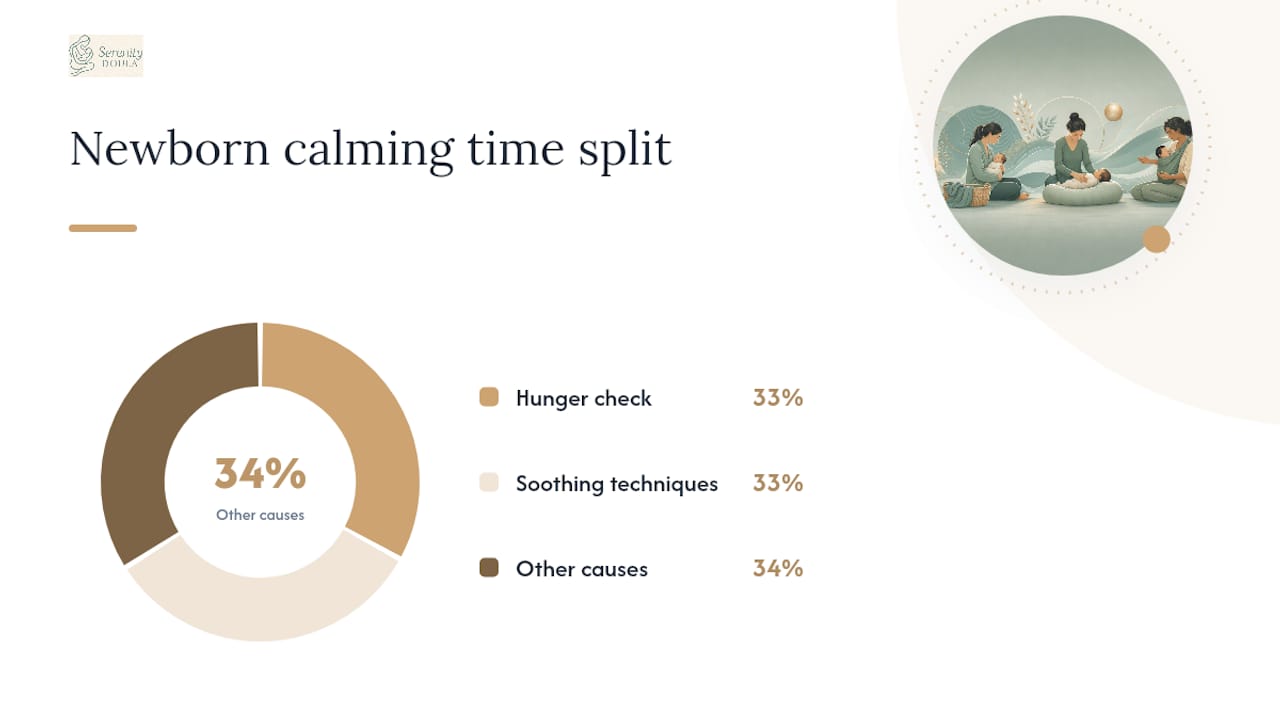
- The 3-3-3 rule helps parents systematically address crying by checking hunger, basics, and soothing techniques within three-minute intervals.
- Follow-up pediatric visits within two to five days of discharge are crucial for monitoring jaundice, feeding, and weight gain, especially after early hospital releases.
- Private, personalized postpartum support from a doula can help correct ongoing routines and address questions that rushed hospital demonstrations may overlook.
Table of Contents
- Feeding Basics: Reading Hunger and Fullness Cues
- Safe Sleep: What Actually Reduces SIDS Risk
- What Is the 3-3-3 Rule for Newborns?
- Diapering, Cord Care, and Bathing in the First Weeks
- Health Monitoring: Follow-Up Visits and Red Flags
- Choosing a Newborn Care Class or Support Format
- The Skills to Practice Before You Leave the Hospital
- A Doula’s Perspective: What Most Parents Actually Need
- Why Hospital Discharge Instructions Aren’t Enough on Their Own
- How Serenity Doula Supports Your First Weeks Home
- Sources
- FAQ
Feeding Basics: Reading Hunger and Fullness Cues
Newborns eat roughly every 2 to 3 hours, which adds up to several feeds in a 24-hour stretch. That number surprises a lot of parents, especially those who imagined nights of stretch after stretch. Early hunger cues show up before crying: rooting, hand to mouth motions, lip smacking, and restlessness. Crying is a late cue, and a baby who has escalated to crying often needs a moment to calm before latching well.

Statistic Spotlight: Once feeding is established, most newborns produce six or more wet diapers a day, and that count is one of the most reliable signs your baby is getting enough.
If you’re breastfeeding, a good latch should feel like tugging, not pinching, and you should see and hear rhythmic swallowing. Ask your provider about a lactation consult if:
- Latching consistently hurts past the first few days
- Your baby seems to fall asleep within a minute or two of starting
- You’re not seeing the diaper counts below by day four or five
- Your milk supply feels like it hasn’t shifted by day three or four
Formula feeding has its own precision points: follow the mixing ratio on the label exactly, and don’t stretch formula with extra water to save money, since that can throw off your baby’s electrolyte balance. Whichever way you feed, weight checks at follow-up visits are the real scoreboard. A pattern of slow weight gain alongside low diaper counts is worth raising with your pediatrician right away, not waiting out until the next scheduled visit.
Safe Sleep: What Actually Reduces SIDS Risk
Every safe sleep recommendation traces back to one core setup: back to sleep, on a firm flat surface, with nothing loose in the crib. The American Academy of Pediatrics frames this as the primary way to lower SIDS risk across the entire first year, not just the newborn phase.
In practice, that means:
- Baby sleeps on their back for every sleep, naps included
- The mattress is firm and flat, no inclined sleepers or car seats for routine sleep
- No blankets, bumpers, pillows, or stuffed animals in the sleep space
- Room sharing (crib in your room) is recommended; bed sharing is not
- A sleep sack or wearable blanket replaces loose bedding for warmth
Swaddling can help some babies settle, but stop swaddling the moment your baby shows any sign of rolling, and never swaddle over the hips too tightly. Overheating is a real risk too: a simple hand check on the back of the neck, plus one layer more than you’d wear yourself, is a decent rule of thumb.
Pro Tip: Keep a dim light and a designated changing spot near the crib for night feeds. Fumbling around in the dark for supplies is what turns a quick diaper change into a 20-minute wake up.
If your baby seems to fight sleep constantly, snores heavily, or you notice pauses in breathing, that’s a conversation for your pediatrician, not a wait and see situation.
What Is the 3-3-3 Rule for Newborns?
The 3-3-3 rule is a simple mental checklist for a crying baby: check hunger first for 3 minutes, then try soothing techniques for another 3 minutes, and if crying continues, move through your next 3 minutes checking for a less obvious cause like gas, temperature, or overstimulation. It’s not a clinical standard, just a practical way to slow down and work through possibilities instead of panicking.
- Rule out hunger first. It’s the most common cause of newborn crying by far, so check timing since the last feed before anything else.
- Check the basics. Diaper, temperature, and a loose or tight piece of clothing can all be the culprit.
- Try one calming technique at a time. Swaddling, white noise, gentle rocking, or a change of position each deserve a fair shot rather than switching every ten seconds.
- Watch for overstimulation. A baby who’s been passed around or exposed to bright light and noise may just need a quiet, dim space to reset.
- Give it time before escalating. Most newborn crying resolves within minutes once the actual need is addressed.
For a fuller walkthrough of calming techniques and how to layer them, Serenity Doula’s soothing guide breaks down each method step by step.
One rule that has no exceptions: never shake a baby, ever, no matter how exhausted or frustrated you feel. If crying feels inconsolable for hours, comes with fever, or your baby seems limp or unusually quiet, that’s a call to your pediatrician, not something to wait out until morning.
Diapering, Cord Care, and Bathing in the First Weeks
Diaper changes get easier fast, but the contents change on a schedule worth knowing. Your baby’s first stools are thick, tar like meconium, shifting over a few days to looser transitional stools, and then to the yellow, seedy stools typical of breastfed babies. Formula fed stools tend to stay a bit firmer and tan colored throughout.
- Change diapers as soon as you notice them wet or soiled to prevent skin irritation
- Keep the umbilical cord stump clean and dry, and fold the diaper below it so it can air out
- Call your pediatrician if the cord area looks red, swells, or has a foul odor, since that can signal infection
- If your son was circumcised, follow your provider’s specific aftercare instructions on cleaning and petroleum jelly application
- Stick to sponge baths until the cord stump falls off on its own, usually within one to two weeks
- Use gentle, fragrance-free products, since newborn skin is thinner and more reactive than it will be even a few months from now
Newborns don’t need daily baths. Two or three times a week is plenty and actually better for their skin.
Health Monitoring: Follow-Up Visits and Red Flags
Timing matters more than most new parents expect. Babies discharged within 48 hours of birth typically need a follow-up visit within two to five days, depending on risk factors and how early discharge happened. That visit checks feeding, hydration, weight trend, and jaundice, the yellowing of skin and eyes that’s common in the first week but occasionally needs treatment.
Statistic Spotlight: Early, well-timed follow-up is specifically designed to catch feeding and jaundice issues before they become urgent, which is why the AAP frames that first visit as non-negotiable rather than optional.
Call your pediatrician, an urgent care line, or head to the ER if you notice:
- Yellowing that spreads to the arms, legs, or gets more intense rather than fading
- Fewer than six wet diapers a day after the first week
- A fever of 100.4°F or higher (this always warrants same-day medical contact for a newborn)
- Unusual lethargy, difficulty waking for feeds, or a weak cry
- Labored breathing, grunting, or blue tinting around the lips
Choosing a Newborn Care Class or Support Format
Not all newborn education looks the same, and the right format depends on your timeline and how much one-on-one troubleshooting you want.
- Hospital briefings happen fast, often the morning of discharge, and cover the basics: diapering, a feeding demo, safe sleep setup. They’re useful but brief, and you’re absorbing a lot while recovering physically.
- Multi-session community or hospital classes, like the perinatal education programs many hospitals run, spread topics across weeks and often include a group Q&A, which helps normalize the questions you’re too tired to ask alone.
- Private, doula-led sessions offer individualized troubleshooting and can involve your partner directly, which matters if one of you feels less confident with hands-on tasks. For a deeper look at how different formats stack up, this first-time parent guide to newborn care preparation walks through what each option covers.
If you’re pregnant, booking a class in your third trimester gives you time to practice before delivery. If you’ve already delivered, a private session in week one still catches you before habits (good or bad) set in.
The Skills to Practice Before You Leave the Hospital
Ask your nursing staff to walk through these with you, don’t just watch:
- Positioning for a feed and getting a comfortable latch, or a clean formula prep routine
- A full diaper change, including how to handle the umbilical cord area
- A sponge bath from start to finish
- Swaddling technique and setting up the crib for safe sleep
- At least one soothing technique tried in front of staff so they can correct your form
Pro Tip: Keep a simple log of feeds and diaper changes for the first two weeks, whether on paper or an app. It sounds tedious at 3 a.m., but it turns “I think that’s normal?” into a clear pattern you can show your pediatrician.
Partners should practice these too, not just observe. Splitting these tasks from day one changes the whole rhythm of week two. Our guide for dads on building confidence and bonding early covers how to step into these tasks without feeling like the backup parent.
A Doula’s Perspective: What Most Parents Actually Need
Most of the worry I hear in those first days isn’t about anything dramatic. It’s smaller than that: “Is this cry normal?” “Did I latch him right?” “Is his poop supposed to look like this?” The postpartum period is genuinely a learning curve for both of you, and presence and patience matter more than flawless technique. If a feeding or crying pattern worries you, call your pediatrician. That instinct is worth trusting.
Hospital teaching gives you the basics, but it’s often rushed between recovery, visitors, and discharge paperwork. Private newborn education fills that gap by letting you practice slowly and ask the questions you didn’t think of at 9 a.m. with a nurse standing over you. Partners benefit especially, since a lot of newborn classes default to teaching the birthing parent and leaving the other person to figure it out later.
Build a simple postpartum plan before your due date: who’s on call for questions, who’s handling meals, who’s tracking feeds overnight. It sounds obvious, but families who write it down use it.
— Alexis Wallace
Why Hospital Discharge Instructions Aren’t Enough on Their Own
The gap most new parents don’t see coming isn’t a lack of information. It’s timing. Hospitals hand you an enormous amount of instruction in the 24 to 48 hours after one of the most physically taxing events of your life, and expect it to stick. It doesn’t, not fully, and that’s not a failure on the parents’ part.
What actually works is spacing that education out: some before birth, some in the hospital, and some in the first week home when you have real questions instead of hypothetical ones. The conventional advice treats newborn care education as a single event, a class you take once and check off. It should be treated as a process that follows you through week one and beyond. If I’m being honest about what to prioritize first, it’s not mastering every technique before you leave the hospital. It’s knowing exactly who to call, and when, once you’re home and the adrenaline wears off.
— Alexis Wallace
How Serenity Doula Supports Your First Weeks Home
The classes and briefings covered above give you a foundation, but a single hospital demo or one group session doesn’t replace ongoing, hands-on support once you’re actually home and exhausted at 2 a.m. Serenity Doula offers private, personalized childbirth education for Bucks County families who want more than a one-time briefing, plus in-home and virtual postpartum support that continues after your hospital stay ends.

What makes private instruction different is the individualized troubleshooting: a doula watching your specific latch, your specific swaddle, your specific soothing routine, and correcting in real time rather than in a group setting. That includes referrals to local lactation support when needed and follow-up sessions in the days after birth, when your questions actually surface. For families near Newtown, Doylestown, or delivering at Trinity Health St Mary, this kind of continuity fills the exact gap that rushed discharge instructions leave behind. If you’re weighing whether private doula support makes sense for your family, book a free consultation with Serenity Doula and talk through your due date, your birth setting, and what postpartum support could look like for your first weeks home.
Sources
The safe sleep guidance in this article follows the American Academy of Pediatrics recommendations, and post birth transition practices reflect 2025 AHA/AAP guidance on delayed cord clamping and skin-to-skin contact. Follow-up visit timing draws from AAP Pediatric Care Online, and general newborn care expectations, including cord care and feeding recognition, come from the Merck Manual’s clinical overview. For finding local follow-up care, the HRSA health center finder is a useful federal resource.
This article is general information, not a substitute for advice from a qualified doctor. Consult a qualified healthcare professional about your own circumstances before acting on anything here.
- American Academy of Pediatrics safe sleep recommendations (summary)
- Follow-up care of the healthy newborn (AAP Pediatric Care Online)
FAQ
What Are Some Tips for Caring for a Newborn Baby?
Focus on the fundamentals first: feed on demand roughly every 2 to 3 hours, always place your baby on their back to sleep, keep the umbilical cord clean and dry, and track wet diapers as your best sign of adequate feeding.
What Is the 3-3-3 Rule for Newborns?
It’s a practical framework for crying: spend 3 minutes checking hunger, 3 minutes trying a calming technique, and 3 more minutes checking less obvious causes like temperature or overstimulation before assuming something is wrong.
What Are the 5 Steps of Newborn Care?
The five priorities are feeding recognition, safe sleep setup, soothing and calming, diapering and cord care, and timely follow-up with your pediatrician, all reinforced through hands-on practice before hospital discharge.
What Are the 10 Essential Steps of Newborn Care?
Beyond the five core priorities, essentials also include bathing technique, temperature and clothing management, jaundice monitoring, tracking weight and diaper output, vaccination scheduling with your pediatrician, and skin-to-skin bonding time.
When Should My Newborn Have Their First Pediatric Visit?
Babies discharged within 48 hours of birth typically need a follow-up visit within two to five days, though your pediatrician may schedule it sooner depending on jaundice risk or feeding concerns.