

TL;DR:
- A birth team includes both clinical professionals and personal support persons who work together to ensure a safe, comfortable birth experience. Continuous support from a trained advocate improves outcomes, increases spontaneous vaginal deliveries, and promotes early breastfeeding. Clear communication and early coordination with your team create a confident, empowered labor environment.
A birth team is defined as the full group of clinical professionals and personal support persons who work together to keep you and your baby safe, comfortable, and informed throughout labor and delivery. The role of birth team members extends far beyond the delivery room. It spans prenatal visits, active labor, and the first hours after birth. Research shows that continuous labor support increases spontaneous vaginal delivery rates and reduces interventions significantly. Understanding who belongs on your team, and what each person actually does, puts you in a much stronger position to plan a birth experience that feels right for you.
Who are the key members of the birth team and what are their roles?
Your birth team includes both clinical and non-clinical members. Each person serves a distinct purpose, and knowing the difference helps you ask better questions and set clearer expectations.

Clinical team members handle medical oversight, procedures, and pain management:
| Team Member | Primary Role |
|---|---|
| Obstetrician (OB) | Oversees delivery, manages complications, performs cesarean if needed |
| Midwife | Provides continuous labor support and guides physiologic birth |
| Labor and delivery nurse | Monitors fetal heart rate, manages IVs, documents care throughout labor |
| Anesthesiologist | Administers epidurals and manages pain relief options |
| Surgical technician | Prepares equipment and assists in operative deliveries |
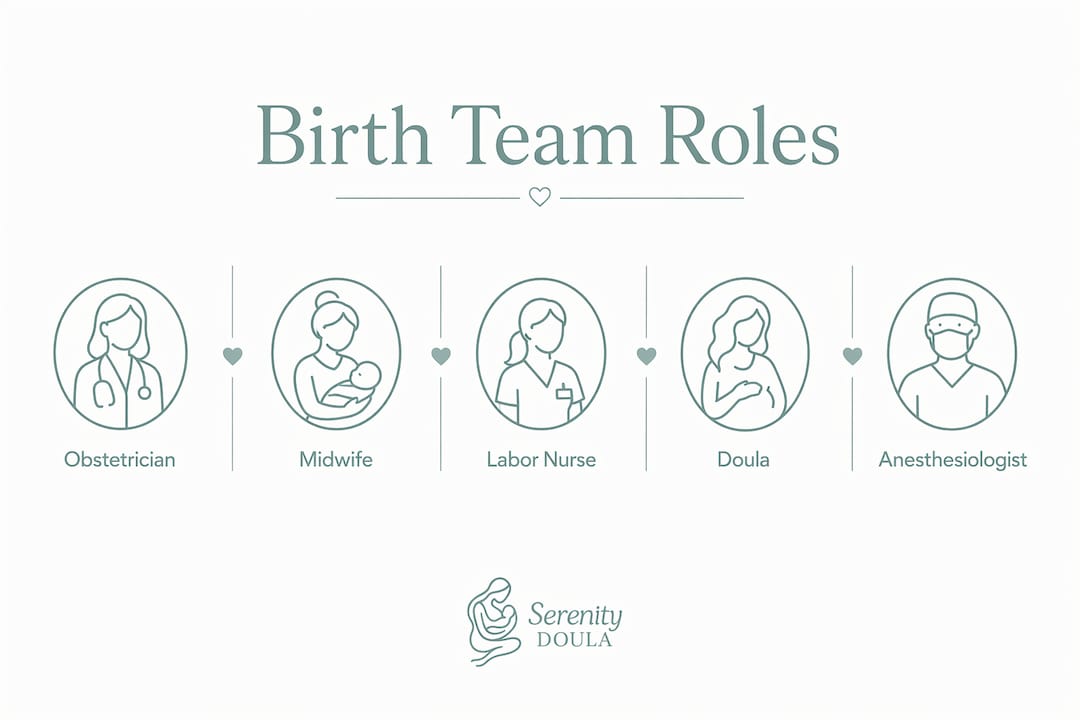
Labor and delivery nurses are often the most present clinical face you see during labor. Nurses monitor your baby, manage IVs, carry out procedures, and document care continuously. Midwives, by contrast, focus on guiding the labor process itself, offering hands-on support and clinical oversight for low-risk births.
Non-clinical support members provide emotional, physical, and informational care:
- Doula: Offers continuous emotional reassurance, physical comfort techniques, and information throughout labor and postpartum
- Birthing partner: Your chosen person, whether a spouse, partner, or family member, who provides personal presence and advocacy
- Postpartum specialist: Supports recovery, infant feeding, and newborn care in the days after birth
Understanding the difference between a doula and midwife is one of the most clarifying steps you can take early in your planning. Midwives hold clinical licenses and can deliver babies. Doulas hold no clinical role but stay by your side the entire time, which is something most nurses and physicians cannot do.
How does continuous support improve birth outcomes?
Continuous labor support produces measurable improvements in birth outcomes. Midwife-led continuous support increases spontaneous vaginal delivery rates from 55.8% to 81.2% and reduces episiotomy by 8.8%. That shift represents a meaningful reduction in surgical intervention for families who want a physiologic birth.
The benefits extend well beyond delivery itself. Breastfeeding initiation rises by 16.5% when continuous labor support is present. For new parents in Bucks County navigating the early days at home, that head start on feeding makes a real difference.
Community-based doula programs add another layer of benefit. Doulas engage clients starting in pregnancy, continue through labor, and follow up postpartum with breastfeeding support. This model reduces prematurity rates, lowers cesarean delivery rates, and addresses care inequities that affect underserved families. Economic analysis also shows a net monetary benefit from doula involvement, largely by reducing prematurity-associated costs.
Key outcomes linked to continuous labor support include:
- Reduced cesarean section rates
- Lower rates of preterm birth and low birthweight
- Decreased use of episiotomy
- Higher rates of spontaneous vaginal delivery
- Improved early breastfeeding initiation
- Greater parental confidence and reduced stress during labor
Pro Tip: When writing your birth plan, specify that you want continuous support present from early active labor. Share this preference with your OB or midwife at Trinity Health St. Mary or your Doylestown-area hospital before your due date.
What is TeamBirth and how does it improve communication in the birth room?
TeamBirth is a structured communication model developed to align everyone in the birth room, including nurses, doulas, partners, and clinicians, around a shared plan. The core tool is a bedside huddle: a brief, structured conversation that happens at key moments during labor. A whiteboard in the room captures the plan so everyone stays on the same page.
Structured bedside huddles are linked to improved patient-reported trust and autonomy, especially during complicated births. That matters because complicated labors are precisely when communication tends to break down and parents feel most out of control.
Experienced teams use huddles to align medical and support staff, which significantly increases the birthing parent’s sense of autonomy. Doulas play an active role in these huddles by helping parents articulate their preferences and understand what the clinical team is recommending.
Here is how families can engage with the TeamBirth model:
- Ask your hospital or birth center whether they use structured bedside huddles
- Request that your doula be included in any team check-ins during labor
- Use the whiteboard or shared plan to note your top priorities (pain management preferences, delayed cord clamping, skin-to-skin contact)
- Ask your nurse to walk you through any change in the plan before it happens
Pro Tip: Before your birth, ask your care provider: “Does your team use structured communication huddles during labor?” If they do, ask how your doula and partner can participate. If they do not, your doula can still facilitate informal check-ins to keep everyone aligned.
How can families choose and coordinate their birth team?
Choosing your birth team is one of the most practical things you can do to prepare for labor. Start by clarifying what kind of birth experience you want, then build the team around that vision.
When interviewing potential doulas, ask questions that reveal their approach to birth team collaboration. Do they communicate with your OB or midwife before labor? Have they worked at your planned birth location? How do they handle situations where the birth plan changes?
For partners and family members, clarity about roles prevents confusion in the room. A partner who knows their job, whether that is counter-pressure, holding your hand, or speaking to the nurse, feels calmer and more useful. Serenity Doula works directly with partners to help them show up confidently. You can also explore how partners support childbirth with specific techniques before labor begins.
Key considerations for coordinating your birth team:
- Confirm each person’s role and availability before your due date
- Share your birth preferences with every team member, not just your OB
- Ask your doula to introduce herself to your labor nurse when you arrive
- Discuss communication preferences: who speaks first, who asks questions
- Plan for flexibility, because birth rarely follows a script exactly
Doula care integration works best when roles are clearly defined and the institution supports collaboration. Choosing a doula who has experience at your specific hospital makes that coordination much smoother.
Key Takeaways
A coordinated birth team, combining clinical expertise with continuous personal support, produces better outcomes and a more confident birth experience for families.
| Point | Details |
|---|---|
| Define each role clearly | Know what your OB, nurse, midwife, and doula each handle before labor starts. |
| Continuous support changes outcomes | Midwife-led continuous support raises spontaneous vaginal delivery rates from 55.8% to 81.2%. |
| TeamBirth huddles build trust | Structured bedside check-ins improve patient autonomy, especially during complicated births. |
| Partners need a defined role | Partners who know their specific job feel calmer and provide more effective support. |
| Start coordination early | Introduce your doula to your care team before labor and share your birth plan with everyone. |
What I have learned from years of Bucks County birth work
After more than a decade attending births across Bucks County, including at Trinity Health St. Mary and hospitals in Newtown and Doylestown, the pattern I see most often is this: families who struggle during labor are almost never struggling because of a medical problem. They are struggling because nobody in the room is talking to each other.
The clinical team is focused on safety, which is exactly what they should be doing. But that focus leaves a gap. Nobody is translating what the monitor readings mean for the parents. Nobody is reminding the partner how to help. Nobody is asking the birthing parent what they need right now. That is the gap a doula fills, and it is not a small one.
I have also seen what happens when a birth team clicks. The nurse introduces herself and asks about the birth plan. The doula checks in with the nurse about the monitoring schedule. The partner knows to offer counter-pressure during contractions. The OB walks in for delivery and the room is calm. That calm is not accidental. It is built in the weeks before labor through intentional planning and clear communication.
If you are building your team right now, I would encourage you to think of your doula not as an add-on but as the connective tissue that holds the rest of the team together. The evidence supports it. The families I have worked with feel it. And the births I have attended with strong, coordinated teams are consistently the ones parents describe as empowering, even when things did not go exactly as planned.
— Alexis Wallace
How Serenity Doula supports your birth team
Serenity Doula offers personalized pregnancy and birth support designed to integrate with your full clinical team. From prenatal meetings where we map out your birth preferences together, to continuous labor support and postpartum follow-up, every service is built around your specific needs. Serenity Doula works alongside your OB, midwife, and labor nurses at Bucks County hospitals to make sure communication stays clear and you stay grounded throughout labor. Families in Newtown, Doylestown, and the surrounding area can also explore childbirth education to prepare every member of their team before labor begins. Reach out today to schedule a free consultation and start building the team that is right for you.
FAQ
What does a birth team include?
A birth team includes clinical members such as an obstetrician, midwife, labor and delivery nurse, and anesthesiologist, as well as support persons like a doula, partner, and postpartum specialist. Each member serves a distinct role during labor and delivery.
What is the role of a doula in the birth team?
A doula provides continuous emotional reassurance, physical comfort, and information throughout labor, filling the support gap that clinical staff cannot cover due to their medical responsibilities. Doula involvement also improves communication between families and their clinical team.
How does continuous labor support affect birth outcomes?
Continuous labor support significantly improves outcomes, raising spontaneous vaginal delivery rates and increasing breastfeeding initiation by 16.5% while reducing cesarean rates and episiotomy.
What is the TeamBirth model?
TeamBirth is a structured communication framework that uses bedside huddles and a shared whiteboard to align nurses, doulas, partners, and clinicians around a common birth plan. It is linked to greater patient trust and autonomy during labor.
How do I choose the right birth team members?
Start by identifying your birth preferences, then interview doulas and care providers who have experience at your planned birth location. Ask each person how they communicate with the rest of the team, and confirm roles clearly before your due date.