

Private postpartum care is paid, personalized support for a new mother and baby at home or in a dedicated facility during the weeks after birth. It covers physical recovery, feeding help, and newborn care from a postpartum doula, newborn care specialist, or maternity nurse, as opposed to the limited follow-up a hospital or single six-week checkup provides. It fits any family who wants steady, hands-on help rather than piecing together advice from a stack of parenting books. March of Dimes outlines how these roles differ, and later sections walk through how to hire well.
TL;DR:
- Private postpartum care costs vary based on the provider’s experience, location, and whether services are hourly, nightly, or bundled into packages.
- Most roles are unregulated, so certifications and references are more reliable indicators of quality than job titles alone.
- Combining daytime postpartum doulas with overnight newborn care specialists is a common approach to ensure full coverage during recovery.
- Insurance coverage for non-medical postpartum services is limited but expanding through employer benefits, FSAs, HSAs, and state Medicaid pilots.
- Early weeks typically involve structured support focused on maternal recovery, infant feeding, and establishing sleep routines, with clear scope and safety protocols.
Table of Contents
- What Does Private Postpartum Care Actually Include?
- Postpartum Doula or Newborn Care Specialist: Which Do You Need?
- How Do Overnight Shifts, Day Visits, and Retreats Work?
- What Does Private Postpartum Care Cost?
- How Do You Vet and Hire a Private Postpartum Provider?
- What Happens in the First Two Weeks of Care?
- Does Insurance Cover Private Postpartum Care?
- A Doula’s Take on What Private Postpartum Care Really Changes
- How Serenity Doula Supports Bucks County Families
- Sources
- FAQ
What Does Private Postpartum Care Actually Include?
Private postpartum care isn’t one job. It’s a category that covers several distinct roles, each built around different priorities.
- Postpartum doulas focus on the whole family: maternal recovery, emotional adjustment, feeding education, and light household support so parents can rest.
- Newborn care specialists (NCS) center on the baby: feeding logistics, sleep routines, and developmental cues, often overnight.
- Maternity nurses, more common in high-touch private arrangements, blend infant care with a more clinical eye toward routine and schedule, typically for concentrated stretches of six to twelve weeks.
- Postpartum retreats move the whole experience out of the home, into a staffed facility with round-the-clock care.
Families lean on daytime doula visits when they need coaching and emotional support, and shift to overnight NCS coverage when survival sleep is the priority. Here’s something worth knowing before you hire anyone: most of these titles aren’t regulated. “Postpartum doula,” “night nanny,” and “newborn care specialist” carry no universal licensing standard, so the title on a resume tells you less than the certifications and references behind it.
Postpartum Doula or Newborn Care Specialist: Which Do You Need?
The cleanest way to think about it: a postpartum doula supports the mother and the family system, while a newborn care specialist supports the infant’s routine. Both are non-medical roles, but they solve different problems at different hours.
- Postpartum doulas usually work daytime shifts of four to eight hours, coaching on feeding, helping process the emotional weight of new parenthood, and doing light tasks like meal prep or laundry so the mother can rest or bond with the baby.
- Newborn care specialists typically work overnight, an eight to twelve hour shift, handling bottle feeds, soothing, and sleep training so exhausted parents can actually sleep.
- Combining both is common among families who want full coverage: a doula during the day for recovery and guidance, an NCS overnight for sleep protection. The NCSA’s comparison of the two roles confirms this pairing is standard practice, not a luxury add-on.
Pro Tip: Ask each candidate directly what they will and won’t do. A doula who says “I don’t do overnight infant care” and an NCS who says “I don’t provide maternal emotional support” are being honest about scope, not limited in skill.
How Do Overnight Shifts, Day Visits, and Retreats Work?
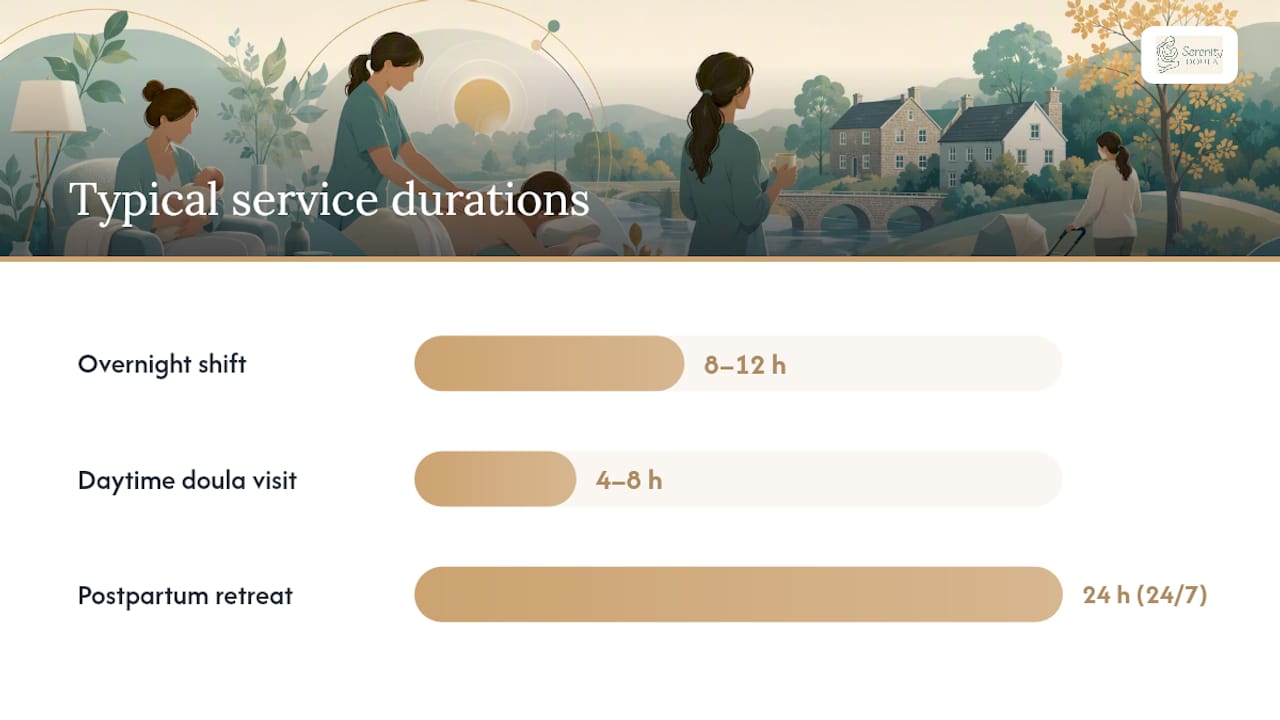
A typical overnight NCS or night nurse shift runs eight to twelve hours, often 9 p.m. to 7 a.m., with bottle prep, diaper changes, soothing, and sleep coaching built in. Daytime doula visits tend to run four to eight hours and can be booked as single visits or in blocks across a week.
During a shift, expect:
- Latch coaching and feeding support within the provider’s training scope
- Soothing techniques and sleep environment guidance
- Bottle prep, sterilizing, and basic newborn hygiene
- Light household tasks like laundry, meal prep, or tidying the nursery
Postpartum retreats sit at the far end of the spectrum. These short-stay facilities bundle meals, massage or other therapies, and 24/7 staff support into one intensive package, often priced at a high nightly rate with a minimum stay requirement. Booking usually needs to happen months ahead, since spots fill fast in the third trimester.
What Does Private Postpartum Care Cost?
Pricing generally follows one of three shapes: hourly rates for daytime doula visits, nightly rates for overnight NCS coverage, or flat package rates for multi-week bookings. Cost climbs with location, the provider’s experience level, and whether you’re booking through an agency or an independent contractor.
Budgeting realistically means accounting for:
- Higher rates in metro areas versus rural coverage zones
- A premium for overnight shifts compared to daytime hours
- Package discounts for multi-week or multi-night commitments
- Agency fees layered on top of the caregiver’s base rate
Statistic Spotlight: Some states and pilot programs are actively expanding Medicaid and private benefit coverage for doula services, a sign that reimbursement pathways for this kind of care are widening, not shrinking.
Before you assume you’re paying entirely out of pocket, ask your employer about postpartum or parental benefits, check whether an FSA or HSA covers doula services, and look into whether your state has a Medicaid doula pilot. It’s a five-minute question that can meaningfully change your budget.
How Do You Vet and Hire a Private Postpartum Provider?
Hiring well comes down to asking the right questions before you sign anything, not after.
- Ask about training and certification. Has the provider completed a recognized postpartum doula or NCS training program, and do they hold infant safe-sleep certification aligned with AAP guidance or Cribs for Kids?
- Request a background check and vaccination proof. Anyone spending unsupervised hours with your newborn should be able to provide both without hesitation.
- Ask for verifiable references. A provider with real experience will have past clients willing to talk, not just a testimonials page.
- Clarify scope and escalation. What happens if they notice something concerning, medically? Who do they call, and how fast?
Red flags are usually obvious once you’re looking for them: no written contract, vague job duties, or a reluctance to provide references. A strong contract spells out hours, specific duties, hourly or nightly rates, a cancellation policy, confidentiality terms, and a clear emergency escalation plan.
Pro Tip: Ask for a written scope of practice that lists what’s in bounds and what isn’t, like bottle prep and soothing on one side, medication administration and wound care on the other. It protects both you and the provider from confusion at 3 a.m.
What Happens in the First Two Weeks of Care?
The first two weeks usually follow a predictable rhythm: an intake call before birth, an orientation visit in the first days home, then a steady cadence of feeding support and sleep protection strategies as the fog of early recovery lifts.
A typical daytime doula visit checklist includes a practical new mom self-care checklist with steps to support recovery and wellbeing:
- Checking in on physical recovery and pain levels
- Feeding support, whether breastfeeding, pumping, or bottle
- Light meal prep or household tasks
- Emotional check-in and postpartum mood screening conversation
An overnight NCS shift checklist typically covers:
- Full overnight feeding and diaper rotation
- Sleep environment setup and safe-sleep practices
- Soothing techniques tailored to the baby’s temperament
- A morning handoff summary for parents
A good provider will also recognize when something is beyond their scope, and gently encourage a call to your OB, midwife, or pediatrician rather than trying to manage a medical concern themselves.
Does Insurance Cover Private Postpartum Care?
Coverage for private postpartum care remains inconsistent across the country, and it’s one of the most common points of confusion for families budgeting for support. Traditional health insurance rarely covers postpartum doula or NCS services directly, since these are non-medical roles rather than clinical care.
That gap exists partly because hospital-based postpartum follow-up is thin to begin with. Most major hospitals provide strong inpatient support, including lactation consultants and physical therapy resources, but the routine postpartum medical visit is often scheduled around six weeks after birth, leaving weeks of recovery with no built-in check-in. Private postpartum care fills exactly that stretch, which is why more families are asking their insurers and employers directly about it rather than assuming it’s excluded.
A few paths are worth exploring before you write off reimbursement entirely. Some employer-sponsored benefit packages now include a postpartum or parental support stipend, separate from standard medical coverage. FSA and HSA funds can sometimes apply to doula services depending on plan rules, so it’s worth calling your plan administrator and asking directly rather than guessing. And a growing number of state Medicaid programs have piloted doula coverage, though eligibility and covered services vary widely by state.
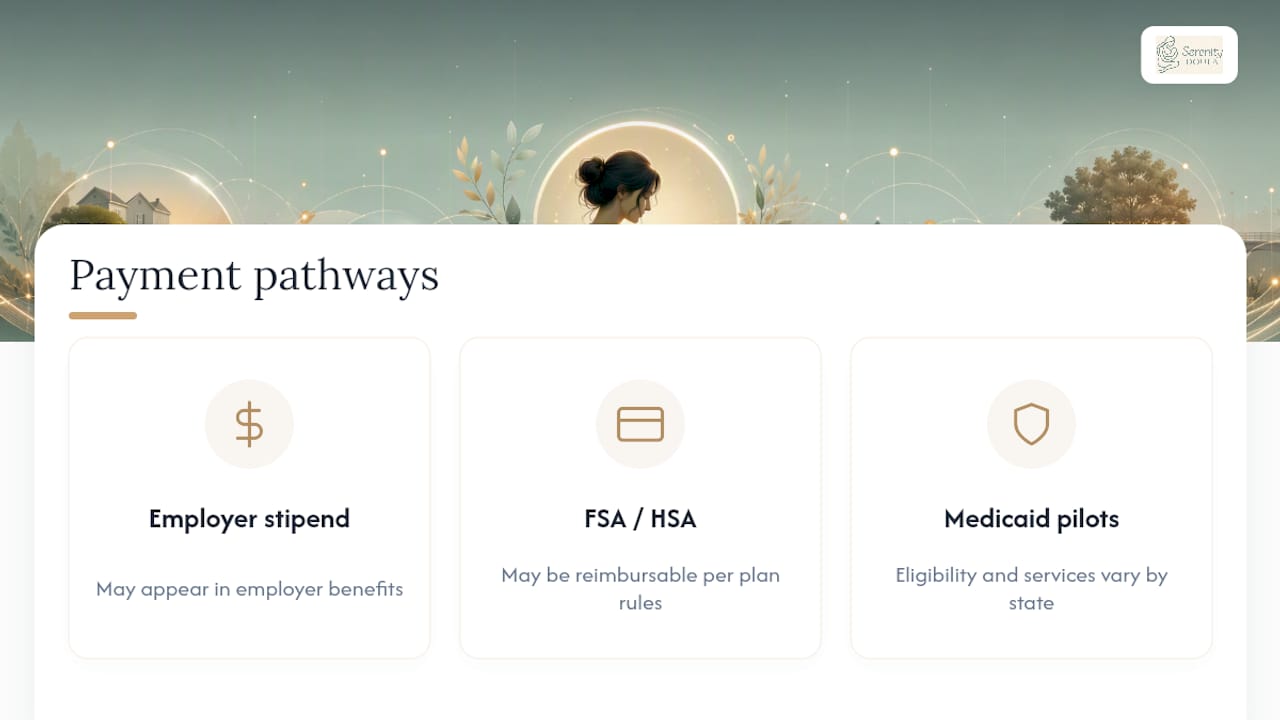
Ask your provider or insurer these specific questions: Does my plan classify doula or postpartum support services as reimbursable under any benefit category? Does my employer offer a parental or postpartum stipend separate from medical insurance? Is there an active Medicaid doula pilot in my state, and do I qualify? None of these questions require a medical background to ask, and the answers can shift your budget considerably.
A Doula’s Take on What Private Postpartum Care Really Changes
The biggest shift I see isn’t logistical. It’s the space it creates. When a family has real support in those first weeks, something loosens. Parents stop white-knuckling through every feeding and start actually learning their baby’s cues.
I think of one family who came in exhausted, convinced something was wrong because their newborn wouldn’t settle without being held constantly. A few visits in, once the schedule stabilized and the parents had someone coaching them through soothing techniques, the anxiety dropped out of the room. The baby was fine. The parents just needed someone steady beside them long enough to believe it.
That’s the real value: not doing the parenting for someone, but standing close enough that confidence has room to grow.
— Alexis Wallace
How Serenity Doula Supports Bucks County Families
Serenity Doula is the high-touch alternative to piecing together postpartum help from a rotating cast of unfamiliar caregivers, built specifically around Bucks County families who want continuity, not a new face every visit.
Serenity Doula’s postpartum offerings are built around what families in Newtown, Doylestown, and across Bucks County actually ask for:
- In-home postpartum visits with a consistent, familiar doula
- Overnight support for families prioritizing sleep recovery
- Follow-up sessions tied to your childbirth education plan
- Virtual check-ins for quick questions between visits
Every plan is built around your specific recovery, not a generic template, and grounded in evidence-informed practice rather than guesswork. If you deliver at Trinity Health St. Mary or anywhere else in the region, Serenity Doula coordinates around your actual circumstances. Ready to talk through what your first few weeks could look like? Book a free consultation and let’s map out a plan that fits your family.
This article is general information, not a substitute for advice from a qualified doctor. Consult a qualified healthcare professional about your own circumstances before acting on anything here.
Sources
- March of Dimes — Role of postpartum doulas and mental health support
- Beth Israel Deaconess Medical Center — Postpartum care overview
- Thrillist — Postpartum retreats in the U.S.
FAQ
How Much Does It Cost to Go Private When Giving Birth?
Costs vary widely by role and hours, with hourly doula rates, nightly NCS rates, and package pricing for multi-week maternity nurse arrangements all common; location and agency fees are the biggest swing factors.
What Is the 5-5-5 Rule in Postpartum?
It’s a common recovery guideline suggesting five days in bed, five days on the bed, and five days near the bed, giving the body a structured runway to heal before returning to normal activity. Ask your OB or midwife whether it fits your specific recovery.
Is Vulvar Pain Normal After Giving Birth?
Some soreness and swelling in the first days after a vaginal birth is common as tissue heals, but pain that’s severe, worsening, or accompanied by fever warrants a call to your provider rather than waiting it out.
How Long Should I Use a Peri Bottle After Birth?
Most people use a peri bottle for one to two weeks after a vaginal birth, tapering off as soreness fades, though your own timeline depends on your recovery and any stitches. When in doubt, ask your provider what they recommend for your specific case.