

TL;DR:
- Newborn eye ointment, primarily erythromycin, prevents serious bacterial eye infections that can cause blindness.
- While evidence supports universal prophylaxis, holistic families may question its necessity, emphasizing individualized care.
One simple tube of ointment, applied within minutes of your baby’s first breath, has quietly prevented a form of newborn blindness for well over a century. And yet, for parents planning holistic or low-intervention births, this routine procedure raises real questions. Newborn eye ointment, primarily erythromycin, is used to prevent a serious bacterial eye infection that, left untreated, can cause permanent vision loss. Understanding the evidence behind this practice, alongside the ongoing debates, helps you make a confident, values-driven choice for your baby.
Table of Contents
- Why newborn eye ointment is used: The evidence and history
- What does the research say about effectiveness?
- Comparing ointment options: Safety, cost, and effectiveness
- Universal versus targeted prophylaxis: Debates and holistic perspectives
- Practical guidance for informed decision-making
- Our perspective: Beyond mandates, finding what’s truly best for each family
- Holistic support for your informed birth journey
- Frequently asked questions
Key Takeaways
| Point | Details |
|---|---|
| Prevents major infections | Eye ointment protects newborns from serious infections like ophthalmia neonatorum linked to untreated maternal STIs. |
| Multiple ointment options | Erythromycin is standard in the US, but povidone-iodine and others may be used in different settings or countries. |
| Safety and side effects | Most ointments cause only mild side effects, but some, like silver nitrate, are rarely used due to irritation. |
| Informed parental choice | Discuss birth setting policies and your preferences early to make empowered, evidence-based decisions. |
| Support for every approach | Collaborative care helps families integrate medical and holistic values for the best outcomes. |
Why newborn eye ointment is used: The evidence and history
The moment your newborn arrives, a short list of routine procedures begins. Eye ointment is among the first. But why?
The primary goal is to prevent ophthalmia neonatorum (ON), a severe eye infection that newborns can contract when passing through a birth canal exposed to bacterial infections, especially gonorrhea. Before prophylactic ointment became standard practice, ON was one of the leading causes of childhood blindness in the United States.
Here is what the ointment is designed to protect against:
- Gonorrheal ON: The most dangerous form, capable of causing corneal scarring and blindness within days of birth
- Chlamydial ON: A slower-developing infection that can also affect eye health
- Other bacterial exposures: General protection against pathogens encountered during delivery
The evidence for universal prophylaxis is supported by both the CDC and the U.S. Preventive Services Task Force (USPSTF), who recommend applying ointment within the first 24 hours of birth for all newborns, regardless of maternal STI status.
“The goal isn’t to question every parent’s lifestyle, it’s to create a safety net broad enough to catch the cases that fall through screening gaps.”
For families planning holistic or home births, this procedure can feel at odds with a low-intervention philosophy. That tension is real, and it’s worth exploring through an evidence-based birth framework so your choices feel grounded rather than pressured.
What does the research say about effectiveness?
Knowing why ointment is used is one thing. Knowing how well it works is another.
A major Cochrane review of 12 studies found that prophylaxis does reduce the overall risk of acute eye infections in newborns at one month of age. The evidence suggests roughly a 35% lower relative risk for any acute eye infection. However, the evidence for preventing specifically gonococcal ON cases was rated as moderate to low quality, largely because gonorrhea rates in study populations were often too low to generate statistically clear results.
| Outcome measured | Finding | Evidence quality |
|---|---|---|
| All-cause acute eye infection | ~35% relative risk reduction | Moderate |
| Gonococcal-specific prevention | Uncertain | Low |
| Blindness prevention | No direct published data | Insufficient |
| Safety profile | Mild, temporary side effects | High |
This doesn’t mean ointment isn’t effective. It means the research reflects the challenge of studying a rare outcome in diverse populations. The prevention of ON, particularly in settings where maternal STI screening isn’t perfect, still rests heavily on universal treatment.
Statistic spotlight: Across the 12 studies reviewed, no prophylactic ointment type was found to be clearly superior to another, though povidone-iodine showed promise in lower-resource settings.
Pro Tip: Ask your provider not just if they use ointment, but when it will be applied. Some families request a brief delay for skin-to-skin bonding time, which many hospitals now accommodate. You’ll find helpful context in these soothing newborn tips as well.
Comparing ointment options: Safety, cost, and effectiveness
Not all eye ointments are the same. The type your hospital uses may depend on availability, cost, and local or national guidelines.

Here is a breakdown of the most common options:
| Ointment | Status in US | Effectiveness | Common side effects |
|---|---|---|---|
| Erythromycin | Standard | Moderate broad protection | Mild irritation, blurred vision |
| Silver nitrate | Discontinued | Historically effective | High rate of chemical conjunctivitis |
| Povidone-iodine | Not FDA-approved | Broad coverage, promising | Low toxicity, minimal irritation |
| Gentamicin | Used in shortages | Limited data | Eye irritation, adverse reactions |
| Tetracycline | Rarely used | Similar to erythromycin | Mild irritation |
According to published clinical guidance, erythromycin remains the U.S. standard due to its low cost and mild side effect profile. Silver nitrate, once widely used, was largely discontinued because of its high rate of causing chemical conjunctivitis, a reaction that ironically looked like an infection. Povidone-iodine is used in many other countries and shows a favorable safety profile, but it has not yet received FDA approval for this specific use.
Key considerations for families weighing options:
- Erythromycin is widely available and well-studied in U.S. hospital settings
- Povidone-iodine is considered promising internationally but is not currently a standard U.S. option
- Gentamicin may appear if erythromycin is in short supply, but carries a higher risk of adverse reactions
- All options cause temporary blurring of vision, which clears within a few hours
If you’re planning a natural birth and want to discuss ointment specifics with your provider, knowing these distinctions puts you in a much stronger position to have that conversation.
Universal versus targeted prophylaxis: Debates and holistic perspectives
Here is where the conversation gets more nuanced. Should every baby receive ointment, regardless of individual risk factors? Or should the decision depend on whether the mother has been screened and treated?
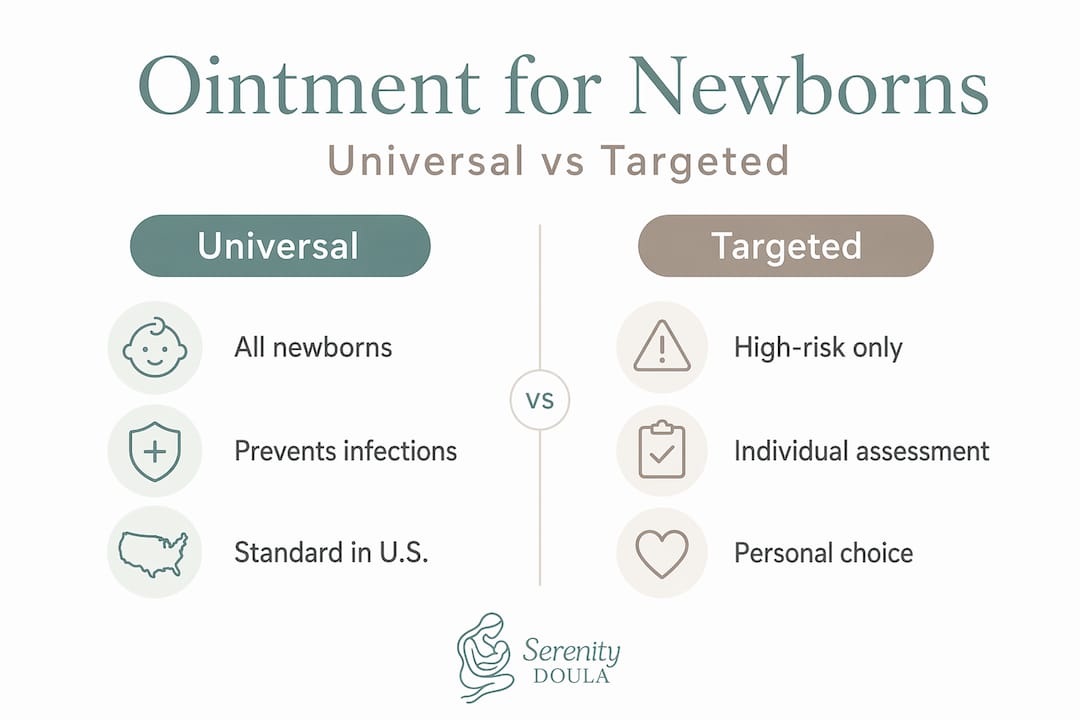
In the U.S., universal prophylaxis is still recommended or legally required in most states. But globally, the picture looks different. Several countries have moved toward risk-based or screening-based policies, where ointment is only applied if maternal STI status is unknown or positive.
Here are the key questions to think through before your birth:
- Has your maternal STI screening been completed, including gonorrhea and chlamydia testing?
- What is your state’s current policy on newborn eye prophylaxis?
- Does your birth setting (hospital, birth center, home) have a specific protocol?
- If you’re considering declining, have you documented your informed refusal and discussed it with your care team?
- What backup plan is in place if any concern arises after birth?
For families choosing holistic birth preparation, this conversation should start well before your due date.
“Universal prophylaxis exists not because providers distrust parents, but because screening systems are imperfect and the cost of missing one case is catastrophic.”
Pro Tip: If you’re planning a home birth or working outside a traditional hospital setting, confirm your midwife’s protocol around newborn eye care and have a clear discussion about STI screening timelines.
Practical guidance for informed decision-making
Knowledge is powerful. But what do you actually do with it? Here are concrete steps to take during your birth planning process:
- Discuss ointment early. Bring it up during a prenatal appointment, not in the delivery room. Policies and exemptions vary by state and provider.
- Request your STI screening results. Confirm that gonorrhea and chlamydia tests are part of your prenatal panel and that results are documented.
- Ask about timing flexibility. Many providers will delay ointment application for a short window, such as one to two hours, for uninterrupted skin-to-skin time.
- Understand your rights. If you choose to decline, most settings require a signed informed refusal document. Know what that means for your baby’s care.
- Work with a knowledgeable support person. A doula or childbirth educator can help you ask the right questions and advocate for your preferences calmly.
The primary prevention of ON starts with complete maternal STI screening and treatment. Eye ointment is the safety net, not the starting point. When you understand that distinction, the decision feels much clearer. Your birth preparation guide is a great place to start building that picture.
Our perspective: Beyond mandates, finding what’s truly best for each family
We’ve supported hundreds of families through birth planning conversations, and here is what we know to be true: the struggle usually isn’t about information. Parents who research newborn eye ointment are not confused about what it does. They’re navigating a deeper tension between institutional policies and personal values, and they’re often doing it without anyone truly in their corner.
Holistic birth and evidence-based medicine are not opposites. They can, and should, coexist. Universal prophylaxis policies were built to protect vulnerable babies in a wide range of circumstances. But those policies were never meant to replace genuine, individualized conversations between parents and their care team.
What we’ve seen repeatedly is that parents feel most at peace when they’ve been heard, not just informed. When a provider explains the reasoning behind ointment rather than simply announcing it, everything shifts. When a doula helps a family articulate their questions without judgment, the whole experience feels different.
You deserve to approach every decision, including this one, with clarity and support. That’s what personalized evidence-based birth looks like in practice. Not choosing between holistic values and medical protection, but integrating both into a birth plan that truly reflects your family.
Holistic support for your informed birth journey
Making decisions like this one doesn’t have to feel isolating. When you have the right support around you, every question becomes a conversation instead of a confrontation.

At Serenity Doula, we offer pregnancy and birth support designed to help you feel grounded, respected, and genuinely prepared. Our childbirth education classes walk you through evidence-based information on everything from newborn procedures to labor comfort, so nothing catches you off guard. And if a difficult birth experience has left you with unresolved questions or emotional weight, our birth trauma recovery resources are here to help you heal. You don’t have to carry this alone.
Frequently asked questions
Is newborn eye ointment legally required in every state?
Most U.S. states mandate newborn eye ointment, but some allow informed refusal, so check your local policy well before your due date.
Are there natural alternatives to standard eye ointment?
Povidone-iodine is considered a lower-toxicity alternative used in some countries, but it is not currently FDA-approved for this use in the United States.
What happens if I decline the eye ointment for my newborn?
Your baby may face a higher risk of severe eye infection if maternal STI status is unknown or untreated, and the risk of blindness from untreated ON is real. Some providers will require a signed informed refusal document.
Does eye ointment affect bonding or vision in the first hours?
Ointment may cause temporary blurring of your baby’s vision for the first hour or two, but bonding is not meaningfully affected and vision clarity returns quickly on its own.
Can I ask for a specific ointment brand or decline certain types?
In some settings you can discuss preferences, but product availability is limited. Raise this during a prenatal appointment so your provider has time to explore options with you.