

Staying upright, keeping hydrated, and moving your body are the three safest first steps to help move labor along at home. Walking, gentle pelvic rocking, and leaning forward on a birth ball all use gravity to encourage your baby to descend and press against your cervix. When you’re at or past 39 weeks, a membrane sweep performed by your clinician can meaningfully increase the chance of spontaneous labor within 48 hours, according to clinical evidence from the AAFP. None of these approaches require special equipment or a hospital stay, but every one of them deserves a quick conversation with your provider first.
Here are the three most practical things to try at home right now:
- Walk or change positions every 30–60 minutes to encourage fetal descent through gravity.
- Eat a light snack and drink water or electrolytes to keep your energy and uterine function supported.
- Try hands-and-knees or leaning forward to relieve back pressure and open your pelvis.
One firm safety note: never attempt clinical procedures at home. Membrane sweeps, amniotomy, and any form of cervical manipulation belong in a provider’s office or hospital. Mayo Clinic and ACOG both emphasize that your individual medical history determines which methods are appropriate for you.
Key Takeaways
Upright movement, hydration, and a clinician-performed membrane sweep after 39 weeks are the most evidence-supported ways to help labor progress safely.
| Point | Details |
|---|---|
| Move upright early | Walking, squatting, and hands-and-knees positions use gravity to encourage fetal descent and cervical pressure. |
| Hydrate and fuel consistently | Drinking water and eating light snacks throughout early labor supports uterine function and your stamina. |
| Membrane sweep after 39 weeks | A clinician-performed sweep increases the chance of spontaneous labor within 48 hours and may reduce the need for formal induction. |
| Know your red flags | Heavy bleeding, absent fetal movement, or fluid leaking means call triage immediately, not later. |
| Serenity Doula supports your plan | Continuous doula support from Serenity Doula keeps you moving, informed, and connected to your care team throughout labor. |
Table of Contents
- Who should try these methods, and when is it safe?
- 1. Walking and upright positions help your baby descend
- 2. Exercises and home techniques worth trying (and a few to skip)
- 3. What clinical options can do that home methods can’t
- 4. Red flags to watch for and questions to bring to your provider
- 5. How continuous support helps labor move forward
- What I’ve learned from years of early-labor support
- Serenity Doula is here for every stage of early labor
- Sources
- FAQ
Who should try these methods, and when is it safe?
Not every technique is right for every pregnancy, and timing matters more than most people realize.
The general rule of thumb: wait until at least 39 weeks before trying anything intended to encourage labor. Before 37 weeks, your baby is preterm, and any attempt to speed things along carries real risk. Between 37 and 39 weeks, your baby is technically full-term but may still benefit from more time, so most providers prefer to wait unless there is a clinical reason to move sooner. NHS guidance confirms that even membrane sweeps are typically offered after 39 weeks.
Medical contraindications to self-help methods include:
- Previous classical (vertical) uterine incision from a prior cesarean
- Placenta previa or low-lying placenta
- Unexplained vaginal bleeding
- Fetal concerns flagged at a recent appointment
- Multiple gestation with specific provider restrictions
Stop what you’re doing and call your provider immediately if you notice:
- Heavy or bright-red vaginal bleeding
- Decreased or absent fetal movement
- Regular, painful contractions accompanied by bleeding or fluid leaking
- Fever, chills, or signs of infection
- Sudden severe headache or vision changes
Pro Tip: When calling your clinician, try this script: “I’m [X] weeks pregnant and I’d like to try [specific method] to help move things along. Given my history, is that safe for me? What signs should I watch for, and when should I call you back?”
1. Walking and upright positions help your baby descend
Gravity is genuinely your ally in labor. When you stay upright and move, your baby’s head presses more consistently against your cervix, which signals your body to release prostaglandins and stimulate contractions. Lying flat for long stretches removes that pressure and can slow progress.
Here are the positions that work best and when to use them:
- Walking (pre-labor and early labor): Aim for 20–30 minutes at a comfortable pace. Slow, deliberate steps with a slight forward lean are more effective than a brisk pace. Your partner can walk beside you and offer a hand or forearm for balance.
- Hands-and-knees (early and active labor): Get on all fours on a yoga mat or bed. Rock your hips gently side to side. This position takes pressure off your back and can help rotate a posterior baby.
- Leaning on a counter or birth ball (early labor): Stand and drape your arms over a kitchen counter or birth ball at hip height. Let your belly hang forward. This opens the pelvis and gives your lower back a rest.
- Supported squats (active labor): Hold a squat bar, your partner’s hands, or a sturdy chair back. Lower slowly, hold for 5–10 seconds, then rise. Squatting widens the pelvic outlet by a meaningful amount.
- Lunges (early labor): Place one foot on a step or low chair and lunge sideways, holding for 3–5 contractions per side. This asymmetric position can help a baby who is slightly off-center find a better angle.
- Slow dancing or swaying (any stage): Wrap your arms around your partner’s neck and sway. The rhythmic hip movement keeps the pelvis mobile and the mood calmer.
Pro Tip: Ask your partner to place one hand on your lower back during walking or swaying and apply gentle, steady pressure. That simple counterpressure keeps you grounded and gives your partner something concrete to do.
For a deeper look at how movement supports labor, the tips for labor progress resource from Serenity Doula walks through stage-by-stage positioning in plain language.
2. Exercises and home techniques worth trying (and a few to skip)
Low-risk exercises with practical how-to cues
Pelvic tilts: Lie on your back with knees bent, or get on hands and knees. Tilt your pelvis forward and back in a slow, controlled rhythm. Ten repetitions, two or three times a day, keeps the pelvis mobile and can relieve lower back tension.

Birth ball bouncing: Sit on a properly inflated birth ball (your hips should be level with or slightly above your knees). Bounce gently or trace slow figure-eights with your hips. Twenty minutes of this is enough to feel the difference. It encourages fetal descent while giving your legs a rest from standing.
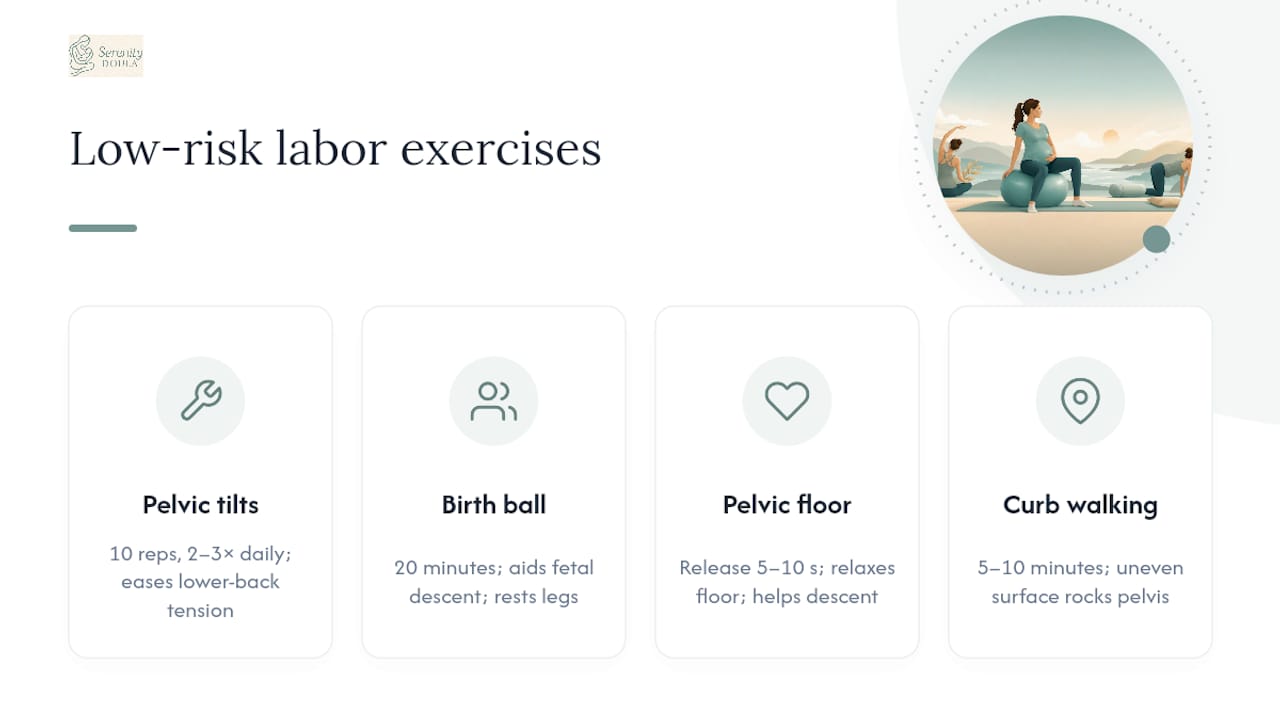
Pelvic floor release: Sit comfortably and consciously soften your pelvic floor muscles, the same ones you’d use to stop urinating. Holding tension there can slow descent. Practice releasing for 5–10 seconds at a time, especially during contractions.
Curb walking: Walk with one foot on the curb and one on the street, alternating sides every few steps. The uneven surface creates a gentle rocking motion through the pelvis. Five to ten minutes is plenty.
What the evidence actually says about common home methods
Observational data show that walking and sexual intercourse are among the most commonly used self-induction techniques, but the evidence that walking actually starts labor is limited. It may help labor progress once it has already begun, which is a meaningful distinction.
- Dates: Small studies suggest eating dates in the final weeks of pregnancy may support cervical ripening. The risk is essentially zero, so if your provider is fine with it and you enjoy them, it’s a reasonable addition.
- Sexual intercourse: Semen contains prostaglandins, and orgasm can trigger uterine contractions. Evidence is mixed, but the risk is low for uncomplicated pregnancies. Ask your provider if your membranes are intact and there are no bleeding concerns.
- Nipple stimulation: This one has some real physiological backing. It raises oxytocin and can trigger contractions. The concern is uterine hyperstimulation, meaning contractions that come too fast or too hard. The Cleveland Clinic recommends using nipple stimulation only with clinical guidance and monitoring, not as a casual home experiment.
- Spicy food: No reliable evidence. Enjoy it if you like it, but don’t count on it.
- Castor oil: Banner Health’s clinical summary flags castor oil as lacking reliable evidence and carrying a real risk of severe diarrhea, dehydration, and uterine hyperstimulation. Skip it.
- Raspberry leaf tea and other herbs: Evidence is insufficient, and herbal remedies are not regulated for dosage or purity. Discuss any herb with your provider before using it.
For a fuller breakdown of what’s evidence-backed versus what’s popular but unsupported, the natural induction methods guide from Serenity Doula is a good next read.
Pro Tip: Acupuncture and acupressure are sometimes used as complementary approaches near the due date. A guide to acupuncture in childbirth from Parks Therapy Centre outlines what the evidence supports — worth reading before your next provider appointment.
3. What clinical options can do that home methods can’t
When home measures aren’t moving things forward, your provider has a range of clinical tools. Understanding what they are and what to expect helps you ask better questions.
Membrane sweep: A clinician inserts a gloved finger through the cervix and gently separates the amniotic sac from the uterine wall. This releases local prostaglandins that can ripen the cervix and trigger labor. According to AAFP clinical evidence, a membrane sweep increases the likelihood of spontaneous labor within 48 hours and reduces the need for formal induction. It’s typically offered at or after 39 weeks, as NHS guidance confirms, and is usually done in an outpatient setting.

For a patient-facing overview of the full range of induction options, Serenity Doula’s induction of labor methods guide is a helpful companion to this section.
For women with a favorable cervix, network meta-analysis data show that misoprostol and oxytocin with amniotomy are among the options most likely to result in vaginal delivery within 24 hours, though the comparative safety rankings between methods carry some uncertainty.
A word on timing: induction before 39 weeks without a medical indication carries real risk, including a higher chance of cesarean and neonatal complications. Non-indicated early induction is not a shortcut worth taking.
4. Red flags to watch for and questions to bring to your provider
When to call your provider or go to triage
- Vaginal bleeding heavier than spotting
- Fewer than 10 fetal movements in two hours (or a noticeable drop from your baby’s normal pattern)
- Regular contractions every 5 minutes or closer, lasting 60 seconds, for at least an hour
- Fluid leaking from your vagina (could indicate ruptured membranes)
- Fever above 100.4°F
- Severe headache, blurred vision, or sudden swelling in your face or hands
Your action plan
- Try a home measure (walking, positioning, hydration).
- Wait 30–60 minutes and reassess how you feel and how contractions are spacing.
- If contractions are regular or any red flag appears, call your provider’s triage line.
- Go in immediately if you notice heavy bleeding, absent fetal movement, or fluid leaking.
Questions to bring to your next appointment
- “Am I a candidate for a membrane sweep, and if so, when would you recommend it?”
- “Which home methods are safe given my specific history?”
- “What contraction pattern should prompt me to call triage?”
- “If I’m past my due date, what’s your induction protocol and timeline?”
- “Are there any positions or exercises I should avoid given my baby’s current position?”
5. How continuous support helps labor move forward
The presence of a knowledgeable, calm support person changes the physical experience of labor in measurable ways. PMC research shows that doula support strongly predicts increased use of non-medical techniques and better birth outcomes, including lower epidural rates and higher rates of spontaneous vaginal birth. That’s not a coincidence. A doula or engaged partner keeps you moving, breathing, and hydrated when you’d otherwise stop because you’re tired or scared.
Practical comfort measures that also help labor progress:
- Positioning cues: A doula watches for signs of stalled progress and suggests a position change before you think to ask.
- Massage and counterpressure: Hip squeezes during contractions reduce pain and keep the pelvis mobile.
- Water therapy: A warm shower or bath can ease muscle tension enough to let contractions become more regular.
- Breathing patterns: Slow, deliberate exhales through contractions prevent the breath-holding that tightens the pelvic floor.
- TENS units: Transcutaneous electrical nerve stimulation can reduce pain perception in early labor. Serenity Doula’s TENS unit guide covers the evidence and safe use in plain terms.
- Hot and cold packs: Alternating heat on the lower back and cold on the perineum gives the nervous system something to focus on other than pain.
- Hydration and light snacks: A doula or partner tracks when you last drank water and offers a snack between contractions to keep your energy from crashing.
Pro Tip: When you arrive at the hospital in early labor, tell the nurse directly: “We’d like to keep moving and try different positions. Can you show us which monitoring setup gives us the most mobility?” Most hospitals can accommodate intermittent monitoring for low-risk labors, which gives you far more freedom to move.
You can read more about the research behind evidence-based doula care and how it translates into practical labor support on the Serenity Doula site.
What I’ve learned from years of early-labor support
Early labor has a way of catching people off guard. You’ve been waiting for this moment for weeks, and then it arrives at 2 AM, and suddenly the plan feels very far away. The families I support in Bucks County most often need the same three things in those first hours: something to drink, something to do with their body, and someone to tell them they’re doing it right.
My three go-to habits for early labor:
- A hydration plan: Keep a water bottle and a small snack (crackers, dates, a banana) on the kitchen counter from 37 weeks on. When contractions start, eat and drink before you do anything else.
- A movement routine: Walk your neighborhood block, do 10 minutes on the birth ball, then rest. Repeat. Don’t lie down for hours and wait — gentle, rhythmic movement keeps things progressing.
- An energy snack strategy: Pack snacks for the hospital bag. Honey sticks, nut butter packets, and electrolyte drinks are easy to eat between contractions and keep your stamina up.
For families delivering at Trinity Health St. Mary in Langhorne, I always suggest parking in the main garage off Newtown Road and texting me when you’re heading in so I can meet you at the entrance. For those in Doylestown or Newtown, we typically do a phone check-in first to assess whether it’s time to head to the hospital or stay home a little longer. That call alone saves a lot of unnecessary early trips to triage.
Serenity Doula is here for every stage of early labor

When you’re trying to figure out how to move labor along, having someone in your corner who knows the evidence and knows your birth plan makes a real difference. Serenity Doula offers continuous labor support, private childbirth education classes that cover stage-based movement and positioning, early-labor phone coaching, and postpartum follow-up for families across Bucks, Montgomery, Philadelphia, and Burlington Counties.
As your doula, Alexis works alongside your medical team at Trinity Health St. Mary and other local hospitals, offering non-medical support that keeps you moving, comfortable, and informed without ever overstepping clinical boundaries. You get the hands-on guidance of someone who has supported hundreds of births in this area, paired with care that is personal enough to remember your preferences at 3 AM.
Ready to talk through your birth plan and early-labor strategy? Book a free consultation to connect with Alexis and find out how Serenity Doula can support you from early labor through postpartum.
Sources
- Cervical ripening and induction of labor | AFP
- Induction of labour: clinical evidence synthesis | NCBI Bookshelf
- Patterns of use of medical and non-medical methods of induction and pain management | PMC
- Inducing labor – Mayo Clinic
- What natural ways to induce labor actually work? | Cleveland Clinic
- Inducing labour – NHS
How to use these sources: Print or bookmark one or two before your next prenatal appointment. Pointing your provider to a specific study or guideline makes the conversation more productive and shows you’ve done your homework.
This article is for general informational purposes only and is not a substitute for professional medical advice. Always confirm any labor-related technique with your healthcare provider before trying it.
FAQ
How can you move labor along faster at home?
Walking, changing positions every 30–60 minutes, and staying hydrated are the most practical home strategies. These keep your baby pressing against the cervix and your body fueled, but they work best once labor has already started rather than as a way to trigger it from scratch.
Does bouncing on a birth ball help dilate the cervix?
Bouncing or swaying on a birth ball encourages fetal descent and keeps the pelvis mobile, which can support cervical progress during active labor. It’s not a direct dilation tool, but the movement and positioning it promotes are genuinely helpful.
Can resting too much slow labor down?
Lying flat for extended periods removes the gravitational pressure your baby’s head places on the cervix, which can reduce the frequency and strength of contractions. Short rest breaks are fine and necessary, but staying upright and mobile for most of early labor tends to keep things moving.
What triggers the cervix to open?
Cervical dilation is driven by a combination of uterine contractions, prostaglandins (released naturally and sometimes through membrane sweep or semen), and the mechanical pressure of your baby’s presenting part against the cervix. Oxytocin, whether produced by your body or given clinically, coordinates the contractions that create that pressure.