

In labor, fear feels urgent, loud, and physically overwhelming. Intuition feels quieter, steadier, and oddly specific. Knowing which one is speaking to you in a given moment can change how you respond, how you communicate with your care team, and how your birth unfolds.
Here is the short version: fear triggers your fight-or-flight system (racing heart, shaking, tunnel vision, an urge to escape). Intuition arrives as a calm, repeatable nudge toward something specific, like shifting position or asking for a check. Both deserve attention. Only one requires immediate action.
Three steps to use right now in labor:
- Pause. Take three slow breaths before reacting to any strong feeling.
- Name it aloud. Say “I feel scared” or “Something feels off” to your partner, doula, or nurse. Naming it out loud often clarifies which one it is.
- Ask one specific question. “Can we check the baby’s heart rate?” or “Is this normal at this stage?” moves you from feeling to information.
Quick in-the-moment signals to scan:
- Racing heart, trembling, hot or cold waves, and an urge to escape point toward fear.
- A steady, specific sense that something needs to change, one that stays consistent across contractions, points toward intuition.
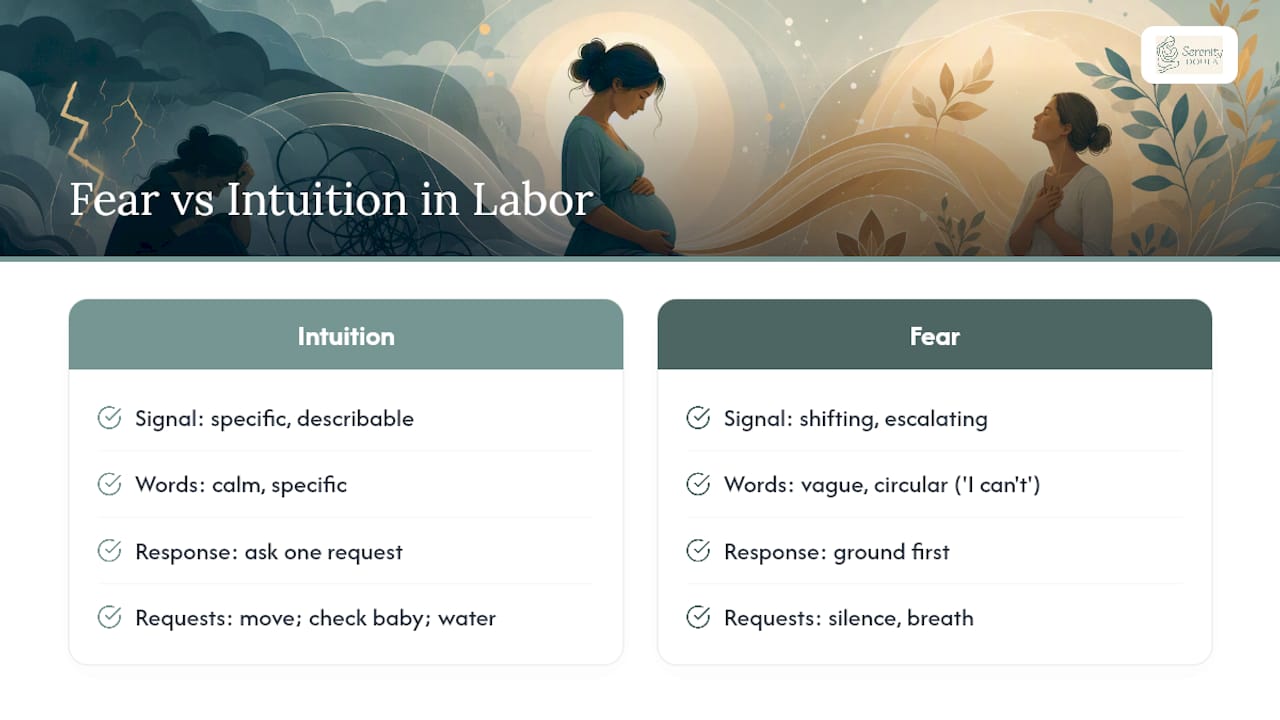
- Fear language sounds absolute (“I can’t do this,” “Something is terribly wrong”). Intuition language sounds quieter and more precise (“I need to move,” “This position doesn’t feel right”).
Pro Tip: Memorize three words before your due date: “Check, name, share.” When a strong feeling hits in labor, check your body signals, name the feeling aloud, and share it with whoever is beside you.
Key Takeaways
Distinguishing fear from intuition during labor comes down to one repeatable skill: pause, name the feeling aloud, check whether it is specific and steady, and share it with your support team before acting.
| Point | Details |
|---|---|
| Fear vs. intuition signals | Fear is loud, escalating, and vague; intuition is calm, specific, and repeatable across contractions. |
| The pause-test works | Three breaths, name it aloud, check body signals, ask one specific question to your partner or doula. |
| Fear has real physiology | Catecholamines from stress can slow uterine activity; oxytocin, supported by safety and touch, helps labor progress. |
| Red flags need immediate action | Bleeding, absent fetal movement, severe sudden pain, fever, or abnormal fluid color require a call or triage visit, not a pause-test. |
| Serenity Doula supports both | Continuous doula presence, prenatal emotional sessions, and birth-plan scripting help you recognize and act on both fear and intuition in real time. |
Table of Contents
- How fear and intuition actually feel during labor
- Why fear can disrupt labor, and why intuition feels different
- How to tell fear from intuition in the moment
- Coping strategies that help when fear arises
- When to trust your instincts versus when to call your provider
- What fear and intuition look like in real labor situations
- What ACOG and systematic reviews say about emotional support in labor
- What I’ve learned about fear and intuition after 10+ years at the bedside
- Serenity Doula is here to help you prepare for exactly this
- Sources
- FAQ
How fear and intuition actually feel during labor
Fear and intuition can arrive within seconds of each other during a contraction, which is why so many people describe labor as emotionally confusing. Understanding how each one tends to show up in your body and mind makes it much easier to sort them out in real time.
Physical signs of fear
Fear activates your sympathetic nervous system, the same system that responds to danger. In labor, that can look like:
- A sudden spike in heart rate or a pounding sensation in your chest
- Shaking or trembling, especially in your hands or legs
- Hot flashes or cold sweats that feel separate from contraction intensity
- Muscle tightening across your shoulders, jaw, or thighs
- Tunnel vision or difficulty hearing what people around you are saying
- A strong, almost physical urge to get up, leave, or make it stop
These signals are real and valid. They are also your nervous system responding to perceived threat, not necessarily actual danger.
Physical signs of intuition
Intuition tends to feel different in texture. It is usually:
- A steady, specific bodily nudge, like a pull toward hands-and-knees position or a sense that something in the room needs to change
- Quiet and persistent across multiple contractions, not spiking and fading with panic
- Calm enough that you can describe it in a sentence, even mid-labor
- Located in your chest or gut rather than your racing mind
The emotional and language difference
Fear sounds dramatic. It uses words like “always,” “never,” “I can’t,” and “something is terribly wrong.” Intuition sounds more measured: “I need to move,” “This doesn’t feel right,” “Can someone check on the baby?”
Context shapes both signals. Prior trauma, an unfamiliar hospital environment, or a history of anxiety can amplify fear responses significantly. Tokophobia, a severe fear of childbirth, can make fear feel indistinguishable from intuition without prenatal support. If you have experienced a previous difficult birth, talking with your provider or a mental health professional before labor is one of the most protective things you can do.
Pro Tip: Tell your doula or partner first when something feels off. They can help you name it and decide together whether to call the nurse. That one extra step often prevents both panic and missed signals.
Why fear can disrupt labor, and why intuition feels different
The difference between fear and intuition in childbirth is not just emotional. It is physiological, and the research behind it is worth understanding.

Oxytocin: your body’s labor ally
Oxytocin drives uterine contractions, supports bonding, and reduces the perception of pain. Crucially, oxytocin release is enhanced by feelings of safety, supportive touch, and continuous care. When you feel seen, held, and calm, your body tends to produce more of it. Intuition, because it arrives without the alarm of fight-or-flight, does not disrupt that process.
Catecholamines: what fear releases instead
When fear takes over, your body releases catecholamines, primarily epinephrine and norepinephrine. These stress hormones redirect blood flow away from the uterus and toward your limbs, preparing you to run. In labor, that redirection can weaken uterine contractions and slow progress. A review of physiological and cohort studies found that anxiety and fear are associated with longer labors in some populations, and one large Danish cohort of over 25,000 first-time mothers found modestly increased odds of emergency cesarean associated with childbirth fear, though findings across studies are mixed and the effect size varies considerably.
What this means in practice: Fear is not a character flaw in labor. It is a biological response that, when prolonged, can work against the very process your body is trying to complete. Calming that response is not just emotional self-care. It is physiological support for your labor.
Why environment and support change the equation
A positive birthing environment and continuous emotional support can shift your nervous system from threat-response toward the calm that supports oxytocin. Dim lighting, familiar faces, and a steady voice during contractions are not luxuries. They are inputs your nervous system uses to decide whether you are safe. Intuition tends to surface more clearly when that baseline of safety is present, which is one reason trusting instincts in labor often feels easier with a doula in the room.
How to tell fear from intuition in the moment
This is a repeatable method you can practice before labor and use during it. It takes under a minute.
The pause-test: step by step
- Stop reacting. Before you speak, move, or call anyone, take three slow breaths. This alone begins to lower catecholamines.
- Name the feeling aloud. Say exactly what you are experiencing: “I feel panicked,” “Something feels wrong,” or “I have a strong urge to change position.” Hearing your own words helps your brain categorize the signal.
- Check your body signals. Is your heart pounding and your muscles rigid? That points toward fear. Is the sensation steady and specific, present across the last few contractions? That points toward intuition.
- Ask your partner or doula one specific question. “Does my breathing look different to you?” or “Have I been saying this for a while?” An outside perspective in under 30 seconds can confirm or redirect your read.
The 4-1-1 check
Adapted from the labor timing rule for contractions, the 4-1-1 check applies the same logic to feelings:
- 4: How long has this feeling been present? A sensation that has been building for four or more contractions is more likely intuition than a fear spike.
- 1: Does it repeat consistently? A feeling that comes back in the same form, in the same part of your body, across different moments, is a signal worth acting on.
- 1: Is it specific? Intuition tends to point somewhere (“I need to be on my hands and knees,” “I want the nurse to check the monitor”). Fear tends to be vague and all-encompassing.
Quick checklist: fear or intuition?
- Sudden onset, escalating fast: lean toward fear
- Present across multiple contractions, steady: lean toward intuition
- Accompanied by shaking, tunnel vision, urge to escape: lean toward fear
- Calm, specific, and repeatable: lean toward intuition
- Vague dread with no clear direction: lean toward fear
When the check leans toward fear: use grounding techniques (see the next section), ask your doula or partner to stay close, and let your nurse know you are feeling anxious. You do not need to manage it alone.
When the check leans toward intuition: ask for a specific assessment. “Can we check fetal heart tones?” or “I’d like to try a position change and see if it helps” are both clear, safe ways to act on a gut sense without bypassing your care team.
Coping strategies that help when fear arises
Fear in labor is common, and there are real, evidence-aligned ways to work through it. Building a plan before your due date means you will not be searching for tools in the middle of a contraction.
Nonpharmacologic techniques
- Breathing patterns: Slow, deliberate exhales (longer out than in) activate the parasympathetic nervous system. Practice 4-count inhale, 6-count exhale in the weeks before labor so it becomes automatic.
- Position changes: Moving to hands-and-knees, side-lying, or upright positions can relieve pressure and give your body something productive to do with anxious energy. Relaxation techniques that pair breathing with movement are especially useful.
- Warm water immersion: Laboring in a tub or shower reduces muscle tension and can lower the perception of pain. Ask your provider whether hydrotherapy is available at your birth location.
- Massage and tactile support: Firm counter-pressure on the lower back during contractions, or light stroking between them, stimulates oxytocin release and gives your nervous system a calming input.
- Environmental adjustments: Dim lights, a familiar scent, soft music, and limiting foot traffic in the room can reduce the sensory load that amplifies fear. Knowing what to ask for ahead of time makes this easier to request in the moment.
The role of continuous support
Continuous one-to-one emotional support during labor, the kind a doula provides, is associated with shorter labors, fewer requests for pain medication, and higher satisfaction with the birth experience. The mechanism connects directly to the oxytocin research above: feeling genuinely supported shifts your nervous system toward the conditions that help labor progress. Spiritual and mindfulness practices can also support anxiety management between contractions, particularly for those who find grounding through breath or intention.
Medical pain relief and the fear cycle
Epidurals and other medical pain relief options can interrupt the fear-tension-pain cycle when fear has become so intense that nonpharmacologic tools are not enough. This is not a failure. A question worth discussing with your provider before labor: “At what point would you recommend pain relief based on my emotional state, not just pain level?” Having that conversation in advance means you will not be making the decision from scratch in the middle of a contraction.
Prenatal preparation
Childbirth education, trauma-informed birth planning, and prenatal emotional support all reduce fear before it has a chance to take hold in labor. For those with significant anxiety, ACOG recommends discussing symptoms and treatment options with your clinician, including therapy and, when appropriate, medication. If your fear of childbirth feels persistent or severe, that conversation belongs in a prenatal appointment, not in a delivery room.
Pro Tip: Give your partner this script for contractions: “I’m right here. You’re doing it. Tell me one thing you need.” Three sentences, repeated calmly, give you something to anchor to. More partner support guidance is available if you want to prepare together.
When to trust your instincts versus when to call your provider
Some feelings in labor need a pause-test. Others need a phone call or a trip to triage right now. Here is how to tell the difference.
Red-flag checklist: seek immediate care
Call your provider or go to the hospital immediately if you notice:
- Vaginal bleeding beyond normal bloody show
- Reduced or absent fetal movement
- Sudden, severe abdominal pain that does not ease between contractions
- Fever above 100.4°F
- A gush of fluid that is green, brown, or foul-smelling
- Severe headache, vision changes, or sudden swelling in your face or hands
These are not intuition signals. They are red flags that require medical evaluation, not a pause-test.
Trust-your-intuition checklist
Act on a gut feeling by requesting a non-urgent assessment when:
- A specific, steady sensation has persisted across four or more contractions
- You feel a strong, calm pull toward a position change or a monitoring check
- Something about the baby’s movement pattern feels different from your normal baseline
- A quiet, repeatable sense tells you something needs attention, even if you cannot name exactly what
Sample questions to ask your care team
You do not need to diagnose anything. You just need to communicate clearly. These phrases work:
- “Can we do a 10-minute fetal heart rate check? Something feels different to me.”
- “I’d like to try a position change. Can you help me move to hands-and-knees?”
- “I’m feeling a lot of anxiety right now. Is there something we can do to help me settle?”
- “Can you walk me through what’s happening with my contractions right now?”
Specific questions get specific answers. Vague distress often gets reassurance without information.
What fear and intuition look like in real labor situations
These vignettes are illustrative scenarios drawn from common labor patterns, not individual client stories.
Vignette 1: First-time labor panic at home
A first-time parent at 39 weeks wakes at 2 AM with contractions five minutes apart. Within an hour, the intensity spikes and panic sets in: heart pounding, shaking, convinced something is wrong. Her partner runs the pause-test: three breaths, name it aloud (“I’m scared, not in danger”), check the body signals (no bleeding, baby moving, contractions regular). They call their doula, who talks them through a breathing pattern over the phone and helps them decide to labor at home another hour before heading to the hospital.
Quick action: Pause-test, partner support, doula call.
Learning point: Panic at transition is normal. The pause-test separates fear from a true emergency.
Vignette 2: A quiet intuition about position
Midway through active labor, a person laboring at Trinity Health St. Mary in Langhorne feels a persistent, calm pull to move off her back. She cannot explain it, but the feeling stays consistent across three contractions. She tells her doula, who helps her shift to hands-and-knees. Within 20 minutes, contraction pressure changes and her provider notes better fetal descent.
Quick action: Named the feeling, shared it with her doula, requested a position change.
Learning point: Intuition is often quiet and specific. It does not need to be dramatic to be worth acting on.
Vignette 3: Tokophobia and prenatal planning
A Doylestown parent with a previous traumatic birth finds that fear of delivery is affecting her sleep and daily functioning by 28 weeks. Her midwife recognizes the signs of tokophobia and refers her to a perinatal mental health therapist. Together with her doula, they build a detailed birth plan that includes specific language for her care team, agreed-upon coping signals, and a clear protocol for when she needs a pause.
Quick action: Prenatal mental health referral, trauma-informed birth plan, doula partnership.
Learning point: ACOG advises discussing significant childbirth anxieties with your provider and considering a mental health referral when fears cause marked impairment. Prenatal support changes the labor experience.
What ACOG and systematic reviews say about emotional support in labor
The evidence base for emotional support in labor is clear enough that major clinical organizations have built it into their guidance.
ACOG on individualized care and shared decision-making
ACOG’s 2024 clinical practice guideline on first- and second-stage labor management recommends individualized, shared decision-making for prolonged second-stage labor and recognizes emotional support as an important factor in intrapartum care and patient satisfaction. In practice, this means your emotional state is a clinically relevant input, not a side issue. You have standing to raise it with your provider.
What systematic reviews show about continuous support
Cochrane-level reviews of continuous one-to-one support in labor consistently find:
- Reduced use of pain medication
- Higher rates of spontaneous vaginal birth
- Greater satisfaction with the birth experience
- Mixed effects on labor duration (some studies show shorter labors; others show no significant difference)
Continuous support does not guarantee any specific outcome, but the pattern across studies is consistent enough that ACOG recognizes it as beneficial. The mechanism, as the oxytocin research suggests, is partly neurohormonal.
How to use this in a provider conversation
That sentence, or something close to it, gives your provider a clear, evidence-grounded opening. You are not asking for special treatment. You are asking for what the guidelines already support.
What I’ve learned about fear and intuition after 10+ years at the bedside
Most people arrive at labor expecting fear to be the enemy. What I have seen, birth after birth, is that fear is usually just information that has not been sorted yet.
The moment I find most telling is when a laboring person says, “Something feels wrong,” and I ask them to describe it. If they can describe it, specifically and calmly, even through tears, that is almost always intuition. If the description keeps shifting, escalating, and circling back to “I just can’t,” that is usually fear, and it needs a different response.
What I do in that moment is simple: I get close, make eye contact, and say, “Tell me one specific thing your body is asking for.” That question cuts through the noise almost every time. The answer is either a clear request (move me, check the baby, I need water) or silence followed by a breath, which tells me we are working with fear and need to ground first.
The scripts I use with clients are not complicated. “I’m right here” is often enough. For providers, I help clients phrase their intuitions as requests: “Can we check?” rather than “I think something is wrong.” The first opens a conversation. The second can close one.
At Serenity Doula, we build these checks into prenatal sessions so that by the time labor starts, the pause-test feels like second nature. The goal is not to eliminate fear. It is to make sure fear does not get the last word.
Serenity Doula is here to help you prepare for exactly this
Knowing the difference between fear and intuition in labor is one thing. Having someone beside you who can run the check in real time is another. That is the work Serenity Doula does, from your first prenatal session through the final moments of pushing.

Serenity Doula’s birth doula support includes continuous labor presence, real-time pause-tests, and direct communication with your care team when your gut says something needs attention. Prenatal sessions cover breathing patterns, partner scripts, and birth-plan language that reflects your specific fears and preferences. For those with significant anxiety, prenatal emotional support sessions go deeper, building a personalized plan before labor begins. Serenity Doula serves families throughout Bucks County, including Newtown, Doylestown, and surrounding communities. To talk through what support would look like for your birth, schedule a free consultation and see what it feels like to have someone in your corner.
Sources
These are the primary sources used throughout this article. Consider bringing them to a prenatal appointment if you want to discuss evidence-based emotional support with your provider.
- Birth as a neuro-psycho-social event: An integrative model of maternal experiences and their relation to neurohormonal events during childbirth | PLOS One
- Review article on anxiety, fear, and labor physiology — PMC
Bring any of these to your next prenatal visit and ask your provider how their recommendations apply to your specific situation.
This article is general information, not a substitute for advice from a qualified doctor. Consult a qualified healthcare professional about your own circumstances before acting on anything here.
FAQ
Is it normal to feel terrified of giving birth?
Yes. Fear during delivery is extremely common, especially for first-time parents. When fear is severe, persistent, and affecting daily life, it may indicate tokophobia, and ACOG recommends discussing it with your provider and considering a mental health referral.
What is the 4-1-1 rule in labor?
The 4-1-1 rule traditionally describes contraction timing: contractions four minutes apart, lasting one minute each, for at least one hour. Applied to feelings in labor, the same logic helps: if a sensation has been present for four or more contractions, repeats consistently, and points to something specific, it is worth acting on as intuition rather than dismissing as fear.
What are the most effective coping techniques for contractions?
Slow breathing with a longer exhale than inhale, position changes, warm water immersion, and firm counter-pressure on the lower back are among the most consistently supported nonpharmacologic options. Continuous emotional support from a doula or partner amplifies the effect of all of them by supporting oxytocin release.
How do you avoid panicking during labor?
The pause-test helps most: take three breaths, name the feeling aloud, and ask one specific question of your support person before reacting. Prenatal preparation, including childbirth education and a written birth plan, reduces the likelihood of panic by making the unfamiliar feel familiar before labor begins.
When should I call my provider instead of waiting?
Call immediately for bleeding beyond normal bloody show, absent or reduced fetal movement, sudden severe pain, fever above 100.4°F, or abnormal fluid color or odor. For a steady, specific intuitive sense that something needs checking, a calm call or request for monitoring is always appropriate. Your care team would rather hear from you.