

How fear and intuition show up differently during labor
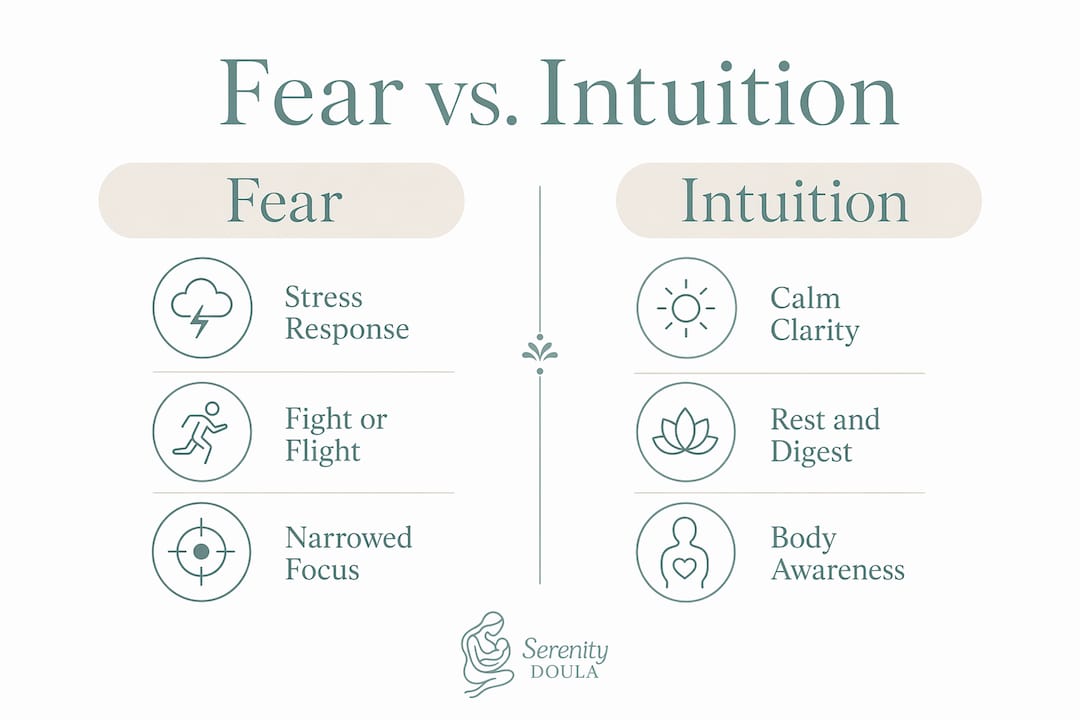
Fear and intuition are not the same feeling, even though they can both arrive quietly and feel deeply personal. The core difference is this: fear is urgent and chaotic, while intuition is calm, grounded, and steady over time. Knowing which one is speaking to you during labor can genuinely shape the decisions you make and the experience you carry forward.
Here is what each one typically looks like in the birth room:
Fear tends to:
- Feel loud, reactive, and emotionally overwhelming
- Push you toward immediate decisions without reflection
- Create racing thoughts, worst-case scenarios, and a sense of panic
- Shift and change rapidly, sometimes hour to hour
- Tighten your body, raise your heart rate, and activate your stress response
Intuition tends to:
- Feel quiet, persistent, and grounded
- Return again and again without urgency or chaos
- Align with your deeper values and what you know about your body
- Bring a sense of clarity, even when the decision is hard
- Feel honest rather than alarming
The physiological contrast matters, too. Fear triggers the body’s fight-or-flight response, flooding you with cortisol and adrenaline. Intuition does not produce that same physical storm. It tends to arrive as a steady inner knowing, sometimes a sensation in the chest or gut, sometimes just a quiet certainty that something is right or wrong. Learning to tell these two apart is one of the most useful things you can do before you walk into that delivery room.
Table of Contents
- What fear actually feels like during labor
- What intuition actually feels like during labor
- Is it normal to feel afraid during labor?
- How to tell fear from intuition in the moment
- Coping strategies that actually help with fear during labor
- A doula’s perspective on fear versus intuition in the birth room
- How fear and intuition shape your labor experience
- The psychology behind fear and intuition in childbirth
- When to trust your intuition over fear during labor
- Real-life scenarios: fear versus intuition in labor
- What medical professionals say about fear and intuition during labor
- Ready to feel more grounded going into your birth?
- Key Takeaways
- FAQ
What fear actually feels like during labor
Fear during labor is not just a mental experience. It shows up in your body, and it can be surprisingly physical.
Physical signs of fear:
- Racing or pounding heart
- Muscle tension, especially in the jaw, shoulders, and pelvic floor
- Shallow, rapid breathing
- Nausea or a tight feeling in the chest
- Trembling or feeling physically frozen
Emotional and mental signs of fear:
- Repetitive, looping thoughts (“What if something goes wrong?”)
- Catastrophic thinking or imagining worst outcomes
- Difficulty making decisions or feeling paralyzed by options
- Compulsive reassurance-seeking from nurses, your partner, or your doula
- A sense of emotional flooding where everything feels too big to handle
Fear also shapes decision-making in ways that are worth understanding. When you are in a fear state, your brain narrows its focus toward perceived danger. That can make it hard to weigh options clearly, ask the right questions, or feel confident in your choices. Fear during labor can contribute to prolonged labor and higher rates of cesarean delivery, which is why addressing it early matters so much. This is not about being “brave.” It is about giving your body the conditions it needs to work well.
What intuition actually feels like during labor
Intuition during labor is quieter than most people expect. It does not announce itself. It does not scream.
Physical signs of intuition:
- A settled, grounded feeling in the body, even amid intensity
- A sense that something feels right or wrong without being able to fully explain it
- Physical sensations that persist, like a pull toward a certain position or a feeling that something has shifted
- Calm after sitting quietly with a decision, rather than more anxiety
Emotional and mental signs of intuition:
- A recurring feeling that keeps returning, gently, over time
- Clarity that does not depend on reassurance from others
- A sense of alignment with your values and what you know about your body
- Feeling honest with yourself, even when the truth is uncomfortable
Intuitive feelings are quiet rather than panicked and tend to foster calm clarity. One of the most telling signs: intuition stays consistent. Fear shifts. If you notice a feeling returning steadily over hours, that is worth paying attention to. Experienced maternity care workers describe something similar. Research on gut feelings in obstetrics found that with increasing experience, providers rely more on non-analytic, intuitive reasoning alongside objective data when making critical labor decisions. Your body has its own version of that wisdom.
Is it normal to feel afraid during labor?
Yes, completely. Worry about labor pain, about your baby’s health, about the unknown is a normal part of pregnancy for most people. These concerns usually pass and do not interfere with daily life or labor progress. But for some, fear runs much deeper.
When fear crosses into something more serious
A condition called tokophobia, an extreme fear of pregnancy and childbirth, affects more people than most realize. ACOG notes that as many as 1 in 20 cases of postpartum depression and anxiety may be related to tokophobia. It can develop after a difficult previous birth, or it can arise without any prior trauma. People with tokophobia may avoid sleep, struggle to eat, or feel so strongly about avoiding vaginal delivery that they request a cesarean. These are not signs of weakness. They are signs that someone deserves real support.
What the experts say
Dr. Roussos-Ross of ACOG is clear: “If you have tokophobia, you are not alone. It’s fairly common. And it’s not something to be ashamed of or to blame yourself for.” Cognitive-behavioral therapy (CBT) is often very effective for tokophobia, particularly when it develops after a traumatic birth experience. Childbirth education classes, a supportive birth team, and a calming delivery environment can also help significantly.
A few questions worth asking your provider:
- “Could what I’m feeling be more than typical pregnancy anxiety?”
- “Would a referral to a therapist who specializes in perinatal mental health be appropriate for me?”
- “What options do we have if my fear is affecting my ability to cope during labor?”
You do not have to carry this alone. Naming it to your provider is the first step toward getting the right kind of help.
How to tell fear from intuition in the moment
The tricky part is that fear can feel very convincing. When your nervous system is activated, fear can masquerade as intuition, making it feel urgent and important. Mindfulness and emotional regulation are key to listening inward with clarity, especially when you are in the middle of labor’s intensity.
Practical strategies to help you discern:
- Pause and breathe first. Fear pushes urgency. Before reacting to a strong feeling, take three slow breaths and give yourself 60 seconds. If the feeling is intuition, it will still be there. If it is fear, it often shifts or softens.
- Ask yourself: has this feeling been here before? Intuition tends to return quietly over time. Fear tends to spike and change.
- Notice your body. Is your jaw clenched? Are your shoulders up near your ears? That is your stress response talking. A grounded, settled body is more likely to be in an intuitive state.
- Journal before labor begins. Writing down your fears and your gut feelings in the weeks before your due date helps you recognize the difference when you are in the thick of it.
- Check for alignment. Does this feeling connect to your values, your birth preferences, your knowledge of your body? Intuition usually does. Fear usually connects to a perceived threat.
- Ask your doula or support person. Sometimes an outside perspective from someone who knows you and your birth plan can help you name what you are feeling.
Trusting your body in delivery gets easier when you have practiced these skills before labor starts. The birth room is not the ideal place to learn them for the first time.

Coping strategies that actually help with fear during labor
Managing fear in labor is not about suppressing it. It is about giving your nervous system enough support that you can stay present and make clear decisions.
Mindfulness and relaxation techniques:
- Slow, diaphragmatic breathing during contractions
- Body scan meditation to release tension in specific muscle groups
- Guided imagery or visualization of a calm, safe place
- Gentle movement, position changes, and walking between contractions
Research supports this approach. Meditation combined with prenatal education significantly lowers anxiety scores and enhances birth confidence, helping laboring people feel more in control throughout the process.
Environmental adjustments:
- Dimming the lights in your room
- Playing music or a calming playlist you prepared in advance
- Using aromatherapy, such as lavender, if your birth setting allows it
- Limiting the number of people in the room to those who genuinely calm you
Your support team:
- A doula who knows your fears and your birth preferences
- A partner or family member who has been prepared to offer grounded, reassuring presence
- Nurses and providers who communicate in calm, clear language
Having a doula and a supportive birth team reduces fear by providing reassurance, advocacy, and emotional techniques throughout labor. The American College of Obstetricians and Gynecologists (ACOG) guidelines on labor management note that continuous one-on-one emotional support during active labor improves outcomes and may be the most effective adjunct strategy available. That is not a small claim. It is one of the strongest evidence-based recommendations in modern obstetric care.
Pro Tip: If you are birthing at Trinity Health St. Mary in Langhorne or another Bucks County hospital, ask your care team in advance what environmental accommodations they can offer, such as dimmer switches, a Bluetooth speaker, or a birthing ball. Knowing what is available removes one layer of the unknown.
A doula’s perspective on fear versus intuition in the birth room
After more than 10 years supporting families through labor and delivery in Bucks County, I can tell you this with confidence: the moment a laboring person shifts from fear into trust is visible. The shoulders drop. The breath deepens. The face changes. It is one of the most powerful things I witness in this work.
Fear and intuition feel different, and they look different from the outside, too. Fear tends to make people rigid, either frozen or frantically seeking reassurance. Intuition tends to make people go inward. They get quiet. They start listening to their body instead of fighting it. That shift does not happen by accident. It happens when someone feels genuinely safe and supported.
What I tell every family I work with in Newtown, Doylestown, and across Bucks County is this: your body has been preparing for this. The sensations of labor are intense, but intensity is not the same as danger. When you feel something strongly during labor, whether it is a pull toward a certain position, a sense that something has changed, or a quiet certainty that you need to speak up, that is worth voicing. Your care team at Trinity Health St. Mary or wherever you are birthing wants to hear it.
Pro Tip: Before your due date, write down two or three things you know to be true about your body and your instincts. Read them before you go into labor. That small act of self-trust can anchor you when the room gets loud.
Evidence-based doula care is not just about physical comfort techniques. It is about helping you stay connected to yourself when everything around you is moving fast.
— Alexis Wallace
How fear and intuition shape your labor experience
The emotional state you bring into labor does not stay separate from the physical process. Fear activates the sympathetic nervous system, releasing cortisol and adrenaline. Those hormones cause muscles to tense, including the uterine muscles, which can slow contractions and make labor longer and more painful. It is a cycle: fear creates tension, tension creates more pain, more pain creates more fear.
Intuition, by contrast, tends to support the parasympathetic nervous system, the “rest and digest” state where oxytocin flows more freely. Oxytocin drives contractions and also produces feelings of calm, bonding, and trust. When you are in a grounded, intuitive state, your body is more likely to work with labor rather than against it. Prenatal emotional support that helps you build this capacity before labor begins can make a real difference in how your body responds on the day.
The impact extends beyond the birth itself. How you feel during labor, whether you felt heard, safe, and in control, shapes your birth experience and your postpartum emotional health. That is not a small thing.
The psychology behind fear and intuition in childbirth
Fear of childbirth has a recognized psychological profile. It often involves anticipatory anxiety, where the mind rehearses worst-case scenarios repeatedly. This kind of thinking narrows cognitive flexibility, making it harder to process information clearly or weigh options calmly. For people with a history of trauma, medical anxiety, or a previous difficult birth, this pattern can be especially pronounced.
Intuition, from a psychological standpoint, draws on a different system. It integrates past experience, bodily sensation, and pattern recognition in ways that operate below conscious awareness. Research on gut feelings in obstetrics and midwifery shows that even trained professionals rely on this non-analytic reasoning more as their experience deepens. For laboring people, this means the quiet sense that something has changed, or that a particular position feels right, is not random. It is your body and mind processing information in real time.
Mindfulness practices build the bridge between these two systems. By calming the nervous system, mindfulness reduces the noise of fear-based thinking and makes it easier to hear the steadier signal of intuition. This is why integrating mindfulness and prenatal education before labor, not just during it, produces the most consistent results for confidence and coping.
When to trust your intuition over fear during labor
Not every strong feeling during labor is fear. Sometimes what feels like fear is actually your body telling you something real. The challenge is learning to tell the difference in the moment.
Trust your intuition when:
- A feeling has been present and consistent for a while, not just spiking in a moment of panic
- Your body is giving you a clear, persistent signal, such as an urge to change positions, to push, or to speak up about something that feels wrong
- The feeling aligns with what you know about your body and your birth preferences
- You feel calmer after sitting quietly with it, not more anxious
Be more cautious about acting on fear when:
- The feeling arrived suddenly and is shifting rapidly
- Your thoughts are looping and catastrophic
- You are seeking constant reassurance and still not feeling settled
- The feeling is pushing you toward an immediate, irreversible decision without time to reflect
The 4-1-1 and 5-1-1 labor rules are a good example of this principle in practice. These timing guidelines for when to head to the hospital are tools, not absolutes. Experienced doulas consistently advise prioritizing how well you are coping over rigid timing. If something feels off, trust that. If you feel like you need to go in sooner, go. Your instincts about your own body deserve to be honored.
Real-life scenarios: fear versus intuition in labor
These scenarios are drawn from patterns commonly seen in birth work. They are not individual client stories, but they reflect experiences that come up again and again.
Scenario 1: The position shift
A laboring person is on their back, contractions are stalling, and they feel a persistent pull to get on hands and knees. Their nurse suggests staying put for monitoring. The pull does not go away. That is intuition. Speaking up, asking to try a different position, is the right call. Position changes during labor can reduce pain and support fetal descent.
Scenario 2: The catastrophic spiral
At 7 centimeters, a laboring person becomes convinced something is terribly wrong. Their heart is racing, their thoughts are looping, and they are asking everyone in the room for reassurance every few minutes. Their vitals are normal. Baby’s heart rate is steady. This is fear, not intuition. The right response is grounding: slow breathing, a calm voice, a hand on the shoulder, and a gentle reminder that the monitors are showing a healthy baby.
Scenario 3: The quiet knowing
A laboring person says quietly, “Something feels different. I think I need to push.” They are at 9 centimeters, not quite fully dilated. But the nurse checks and finds they are complete. That quiet, persistent sense of readiness was intuition, and it was right. Laboring people often know before the monitor does.
Scenario 4: The fear-driven request
After a long early labor, someone requests a cesarean not because of a medical indication but because they are exhausted and terrified. This is a moment for compassionate conversation, not judgment. The right response is to address the fear directly, offer support, and help them understand what is actually happening in their body before making a decision they cannot undo.
What medical professionals say about fear and intuition during labor
ACOG’s guidelines on labor management are unambiguous about one thing: emotional support during labor is not optional. Continuous one-on-one support during active labor increases the likelihood of spontaneous birth and decreases labor duration by an average of 40 minutes. That is the kind of evidence that changes how we think about what “medical care” actually means in the birth room.
On the question of fear, ACOG is equally clear. Tokophobia is real, treatable, and more common than most people realize. Ob-gyns are encouraged to ask about fear directly, connect patients with therapists who specialize in CBT, and create birth environments that reduce anxiety. Childbirth classes, familiar surroundings, and a trusted support person all carry genuine clinical weight.
On intuition, the research from obstetrics and midwifery is striking. Experienced providers do not dismiss gut feelings. They integrate them. The study on gut feelings in obstetric decision-making found that maternity care workers clearly develop a sense that labor is moving toward a cesarean before the objective data fully confirms it. That is intuition at work in a clinical setting. If trained professionals trust it, laboring people can too.
For families navigating prenatal genetic considerations alongside birth planning, resources like family genetic planning guides can help address some of the underlying anxieties that feed fear during pregnancy.
The consistent message from providers across disciplines: name your fears, ask your questions, and do not dismiss what your body is telling you. Both matter.
Ready to feel more grounded going into your birth?
At Serenity Doula, we work with families across Bucks County, from Newtown to Doylestown, to help you walk into labor feeling prepared, supported, and genuinely confident. Whether you are sorting through fear, learning to trust your instincts, or simply wanting someone in your corner who has seen it all, we are here for that.
Our pregnancy and birth support services are built around you: your birth preferences, your fears, your strengths, and your questions. We bring evidence-based care and a calm, steady presence to every birth we attend.
If you are curious about what working with a doula actually looks like, or whether it is the right fit for your family, we would love to talk. Book a free consultation and let’s start there.
Key Takeaways
Fear and intuition in labor and delivery are physiologically and emotionally distinct: fear activates the stress response and narrows decision-making, while intuition arrives as a calm, persistent signal that aligns with your body’s knowledge and your deeper values.
| Point | Details |
|---|---|
| Fear vs. intuition differ physically | Fear triggers fight-or-flight responses; intuition feels grounded, steady, and persistent over time. |
| Fear affects labor outcomes | Fear during labor can contribute to prolonged labor and higher cesarean rates, making emotional support a clinical priority. |
| Continuous support changes outcomes | ACOG guidelines note that one-on-one emotional support during active labor decreases labor duration by an average of 40 minutes. |
| Tokophobia is real and treatable | Some cases of postpartum depression and anxiety may be linked to tokophobia; CBT and provider support are effective. |
| Mindfulness builds discernment | Meditation combined with prenatal education lowers anxiety and enhances birth confidence, making it easier to hear intuition clearly. |
FAQ
How do I know if it’s intuition or fear during labor?
Intuition tends to feel calm, persistent, and consistent over time, while fear feels urgent, reactive, and shifts rapidly. If a feeling keeps returning quietly and aligns with what you know about your body, it is more likely intuition.
Is it normal to be afraid to give birth?
Yes. Mild to moderate fear about labor is very common and usually does not interfere with the birth process. When fear is severe and affects daily functioning, it may be tokophobia, a recognized anxiety condition that ACOG confirms is fairly common and treatable with the right support.
What is the 4-1-1 rule in labor?
The 4-1-1 rule is a guideline suggesting you head to the hospital when contractions are 4 minutes apart, last 1 minute each, and have followed that pattern for at least 1 hour. It is a useful tool, not a hard rule; how well you are coping matters as much as the timing.
Is it normal to feel disconnected from my baby during pregnancy?
Yes, feeling emotionally disconnected from your baby at times during pregnancy is common and does not reflect on your capacity to bond. Prenatal education and emotional support can help strengthen that sense of connection as your pregnancy progresses.
Can anxiety feel like intuition?
It can, especially when the nervous system is activated. Anxiety tends to feel urgent and catastrophic, while intuition feels steady and grounded. Mindfulness practices and nervous system regulation help you tell the two apart more reliably over time.