

TL;DR:
- Newborns routinely receive erythromycin ointment to prevent bacterial eye infections that can cause blindness.
- While effective and safe, this practice’s universal application is debated due to advances in prenatal STI screening and alternative approaches.
When your baby arrives, the last thing you expect is a small tube of ointment being applied to their eyes within minutes of birth. Yet newborns routinely receive erythromycin ointment to prevent severe eye infections that, if left untreated, can cause permanent blindness. This guide walks you through exactly why this happens, what the evidence says, and how holistic-minded families can approach this decision with both confidence and clarity. You don’t have to choose between safety and your values.
Table of Contents
- Why are eye drops given to newborns after birth?
- How effective and safe are routine newborn eye drops?
- What are the alternatives to standard eye drops, and do holistic remedies really work?
- What should holistic-minded families consider about newborn eye care?
- A holistic perspective on newborn eye drops: Beyond the mandates
- Find holistic support for your birth and newborn journey
- Frequently asked questions
Key Takeaways
| Point | Details |
|---|---|
| Purpose of eye drops | Eye drops are given after birth to prevent rare but severe infections that can threaten newborn vision. |
| Effectiveness and risks | Routine ointment is generally safe and supported by evidence, causing only mild, temporary side effects for most babies. |
| Holistic considerations | Holistic approaches should start with prenatal STI screening and informed conversations, not alternative home remedies. |
| Parental choice | Parents can and should personalize newborn care with guidance from their medical provider. |
Why are eye drops given to newborns after birth?
The story of newborn eye drops goes back more than 150 years. In the 1880s, a physician named Carl Credé introduced the practice of applying silver nitrate to newborn eyes to prevent a devastating bacterial infection called gonococcal conjunctivitis. This infection, caused by the bacterium Neisseria gonorrhoeae, can be passed from a birthing parent to a baby during delivery. Left untreated, it can lead to corneal scarring and blindness within days.
Today, erythromycin ointment is applied as soon as possible after birth, ideally within 24 hours, and is required by law in most US states. Silver nitrate is rarely used anymore because of its harsher side effects. Erythromycin, a gentle antibiotic ointment, became the standard of care because it’s effective, affordable, and well-tolerated by newborns.
“Protecting a newborn’s vision in the first hours of life is one of the simplest and most impactful steps in routine care.”
Understanding the why behind this practice helps you feel grounded when advocating for your baby. Here’s a quick breakdown of the key facts:
- Gonococcal conjunctivitis is the primary threat the ointment targets
- The infection spreads from birth parent to baby during vaginal delivery
- Even parents who test negative for gonorrhea during prenatal care can carry it asymptomatically
- Most US states legally require prophylaxis (infection prevention) for all newborns
- The ointment is applied to both eyes, usually in a thin strip along the inner eyelid
You can read more about newborn care basics on our website to understand how eye care fits into the bigger picture of your baby’s first days.
| Medication | Era used | Why it changed |
|---|---|---|
| Silver nitrate | 1880s to mid-1900s | Caused significant chemical irritation |
| Tetracycline ointment | Mid-1900s to 1990s | Supply issues and resistance concerns |
| Erythromycin ointment | 1990s to present | Safer profile and widely available |
How effective and safe are routine newborn eye drops?
With the purpose of newborn eye drops understood, it’s important to ask: are these eye drops backed by evidence, and are they safe for all babies?
The short answer is yes, but with some nuance. A Cochrane Review found moderate-certainty evidence that prophylaxis reduces all-cause acute eye infections in newborns, though there is low certainty for preventing specific pathogens, and no direct data on blindness prevention specifically. That doesn’t mean it doesn’t work. It means the research has limitations, which is honest and important to understand.
The most commonly reported side effect is chemical conjunctivitis (redness and mild irritation caused by the ointment itself, not an infection). This is temporary. Chemical conjunctivitis is mild and resolves within a few days, and erythromycin’s side effects are minimal compared to older alternatives.
What the evidence tells us:
- Erythromycin reduces the overall risk of newborn eye infections
- It does not fully protect against chlamydial eye infections, which require systemic (whole-body) antibiotic treatment
- Short-term blurry vision from the ointment may temporarily affect newborn-parent bonding during the immediate postpartum period
- No serious systemic side effects have been linked to the ointment
There is an ongoing conversation among healthcare providers about whether universal mandates still make sense. With improved prenatal screening for sexually transmitted infections (STIs), some argue that selective treatment could be a reasonable approach. However, no major medical organization currently recommends abandoning universal prophylaxis.
Pro Tip: If you’re concerned about the ointment temporarily affecting your baby’s vision during those first skin-to-skin moments, ask your care team if it can be applied after the initial bonding period. Many hospitals already allow this flexibility.
| Factor | Erythromycin ointment | Silver nitrate (historical) |
|---|---|---|
| Effectiveness | Moderate-high | Moderate |
| Side effects | Mild, temporary | More pronounced irritation |
| Coverage of chlamydia | Limited | None |
| Current use | Standard in US | Discontinued in most settings |
What are the alternatives to standard eye drops, and do holistic remedies really work?
While routine newborn eye drops are the norm, many parents, especially those focused on natural health, ask about other options. How do these stack up?
There are a few medications that have been used historically or in other countries. Silver nitrate, tetracycline, and povidone-iodine have all been tried, but each comes with limitations, ranging from discontinuation due to side effects to less favorable profiles in modern clinical settings.
Common alternatives and their current status:
- Povidone-iodine: Used in some countries, especially where erythromycin is unavailable. Not FDA-approved for this use in the US.
- Tetracycline ointment: Phased out due to manufacturing shortages and resistance concerns.
- Silver nitrate drops: Rarely used today because they cause significant chemical conjunctivitis.
- No treatment: Not recommended unless prenatal STI screening is thoroughly documented and discussed with a provider.
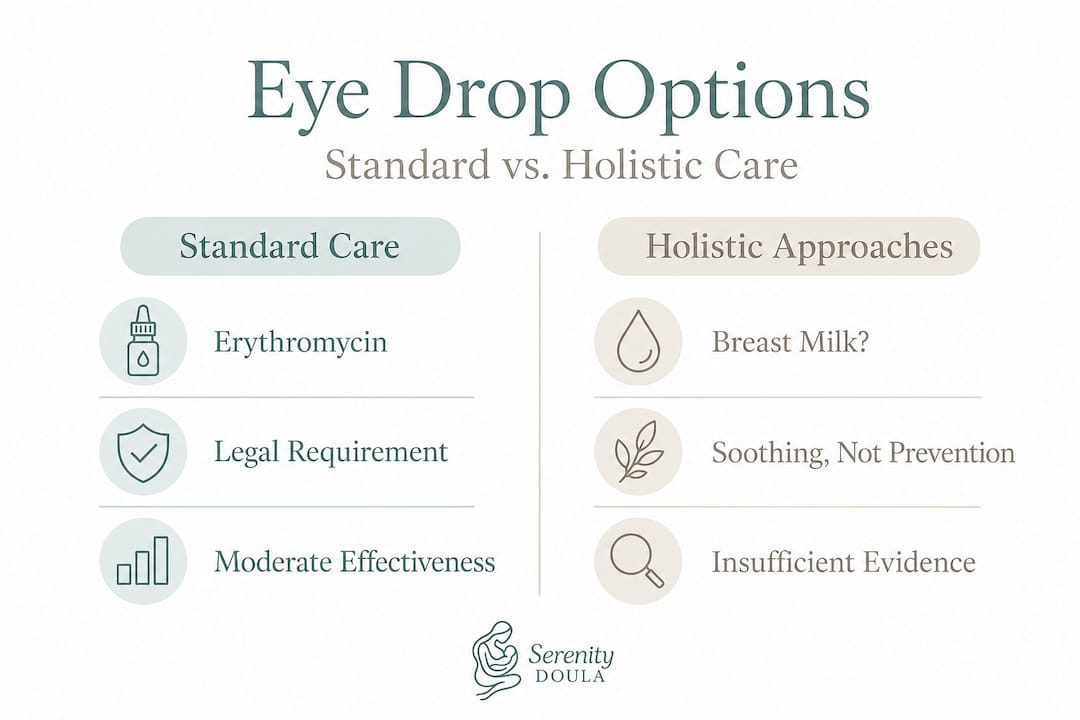
Now, what about breast milk? Many holistic-minded parents ask this question, and it’s a fair one. Breast milk does contain antibodies and has real health benefits. However, breast milk drops are not recommended as substitutes for infection prevention; consult a provider before using them as a replacement for prescribed ointment.
The truth is that breast milk may soothe irritated eyes in some contexts, but it has not been studied as a prophylactic measure against gonococcal conjunctivitis. The stakes of that particular infection are simply too high to rely on an unproven remedy.
Pro Tip: If you follow an evidence-based birth approach, you’ll want to bring your questions about alternatives to your prenatal appointments. A well-informed conversation is your best tool. Our resources on holistic prenatal care can help you build that foundation before birth day arrives.
For families navigating a difficult birth experience, our trauma recovery support and soothing newborn tips are here for the days ahead.
What should holistic-minded families consider about newborn eye care?
For parents who prioritize both safety and minimizing unnecessary interventions, here are ways to approach newborn eye care holistically and responsibly.

📊 Statistic spotlight: Universal prophylaxis remains widely practiced, but ongoing discussion about mandates continues as prenatal STI screening improves. Prenatal testing is a cornerstone of any personalized approach.
Here’s a step-by-step framework for thoughtful decision-making:
- Get thorough prenatal STI screening. This is the most important step if you’re considering any deviation from standard care. If you know your STI status, you and your provider can make a more individualized plan.
- Understand what erythromycin doesn’t cover. It does not protect against chlamydial infections, which require systemic antibiotics. Know the full picture.
- Document your preferences in your birth plan. Talk with your provider about your values and write them down. This creates clarity for the entire care team.
- Ask about timing flexibility. Many hospitals will allow a short delay in ointment application so you can have uninterrupted skin-to-skin time immediately after birth.
- Monitor your baby’s eyes regardless. Watch for redness, swelling, or discharge beyond the first 48 hours. These can be signs of infection that need prompt attention.
Feeling seen in your preferences matters. You don’t have to blindly accept every intervention, and you also don’t have to reject standard care to honor your holistic values. The goal is an informed, collaborative conversation.
A holistic perspective on newborn eye drops: Beyond the mandates
Here’s something we want to say clearly, because it often gets lost in the debate: the conversation around newborn eye drops is rarely about whether to protect your baby. It’s about how you want to participate in that protection.
Universal prophylaxis was designed in a public health era when prenatal screening was limited and STI rates were higher and less monitored. Today, many families enter birth with detailed prenatal records, up-to-date STI testing, and deeply considered birth plans. For these families, a one-size-fits-all mandate can feel like it dismisses all that careful preparation.
At the same time, we’ve seen what happens when families make decisions based on fear of intervention rather than genuine understanding of risk. Rejecting eye ointment entirely, without a clear plan, without knowing your STI status, and without a conversation with your provider, is not a holistic choice. It’s a gap in care.
The most grounded approach sits in the middle. It involves being fully informed, asking the right questions before birth, and letting your values guide the conversation, not override it. Open, evidence-based dialogue leads to better outcomes than either blind compliance or blanket refusal.
Your baby’s eye health is not something to navigate alone, and you shouldn’t have to carry this question into the delivery room without support.
Find holistic support for your birth and newborn journey
Navigating decisions like newborn eye care is exactly why having a knowledgeable, caring support team matters so much. You deserve guidance that honors both the evidence and your values.

At Serenity Doula, we offer pregnancy and birth support designed around you, not a checklist. Whether you’re building your birth plan, processing prenatal information, or preparing for those first newborn days, our team walks with you. Explore our childbirth education benefits to build real confidence, and connect with prenatal emotional support that holds you through the unknowns. You don’t have to figure this out alone.
Frequently asked questions
Are newborn eye drops legally required everywhere?
Most US states require newborn eye drops by law, though the specific regulations can vary by state, so it’s worth checking with your provider or hospital.
How soon are eye drops given after birth?
The ointment is applied as soon as possible after birth, often before baby leaves the delivery room, and always within the first 24 hours.
Are there risks or side effects to the eye ointment?
Side effects are generally mild. Chemical conjunctivitis resolves within 2 to 4 days, and erythromycin carries minimal systemic risk for newborns.
Can I use breast milk instead of prescription ointment?
Breast milk lacks strong evidence as a substitute for antibiotic ointment and is not recommended for preventing serious newborn eye infections.
Should I discuss eye ointment options with my provider before birth?
Absolutely. Bringing your questions and birth preferences to a prenatal appointment gives your care team the chance to understand your values and create a plan that keeps your baby safe while honoring your approach.