

TL;DR:
- Epidurals are associated with slightly longer labor durations but do not increase the risk of cesarean delivery or adverse outcomes. Timing of epidural placement influences labor length, with late placement generally shortening active labor. Proper management, support, and understanding of options empower parents to make informed decisions for a comfortable and efficient labor experience.
An epidural is defined as a regional anesthesia technique that blocks pain signals from the lower body during labor, and it does not typically speed up the labor process. Most parents ask this question hoping for a simple yes or no, and the honest answer is: epidurals are associated with a slightly longer labor duration, not a shorter one. That said, the full picture is more nuanced, and understanding how epidural analgesia affects labor progression can help you make a decision you feel genuinely good about.
Does an epidural speed up labor, according to research?
The short answer is no. Epidurals are linked to longer total labor duration, including both the first and second stages, compared to laboring without one. A study of 1,035 women found that epidural use extended labor time across all vaginal delivery stages. This does not mean something is going wrong. It simply reflects how the medication affects uterine muscle activity and the body’s natural hormonal rhythm.
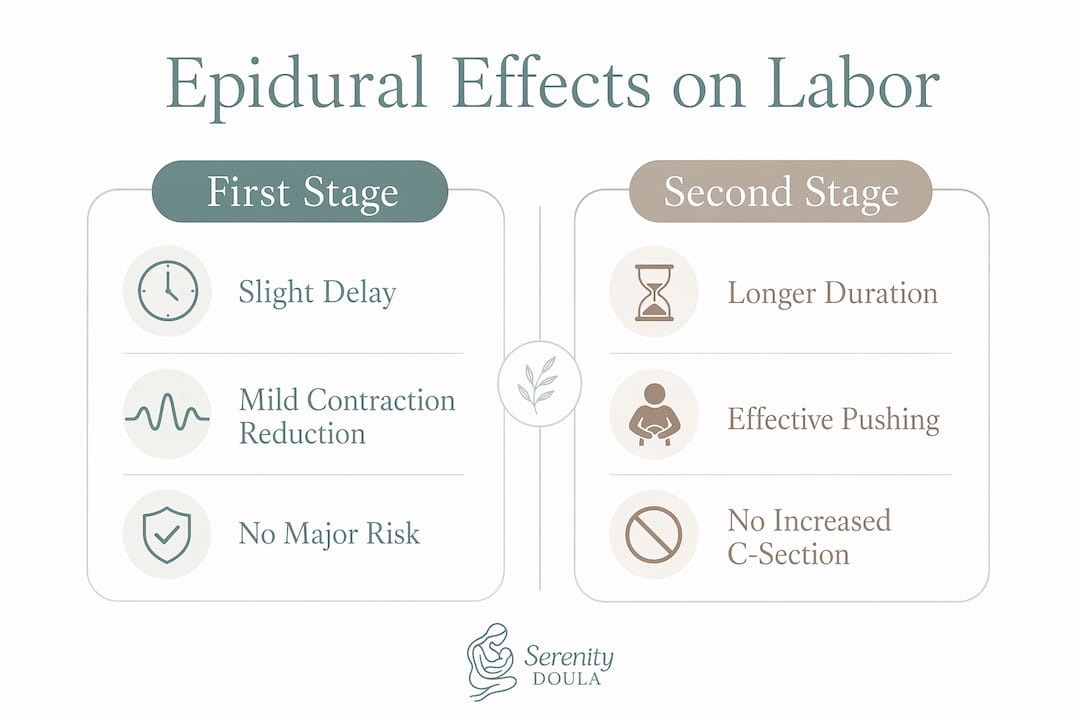
The physiological reason comes down to how epidurals interact with uterine contractions. Epidurals may slightly reduce contraction amplitude, which can slow the pace of dilation. Practitioners account for this by monitoring uterine efficiency rather than just contraction timing. The good news from the same research: longer labor with an epidural does not increase the risk of postpartum hemorrhage or other adverse outcomes for you or your baby.
Pro Tip: If your labor is taking longer after an epidural, that is not automatically a red flag. Talk to your care team about what “normal progress” looks like for your specific situation.
Here is a quick look at how epidural use affects labor stages:
| Labor stage | Typical effect with epidural | Clinical significance |
|---|---|---|
| First stage (early labor) | Moderately prolonged | Monitored but not harmful |
| First stage (active labor) | Noticeably longer with early placement | Timing of placement matters |
| Second stage (pushing) | Slightly extended | No increase in adverse outcomes |
| Overall delivery mode | No change in cesarean rate | Safe for most laboring parents |
How does epidural timing affect labor speed?
When you get your epidural matters more than most people realize. Research comparing early placement (at or before 4 cm dilation) versus late placement (after 4 cm) shows a meaningful difference in active labor duration. In one study of 128 multiparous patients, active labor averaged 85 minutes with late epidural placement versus 114 minutes with early placement. That is a 25% difference in active phase length, simply based on timing.

For first-time parents (nulliparous women), an emerging strategy involves using intravenous nalbuphine as a bridge to delayed epidural placement. Delayed epidural with IV nalbuphine showed a hazard ratio of 1.629 for a shorter first stage compared to early epidural initiation. This means the bridging approach can shorten labor while still keeping you comfortable during early contractions.
Here is how early versus late epidural timing compares across key factors:
| Factor | Early epidural (≤4 cm) | Late epidural (>4 cm) |
|---|---|---|
| Active labor length | Longer (avg. 114 min) | Shorter (avg. 85 min) |
| Pain relief quality | Better, longer coverage | Effective but shorter window |
| Maternal satisfaction | Generally high | High, with more early discomfort |
| Labor progression | Slightly slower | More efficient active phase |
What does this mean for you practically? A few things worth knowing:
- Early epidurals provide more complete pain coverage but may extend your active labor phase.
- Waiting until active labor is well established can shorten that phase, though early labor may be more uncomfortable.
- Intravenous pain relief options like nalbuphine can help you manage early labor pain while you wait for optimal epidural timing.
- Your care provider can help you weigh these trade-offs based on your dilation, pain level, and how labor is progressing.
What myths about epidurals and labor speed should you know?
A lot of fear around epidurals comes from outdated information. Modern neuraxial analgesia does not increase cesarean section rates, a concern that was common in older obstetric practice. Current evidence is clear: choosing an epidural does not put you on a path toward surgical delivery.
Here are the most common myths, and what the evidence actually says:
- Myth: Epidurals stop contractions. Contractions continue after an epidural. The medication may slightly reduce their intensity, but your uterus keeps working. Your care team monitors this closely.
- Myth: You cannot push effectively with an epidural. Most people push very effectively with epidural analgesia in place. Modern low-dose formulations preserve enough sensation and muscle control for effective pushing.
- Myth: Early epidurals always lead to a C-section. Early epidural placement may prolong the first stage, but it does not increase cesarean delivery rates.
- Myth: Epidurals harm your baby. Research consistently shows no increase in adverse neonatal outcomes with epidural use.
Pro Tip: If you want to explore non-epidural options for early labor, TENS units and movement-based comfort measures can help you stay comfortable while you wait for optimal epidural timing.
Can an epidural indirectly help labor by reducing anxiety?
Here is something that often gets overlooked in the speed conversation. Pain relief does more than make labor more comfortable. It lowers your stress hormones, and that matters for how your body labors. High levels of adrenaline and cortisol from unmanaged pain can actually interfere with the oxytocin-driven rhythm of contractions.
“Effective labor pain management is as much about emotional support and relaxation as it is about pharmacology.” — American Pregnancy Association
When you are not bracing against every contraction, your body can relax between waves. That relaxation supports uterine efficiency and helps you conserve the energy you will need for pushing. Pain relief reduces maternal anxiety, which can indirectly support labor progression even when the biological timeline is slightly extended. For long labors especially, an epidural can be the difference between arriving at the pushing stage exhausted or arriving with something left in the tank. You can also explore childbirth relaxation techniques to complement whatever pain management approach you choose.
Practical tips for deciding when and how to use an epidural
Making a decision about epidural timing does not have to feel overwhelming. Here are six steps that can help you go into labor feeling prepared:
- Talk to your provider early. Discuss your pain tolerance, birth preferences, and what dilation milestone might signal the right time for an epidural in your specific case.
- Consider non-epidural options for early labor. Movement, hydrotherapy, and comfort measures can carry you through early contractions while you wait for active labor to establish.
- Ask about IV analgesia as a bridge. If you want to delay your epidural but need some relief, ask your care team whether nalbuphine or a similar option is available.
- Monitor your progress with professional support. A doula or nurse can help you track how labor is moving and when timing an epidural makes the most sense.
- Know that you can change your mind. Birth plans are guides, not contracts. If you planned to go unmedicated and change your mind, that is a completely valid choice.
- Combine epidural use with supportive care. Research and clinical experience both show that doula support alongside epidural use leads to better overall birth experiences.
Key takeaways
Epidurals do not speed up labor. They are associated with slightly longer labor duration, but they carry no increased risk of cesarean delivery or adverse outcomes, and they provide significant comfort and relaxation benefits that support overall labor progression.
| Point | Details |
|---|---|
| Epidurals and labor length | Epidurals are linked to longer labor stages, not shorter ones. |
| Timing makes a difference | Late placement (>4 cm) results in a shorter active phase than early placement. |
| No cesarean risk increase | Modern epidural analgesia does not raise cesarean delivery rates. |
| Relaxation supports labor | Pain relief lowers stress hormones, which can indirectly support uterine efficiency. |
| Bridging strategies exist | IV nalbuphine can manage early labor pain while delaying epidural for better timing. |
What I have learned from being in the room
By Justin
After supporting many families through labor, I can tell you that the question “will this slow things down?” is almost never the right frame. What I have seen again and again is that a parent who is exhausted, terrified, and in unmanaged pain does not labor efficiently regardless of what the clock says. The epidural conversation is really a comfort and endurance conversation.
What I wish more parents knew is that the research on timing is genuinely useful. Waiting until active labor is established before requesting an epidural is not about being “tough.” It is a practical strategy that can shorten your active phase while still giving you excellent pain coverage when you need it most. That said, there is no medal for suffering through early labor without support. Your birth, your body, your call.
The parents I see feel most grounded going into labor are the ones who understand their options before contractions start. Knowing what an epidural does and does not do puts you in the driver’s seat, and that confidence carries you further than any single decision about timing.
— Justin
How Myserenitydoula supports your labor comfort and progression
Choosing how to manage pain in labor is one of the most personal decisions you will make as a parent. At Myserenitydoula, we walk alongside you through every stage of that decision, whether you plan to use an epidural, go unmedicated, or keep your options open.

Our pregnancy and birth support doula services are designed to complement whatever pain management path you choose. We help you understand your options before labor begins, advocate for your preferences in the room, and provide physical and emotional support that no medication can replace. We also offer childbirth education classes that cover epidural timing, labor progression, and comfort strategies in depth. You deserve to feel informed, supported, and seen throughout your birth experience.
FAQ
Does an epidural make labor longer?
Yes, epidurals are generally associated with longer labor duration, particularly in the first and active stages. A study of 1,035 women confirmed this link, though no increase in adverse outcomes was found.
When is the best time to get an epidural?
Research suggests that waiting until active labor (beyond 4 cm dilation) can shorten the active phase compared to early placement. Talk to your care provider about what timing makes sense for your specific labor.
Will an epidural increase my chances of a C-section?
No. Modern neuraxial analgesia does not increase cesarean delivery rates. Multiple studies, including a 2025 randomized trial, confirm that epidural use does not affect delivery mode.
Can I still push effectively with an epidural?
Yes. Low-dose epidural formulations preserve enough sensation and muscle control for effective pushing. Most people with epidurals push successfully and deliver vaginally.
Do epidurals stop contractions?
Epidurals do not stop contractions. They may slightly reduce contraction amplitude, which is why your care team monitors uterine activity closely after placement.