
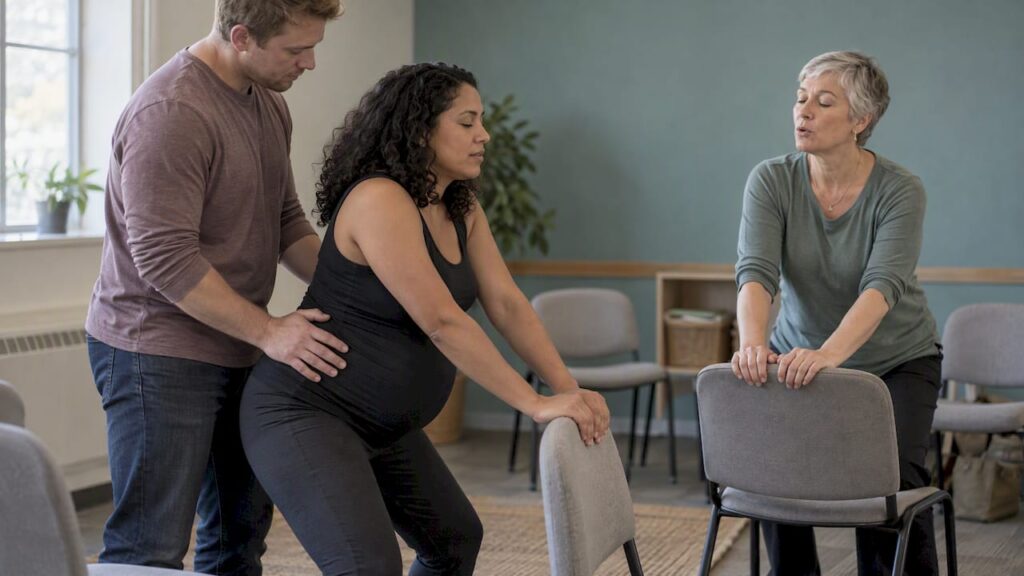
The short answer: register in your second trimester, attend in the late second or early third trimester, and finish your class a few weeks before your due date. That gives you time to practice what you learn and still leaves room for a baby who arrives early. Below is a simple timeline, what a class usually covers, how long different formats run, and what you can expect to pay.
TL;DR
- Register several months before your due date, because classes sometimes fill up quickly.
- Attend roughly between weeks 28 and 32 for most families, so the material is fresh and you still have weeks to practice.
- Expect labor signs and stages, comfort and positioning strategies, medical options, and newborn basics.
- Budget anywhere from about $50 for a single session to several hundred dollars for a series, with private instruction priced separately.
- Ask your provider which classes they recommend and which hospital offerings fit your birth plan.
Table of Contents
- The childbirth class timeline at a glance
- When to register
- When to attend
- What a typical childbirth class covers
- How long classes last: three common formats
- What childbirth classes cost
- Our perspective: why timing matters less than fit
- Personalized classes with Serenity Doula
- Making the most of your class
- FAQ
- Ready for your next step?
- Sources
The childbirth class timeline at a glance
| When | What to do |
|---|---|
| Weeks 12 to 20 | Start researching formats. Ask your OB or midwife what they recommend. |
| Weeks 16 to 24 | Register. Book private or small-group options early. |
| Weeks 28 to 32 | Attend your series or weekend intensive. |
| Weeks 32 to 36 | Practice breathing, positions and partner roles. Finalize your birth preferences. |
| Weeks 36 and on | Review your notes, pack your bag, and revisit the signs of labor. |
This is a guide, not a rule. A twin pregnancy, a planned cesarean, or a history of early labor can all shift the ideal window. That is a good question to bring to your provider: “Given my pregnancy, when would you suggest I finish my class?”
When to register
The federal Office on Women’s Health suggests signing up several months before your due date, since popular classes fill. In and around Newtown, Doylestown and the wider Bucks County area, hospital series and independent instructors alike tend to book ahead, and weekend sessions go first.
Registering early does not mean attending early. You can enroll at 18 weeks for a class that starts at 30 weeks. You simply have your spot and your peace of mind.

When to attend
Most families do best in the late second or early third trimester. Earlier than that, the details can feel abstract and fade by the time labor starts. Later than about 36 weeks, you risk missing the class entirely if your baby comes early, and you have little time to practice.
If you are carrying multiples or have been told you may deliver early, ask your provider about moving everything up by a month or more.
What a typical childbirth class covers
Curricula differ, but the professional framework published by ICEA describes content that may include the physiological patterns of pregnancy, labor, birth and postpartum, medical interventions including cesarean birth, analgesia and anesthesia, plus breastfeeding, nutrition and newborn characteristics.
In practice, a good class walks you through:
- Early labor and when to call: what contractions feel like, and which questions to ask your provider about when to head to the hospital or birth center.
- Stages of labor: what is happening in your body and what your partner can do at each stage.
- Comfort measures: breathing, movement, massage, water, and positions. You can preview some of these in our guides to childbirth relaxation techniques and natural childbirth breathing.
- Pain relief options: from epidurals to non-medical approaches, without pressure toward any one path.
- Common interventions: induction, monitoring, assisted delivery and cesarean birth, and the questions worth asking before saying yes.
- The first hours with your baby and early feeding.
- Partner roles: practical ways to help. Our partner support guide for labor goes deeper.
The Office on Women’s Health also notes you can expect practice with positioning and pain-control strategies, and possibly a tour of the birthing facility.
How long classes last: three common formats
Formats vary by provider, so confirm hours on the registration page. Most fall into one of these patterns:
| Format | Typical shape | Best for |
|---|---|---|
| Multiweek series | Several weekly evening sessions of about 2 to 3 hours | Families who like to absorb and practice between sessions |
| One-day or weekend intensive | A long day or a weekend block | Busy schedules, or a later start |
| Online, self-paced | Recorded lessons you watch on your own time | Flexibility, though with less personalization |
| Private, in-home or virtual | Scheduled around you, tailored to your questions | Families wanting individual attention |
A series has one real advantage: time between sessions. You can practice a breathing pattern on Tuesday and bring questions to the next class. An intensive is efficient, but plan to review your notes in the weeks after.
What childbirth classes cost
Prices swing widely by provider, location and length. One published overview puts single classes at roughly $50 to $200 and series at $100 to $500 or more, and notes that some classes may be covered by insurance or payable with an FSA or HSA. Some hospitals and community organizations also offer free or low-cost options for those who qualify.
What moves the price:
- Group size and instructor credentials
- Total teaching hours
- In person versus online
- Whether it is private and tailored to you and your partner
Questions worth asking your insurer: “Do you reimburse childbirth education? What paperwork do you need?”
Our perspective: why timing matters less than fit
After more than ten years supporting Bucks County families, we have watched people do beautifully with a Saturday intensive and struggle with a six-week series, and the reverse. The difference is rarely the calendar. It is whether the class fit the family.

A group class is wonderful for community and the basics. But it cannot know that you are planning a cesarean, that you are nervous about Trinity Health St. Mary’s policies, or that your partner freezes at the sight of a needle. Private instruction can. We build each class around your birth preferences, whether that is unmedicated, medicated or surgical, and we treat your partner as a full participant, not an audience member.
We also believe a class should leave you calmer, not more anxious. Evidence-based education means honest information about options and risks, delivered without judgment, so you can ask your provider better questions.
— Alexis Wallace
Personalized classes with Serenity Doula
If you want your class timeline built around your due date, your hospital and your questions, our private childbirth education is designed for exactly that. We work with families in Newtown, Doylestown and across Bucks, Montgomery, Philadelphia and Burlington Counties, in person or virtually, and we can pair classes with birth doula support so the person who taught you is the person beside you.
Want a feel for our approach first? Read about the benefits of childbirth education or our prenatal education essentials.
Making the most of your class
- Bring your partner or support person. Shared language makes labor calmer.
- Write questions as they come up and take them to your next prenatal appointment.
- Practice at home for a few minutes a day. A five-minute daily hypnobirthing practice is an easy start.
- Look at your whole picture. Our holistic preparation tips and ways to prepare mind and body pair well with any class.
FAQ
Is it too late to take a childbirth class at 36 weeks?
Not necessarily. A one-day class or a private session can still help a great deal. Ask your provider whether anything about your pregnancy suggests you should prepare sooner, and book as soon as you can.
Do I need a class if I plan an epidural or a cesarean?
Many families find classes helpful regardless of the plan. Labor can change course, and a good class covers pain relief, cesarean birth and recovery, not just unmedicated birth. Ask for a class that treats every path as valid.
Should I take a hospital class or a private class?
Both can work. Hospital classes often include a facility tour and familiarize you with local routines. Private classes tailor content to your preferences and let you ask anything. Many families do one of each.
Can I take childbirth classes online?
Yes. Online options are flexible and often cheaper, though they offer less individual feedback. A virtual private class gives you convenience and personal attention together.
Ready for your next step?
You do not have to figure out the timing alone. If you would like help choosing the right moment and the right kind of class for your family, we would love to meet you. Book a free consultation and we will talk through your due date, your hopes and your questions.
Sources
- Birthing, breastfeeding, and parenting classes, Office on Women’s Health
- Curriculum Development and Content for the Childbirth Educator, ICEA
- Childbirth Classes: Everything You Need to Know as a New Mom, Kindred Bravely