
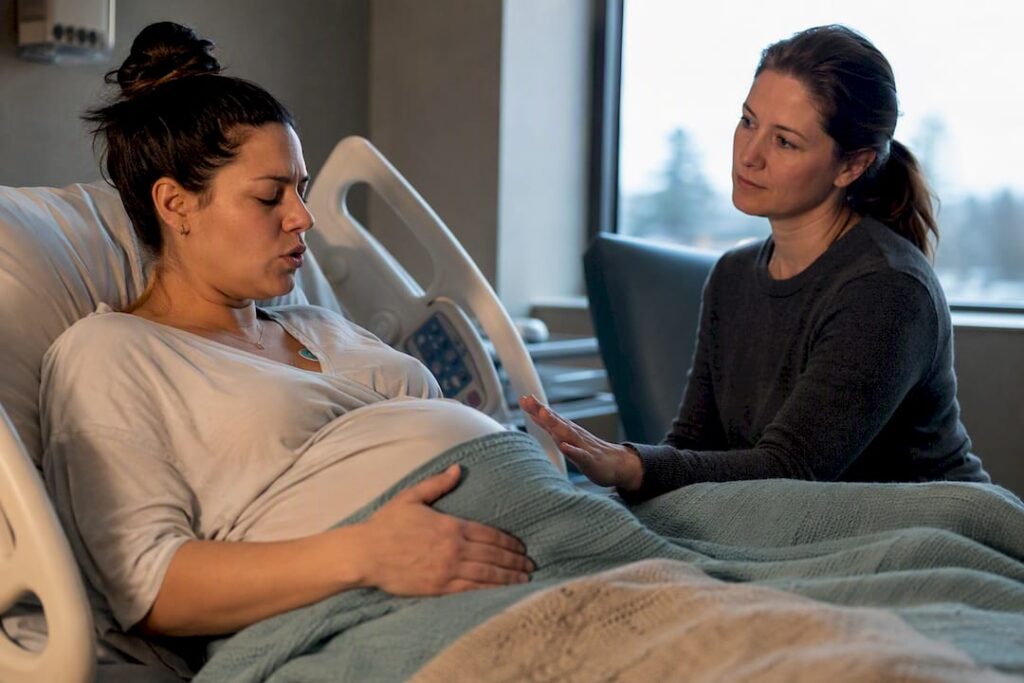
A trauma-informed doula grounds every part of her care in five principles: safety, choices, collaboration, trustworthiness, and empowerment. This approach isn’t therapy, and it doesn’t diagnose or treat anything. It’s a way of showing up for labor and postpartum that lowers the risk of retraumatization and hands you real agency over your own birth, something peer-reviewed guidance and SAMHSA’s framework both back up.
TL;DR:
- A trauma-informed doula provides universal support grounded in five key principles: safety, choices, collaboration, trustworthiness, and empowerment, applicable regardless of trauma history.
- The care involves concrete behaviors like asking permission before touch, offering real options, and clearly communicating throughout labor to help maintain emotional regulation.
- Doulas support clients with debriefs and monitoring postpartum for signs of trauma, while referring to mental health professionals when clinical trauma processing is needed.
- Proper training encompasses nervous-system education, cultural humility, clear scope boundaries, and recognized certifications from bodies like DONA or CAPPA.
- Doulas must prioritize their own support systems, peer debriefs, and licensed supervision to prevent vicarious trauma and sustain trauma-informed, client-centered care.
Table of Contents
- What Is Trauma-Informed Doula Care, Exactly?
- The Five Principles in Action, Not Just on Paper
- Preparing Before Labor: Intake, Planning, and Practice
- What Happens at the Bedside During Labor
- After Birth: Debriefs, Monitoring, and Knowing When to Refer
- Where the Doula’s Role Ends and a Clinician’s Begins
- What Real Trauma-Informed Training Actually Covers
- Why Doulas Need Their Own Support System, Too
- Two Moments From the Birth Room
- Where the Common Advice on This Topic Falls Short
- How Serenity Doula Puts This Into Practice
- Sources
- FAQ
What Is Trauma-Informed Doula Care, Exactly?
Trauma-informed care started outside of maternity work entirely. Researchers Maxine Harris and Roger Fallot developed the framework in the late 1990s for mental health and social services, and SAMHSA later built it into a national model that hospitals, schools, and birth workers now use across the country.
The core idea is what practitioners call a universal approach: instead of asking who has experienced trauma, a trauma-informed doula assumes it’s possible for everyone and adjusts her care accordingly. You never have to disclose a history of assault, a difficult prior birth, or childhood trauma to receive this kind of support. It’s simply how the care is structured, for every client, every time.
Here’s where people sometimes get confused, and it matters: a doula is not a therapist. A narrative review in Midwifery draws a clear line between trauma-informed support, which any doula can offer, and trauma-targeted treatment, which belongs to licensed mental health professionals. The distinction breaks down like this:
- A doula supports. She provides presence, information, grounding, and advocacy.
- A therapist treats. She works through the traumatic memory itself using clinical methods like EMDR or cognitive processing therapy.
- A doula never processes trauma with you in a clinical sense. She recognizes when that processing needs to happen and helps you get there.
- Support and treatment work together, not in competition, when a birth history calls for both.
That handoff, knowing exactly when to step back and point toward a specialist, is what separates a genuinely trauma-informed doula from someone who’s simply kind and well-meaning.
The Five Principles in Action, Not Just on Paper
Anyone can print the words “safety” and “empowerment” on a brochure. What actually matters is what those words look like at 2 a.m. during transition, or at your 32-week appointment when you’re still deciding whether to disclose something painful. According to the PubMed summary on trauma-informed maternity care, the five principles translate into specific, observable behaviors your doula should be practicing, not just believing.
- Safety. She asks before every touch, every exam-room transition, every position change. “Can I put my hand on your shoulder?” is a full sentence she uses often.
- Choices. She presents real options at every decision point, even small ones, like whether the lights stay on or off during a cervical check.
- Collaboration. She treats you as the expert on your own body and history, checking in rather than directing.
- Trustworthiness. She follows through on what she says. If she promises to be in the room during a procedure, she’s there.
- Empowerment. She narrates what’s happening in plain language before it happens, so nothing feels like it’s happening to you without warning.
A simple grounding script she might use in the moment: “You’re safe. You’re at Trinity Health St. Mary, it’s your birth, and we’re going to walk through this together, one step at a time.” Short, calm, repeatable.
Pro Tip: Ask a prospective doula to walk you through how she’d handle an unplanned cervical exam. Her answer will tell you more about her trauma-informed practice than any credential on her website.
Preparing Before Labor: Intake, Planning, and Practice
The prenatal period is where trauma-informed work actually gets built, long before contractions start. A skilled doula’s intake process avoids retraumatizing questions (“What happened to you?”) in favor of open, low-pressure framing (“Is there anything from a past birth or life experience you’d want me to know, so I can support you better?”). You’re never required to answer.
From there, the work usually includes:
- A flexible birth plan built around coping strategies and contingencies, not a rigid outcome, since research on birth trauma prevention suggests that fixating on a single “right” outcome sets people up for the kind of shock that seeds trauma when plans shift.
- Simple nervous-system practice, like paced breathing or a grounding phrase, rehearsed calmly at home so it’s familiar under stress.
- A written privacy preference sheet covering who can be in the room, what language to use around your body, and what topics are off limits with new providers.
- A prepared referral list, assembled before labor starts, not scrambled together during a crisis.
If you’re a partner trying to figure out your own role in this preparation, Serenity Doula’s guide on partner experiences walks through what support looks like from your seat.
What Happens at the Bedside During Labor
This is where the nervous-system work actually gets tested. According to practical guidance for trauma-informed birth workers, a doula’s own regulated presence, her steady tone, slow breath, calm face, is one of the most powerful tools available for keeping a client out of a fight-or-flight state during intense moments.
In the room, that shows up as:
- Explaining each step before it happens: “The doctor wants to check your cervix now. Do you want a moment first, or should we go ahead?”
- Adjusting sensory input on request, dimming lights, lowering voices, changing who’s talking to you and when.
- Matching her breath and tone to yours, then gently guiding both toward calm rather than matching escalating panic.
- Advocating clearly with the care team: “She’d like a moment before that exam” is a full, respectable request, and a good doula makes it without hesitation.
Pro Tip: If you notice yourself feeling far away or checked out during labor, a sign your nervous system has shifted into a protective freeze response, tell your doula the word “grounding” ahead of time. Agree on it in advance so she knows exactly what you need without a long explanation in the moment.
After Birth: Debriefs, Monitoring, and Knowing When to Refer
A trauma-informed postpartum visit isn’t a casual check-in. It has structure and purpose.
- The debrief. Within the first days, a good doula walks through the birth story with you at your pace, validating what happened without trying to reframe or “fix” your feelings about it.
- Early contact. Practice guidelines suggest reaching out within 48 to 72 hours after a difficult birth. The timing matters less than the content: normalize what you’re feeling and mention referral options if anything seems off.
- Ongoing monitoring. Over the following weeks, she watches for red flags: intrusive memories, avoidance of anything birth-related, disrupted sleep beyond normal newborn exhaustion, or a general sense that something isn’t lifting.
- The referral, when needed. If those signs show up, she names them plainly and connects you to a perinatal mental health specialist, often trained in EMDR or cognitive processing therapy, rather than attempting to process the trauma herself.
Two resources worth bookmarking now, before you need them: Serenity Doula’s guide to processing birth trauma and its companion piece on holistic recovery approaches.
Where the Doula’s Role Ends and a Clinician’s Begins
A useful test, drawn from scope-of-practice guidance for birth workers: if a form of support requires structured re-exposure to a memory, formal trauma processing, or clinical risk assessment for safety, it belongs to a licensed therapist, never a doula.
What a trauma-informed doula does and doesn’t do:
- She listens, validates, and normalizes. She does not diagnose PTSD or any other condition.
- She keeps a current local referral list on hand. She does not attempt to “fix” the trauma in a prenatal or postpartum visit.
- She documents care with your consent and keeps your history confidential. She does not share your disclosures with your medical team without your explicit permission.
- She coordinates with your OB or midwife when you ask her to. She does not override your provider’s clinical decisions.
Before hiring, ask directly how a doula draws these lines. Serenity Doula’s guide on choosing support has a longer list of vetting questions.
What Real Trauma-Informed Training Actually Covers
A single afternoon workshop on trauma doesn’t make a doula trauma-informed. Real preparation weaves the framework through an entire curriculum, not one bolted-on module, and training research backs that integrated approach as the difference-maker for actual client outcomes.
Look for:
- Nervous-system education (polyvagal theory, co-regulation, what activation and freeze actually look like)
- Cultural humility woven throughout, not offered as a separate elective
- Clear scope-of-practice boundaries taught explicitly, with real referral protocols
- Recognized credentialing bodies like DONA International, CAPPA, or trauma-specific programs such as Rooted
Ask any doula you’re considering: “Who trained you, and how did trauma-informed practice show up in that program?” A vague answer is itself useful information.
Why Doulas Need Their Own Support System, Too
Doulas absorb a lot. Sitting with someone else’s fear and pain, appointment after appointment, carries a real cost, and vicarious trauma is a documented occupational risk in this field.
Warning signs include emotional numbness after intense births, dread before a shift, or trouble sleeping after a hard case. Responsible doulas and the agencies that support them build in real protection:
- Regular peer debriefs with other birth workers
- Access to clinical supervision or a therapist of their own
- Backup on-call coverage so no one carries every high-acuity client alone
- Permission to step back from a case when their own capacity is genuinely full
Pro Tip: If you’re interviewing a doula, it’s fair to ask how she cares for herself between births. A doula who can’t name an answer may be running on empty exactly when you need her most steady.
Two Moments From the Birth Room
I once supported a client who froze completely during a cervical check, eyes distant, breath shallow. We’d agreed beforehand on the word “grounding.” I said it quietly, and she came back to the room within seconds. That single word, chosen weeks earlier, did more than any speech I could have given in the moment.

Another client asked me, mid-labor, to stop the nurse from narrating measurements out loud. I relayed the request calmly: “She’d like updates given to me first, privately.” The room adjusted immediately. No confrontation, just a boundary honored.
Scripts worth borrowing: “Can I touch you there?” before any contact. “Pause, please” when you need a beat. “Explain before you act” as a standing request to any provider in the room. Serenity Doula builds all of this into intake, birth support, and postpartum visits as a matter of course.
Where the Common Advice on This Topic Falls Short
Most articles on trauma-informed care stop at defining the five principles and calling it a day. That’s not wrong, it’s just incomplete. The principles are the easy part. The harder, less-discussed truth is that trauma-informed care only works when a doula also knows precisely where her role ends.
I’d argue the industry underrates scope discipline compared to how much it emphasizes empathy. Warmth without a referral pathway isn’t trauma-informed care, it’s just kindness with good intentions, and good intentions don’t catch a case of postpartum PTSD before it takes root. The doulas who genuinely protect clients are the ones who can sit calmly with big feelings and say, without hesitation, “This is beyond what I can hold, let’s get you to someone who can.”
If you’re evaluating doulas in Bucks County right now, prioritize that second half. Ask about referral networks before you ask about birth philosophy. Ask what training actually covered, not just what certification it produced. The doulas worth hiring will welcome the question rather than deflect it.
— Alexis Wallace
How Serenity Doula Puts This Into Practice
If everything above sounds like exactly the kind of care you want but you’re not sure how to find it locally, this approach is integrated from intake through postpartum as the foundation of how care happens for families in the Bucks County area.

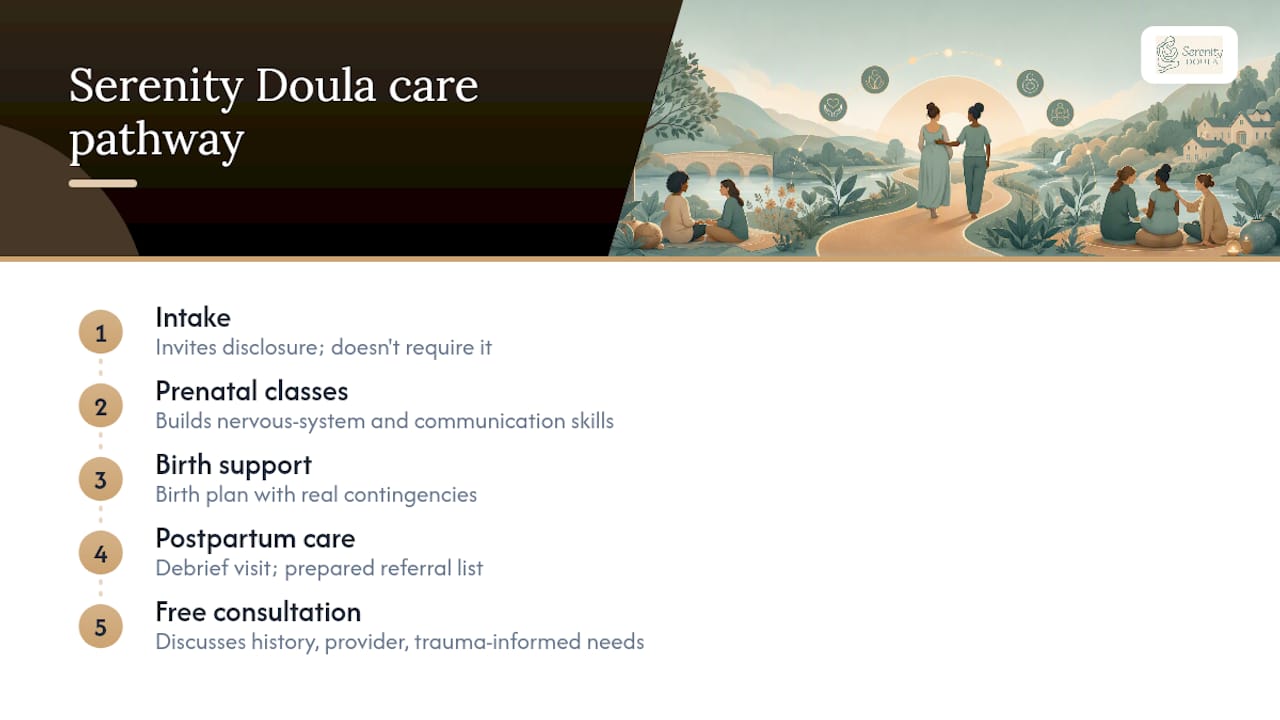
That means your intake conversation is designed to invite disclosure without ever requiring it, your birth plan includes real contingencies instead of a single fixed outcome, and your postpartum visits include a genuine debrief with a prepared referral list ready if you need it. Whether you’re preparing for a first birth, working through history from a prior one, or supporting a partner through it, Serenity Doula’s pregnancy and birth doula support walks with you through the whole arc. If prenatal preparation is where you want to start, the childbirth education classes build nervous-system and communication skills well before labor begins, and the postpartum care service picks up exactly where labor support leaves off. Families dealing with the emotional aftermath of a hard birth often find added grounding in community resources like this guide to postpartum support benefits, used alongside professional care rather than instead of it.
A free consultation with Serenity Doula includes a real conversation about your history, your provider (whether that’s a Trinity Health St. Mary team or another Bucks County practice), and what trauma-informed support would actually look like for your specific birth. Book your free consultation and let’s talk through what you need.
Sources
The Midwifery review offers the strongest peer-reviewed synthesis of doula-specific trauma-informed guidelines. SAMHSA’s whitepaper explains the five-principle framework at its source, and the Phoenix Health scope-of-practice guide details referral triggers in plain language. Harvard Health’s overview gives accessible background for anyone new to the concept.
- Evidence and guidelines for trauma-informed doula care (Midwifery, 2020)
- Trauma-informed care in maternity settings (PubMed summary)
FAQ
What Are the Five Key Trauma-Informed Principles?
Safety, choices, collaboration, trustworthiness, and empowerment, as defined by SAMHSA’s framework and applied specifically to maternity care in the Midwifery review.
How Can a Doula Help After a Traumatic Birth?
A doula offers a structured debrief, normalizes difficult feelings, monitors for warning signs like intrusive memories or avoidance, and connects you to a perinatal mental health specialist if those signs appear, all without attempting therapy herself.
Can Preeclampsia or a Difficult Diagnosis Contribute to Birth Trauma?
A frightening diagnosis or a fast-moving medical emergency during labor can absolutely contribute to a traumatic birth experience, which is exactly why trauma-informed support, communication, and follow-up debriefing matter regardless of how the birth unfolds medically. Talk with your OB or midwife about your specific risk factors and what monitoring looks like for your pregnancy.
Do Doulas Only Support Birth, or Do They Offer Other Kinds of Support Too?
Birth and postpartum doulas are the most common roles, though some doulas also train specifically to support end-of-life care using similar presence-based, trauma-informed skills. The services focus on pregnancy, birth, and postpartum support for families across several counties in the region, including Bucks, Montgomery, Philadelphia, and Burlington.
How Much Does Trauma-Informed Doula Support Cost?
Pricing varies by service and package. Current rates for pregnancy and birth doula support, childbirth education, and postpartum care are listed on each service page, and a free consultation is the easiest way to get a personalized quote.