
TL;DR:
- The ring of fire is a brief sensation of burning or stinging experienced during crowning, signaling that birth is imminent. Coping strategies like slow breathing, warm compresses, and position shifts can make this moment more manageable. Preparation techniques such as perineal massage and understanding the mechanics of crowning contribute to a smoother labor experience.
The “ring of fire” is the brief burning or stinging sensation felt during crowning, when your baby’s head stretches the vaginal opening in the final moments of labor. Many expectant mothers hear this term and feel a wave of anxiety, picturing something far more overwhelming than it actually is. The truth? This sensation is a signal that your baby is almost here. With the right knowledge and coping strategies in place, it becomes something you can move through with calm, confidence, and a sense of awe rather than dread.
Table of Contents
- What is the ring of fire and when does it occur?
- Coping strategies during crowning
- Preventive techniques: perineal massage and stretching
- How epidurals change the ring of fire experience
- The holistic framing: mechanics and mindset that make a difference
- Serenity Doula support: your next step for empowered birth
- Frequently asked questions
Key Takeaways
| Point | Details |
|---|---|
| Brief sensation signals birth | The ring of fire marks crowning and means delivery is only minutes away. |
| Coping strategies reduce discomfort | Breathing, pausing pushing, and warm compresses can significantly ease the ring of fire. |
| Preventive massage helps | Antenatal perineal massage reduces trauma especially for first-time vaginal births. |
| Epidural alters sensation | Many epidural users experience dulled or shifted sensation instead of classic burning. |
| Mindset empowers experience | Understanding body mechanics and reframing discomfort as progress can transform childbirth challenges. |
What is the ring of fire and when does it occur?
The ring of fire happens at crowning, the point in labor when your baby’s head pushes through the vaginal opening for the first time. It is part of the second stage of labor, which begins when you are fully dilated (10 centimeters) and ends with the birth.
BabyCenter describes it as a burning or stinging sensation as the baby’s head passes through the vaginal opening, a clear sign that birth is very near, and notes it typically lasts at most a few minutes. For those who have an epidural (a regional anesthetic placed in the lower back), the sensation may feel much less noticeable or even absent altogether.
Here is a quick breakdown of what happens physiologically:
| Stage | What is happening | Sensation |
|---|---|---|
| Active pushing | Baby descends through the birth canal | Pressure and urge to push |
| Crowning begins | Baby’s head reaches the vaginal opening | Intense stretching, burning begins |
| Full crowning | Baby’s head is fully visible | Peak ring of fire sensation |
| Head delivered | Baby’s head emerges | Sensation eases quickly |
Key things to know about the ring of fire:
- It is brief. Most people experience it for only a few minutes.
- It signals progress. When you feel it, your baby is almost born.
- It varies. Pain tolerance, baby’s position, and birth setting all affect intensity.
- Epidurals change things. With medication, burning may be replaced by pressure or felt very little.
Understanding managing ring of fire sensations starts with knowing exactly what is causing them, and that knowledge alone can shift your experience from fear to readiness.
Coping strategies during crowning
Once you understand what the ring of fire is, focusing on coping strategies can make it far less daunting. You have more tools available than you might think, whether you are planning an unmedicated birth or using pain medication.

BabyCenter recommends several non-epidural coping strategies for crowning, including breathing and relaxation techniques, warm compresses on the perineum (the area between the vaginal opening and rectum), and perineal counter-pressure. Comfort positions also play a role, and epidurals may reduce or alter the sensation significantly.
Here is a step-by-step approach to managing the moment:
- Breathe through it. Slow, intentional breaths signal your nervous system to stay calm. Try exhaling slowly while making a low, open sound to relax your pelvic floor.
- Pause pushing. Your care provider may guide you to stop pushing briefly, allowing the tissue to stretch gradually instead of tearing suddenly.
- Welcome warm compresses. A warm, damp cloth applied to the perineum during crowning soothes the tissue and eases the burning sensation.
- Use counter-pressure. A doula or birth partner can apply firm, steady pressure to your lower back or perineum to offset the intensity of sensation.
- Shift your position. Upright positions like hands-and-knees or side-lying can reduce pressure on the perineum and allow for a slower, gentler delivery.
Comparison of coping strategies:
| Strategy | Best for | Key benefit |
|---|---|---|
| Slow breathing | All births | Calms nervous system, reduces tension |
| Warm compresses | Unmedicated births | Softens tissue, dulls burning |
| Pausing pushing | Provider-guided births | Allows gradual stretching |
| Counter-pressure | With a support person | Offsets intensity of sensation |
| Comfort positions | All births | Reduces perineal pressure |
You can explore labor comfort measures for a more personalized breakdown of what might work best for your body and birth plan. Some families also find that TENS unit pain relief during labor provides helpful distraction and pain modulation in the lead-up to crowning.
Pro Tip: Practice slow exhale breathing during pregnancy so it becomes automatic under pressure. When crowning begins, your body will already know what to do.
Preventive techniques: perineal massage and stretching
Beyond coping strategies, preventive techniques offer proactive support for a smoother crowning experience. Starting preparation before labor even begins can make a meaningful difference.
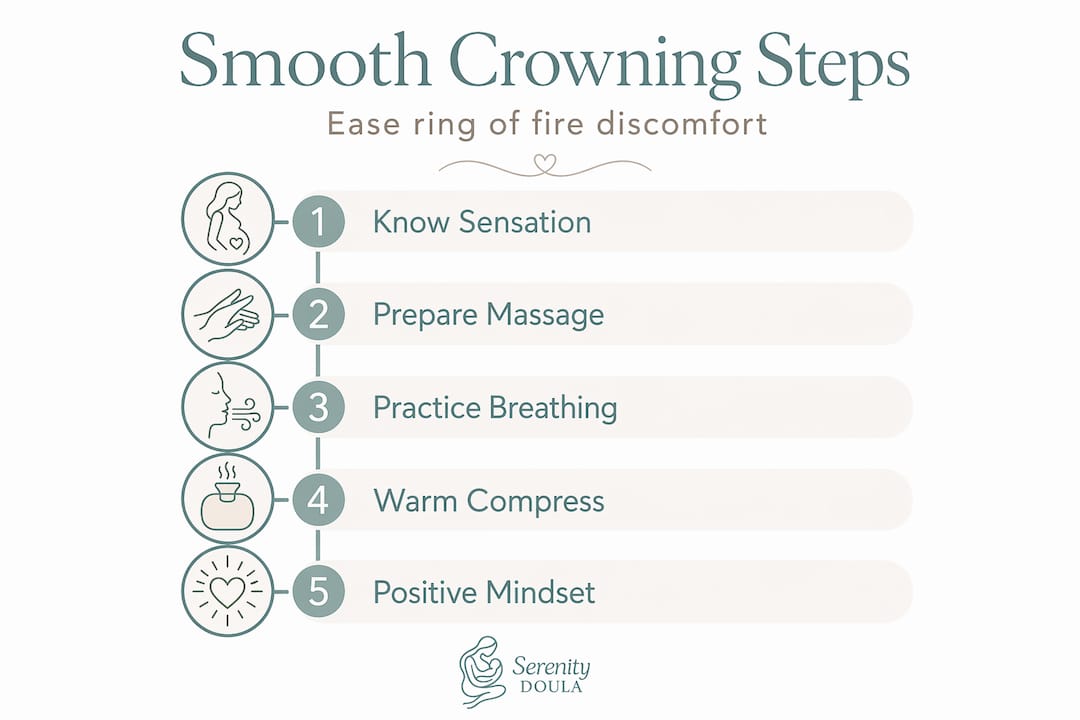
Antenatal perineal massage (gentle, manual stretching of the perineal tissue during the last weeks of pregnancy) is one of the most well-researched preventive tools available. A Cochrane review found that antenatal perineal massage has clear evidence of benefit for reducing perineal trauma, particularly episiotomy (a surgical cut made to widen the vaginal opening) and some forms of ongoing perineal pain. The benefits are most pronounced for people giving birth vaginally for the first time; effects are less definitive for those who have had prior vaginal births.
During labor itself, perineal techniques continue to matter. A Cochrane review update found that during the second stage of labor, perineal techniques including massage and warm compresses are used to allow the perineum to stretch more slowly, with possible benefits for outcomes like severe tears and episiotomy, though results vary by study.
Here is what a proactive plan might look like:
- From 34 to 36 weeks onward: Begin antenatal perineal massage for 5 to 10 minutes, 3 to 4 times per week.
- Use a clean, natural oil such as coconut or almond oil to reduce friction during massage.
- Practice relaxing your pelvic floor while doing massage to train your body to release tension rather than resist stretching.
- During labor: Ask your midwife or provider about using warm compresses and supportive perineal techniques at crowning.
- After birth: Plan for postpartum care that supports perineal healing, regardless of how birth unfolds.
“The more prepared and relaxed your perineal tissue is before labor, the more gently it can stretch when the moment comes. Prevention and preparation are acts of self-care, not just strategies.”
If you want to feel more ready for labor in body and mind, our guide on how to prepare for labor walks you through a holistic approach to getting grounded before the big day.
Pro Tip: If you are unsure how to start perineal massage, ask your midwife or doula at a prenatal visit. A quick demonstration can give you the confidence to practice at home.
How epidurals change the ring of fire experience
Individual experience varies enormously, especially for those choosing pain medication during labor. If you have an epidural, your experience of the ring of fire may look and feel very different from what you have read or heard.
Both BabyCenter and the American Pregnancy Association note that when a person has an epidural, the ring of fire sensation may be absent or significantly altered. Instead of intense burning, you might feel a duller pressure, a vague stretching sensation, or nothing distinctly at all. This is completely normal and does not mean something is wrong.
What this means for your coping:
- Focus on pressure, not pain. With an epidural, your cue to push or pause may come from pressure feedback rather than burning.
- Trust your care team’s guidance. Your provider will watch for crowning and help direct your pushing, especially if your sensation is limited.
- Stay present and connected. Even without intense physical sensation, staying emotionally tuned in to your body helps you engage with the birth.
- Communicate openly. Let your nurse or midwife know what you do and do not feel so they can tailor their guidance accordingly.
- Your doula remains essential. A doula can keep you focused, calm, and informed throughout crowning, regardless of your pain management choice.
Learning more about epidural effects on ring of fire sensations can help you plan realistically for your birth experience, whatever path you choose.
The holistic framing: mechanics and mindset that make a difference
Here is something most birth guides skip over: the ring of fire is not just a pain event. It is a mechanical event. And understanding the mechanics changes everything.
The American Pregnancy Association explains that the ring of fire corresponds to crowning-related stretching and nerve stimulation at the vaginal opening. This means that strategies which slow delivery during crowning (like pausing pushing) and help the perineum relax and extend (like relaxation, warm compresses, and perineal techniques) are not just comfort measures. They are conceptually aligned with what your body is already trying to do.
We believe the most empowered birthing people are those who understand the why behind each strategy. When you know that slow breathing relaxes the pelvic floor, allowing tissue to yield rather than resist, you are no longer just enduring a contraction. You are actively participating in your birth. When you feel the burning begin and recognize it as your body making space for your baby, the narrative shifts from “something is wrong” to “I am almost there.”
This mindset does not minimize the intensity of the sensation. It reframes it as useful information, a physiological signpost that your baby is crossing the threshold into the world. That one shift, from fear to meaning, is what we see separate births that feel traumatic from those that feel transformative. We encourage you to explore holistic coping strategies that bring both the mechanics and the mindset together.
Serenity Doula support: your next step for empowered birth
You have explored the ring of fire from every angle, what it is, how to cope, how to prepare, and how to frame it. The next powerful step is having personalized support walking alongside you.

At Serenity Doula, we offer pregnancy and birth support that bridges education with hands-on comfort during every phase of labor, including crowning. Our childbirth education benefits go beyond textbook facts, helping you build real confidence and a personalized coping plan. Whether you are planning an unmedicated birth, using an epidural, or preparing for a cesarean, our doula services meet you exactly where you are. You deserve to feel grounded, informed, and genuinely supported on the day your baby arrives.
Frequently asked questions
How long does the ring of fire last during childbirth?
The ring of fire usually lasts just a few minutes, primarily during crowning. BabyCenter notes it lasts at most a few minutes, making it one of the briefest but most intense sensations in labor.
Can the ring of fire be prevented altogether?
The sensation typically cannot be eliminated entirely, but perineal massage can reduce tissue trauma and may ease discomfort, especially for first-time vaginal births.
Does an epidural remove the ring of fire sensation?
An epidural often dulls or replaces the burning with pressure, and may make the ring of fire barely noticeable or fully absent, depending on the individual and dosage.
What is the most effective coping strategy for crowning discomfort?
The American Pregnancy Association highlights pausing pushing, slow breathing, and warm compresses as key methods for reducing crowning discomfort and supporting gradual tissue stretching.
Are these strategies helpful for all births, including first-time and subsequent deliveries?
Most coping strategies support all births, but perineal massage shows the clearest benefit for first-time vaginal births, with less definitive evidence for subsequent deliveries.