
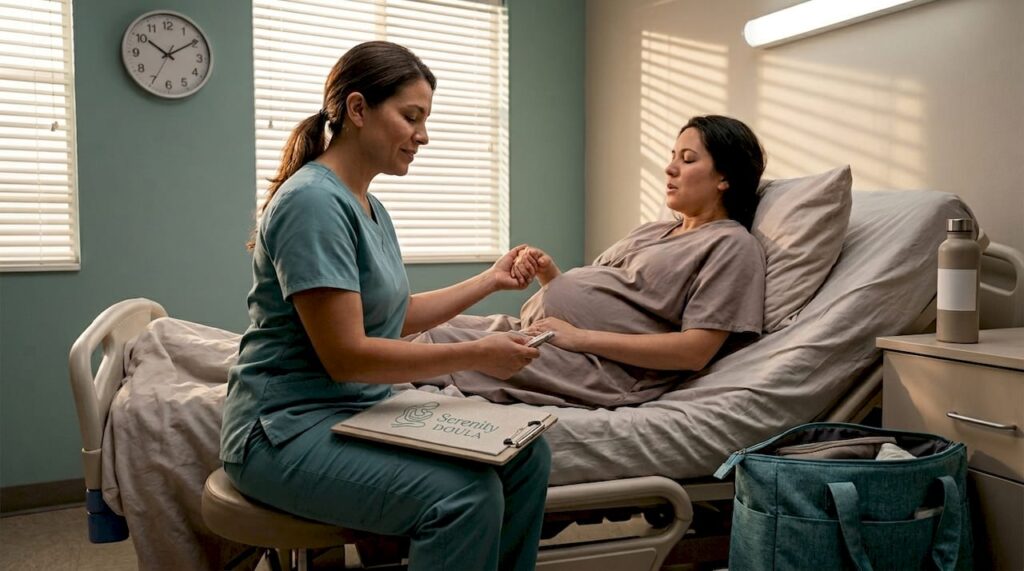
TL;DR:
- Labor support extends beyond holding your hand, providing emotional, physical, and informational assistance throughout childbirth. Evidence shows that doula care improves outcomes such as higher breastfeeding rates, more postpartum visits, and fewer preterm births, especially when covered by Medicaid in Philadelphia. Finding a compatible, credentialed doula who understands your needs enhances your birth experience and health results significantly.
Most expectant families in Philadelphia think of labor support as someone holding your hand through contractions. The reality is far more powerful than that. Doula care is associated00869-X/fulltext) with 20% higher exclusive breastfeeding rates, 5 to 6 more postpartum visits, and 3 to 4 fewer preterm births per 100 deliveries, based on a landmark UPMC study of nearly 18,000 patients. This article walks you through everything you need to know: what labor support really means, how doulas guide you through each stage, and what the data actually shows about outcomes for families right here in the Philadelphia area.
Table of Contents
- Understanding labor support: More than just presence in the room
- Labor stages and how doulas guide each phase
- Evidence-based benefits: Doula care by the numbers
- Choosing and accessing the right labor support for your family
- Why personalized labor support matters more than ever
- Discover holistic doula support in Philadelphia
- Frequently asked questions
Key Takeaways
| Point | Details |
|---|---|
| Doula care leads to better outcomes | Professional labor support decreases preterm births and boosts breastfeeding rates. |
| Holistic support is key | Emotional, physical, and informational help from doulas shapes positive birth experiences. |
| Philly access is expanding | Medicaid and community programs now make doula support more available than ever. |
| Personal fit matters most | Choosing a doula who aligns with your family’s needs leads to the best results. |
| Evidence confirms benefits | Research repeatedly shows improved outcomes for doula-supported births regardless of background. |
Understanding labor support: More than just presence in the room
Labor support is a term that covers emotional, physical, and informational assistance throughout your entire birthing experience. It is not simply having someone nearby. Real labor support means having a trained person who reads the room, responds to your shifting needs, and bridges the gap between you and your medical team.
A professional doula brings holistic, personalized care that adapts in real time. That looks different from what a nurse, partner, or family member typically provides. Here is what trained labor support actually includes:
- Continuous emotional presence throughout active labor, not just check-ins
- Physical comfort techniques such as counter-pressure, massage, and positioning guidance
- Non-judgmental information sharing to help you understand your options
- Advocacy and communication support so your voice is heard by your care team
- Breathing and relaxation coaching tailored to your birth preferences
Doula care benefits in Pennsylvania are growing in recognition, and the evidence behind them is strong. Studies consistently show benefits including lower C-section rates and reduced preterm birth, even as researchers continue working through regulation challenges tied to insurance expansion. In Philadelphia specifically, Medicaid coverage and community-based doula programs have made this support more reachable than ever before.
“Labor support is not a luxury add-on. It is a clinically recognized practice that changes measurable outcomes for mothers and babies.”
Learning to think about balancing wellness for parents means seeing labor support as one piece of a broader picture of family wellbeing, not an isolated birth-day event. Your doula is part of a support system that holds you before, during, and after your baby arrives.
Labor stages and how doulas guide each phase
To understand what your doula actually does, it helps to understand how labor itself unfolds. Labor is not one long, identical experience. It moves through distinct phases, and each one calls for different kinds of support.
Here is a look at the major stages and what doula involvement typically looks like at each point:
-
Early labor (latent phase): This phase can last up to 20 hours for first-time mothers or up to 14 hours for those who have given birth before. Contractions are irregular and manageable. Your doula often supports you by phone or arrives at your home to help you stay calm, rest when possible, and eat lightly.
-
Active labor: Beginning around 6 centimeters dilation, active labor progresses at roughly 1 to 2 centimeters per hour. This is where continuous support becomes critical. Your doula uses techniques like hip squeezes, rebozo (a supportive cloth technique), warm compresses, and position changes to help manage intensity without medication, or alongside it if that is your plan.
-
Transition: The most intense and shortest phase. Your doula focuses entirely on grounding you, offering steady eye contact, breathing cues, and verbal reassurance. This is often where families feel most overwhelmed, and the presence of a calm, experienced guide makes an enormous difference.
-
Pushing and birth: Your doula supports positioning, helps you follow your body’s cues, and keeps communication open between you and your care team. She is not delivering the baby; she is making sure you feel seen and supported while your medical providers do their work.
-
Immediate postpartum: A doula helps with first latch if you choose to breastfeed, provides emotional grounding after the intensity of birth, and often assists with skin-to-skin time and early bonding.
Understanding types of childbirth support helps you recognize how a doula’s role fits alongside your OB, midwife, or partner’s role without overlap or confusion.

How doula and partner support compare:
| Role | Primary focus | Clinical training? | Continuous presence? |
|---|---|---|---|
| Doula | Emotional, physical, informational | Yes, specialized birth support | Yes |
| Partner/family | Emotional, relational | No | Often yes |
| OB/midwife | Medical care and safety | Yes, medical degree | Intermittent |
| Labor nurse | Medical monitoring and care | Yes, nursing degree | Varies by shift |
Your support during labor guide can help partners understand exactly where they fit into this picture. Many families find that having a doula actually helps their partner feel more confident and less anxious because the doula fills in the gaps that love alone cannot cover.
Understanding doula vs. midwife roles is also key. These are not interchangeable. They work together beautifully, but their purposes are very different.
Pro Tip: Do not just plan for pain management. Plan comfort strategies for each specific phase before labor begins. What will feel grounding during early labor at home may feel completely different from what you need during active labor in the hospital. Talk through phase-by-phase preferences with your doula well before your due date.
Evidence-based benefits: Doula care by the numbers
Now that you understand what doulas do moment to moment, the clinical data tells an equally compelling story. This is not anecdotal. These are real outcomes measured across large, diverse populations.
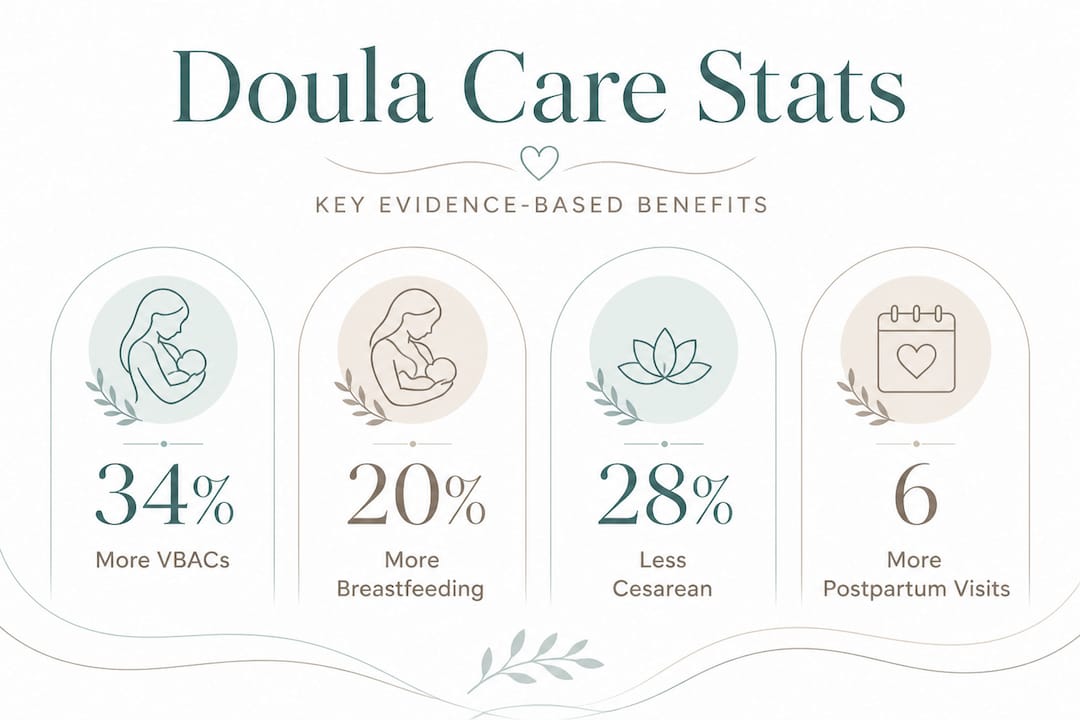
A landmark study of 17,831 patients through UPMC found the following outcomes for families with doula support compared to those without:
| Outcome measure | Change with doula care |
|---|---|
| VBAC (vaginal birth after cesarean) rate | 15 to 34 more per 100 patients |
| Postpartum care visits | 5 to 6 more visits |
| Exclusive breastfeeding | 20% higher rate00869-X/fulltext) |
| Preterm births | 3 to 4 fewer per 100 deliveries |
What makes these findings especially powerful is consistency. These results held across different races and insurance types. Whether you are a first-time mother, a VBAC candidate, or navigating a high-risk pregnancy, the benefits of having a doula do not disappear based on your background or your insurance plan.
Key advantages Philadelphia-area families should know:
- Reduced likelihood of cesarean birth without medical necessity
- More confidence going into labor thanks to ongoing prenatal education and preparation
- Higher likelihood of meeting your breastfeeding goals
- Smoother postpartum recovery supported by continued check-ins and resources
- Decreased anxiety and greater sense of control throughout the birth experience
If you are exploring doula support for VBAC, the data is particularly encouraging. Families with a history of cesarean birth saw some of the most dramatic improvements in birth outcomes when doula care was part of their plan.
The benefits of childbirth education compound these outcomes even further. When you arrive at labor prepared, informed, and supported, your ability to move through each phase with confidence increases significantly.
Statistic spotlight: Families with doula support are 20% more likely to exclusively breastfeed. That number matters not just for feeding goals but for long-term infant health outcomes including reduced infection risk and stronger immune development in your newborn’s first weeks.
Choosing and accessing the right labor support for your family
Knowing the benefits is one thing. Finding the right support for your specific family is where the real work begins. And the good news is that in Philadelphia and surrounding areas, your options have never been more accessible.
Here is how to approach the search thoughtfully:
-
Start with training and credentials. Look for doulas certified through recognized organizations like DONA International, CAPPA, or ICEA. Certification means they have completed formal education, observed births, and received feedback on their practice.
-
Assess their experience with your specific needs. Are you planning a medicated birth? An unmedicated one? A VBAC or a cesarean? Make sure your doula has experience supporting families whose goals look like yours.
-
Evaluate communication style and fit. A doula who makes you feel calm in a prenatal meeting is more likely to make you feel grounded during labor. Trust your gut about personality fit.
-
Ask about their backup plan. Babies do not always arrive on schedule. Know whether your doula has a trusted colleague who would step in if she is unavailable.
-
Understand the full scope of their services. Some doulas offer prenatal visits, postpartum support, and even childbirth coaching in addition to labor attendance.
-
Explore financial options. Philadelphia-area families have more resources than many realize. Medicaid and insurance access to doula care is expanding through community programs and hospital partnerships. Ask your doula directly about sliding-scale fees or coverage options.
Helping your partner play their best role is also part of choosing wisely. Some families worry that hiring a doula means their partner will feel pushed out. The opposite tends to be true. A skilled doula invites your partner in, teaches them in real time, and makes sure the whole room is supporting you together.
Pro Tip: Interview at least two or three doulas before deciding. Ask each one how they would handle a situation where your birth plan changes, such as an unexpected recommendation for a cesarean. Their answer will tell you a great deal about how they show up under pressure.
Why personalized labor support matters more than ever
Here is something that does not get said enough: the data only tells part of the story.
Yes, the numbers are compelling. Fewer preterm births. More breastfeeding success. Better postpartum follow-through. These outcomes matter enormously. But the real engine behind those numbers is something harder to quantify: fit.
A doula who is skilled but not the right match for you can still leave you feeling unseen during the most intense experience of your life. Philadelphia families are not a monolith. This city is one of the most culturally and economically diverse in the country, and what feels empowering to one family may feel completely wrong for another. A one-size-fits-all birth support approach ignores the real, specific factors that shape your experience, including your cultural traditions, your relationship with the medical system, your previous birth experiences, and your personal values around pain, autonomy, and intervention.
Holistic birth support means meeting you where you actually are, not where a template says you should be. The best doula relationships are built on genuine understanding. Your doula should know whether you want encouragement or quiet presence, whether you want options explained or simply want someone to hold steady with you, and whether you draw strength from information or from emotional grounding.
The families who report the most positive birth experiences, regardless of how the birth actually unfolded, are not always the ones with the most “perfect” outcomes. They are the ones who felt held, heard, and informed throughout. That feeling does not happen by accident. It happens because someone took the time to understand what you specifically needed and showed up for that, not for a generic version of you.
Your support choices are yours to make. Own them.
Discover holistic doula support in Philadelphia
You came here looking for answers, and now you have them. The evidence is clear, the roles are defined, and you know what to look for in a support team. The next step is finding the right people to walk this journey with you.

At Serenity Doula, we offer personalized pregnancy and birth support services for families across Philadelphia and the surrounding communities, built around your values, your birth preferences, and your family’s unique needs. Whether you are curious about what a doula does or you are ready to schedule a consultation, we are here to help you feel grounded and confident every step of the way. Explore our full range of doula services including prenatal education, labor support, and postpartum care, and let’s design your birth experience together.
Frequently asked questions
What specific services do labor support doulas provide during childbirth?
Doulas offer physical comfort techniques, emotional reassurance, guidance with labor positions, and clear information to help you make informed choices at every stage, from early labor through the active phases and immediate postpartum.
How does doula care improve postpartum outcomes?
Research shows that doula support leads to 5 to 6 more postpartum visits00869-X/fulltext) and a 20% higher rate of exclusive breastfeeding compared to families without doula care.
Can I access doula support through Medicaid or insurance in Philadelphia?
Yes. As of 2026, Medicaid and some insurance plans in the Philadelphia area have expanded coverage through community partnerships and hospital programs, making doula care more reachable for more families.
What is the main difference between doula and midwife labor support?
Doulas focus entirely on your emotional, physical, and informational support, while midwives provide medical oversight and are responsible for the clinical safety of both you and your baby during labor and birth.
Are the benefits of labor support consistent across races and insurance types?
Yes. The UPMC study of nearly 18,000 patients confirmed that doula care benefits00869-X/fulltext) including lower preterm birth rates and higher breastfeeding success were consistent regardless of race or insurance plan.