
TL;DR:
- Newborn crying is normal, usually lasting 1-4 hours daily, and different cries indicate various needs.
- Effective soothing involves basics first, then applying the 5 S’s: swaddling, side position, shushing, swinging, and sucking.
- Safety and parental self-care are crucial, with professional support and self-compassion essential during challenging moments.
Those first weeks at home with a newborn can feel like the most beautiful and the most bewildering experience of your life, often at the same time. When your baby cries and nothing you try seems to calm them, it’s easy to feel helpless, even though you’re doing everything right. The good news is that there are proven, practical calming strategies that really work, and this guide walks you through every one of them. Whether it’s your first night home or your fortieth, you’ll find clear, step-by-step actions to soothe your baby and feel more grounded while doing it.
Table of Contents
- What you need before you start: Tools, basics, and preparing the environment
- Step-by-step newborn soothing: The essentials
- What if it isn’t working? Troubleshooting and knowing when to call for help
- Safety first: Essential do’s and don’ts when soothing your newborn
- When do newborns learn to self-soothe, and how to build better habits now
- Hard truths and hidden wins: What most guides miss about newborn soothing
- Find more support for you and your newborn
- Frequently asked questions
Key Takeaways
| Point | Details |
|---|---|
| Follow the essentials | Check basic needs first, then use proven calming methods to help soothe your newborn. |
| Track and adjust routines | Every baby is different—keep a simple log and modify soothing steps as you learn what works. |
| Watch for warning signs | Know the difference between normal crying and signals that require medical help. |
| Prioritize safety and self-care | Safe practices protect your newborn, and caring for yourself helps you stay present and calm. |
| Soothing takes practice | It’s normal for soothing to take time and trial; being responsive and patient matters most. |
What you need before you start: Tools, basics, and preparing the environment
Before diving into hands-on steps, ensure you have everything ready to set your newborn and yourself up for soothing success.
Understanding why your baby cries is the first step toward feeling less overwhelmed. Crying is your newborn’s only form of communication, and newborns cry 1-4 hours per day in the first few months. That’s completely normal, even if it doesn’t feel that way at 2 a.m.
Different cries often signal different needs. Over time, you’ll start to recognize patterns. Here’s a quick reference to get you started:
| Cry type | What it may mean | What to try first |
|---|---|---|
| Short, rhythmic cry | Hunger | Feed your baby |
| High-pitched, sudden | Pain or discomfort | Check for hair tourniquet, gas |
| Whiny, building slowly | Tiredness | Rock, swaddle, dim lights |
| Prolonged, hard to soothe | Colic or PURPLE phase | Patience, movement, contact |
| Low-pitched, continuous | Overstimulation | Quiet, dark room, gentle hold |
Your soothing essentials checklist
Having the right tools within arm’s reach makes a real difference, especially when you’re sleep-deprived and stressed. Think about creating a calm environment in your home the way you would for any meaningful, sensitive experience.
Here’s what to have on hand before you need it:
- Clean diapers and wipes close to the changing area
- Feeding supplies ready (breast or bottle) so there’s no scramble
- A safe sleep space (firm, flat mattress, no loose bedding)
- Swaddle blankets in your baby’s current size, pre-washed
- A pacifier (optional, but helpful for some babies after breastfeeding is established)
- A white noise machine or app for background shushing sounds
- A comfortable chair or rocker for extended soothing sessions
- A soothing playlist of lullabies or soft instrumental music
Your own readiness matters just as much as your supplies. Take one slow, deep breath before you pick up your baby. A calmer parent genuinely helps calm a baby, because newborns sense tension in your body and voice. If you have a partner, a family member, or a friend nearby, this is a great moment to tag them in. You don’t have to carry this alone.
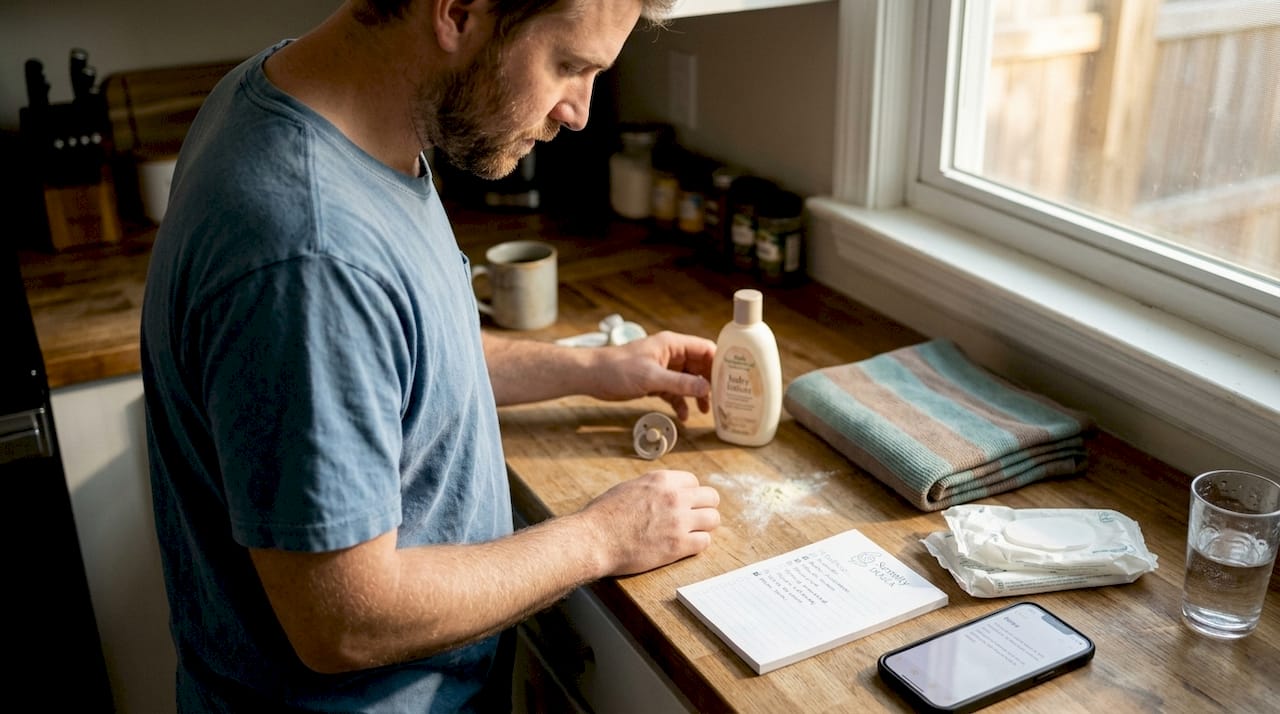
Some parents also find gentle massage for soothing helpful, both for the baby and for their own stress relief between feeding and settling cycles.
Step-by-step newborn soothing: The essentials
With your environment and tools prepared, you’re ready to follow the proven step-by-step routine.
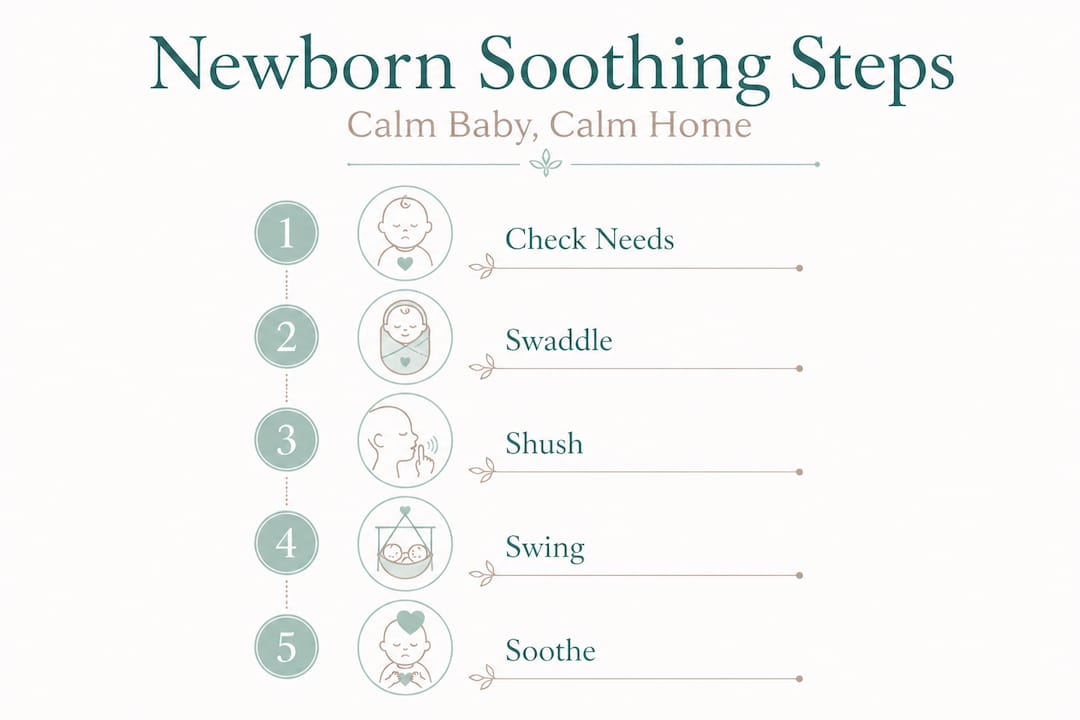
Step 1: Address the basics first
Before anything else, run through the essentials. According to pediatric guidance, check hunger, wet diaper, temperature, and tiredness before moving on to more complex soothing techniques. This sounds simple, but it’s easy to skip in a moment of panic.
- Feed your baby if it’s been more than 2 hours, or sooner if they show hunger cues (rooting, sucking hands).
- Change the diaper even if it seems only slightly wet. Some babies are very sensitive.
- Check for discomfort. Run a finger along your baby’s body to check for a hair or thread wrapped tightly around a finger or toe (called a hair tourniquet).
- Adjust temperature. Feel the back of your baby’s neck. If it’s sweaty, remove a layer. If it feels cool, add one.
- Try burping. Hold baby upright over your shoulder and gently pat for 1-2 minutes if they’ve recently fed.
Step 2: Apply the 5 S’s
Pediatrician Harvey Karp developed the “5 S’s” as a structured method to recreate the sensations of the womb. These techniques, when done together or in sequence, can work surprisingly fast.
| S method | How to do it | Why it works |
|---|---|---|
| Swaddling | Wrap snugly, arms down | Mimics womb containment |
| Side/stomach position | Hold on side or stomach (never for sleep) | Activates calming reflex |
| Shushing | Consistent “shhhh” near ear | Replicates womb sounds |
| Swinging | Small, rhythmic jiggles | Mimics movement in the womb |
| Sucking | Pacifier or breast/bottle | Triggers natural calming |
The key is combining these. Swaddling alone may not calm your baby, but swaddling plus shushing plus gentle swinging often does the trick within a few minutes.
Step 3: Add supportive methods
Once the 5 S’s are in motion, you can layer in additional calming tools. Skin-to-skin contact, soft music, a gentle stroller walk, or a warm bath can all shift the mood. Skin-to-skin, where your baby rests against your bare chest, is especially powerful. It regulates your baby’s heartbeat, breathing, and even temperature.
If you’re a dad or a non-birthing partner reading this, this is your moment too. Newborn care isn’t just a mom’s job, and the care tips for dads on soothing and bonding can build enormous confidence. Your calm presence matters deeply to your baby.
Pro Tip: Keep a simple notes app on your phone and jot down which technique worked, when, and under what conditions. After a week, you’ll start to see your baby’s personal patterns, and soothing will feel far less like guessing.
Staying calm as a parent is genuinely hard in the trenches of new parenthood, but small mindfulness habits like box breathing while you rock your baby can help regulate your own nervous system alongside your little one’s.
What if it isn’t working? Troubleshooting and knowing when to call for help
Sometimes, even with all the right steps, babies won’t settle. Here’s what to do when your best efforts don’t seem to help.
Understanding persistent crying
There’s a difference between a baby who is simply hard to soothe on a particular night and a baby who may need medical attention. Learning that difference helps you stay calm and respond wisely.
The PURPLE crying phase is a normal developmental stage where babies cry in ways that seem resistant to soothing. The acronym PURPLE stands for:
- P = Peak of crying (peaks around 2 months)
- U = Unexpected timing
- R = Resists soothing
- P = Pain-like face (even without pain)
- L = Long lasting
- E = Evening clustering
During this phase, tracking your baby’s crying in a simple diary helps you see patterns and feel less like something is terribly wrong. Note the time, duration, and what (if anything) helped. This log also becomes valuable if you do speak with your pediatrician.
Statistic spotlight: The PURPLE crying phase typically peaks in month two and resolves by month five. Knowing it ends is often the most reassuring piece of information a new parent can have.
Warning signs that need medical attention
Some cries do signal illness or injury. Call your doctor if your baby shows any of these:
- Fever above 100.4°F (38°C) in a baby under 3 months
- A very weak cry or an unusually high-pitched sound
- Refusing to feed for more than one feeding session
- Crying continuously for more than 3 hours without any pause
- A bulging fontanelle (the soft spot on the head)
- A rash alongside crying
Trust your gut. If something feels off, call your pediatrician. You are never overreacting when it comes to your newborn’s health.
Take care of yourself too
Parent mental health is not a luxury. If you’re reaching a breaking point, please read the section on safety and take a break without guilt. Building a strong postpartum care plan before your baby arrives gives you a safety net for exactly these moments.
Safety first: Essential do’s and don’ts when soothing your newborn
In the midst of soothing routines and troubleshooting, don’t overlook the most vital part—your baby’s safety.
Safe soothing and safe sleep go hand in hand. Here are the non-negotiables:
- Always place your baby on their back to sleep, on a firm, flat surface
- Remove all loose items from the sleep area: pillows, blankets, bumpers, stuffed animals
- Never leave your baby unattended on an elevated surface like a couch or changing table
- Avoid sleep positioners and inclined sleepers that have been recalled or flagged for safety risks
- Do not use heavy swaddling that restricts hip movement or covers the face
The single most important rule: never shake a baby. If you’re overwhelmed, place your baby safely in their crib, step away for 10-15 minutes, and breathe. This is not giving up. This is protecting both of you.
Shaken baby syndrome causes severe brain injury and is completely preventable. When frustration peaks, placing your baby down safely and walking away is the most loving thing you can do.
Pro Tip: Write a short safety checklist on a notecard and tape it near the crib and changing area. In sleep-deprived moments, visual reminders help more than memory.
For your own recovery during this time, explore postpartum care essentials that cover physical healing alongside the emotional demands of new parenthood. If you’re recovering from a cesarean birth or a difficult delivery, postpartum recovery tips specific to your situation can be genuinely helpful.
When do newborns learn to self-soothe, and how to build better habits now
After covering safety, it’s helpful to look ahead and understand how your soothing today supports your baby’s future sleep and independence.
Here’s something that relieves a lot of parental pressure: very few babies can self-soothe before three to four months of age. It’s a developmental milestone, not a reflection of your parenting. Self-soothing develops around three months or later, and building toward it is a gradual process.
That means right now, your job is to respond to your baby. Holding, rocking, feeding, and soothing are not spoiling. They are building trust, safety, and the foundation for all future emotional regulation.
Here’s how to gently lay the groundwork:
- Establish a simple routine. Even in the newborn stage, a consistent order of events (feed, burp, cuddle, sleep) helps your baby begin to anticipate rest.
- Put baby down drowsy but awake when you can. This helps them practice the beginning stages of self-settling, without pressure.
- Experiment with different calming tools. Not every baby responds to swaddling. Some hate the pacifier. Some love white noise. Trial and error is not failure.
- Track what works. Keep a brief log of which techniques helped, at what time, and for how long. Patterns emerge faster than you expect.
Pro Tip: A simple notebook on your nightstand works perfectly as a sleep and soothing log. You don’t need a fancy app. Date, time, what you tried, and how it went. That’s it.
As your baby grows and begins to show signs of self-settling, your gentle routines now will support their healthy infant patterns in the weeks and months ahead.
Hard truths and hidden wins: What most guides miss about newborn soothing
Most soothing guides focus almost entirely on technique. Follow these steps, and your baby will calm down. If only it were that straightforward.
Here’s the truth that we share with the families we support in the Philadelphia area: no method works every time, with every baby, on every night. The 5 S’s are genuinely effective, but some nights they won’t land. That’s not a failure in you, and it’s not a failure in the method. It’s just the reality of caring for a tiny, complex human being who is also figuring out the world.
What we’ve seen again and again is that responsive parenting, the act of consistently showing up, trying, adjusting, and trying again, matters far more than perfect execution. Your baby doesn’t need a flawless technique. They need a parent who keeps coming back with warmth and attention.
Philadelphia families have a real advantage here. With resources like Children’s Hospital of Philadelphia (CHOP), local AAP-aligned pediatric networks, and growing communities of new parents in neighborhoods across the city, you’re not navigating this alone. Local parent groups, postpartum support circles, and confidence-building for new parents are more accessible than many families realize.
One more thing no guide talks about enough: self-compassion. The parents who come out of the newborn phase feeling most grounded are rarely the ones who “cracked the code.” They’re the ones who gave themselves permission to not have it all figured out, who asked for help, who rested when they could, and who reminded themselves that crying phases end. They always do.
Find more support for you and your newborn
Knowing the steps is one thing. Having someone beside you to practice them, adjust them, and cheer you on is something entirely different.

At Serenity Doula, we work with Philadelphia-area families to make the postpartum transition feel calmer, more supported, and genuinely manageable. Our team offers birth support doula services and childbirth education programs designed to give you real-world skills for exactly the moments this guide covers. Whether you’re expecting your first baby or adding to your family, Serenity Doula support is here to meet you where you are, with evidence-based guidance and genuine compassion. Reach out to schedule your consultation and find out how we can support you and your growing family.
Frequently asked questions
How long do newborns typically cry each day?
Newborns cry 1-4 hours per day in the early months, with crying often peaking around 6-8 weeks before gradually decreasing.
What is the PURPLE crying phase?
PURPLE crying is a normal developmental phase marked by increased, hard-to-soothe crying that peaks in month two and typically resolves by month five.
How do I know if my baby’s crying is a medical emergency?
Call your doctor if your baby has a fever above 100.4°F, cries continuously for more than three hours, refuses to feed, or has an unusually weak or high-pitched cry.
When will my newborn start to self-soothe?
Most babies begin showing self-soothing skills around three to four months, though timelines vary widely from baby to baby.
What should I do if I feel overwhelmed while trying to soothe my baby?
Place your baby safely in their crib, step away for 10-15 minutes to reset, and reach out to a partner, friend, or professional for support.