

Yes, erythromycin 0.5% ophthalmic ointment is the standard treatment given to nearly every newborn in the United States, and both the USPSTF and the American Academy of Pediatrics recommend it to prevent gonococcal ophthalmia neonatorum, a sight-threatening eye infection newborns can pick up during birth. It works well against that one bacterium but doesn’t reliably stop every cause of newborn conjunctivitis, including chlamydia. It’s applied within the first hour or so of life and may cause brief blurriness or mild irritation, nothing more.
TL;DR:
- Erythromycin ointment offers limited protection against chlamydia and viral infections, so positive maternal screening does not eliminate the risk of neonatal eye disease.
- The ointment is typically applied within the first hour after birth using a single-use tube, with no rinsing afterward, although some hospitals may delay application for bonding.
- Minor, temporary side effects such as eye irritation and blurred vision are common, but allergic reactions are rare and require immediate medical attention.
- Refusal of prophylaxis is permitted but should involve documented counseling, especially if maternal infection status is unclear, because the risk of gonococcal infection remains significant.
- During supply shortages, some hospitals switch to systemic antibiotics like ceftriaxone for high-risk cases rather than relying solely on topical erythromycin.
Table of Contents
- What Erythromycin Eye Ointment Protects Against (and What It Doesn’t)
- How and When Erythromycin Ointment Is Given at Birth
- What Are the Side Effects and Risks of Erythromycin Ointment?
- What If You Refuse the Ointment or It’s Unavailable?
- Warning Signs of Newborn Eye Infection to Watch For
- What Do AAP, USPSTF, CDC, and DailyMed Say?
- A Doula’s Practical Perspective: Questions to Ask and How to Prepare
- How Erythromycin Actually Stops Newborn Eye Infections
- How Common and Serious Is Neonatal Eye Infection Without Prophylaxis?
- Why Newborn Eye Prophylaxis Practices Differ Around the World
- How to Store Erythromycin Eye Ointment Properly
- What to Do If Your Baby Has a Reaction to the Ointment
- Where the Conventional Advice Falls Short for Parents
- Preparing for the Birth Room Conversation, With Support
- Sources
- FAQ
What Erythromycin Eye Ointment Protects Against (and What It Doesn’t)
The ointment’s main job is guarding against Neisseria gonorrhoeae, a bacterium a baby can pick up while passing through the birth canal if the birthing parent carries it, often without any symptoms. Left untreated, gonococcal eye infection in a newborn can progress quickly, sometimes within days, and cause corneal damage or permanent vision loss. That speed is exactly why prophylaxis happens in the delivery room rather than waiting for lab results.
Erythromycin’s coverage has real limits, though:
- It offers only partial protection against Chlamydia trachomatis, another common cause of newborn eye infection.
- It does nothing for viral conjunctivitis or infections introduced after the hospital stay.
- Prenatal screening for gonorrhea and chlamydia catches most cases, but timing gaps, false negatives, and new exposure close to delivery mean screening alone isn’t foolproof.
That’s the logic behind universal application. Even with excellent prenatal care, the CDC notes that no screening protocol catches every case, so every newborn gets the ointment rather than only those flagged as high risk.
How and When Erythromycin Ointment Is Given at Birth
Here’s what typically happens, in order:
- Right after delivery. Once your baby is dried off, warmed, and has had skin-to-skin time, a nurse applies the ointment, usually within the first hour of life, either in the delivery room or shortly after in the nursery.
- A thin ribbon, precisely placed. Federal drug labeling calls for a ribbon of ointment instilled into the lower conjunctival sac of each eye. A fresh, single-use tube is used for every baby, no exceptions.
- No rinsing afterward. The ointment stays in place. Wiping or rinsing it out defeats the purpose.
- A little blurriness, briefly. Your baby’s vision may look smeary for an hour or two, and you might notice a light film on the lashes. Both resolve on their own.
Pro Tip: Ask your nursing team if they can hold off on the ointment until after your first hour of skin-to-skin bonding and initial breastfeeding attempt. Most hospitals will accommodate this as long as it’s still given within the recommended early window.
What Are the Side Effects and Risks of Erythromycin Ointment?
Reactions to erythromycin ointment are almost always minor and short-lived, according to clinical reference data on the medication. Still, it’s worth knowing what’s normal and what isn’t.
Expected, temporary effects include:
- Mild eye irritation or redness for a few hours
- Slight puffiness of the eyelids
- Brief blurred vision immediately after application
The ointment is contraindicated for infants with a known erythromycin allergy, which is rare but worth mentioning to your care team if there’s a family history of antibiotic reactions. Tell your nurse or pediatrician before delivery if you’re aware of any drug sensitivities in your baby’s father or close relatives. Nursing staff typically document the time of application, which eye or eyes received it, and any reaction observed, all of which becomes part of your baby’s chart.
What If You Refuse the Ointment or It’s Unavailable?
Declining prophylaxis is your right, but most hospitals have a defined process for it. A clinician will usually walk through the risks and benefits with you, then ask you to sign a formal refusal form, which becomes part of your baby’s permanent medical record. This isn’t about pressure. It’s documentation that protects everyone and creates a paper trail for follow-up care.
Refusing prophylaxis does carry real risk, especially if maternal gonorrhea status is unknown or unscreened. That’s why follow-up appointments matter even more if you decline.
Shortages happen periodically, too. When supply runs short, AAP guidance supports testing the birthing parent directly and, for newborns at high risk of gonococcal exposure, using systemic ceftriaxone instead of topical ointment. If you’re pregnant during a known shortage period, it’s worth asking your delivery hospital ahead of time what their contingency plan looks like.
Warning Signs of Newborn Eye Infection to Watch For
Prophylaxis lowers your baby’s risk. It doesn’t erase it. Watch for these signs after you’re home, and follow pediatricians’ infection-prevention advice carefully:
- Thick yellow or green discharge, especially if it reaccumulates quickly after wiping.
- Swollen, red, or increasingly puffy eyelids, particularly if one or both eyes seem to be worsening rather than improving.
- Fever in a baby younger than 3 months, which always warrants same-day medical attention regardless of eye symptoms.
- Watery discharge that turns thicker or colored over the first one to two weeks of life, a pattern sometimes associated with chlamydial conjunctivitis.
A little clear, sticky discharge in the first days of life is common and usually harmless. Thick, colored discharge or true swelling is not. If you see either, call your pediatrician the same day rather than waiting for a scheduled visit.
What Do AAP, USPSTF, CDC, and DailyMed Say?
The evidence behind this practice is about as settled as newborn medicine gets. The USPSTF’s final recommendation statement found convincing evidence that ocular prophylaxis prevents gonococcal ophthalmia neonatorum without serious associated harms, and the AAP endorses universal application for that reason.
A few practical notes from the guideline bodies:
- The FDA-approved drug label on DailyMed specifies the ribbon-length dosing and single-tube-per-infant rule referenced above.
- The CDC maintains separate clinical guidance for treating confirmed gonorrhea in neonates, distinct from routine prophylaxis.
- Ongoing shortages have pushed some hospitals toward the ceftriaxone-based contingency approach described earlier, a shift that reflects supply reality more than any change in the underlying evidence.
Research gaps remain around antibiotic resistance patterns and whether prophylaxis needs updating as gonococcal resistance evolves, but no major body has walked back the core recommendation.
A Doula’s Practical Perspective: Questions to Ask and How to Prepare
If you’re the kind of parent who likes to walk into the delivery room informed rather than surprised, you’re already doing the right thing. A few questions worth having ready for your labor and delivery team: When exactly will the ointment be given, and can it wait until after our first bonding time? What’s your protocol if there’s a shortage? How do you document refusal if we choose that route?
Practicing these conversations ahead of time, whether in a childbirth education class or with your doula, tends to make the actual moment feel far less rushed. You deserve to feel like an informed participant in your baby’s first hour, not a bystander to routine hospital procedure.
— Alexis Wallace
How Erythromycin Actually Stops Newborn Eye Infections
Erythromycin belongs to a class of antibiotics called macrolides, and its mechanism is fairly elegant once you see it laid out. It works by binding to the 50S ribosomal subunit inside bacterial cells, the machinery bacteria use to build proteins. Without functioning ribosomes, Neisseria gonorrhoeae can’t produce the proteins it needs to survive or multiply on the surface of a newborn’s eye.

Applied topically as an ointment rather than swallowed or injected, erythromycin sits directly on the conjunctiva, the thin membrane covering the white of the eye and lining the eyelids, where exposure to gonococcal bacteria would occur during birth. That local placement is the whole strategy: rather than treating a systemic infection after it takes hold, the ointment creates a hostile environment for the bacteria at the exact point of potential entry, before colonization has a chance to progress into full-blown infection.
The ointment base itself also matters. Because it’s a thick, petroleum-based formulation rather than a drop, it clings to the eye surface longer than a water-based solution would, giving the antibiotic more contact time to work. That’s part of why the ointment causes temporary blurriness. The same stickiness that keeps it in place also filters light for a while.
It’s worth being clear-eyed about the limits of this mechanism, too. Erythromycin’s ribosomal blocking action is well suited to gonococcal bacteria but only partially effective against chlamydial organisms, which have a different intracellular life cycle that makes topical antibiotics less reliable against them. That’s the biological reason chlamydia sometimes still shows up as conjunctivitis weeks after a baby has already received prophylaxis.
How Common and Serious Is Neonatal Eye Infection Without Prophylaxis?
Before universal ocular prophylaxis became routine practice in the United States, gonococcal ophthalmia neonatorum was a leading cause of preventable childhood blindness. That single fact explains why the practice took hold so broadly and why it has remained standard for generations of newborns since.
The severity curve for untreated gonococcal infection is unusually steep for a newborn illness. Symptoms can appear within 24 to 48 hours of birth, far faster than most infections show themselves, and can progress from mild redness to corneal ulceration and perforation within days if left unaddressed. That speed is what separates this particular infection from most run-of-the-mill newborn conjunctivitis, which tends to be more of a nuisance than a genuine threat to sight.
Rates of maternal gonococcal infection vary by region and population, and many cases are asymptomatic in the birthing parent, which is precisely the problem prophylaxis was designed to solve. A parent can complete a full, healthy pregnancy with no signs of infection and still carry bacteria capable of causing severe newborn eye disease at the moment of vaginal delivery. Universal application, rather than selective screening-based application, exists because there’s no reliable way to identify every at-risk birth in advance.
Chlamydial conjunctivitis, while generally less dramatic in its progression, is actually more common overall and can, in a smaller number of untreated cases, extend beyond the eye into chlamydial pneumonia in the first months of life. That’s part of why pediatricians stay alert to any conjunctivitis symptoms that appear in the weeks following birth, even after prophylaxis, rather than treating the ointment as the final word on newborn eye health.
Why Newborn Eye Prophylaxis Practices Differ Around the World
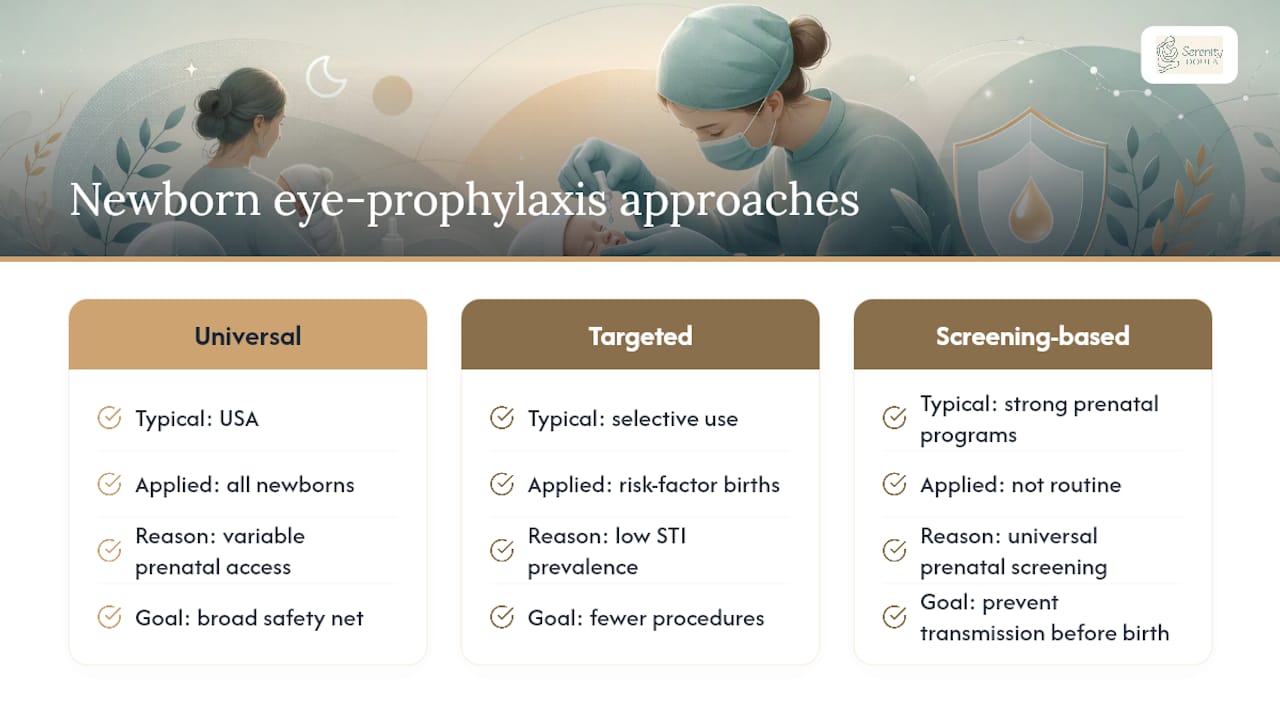
Universal erythromycin prophylaxis is a distinctly American approach, and it’s worth knowing that other countries handle this differently, often for reasons rooted in their own public health infrastructure rather than differing views on the underlying science.
Some countries with robust, near-universal prenatal screening programs and low rates of maternal gonococcal infection have moved away from mandatory ocular prophylaxis altogether, relying instead on prenatal testing and treatment to prevent transmission before birth ever happens. Others have shifted to different antimicrobial agents, or reserve prophylaxis for babies born to parents with documented risk factors rather than applying it universally.
The reasoning behind these differences usually comes down to a few factors: how reliable and accessible prenatal screening is in that country, how common gonococcal and chlamydial infection are in the birthing population, and how each country’s medical establishment weighs the tradeoff between universal low-risk intervention versus targeted, risk-based care. Countries with strong prenatal care systems and low STI prevalence sometimes conclude that universal prophylaxis adds more procedure than protection. Countries where prenatal screening access is inconsistent tend to keep universal application, precisely because they can’t count on every case being caught beforehand.
The United States has stuck with universal prophylaxis in part because prenatal care access and screening completion vary significantly by region and by individual circumstance, even within a single state or county. A policy that depends on catching every case through screening is only as strong as the weakest link in that screening chain, and American public health guidance has generally erred toward the safer, broader net.
How to Store Erythromycin Eye Ointment Properly
If you’re bringing home a leftover tube, or if a birthing center sends you home with one for any reason, proper storage matters more than most parents realize.
Keep the tube at room temperature, generally between 59°F and 77°F, away from direct sunlight and away from bathroom humidity, which can degrade the ointment’s texture and effectiveness over time. Avoid leaving it in a car, a diaper bag in summer heat, or anywhere near a heating vent. Extreme temperature swings are the ointment’s biggest enemy.
Always check the expiration date printed on the tube before use, and never use a tube that’s been opened for an extended period beyond what the label specifies, since the preservative system and antibiotic potency both degrade with time and repeated air exposure. Keep the cap tightly closed between uses to prevent contamination and to slow moisture loss.
Store it out of reach of other children in the household, the same way you’d store any prescription medication, and never share a single tube between infants. That single-use-per-baby rule isn’t just about cross-contamination risk. It’s also about ensuring the correct, unadulterated dose reaches each newborn’s eyes.
If you have any unused ointment after your hospital stay, check with your pediatrician before using it again for a future need. Ophthalmic medications, even ones as generally safe as this one, aren’t meant for casual reuse outside their intended purpose.
What to Do If Your Baby Has a Reaction to the Ointment
Most reactions resolve without any intervention at all, but knowing the steps helps you feel less anxious if you notice something happening.
If your baby shows the expected mild irritation, redness, or brief blurriness in the hours after application, no action is needed beyond normal newborn eye care. Gently wipe away any excess discharge from the outer corner of the eye toward the nose using a clean, damp cotton pad, moving in one direction to avoid spreading anything between eyes.
If swelling seems more pronounced than typical, or if your baby seems unusually fussy in a way tied specifically to eye discomfort, mention it to your nursing team before you’re discharged. They can document the observation and flag it for your pediatrician’s first newborn visit.
A true allergic reaction, marked by significant swelling, hives, or respiratory symptoms, is rare but requires immediate medical attention. Nursing and delivery staff are trained to recognize and respond to this quickly, which is part of why the ointment is applied in a monitored hospital setting rather than something parents administer at home.
If any concerning symptoms develop after you’ve already been discharged, whether that’s worsening redness, new discharge, or eyelid swelling that seems to be increasing rather than settling, call your pediatrician the same day. Don’t wait for your scheduled follow-up if something looks off. Trust that instinct.
Where the Conventional Advice Falls Short for Parents
Most of what’s written about newborn eye prophylaxis reads like a policy brief, heavy on guideline language, light on what it actually feels like to be the parent in that room. The evidence itself is solid. USPSTF and AAP agree, the safety profile is well established, and the practice has prevented real harm for generations of babies. What the standard advice underplays is how much smoother this moment goes when parents have already thought through their preferences and questions before labor starts, rather than trying to process new information between contractions.
The bigger miss in a lot of general guidance is treating this as a single decision point rather than one piece of a broader newborn care conversation. Prophylaxis, screening, follow-up vigilance. These work together, not as separate boxes to check. Parents who understand that connection tend to advocate more confidently, whether that means asking for a short delay to protect bonding time or simply knowing what questions to ask if their hospital experiences a shortage.
If there’s one thing worth prioritizing above the ointment itself, it’s this: build a relationship with your care team, and your birth support, well before delivery day. That’s where the real protection lives.
— Alexis Wallace
Preparing for the Birth Room Conversation, With Support
Knowing the science behind erythromycin ointment is one thing. Feeling calm and prepared to have that conversation in the actual delivery room, mid labor, with a nurse waiting for your answer, is another thing entirely. That’s the gap Serenity Doula exists to close for families across Bucks, Montgomery, Philadelphia, and Burlington Counties.

Serenity Doula’s childbirth education classes walk you through exactly what happens in those first hours after birth, including routine newborn procedures like ocular prophylaxis, so nothing catches you off guard. Our birth doula support means you have someone in the room, whether you’re delivering at Trinity Health St. Mary or elsewhere in the region, who can help you voice your preferences and questions to your care team in real time, and our postpartum guidance continues that support once you’re home and watching for how your newborn settles in. If you’re the kind of parent who wants to walk into your birth informed and confident rather than reactive, book a free consultation with Serenity Doula and let’s talk through what your birth plan should include.
This article is general information, not a substitute for advice from a qualified doctor. Consult a qualified healthcare professional about your own circumstances before acting on anything here.
Sources
- ERYTHROMYCIN ophthalmic ointment — DailyMed (label)
- Erythromycin (ophthalmic route) — clinical reference (NCBI Bookshelf)
- Drug shortages: erythromycin ointment — American Academy of Pediatrics
- Newborn nursery eye prophylaxis refusal — Brigham and Women’s Hospital
FAQ
Why Do Newborns Get Erythromycin Eye Ointment?
Newborns receive erythromycin 0.5% ophthalmic ointment to prevent gonococcal ophthalmia neonatorum, a serious eye infection a baby can contract during vaginal birth if the birthing parent carries Neisseria gonorrhoeae, sometimes without any symptoms.
What Are the Risks of Refusing Erythromycin Eye Ointment for a Newborn?
Refusing prophylaxis leaves a baby unprotected against gonococcal eye infection if maternal status is unknown, which can progress to corneal damage within days; most hospitals require a documented refusal form and clinician counseling before honoring the decision.
Is Erythromycin Safe for Infants?
Yes. The USPSTF found convincing evidence that erythromycin ointment is effective with no serious associated harms, and reported reactions are typically limited to temporary irritation or blurred vision.
How Is Erythromycin Eye Ointment Applied to a Baby?
A nurse instills a ribbon of ointment about 1 centimeter long into each lower conjunctival sac using a single-use tube, usually within the first hour after birth, and the ointment is left in place rather than rinsed out.
What Happens if the Hospital Runs Out of Erythromycin Ointment?
During shortages, the AAP recommends testing the birthing parent for gonorrhea and using systemic ceftriaxone for newborns considered high risk for exposure.