

A routine cervical check, on its own, rarely starts labor or triggers real contractions. What often gets blamed on “just a check” is actually a membrane sweep, a separate procedure your provider may do at the same visit. Sweeping the membranes raises prostaglandin levels enough to nudge some people into labor, with Cochrane’s review putting the number needed to treat at roughly 8. If you’re not sure which one just happened to you, ask before your next exam.
TL;DR:
- Routine cervical checks usually do not trigger labor unless combined with a membrane sweep, which raises prostaglandins and can lead to contractions.
- Being clear about whether an exam is a simple check or a membrane sweep is essential, as sweeps often cause cramping, spotting, and increased chances of labor within 48 hours.
- The likelihood of going into spontaneous labor after a routine check is low, whereas about 1 in 8 people may labor naturally following a membrane sweep.
- Most post-exam symptoms like mild cramping or spotting are normal, but heavy bleeding, strong contractions, or fluid leakage require immediate medical attention.
- Patients should ask providers directly about the intention behind each exam and consider declining routine checks without a clear clinical need.
Table of Contents
- What Is a Cervical Check, and Why Do Providers Do It?
- What Does the Research Actually Say About Checks and Contractions?
- Membrane Sweep vs. Routine Check: How to Tell the Difference
- How Likely Is Labor After a Check or a Sweep?
- What Happens After a Check or Sweep, and When to Call Your Provider
- Consent Questions: What to Ask, and When It’s Okay to Say No
- A Doula’s Perspective on Checks and Sweeps
- Why the “Just a Check” Framing Needs to Go
- How Serenity Doula Supports You Through These Conversations
- Sources
- FAQ
What Is a Cervical Check, and Why Do Providers Do It?
A cervical check is a quick digital exam. Your provider slides two gloved fingers into the vagina to feel the cervix and gather a handful of specific measurements.
Here’s what they’re actually assessing:
- Dilation: how open the cervix is, measured in centimeters from 0 to 10
- Effacement: how thin the cervix has become, expressed as a percentage
- Station: how far the baby’s head has descended into the pelvis
- Bishop score: a combined score (dilation, effacement, station, cervical position, and consistency) that predicts how “ready” the cervix is for induction
Providers typically reach for this exam in a few predictable moments: late in the third trimester at routine visits, at triage when you show up thinking labor has started, and repeatedly during an induction to track whether things are progressing. During an induction, exams every one to two hours in active labor and every two to four hours in the latent phase have been linked to lower cesarean rates and better neonatal outcomes in cohort data, which is a very different clinical situation than a curiosity check at 37 weeks.
The honest limitation here: a cervical check tells you what’s true at that exact minute, not what’s coming next. Plenty of people walk around at 1 centimeter for weeks. Others go from “closed” to “fully dilated” in a matter of hours. A single check is a snapshot, never a forecast, which is worth remembering the next time a number gets handed to you like a due date.
What Does the Research Actually Say About Checks and Contractions?
The evidence splits cleanly into two categories, and mixing them up is where most of the confusion about cervical exam side effects comes from.
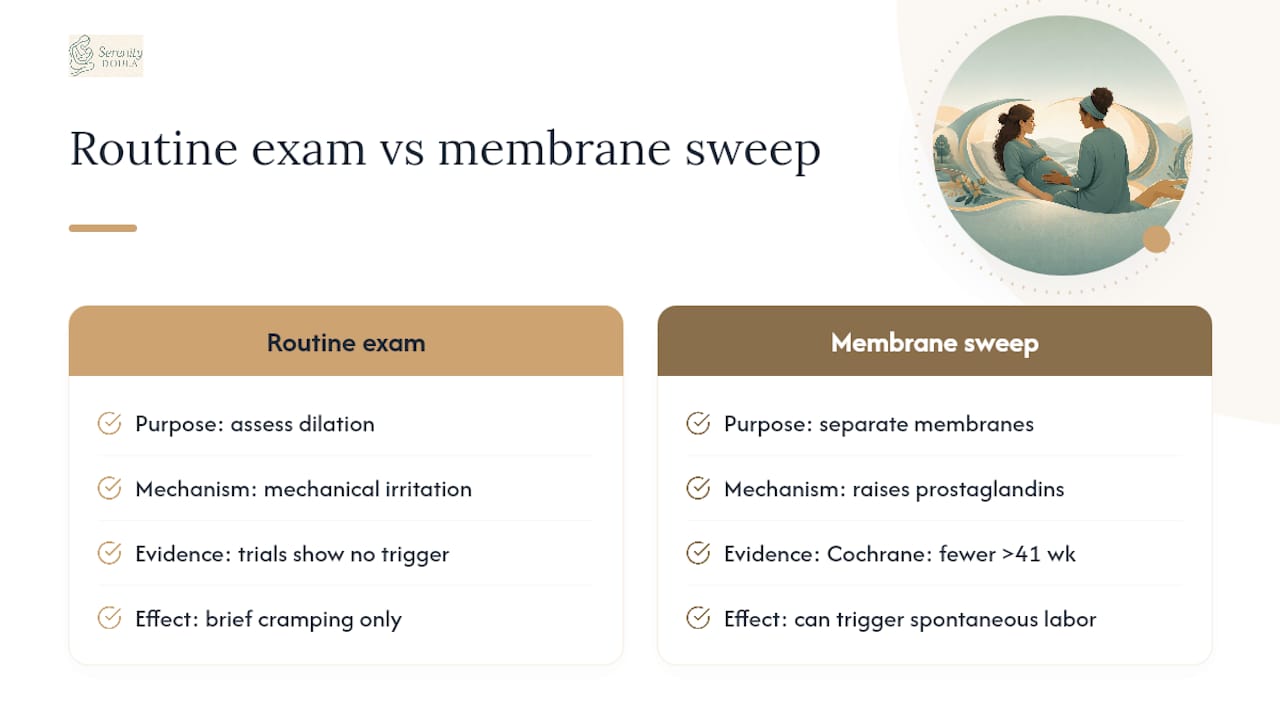
Routine cervical exams, done without any deliberate membrane sweeping, generally have not been shown in trials to trigger labor. Some older studies of weekly prenatal checks produced conflicting results on outcomes like premature rupture of membranes, and evidence reviews suggest one likely explanation: sweeps were sometimes performed during a “routine” check without being clearly documented as such. In other words, the confusing data may reflect confusing procedures, not confusing biology.
Membrane sweeping is a different story entirely. Here’s the actual mechanism: when a provider inserts a finger through the cervix and rotates it against the wall of the uterus, separating the amniotic sac from the cervix, that mechanical disruption raises local prostaglandin levels. Mechanistic research shows this kind of membrane disruption and cervical stretching can trigger uterine contractions through what’s known as the Ferguson reflex, the same feedback loop that ramps up oxytocin release once the cervix is stimulated.
Statistic Spotlight: Cochrane’s systematic review found membrane sweeping reduces the number of pregnancies that continue past 41 and 42 weeks and lowers the need for formal induction, with a number needed to treat of about 8. That means for every 8 sweeps performed, roughly one additional person goes into spontaneous labor who otherwise would have needed a scheduled induction. The certainty of this evidence is rated low to moderate, not definitive, so it’s a real signal, not a guarantee.
Clinical guidance backs up this distinction rather than blurring it. ACOG’s clinical practice guideline on cervical ripening calls for selective, evidence-based use of ripening and induction methods, with attention to who’s a good candidate and who isn’t. The AAFP is even more direct: membrane sweeping is distinct from a routine check, its whole purpose is to raise prostaglandins, and providers should be getting clear consent and explaining what they’re doing before they do it.
So where does that leave the plain question of whether checks cause contractions? A gentle dilation check can cause brief cramping simply from the physical sensation of an exam, the same way a pap smear might. That’s a mechanical irritation response, not labor. A sweep is designed to do something more, and the research backs up that it usually does.
Membrane Sweep vs. Routine Check: How to Tell the Difference
Here’s the part almost nobody explains clearly at the appointment, which is exactly why it needs spelling out here.
- The intent is different. A routine check answers “where are things at right now?” A sweep is performed with the specific goal of starting labor, typically once you’re near or past your due date.
- The technique is different. A check involves gently feeling the cervix. A sweep involves the provider’s finger actually passing through the cervical opening and sweeping around the inside edge to separate the membranes from the uterine wall, which requires the cervix to already be at least a little open.
- The sensation is different. A check might feel like brief pressure or an uncomfortable pinch. A sweep is typically described as more intense, sometimes sharp, and often followed by cramping that lasts for a few hours afterward.
- The aftermath is different. Sweeps are more likely to cause spotting, irregular contractions, and general pelvic discomfort in the hours that follow, and they carry a meaningfully higher chance that you’ll be in labor within 48 hours compared with a plain check.
Pro Tip: Before any late-pregnancy exam, simply ask: “Is this a routine check, or are you planning to sweep my membranes?” You have every right to know exactly what’s about to happen inside your own body, and a good provider will answer without hesitation.
If you want a deeper walkthrough of what a sweep involves step by step, our guide on whether a cervical exam can start labor breaks down the physical experience in more detail.
How Likely Is Labor After a Check or a Sweep?
Numbers help here, so let’s get specific.
- After a membrane sweep: roughly 1 in 8 people will go into spontaneous labor who wouldn’t have otherwise needed a formal induction, based on Cochrane’s pooled trial data. When labor does follow a sweep, it typically starts anywhere from a few hours to about 48 hours afterward, though the studies behind that range vary a lot in how the sweep was performed and how far along the person was.
- After a routine check: the odds of it triggering true labor are low. Any contractions afterward are typically mild, irregular, and transient rather than progressing to active labor.
The variation in these numbers isn’t random. It comes down to a few real factors: how dilated the cervix already was going in, how vigorously the sweep was performed, whether you were already close to your due date, and honestly, how consistently different studies even define “a sweep” versus “a check.” That heterogeneity is exactly why Cochrane rates its own evidence as low to moderate certainty rather than high. It’s a real effect with a real range, not a fixed switch that flips the same way for everyone.
If your provider has mentioned induction is on the table, our guide to induction methods walks through how a sweep fits alongside other options.
What Happens After a Check or Sweep, and When to Call Your Provider
Most after-effects are minor and pass on their own. Some light spotting, a bit of cramping, or a few irregular contractions in the hours following an exam are common and not usually a cause for concern.
You may also notice mucus discharge, sometimes tinged pink or brown, which many people assume means their “mucus plug” has come out. It can happen after a check or sweep, but it’s not a reliable sign that labor is imminent. Plenty of people lose bits of mucus plug for days or weeks before anything else happens, and plenty go into labor with no noticeable discharge at all.
Call your provider or head to triage if you notice:
- Heavy bleeding, more than light spotting
- Contractions that become regular, strong, and closer together over time
- A sudden gush or steady trickle of fluid (possible rupture of membranes)
- Fever or feeling unwell
- Noticeably decreased fetal movement
Pro Tip: Keep a simple note on your phone with the time of any contractions and how they feel. If a pattern starts, five minutes apart and getting stronger, that’s the detail your triage nurse actually needs to hear.
On the infection question: clinical guidance notes that frequent, unnecessary exams may carry some added infection risk, which is part of why thoughtful providers limit checks to moments where the information will actually change what happens next. If bleeding after a check feels heavier than expected, this breakdown of what’s normal versus concerning is worth a look.
Consent Questions: What to Ask, and When It’s Okay to Say No
You are allowed to ask questions before any exam, and you’re allowed to decline one entirely. Here’s how to make that concrete instead of abstract.
- Ask directly: “Is this a routine check or a membrane sweep?” and “What will this tell us that we don’t already know?”
- Consider consenting when labor is suspected, when you’re actively planning induction timing with your provider, or when there’s an abnormal fetal heart tracing that needs more information to interpret.
- Consider declining a check that’s purely routine curiosity with no clinical decision riding on the result, especially if you’re not near your due date yet.
- Put it in writing. Add a line to your birth plan stating your preferences on cervical checks and sweeps, and repeat that preference out loud during labor if plans change.
- Ask what changes. If a result might shift your care plan (like moving toward induction), it’s fair to ask exactly what threshold triggers that conversation.
For more on the legal and practical side of saying no, this guide on your rights around declining checks lays out the language clearly.
A Doula’s Perspective on Checks and Sweeps
Clients ask me about this more than almost anything else in the third trimester, and I get it. Nobody wants to be caught off guard by their own body.
My go-to script is simple: before any exam near the end of pregnancy, I encourage clients to ask their provider directly, “Are you checking me, or are you sweeping my membranes?” That one question changes the whole conversation. It puts the decision back where it belongs, with you.
I also spend time normalizing what comes after. Mild cramping or a little spotting doesn’t mean something’s wrong. It usually means your body noticed the exam and is responding the way bodies do. What I watch for with clients is a real pattern: contractions that are getting closer together, stronger, and not letting up. That’s when I encourage a call to triage, not before.
If something about an exam feels rushed or unclear, you’re allowed to pause and ask more questions. That’s not being difficult. That’s informed consent, and it’s yours.
— Alexis Wallace
Why the “Just a Check” Framing Needs to Go
The biggest problem with how this topic gets discussed isn’t the science, it’s the language. When a sweep gets described as “just checking your cervix,” patients lose the chance to actually consent to what’s happening. That’s not a small detail. It’s the difference between a passive exam and an active attempt to start labor, and you deserve to know which one you’re getting.
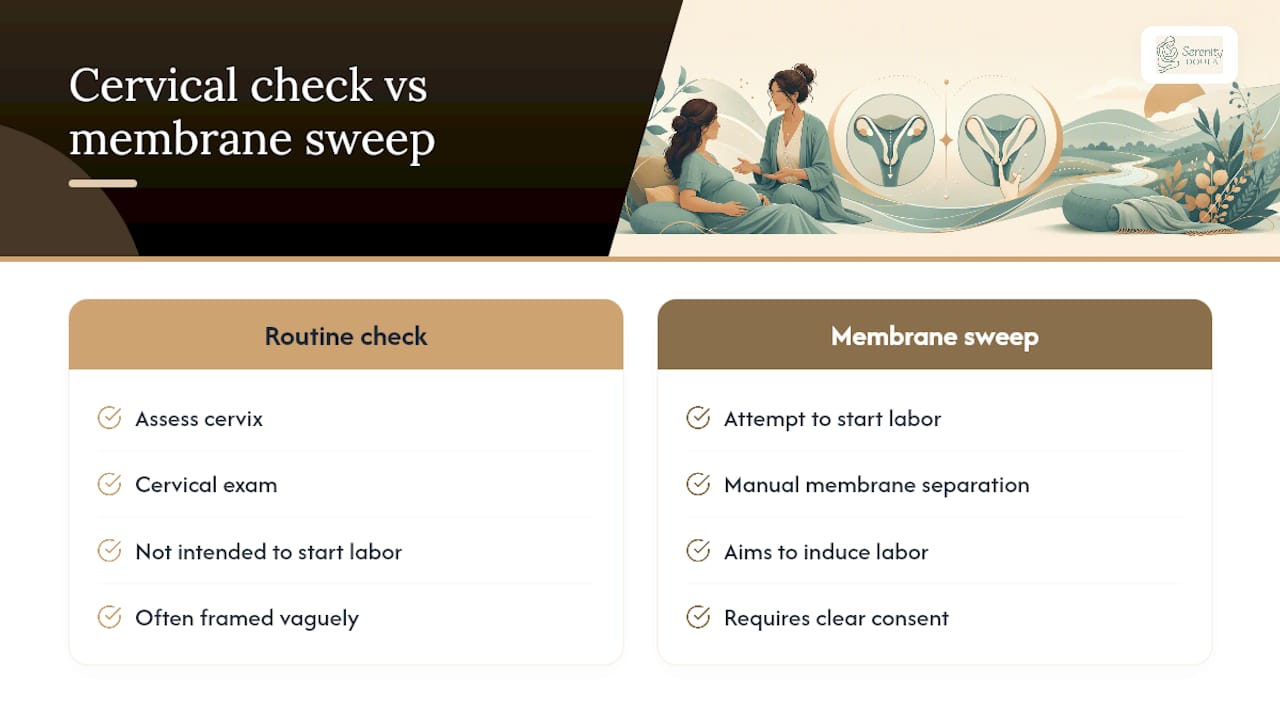
Conventional advice tends to lump both procedures under one vague umbrella, which leaves people confused about their own bodies afterward. My honest read, informed by AAFP’s own guidance that providers should clearly distinguish sweeps from checks, is that the burden shouldn’t sit entirely on the patient to ask the right question. But until that changes system-wide, asking is your most reliable tool.
Prioritize this above anything else in your third trimester: know the difference, ask the direct question every single time, and treat your answer as information you’re entitled to, not a favor your provider is doing you.
— Alexis Wallace
How Serenity Doula Supports You Through These Conversations
Late pregnancy is full of small decisions that feel bigger in the exam room than they do afterward, and having someone in your corner changes that. Serenity Doula’s childbirth education guides Bucks County families through exactly these scenarios ahead of time, so you’re never guessing what a provider means mid-appointment.

Beyond education, in-labor support from a doula means having someone present who knows your preferences and can gently prompt the consent conversation when you’re too deep in labor to find the words yourself. Whether you’re delivering at Trinity Health St. Mary or another hospital across Bucks, Montgomery, Philadelphia, or Burlington Counties, that kind of steady advocacy is often what turns a confusing moment into a manageable one. Explore Pregnancy & Birth Support Doula services and schedule a free consultation to talk through your specific due date, provider, and birth preferences before your next appointment.
This article is general information, not a substitute for advice from a qualified doctor. Consult a qualified healthcare professional about your own circumstances before acting on anything here.
Sources
- Membrane sweeping for induction of labour | Cochrane
- Membrane sweeping to induce labor — AAFP
- PLOS ONE — mechanistic study on membrane disruption and prostaglandin release
- ACOG clinical practice guideline: Cervical ripening in pregnancy
- Cervical Check: Is It Necessary? Exam, Procedure & Timing — Cleveland Clinic
FAQ
How common is it to go into labor after a cervical check?
Going into labor right after a plain, routine check is uncommon. After a membrane sweep, it’s more likely, with Cochrane data suggesting roughly 1 in 8 people go into spontaneous labor who otherwise would have needed a scheduled induction.
What are signs that your cervix is dilating?
Signs can include increasing pelvic pressure, more frequent Braxton Hicks contractions, and sometimes mucus discharge, but the only reliable way to confirm dilation is a cervical exam by your provider.
Can you start dilating after a cervical check?
Yes, a check can nudge dilation slightly in someone who’s already close to ready, but it’s not a reliable trigger. A membrane sweep is far more likely to cause meaningful cervical change and contractions than a routine check alone.
Can a cervical check cause a mucus plug to come out?
Yes, a check or sweep can dislodge some mucus plug, but its appearance isn’t a dependable sign that labor is starting soon. Some people lose bits of it for days or weeks before anything else happens.