
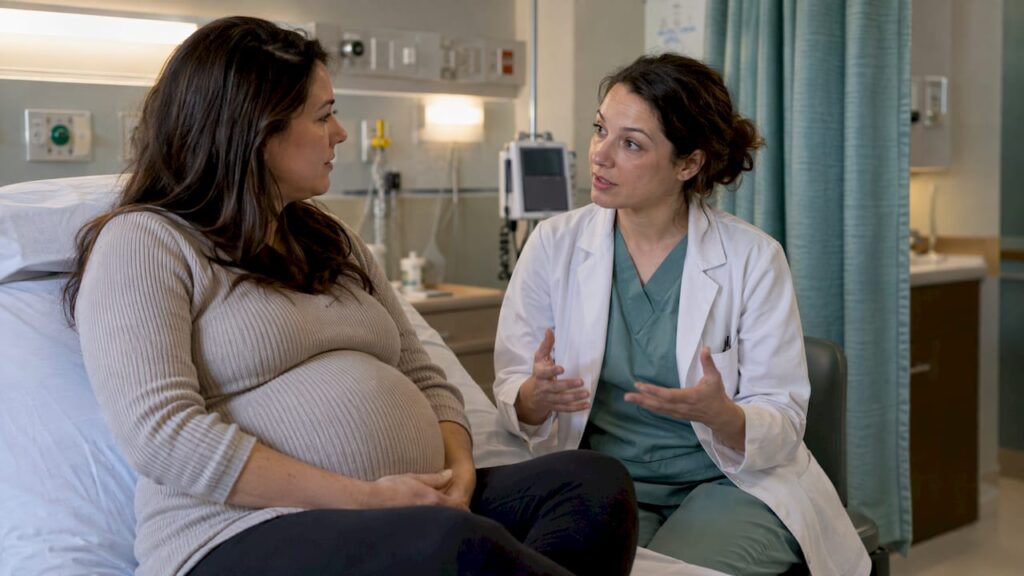
Your Bishop score is a quick cervical check that gives your provider a number from 0 to 13. It estimates how ready your cervix is for labor, and it helps predict how an induction might go. A higher number points toward an easier start. A lower number usually means your team will talk about cervical ripening first. It is one piece of information, not a verdict on you or your body.
If someone has just said “we’ll check your Bishop score,” you may be feeling a little rushed. Let’s slow it down and walk through it together.
TL;DR
- The Bishop score adds up five cervical findings: dilation, effacement, station, position and consistency, for a total of 0 to 13.
- A score above 8 is generally considered favorable, and 5 or less is considered unfavorable, which usually means ripening is discussed first (AAFP).
- The score is subjective and does not capture everything about you or your baby (Cleveland Clinic).
- The Bishop score does not decide when to induce. Your medical situation and gestational age do.
- Induction is a shared decision. Bring questions to your provider and take your time.
Table of Contents
- What the Bishop score is
- How the Bishop score chart works
- What counts as a good Bishop score for induction
- Why the number has limits
- When induction may be recommended
- Pros and cons of induction
- Questions to ask your provider
- Our perspective
- Support that goes beyond the number
- FAQ
- Sources
What the Bishop score is
The Bishop score is a clinical assessment used to judge cervical favorability and to predict how likely a vaginal birth is after induction (AAFP). Your provider does a cervical exam, notes five findings and assigns points to each.
Think of it as a snapshot of how far your body has already traveled toward labor. A “ripe” cervix is softer, thinner and more open. An “unripe” one is firmer, longer and closed.
How the Bishop score chart works
The score is the sum of points for five parameters, and a standard chart defines the point values for each (Cleveland Clinic). The full scale runs from 0 to 13 (AAFP).
| What your provider checks | What it means | Points possible |
|---|---|---|
| Dilation | How open the cervix is, in centimeters | 0 to 3 |
| Effacement | How thin the cervix has become, as a percentage | 0 to 3 |
| Station | How low the baby’s head sits relative to the ischial spines | 0 to 3 |
| Position | Whether the cervix points toward your back or has moved forward | 0 to 2 |
| Consistency | Whether the cervix feels firm, medium or soft | 0 to 2 |
At the low end of each row, the cervix is closed, long, firm and posterior, and the baby is high. At the high end, it is open, thin, soft and forward, and the baby is low. Your provider can show you exactly where you land on each line.
Many parents find it helpful to learn why a single number in early pregnancy can mislead. Our guide on cervix dilation checks explains why 2 to 3 cm often means very little on its own.

What counts as a good Bishop score for induction
A favorable cervix is often defined as a full Bishop score greater than 8. A score of 5 or less is unfavorable, and cervical ripening is likely needed (AAFP). With a score above 8, the chance of a vaginal birth after induction is considered similar to that of spontaneous labor.
Here is how that tends to translate in conversation:
- Above 8: Your cervix is considered ready. Induction may start with oxytocin or breaking the water, if your provider recommends it.
- 6 to 8: You are in between. Your provider will weigh the other details of your situation.
- 5 or less: Your team will likely talk about ripening methods first. Our overview of induction of labor methods walks through what those can look like.
A lower score does not mean your body is “failing.” It means your cervix may need more time or some help before labor can build.
Why the number has limits
The Bishop score is subjective. Two clinicians can score the same cervix a little differently. It also doesn’t account for everything that shapes labor, including maternal health conditions (Cleveland Clinic).
That is why a good care team treats it as a conversation starter. Your baby’s position, your health, your history and your preferences all belong in the picture.
When induction may be recommended
The Bishop score tells you how ready your cervix is. It does not tell you whether you need induction. That decision rests on your medical situation and how far along you are.
ACOG guidance, as summarized by the American Academy of Family Physicians, does not recommend induction before 39 weeks without a medical indication, because early elective induction increases neonatal morbidity (AAFP). Some conditions also rule induction out, such as placenta previa, vasa previa, a transverse baby or a prior classical cesarean (Medscape).
If you are wondering “should I get induced?”, the honest answer is that it depends on your health, your baby’s health and your timing. Your provider is the right person to sort that out with you.
Pros and cons of induction
Here is a balanced look, so you can walk into the conversation steady.
What induction may offer
- It may reduce the risks of continuing a pregnancy when there is a medical reason to do so.
- It may reduce the chance of cesarean delivery in certain situations (AAFP).
- It gives you a plan and time to prepare your support team.
What to be aware of
- Induction increases fetal monitoring and vaginal exams, and it may lengthen your hospital stay (Royal College of Physicians of Ireland).
- Prostaglandins can cause tachysystole, which means contractions that come too often. They also raise the risk of uterine rupture after a prior cesarean (AAFP).
- Induced labor may feel more intense than spontaneous labor. Options such as labor in water, simple pain relief and epidural analgesia may be available (NICE).
If an epidural is on your mind, these two guides can help: birth positions with an epidural and whether an epidural speeds up labor. For non-medication ideas, see our comfort measures for labor.
Questions to ask your provider
Induction decisions are best made together. A recent review describes collaborative decision-making between clinicians and pregnant people as the goal (Induction of Labor: A Narrative Review). Some families also like to understand how their health coverage works around pregnancy care, which is easier to do before a big decision, and a look at private cover during pregnancy can start that thinking.
Here are questions you might bring to your next appointment, whether that is in Newtown, Doylestown or at Trinity Health St. Mary:
- What is my current Bishop score, and how was it assessed?
- What is the medical reason for recommending induction, and what happens if we wait?
- If my cervix is unfavorable, which ripening options would you suggest, and why?
- What are the risks and benefits of each option for my situation?
- What would a realistic timeline look like, and when would we reassess?
- Which pain-relief and movement options are available during induction?
- Is a cervical check needed right now, and may I decline one? (Our guide on refusing cervical checks covers this.)
When decisions pile up, it is normal to feel worn down. Our piece on decision fatigue during labor offers a calmer way through. If you are curious about gentle ways to prepare, read about natural induction methods, and then ask your provider whether they fit your situation.
Our perspective
In my years supporting Bucks County families, the hardest moment is rarely the induction itself. It is the moment a parent hears a number and quietly decides it says something about them.
We see the Bishop score differently. It is a useful snapshot for your care team, and you are allowed to ask what is behind it. Families who understand their options tend to walk into the hospital grounded rather than swept along.
That is how we work at Serenity Doula. We pair evidence-based education with steady, nonjudgmental, one-to-one support, so you feel seen whether your birth is natural, medicated or surgical. We help you turn a pile of unknowns into clear questions, and we hold the space while you make decisions that are yours.
Alexis Wallace
Support that goes beyond the number
We offer Childbirth Education so you can learn about induction, cervical checks and your choices before you need to make them. Our Pregnancy & Birth Doula support is personalized to your preferences, including an induction plan, and is designed to keep you calm and informed through each step.
If you want to know what a doula does alongside your doctor or midwife, start with what a doula does. For help afterward, see our postpartum care.
FAQ
How do you find your Bishop score?
Your provider calculates it during a cervical exam by noting dilation, effacement, station, cervical position and consistency. Each gets points, and the total is your score. You can ask your provider to walk you through each part.
What is a good Bishop score for induction?
A score above 8 is generally considered favorable, and a score of 5 or less is considered unfavorable (AAFP). Your provider will consider it with your overall health and your baby’s.
Is labor induction painful?
Induced labor may feel more painful than spontaneous labor. Options can include labor in water, simple analgesia and epidural analgesia (NICE). Ask your provider which are available at your hospital.
Does the Bishop score decide when to induce?
No. It estimates cervical readiness, while the timing depends on medical indications and gestational age. Induction before 39 weeks without a medical reason is not recommended (AAFP).
If you would like calm, knowledgeable company while you weigh your options, we would love to talk. You can book a free consultation with Serenity Doula whenever you feel ready, and we will take it from there at your pace.
Sources
- Cervical Ripening and Induction of Labor, American Family Physician
- Bishop Score: Purpose, Calculation & Limitations, Cleveland Clinic
- Induction of Labor: Background, Indications and Contraindications, Medscape
- Plain Language Summary: Induction of Labour, RCPI
- NG207 Inducing labour: Algorithm, NICE
- Induction of Labor: A Narrative Review for Clinical Use
- Private cover during pregnancy