
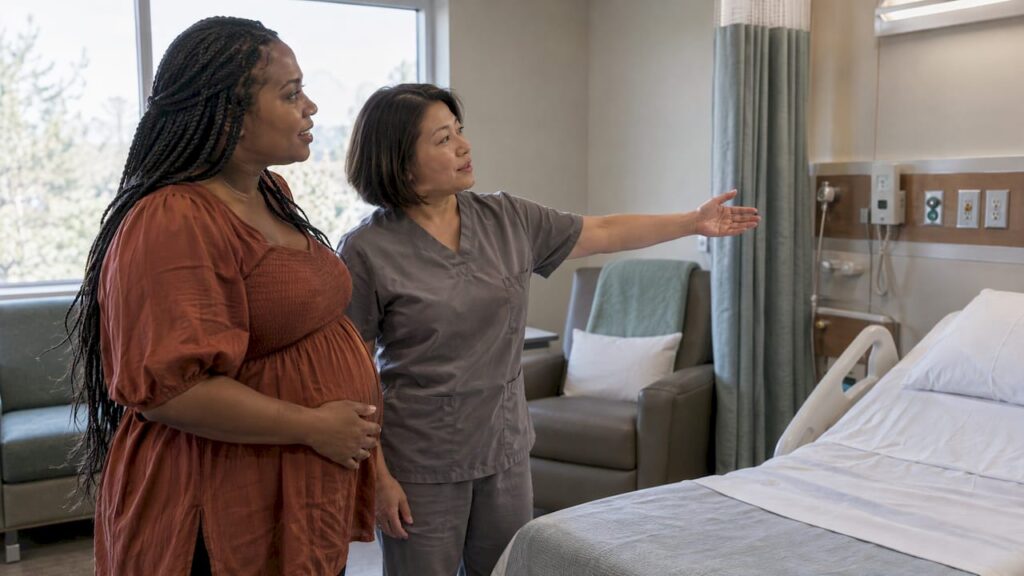
The best hospital tour questions are the ones that help you picture your labor, your recovery and your baby’s first days there: who can be with you, how you can move and manage pain, what happens if plans change, and what it all costs. Bring a short list, take notes, and ask your own provider about anything medical.
A tour can feel like a lot to take in. You are looking at beds and monitors while trying to imagine the biggest day of your life. A written list lets you stay present and leave feeling calmer, not more overwhelmed.
TL;DR
- Tour in the late second or third trimester, with your partner or support person, and pre-register if the hospital offers it.
- Ask about private rooms, visitor limits, doulas, movement in labor, pain relief options and cesarean practices.
- Ask about rooming-in, skin-to-skin, lactation help and how the hospital handles newborn care.
- Ask billing about in-network status, what is included and what is billed separately.
- Take your questions about medical choices back to your OB or midwife.
Table of Contents
- When to take the tour and how to prepare
- Questions about labor and delivery rooms
- Questions about support people, doulas and staffing
- Questions about pain relief, movement and cesarean birth
- Questions about your baby and your recovery
- Questions about costs and what is included
- Questions about arrival, parking and going home
- Our perspective
- Bring a doula’s eye to your birth preparation
- FAQ
- Sources
When to take the tour and how to prepare
Most hospitals suggest the second half of pregnancy. Cedars-Sinai says most people tour in the second or early third trimester, so there is time to plan without feeling rushed. St. Mary’s Family Birth Center suggests around 28 to 32 weeks. A Temple Health nurse recommends the third trimester so the details stay fresh.
A few practical habits help:
- Bring your partner or support person. Some hospitals limit guests. Mount Sinai West allows one adult guest and no children on the unit, so check before you go.
- Wear comfortable shoes and start your birth plan beforehand, as the St. Mary’s team suggests.
- Ask about pre-registration. Doing it during or right after the tour saves paperwork on the day.
- Consider touring after childbirth education. You will know what to look for. Our childbirth education classes are built for exactly that.
If you live in Newtown, Doylestown or anywhere around Bucks County, tours at nearby hospitals, including Trinity Health St. Mary, are worth comparing. Check each hospital’s own page for current tour schedules.
Questions about labor and delivery rooms
Start with the space where you will spend the most intense hours.
- Will I labor, deliver and recover in the same room?
- Are rooms private, with their own bathroom? Is there a shower or a tub? Emory’s FAQ shows how specific the answer can be: private rooms, showers but no tubs.
- What happens if every labor room is full? UCSF explains its overflow plan on its tour page, a good example of what to ask.
- Is there a birthing ball, a peanut ball, a birthing tub or a squat bar?
- Can I eat, drink and walk during labor, within what my provider advises?
- Are photos allowed? Is video?
Bed design matters more than most people expect. Our guide to labor and delivery beds explains how to ask about positions and mobility.
Questions about support people, doulas and staffing
This is where hospitals differ most, and where your birth team gets set.
- How many people can be with me in labor? UCLA Health allows two in Labor and Delivery and one overnight visitor on Postpartum, and may adjust for safety or clinical needs.
- Are doulas welcome, and do they count toward the visitor limit? Some hospitals, such as Mount Sinai West, state that they welcome doulas.
- What are typical nurse-to-patient ratios? The Bump notes a common ideal of 1:1 or 1:2 in labor and 1:3 in postpartum recovery.
- Are anesthesia providers on site around the clock? A Temple Health nurse notes that their team is available 24/7.
- Can my partner stay overnight, and where do they sleep?
Partners often wonder what their role will be. Our step-by-step guide to supporting your partner during labor is a good thing to read before the tour.
Questions about pain relief, movement and cesarean birth
Birth plans are never written in stone, and how you feel about pain can change from one hour to the next. Ask, then take medical specifics to your provider.
- What pain relief options are offered, such as epidurals or nitrous oxide? Mount Sinai West lists both on its page.
- Can I move and change positions? Is monitoring continuous or intermittent? Ask your provider which fits your pregnancy.
- What are the hospital’s cesarean and episiotomy rates? Some hospitals publish them, as Mount Sinai West does.
- If I need a cesarean, can my partner or doula be with me? Can we do skin-to-skin in the operating room?
- Is delayed cord clamping offered? Emory Midtown lists one to two minutes in stable deliveries. Read our piece on delayed cord clamping first.
Our comfort measures for labor give you ideas to ask the nurses about.
Questions about your baby and your recovery
The days after birth are easy to overlook on a tour. Don’t.
- Is rooming-in the norm? The CDC defines it as mother and baby staying together 24 hours a day, and encourages skin-to-skin for medically stable mothers and newborns.
- How long does skin-to-skin last? Emory Midtown notes at least 60 minutes or until the first feeding is complete, including after a cesarean. We explain this in our parent’s guide to skin-to-skin and our page on skin-to-skin after a cesarean.
- When is the first bath? Boston Medical Center delays it at least 12 to 24 hours.
- Are lactation consultants available, and on which days?
- What are visiting hours and quiet times? Boston Medical Center, for example, lists a nightly 8 p.m. end and a 2 to 4 p.m. quiet time.
- How long is a typical stay? Emory’s FAQ gives one to two days after vaginal birth and two to three after a cesarean.
Before you leave, you will want newborn confidence too. See how to practice five newborn care skills before discharge.
Questions about costs and what is included
Ask the billing department, not only the tour guide. U.S. News suggests asking whether the hospital and your doctor are in-network, the estimated cost of vaginal versus cesarean delivery, what the maternity package includes, whether anesthesia and newborn care are billed separately, and whether insurance covers a NICU stay.
The Bump reports that birth in the US costs nearly $20,000 on average, and that a 2021 federal rule requires hospitals to publish estimated procedure costs.
Also ask about upgraded rooms. As one example, Maimonides Health charges $525 for a one-night deluxe stay after vaginal delivery, not covered by insurance. Your hospital’s fee will differ.

Questions about arrival, parking and going home
These feel small until you are in labor.
- When should I call, and what number do I use? Write it in your phone now.
- Where do I park, and where do I enter? The Bump warns that the entrance can change by time of day, sometimes through the emergency room.
- What should I pack, and what does the hospital provide?
- What does discharge look like, and who checks on me and the baby afterward?
If you are comparing settings, our guide to birthing environments lays out the options.
Our perspective
After more than ten years supporting families across Bucks County, we have learned that the tour is not really about the building. It is about whether you feel seen there.
We encourage clients to notice how they feel walking in, then ask the questions that matter most to them. A family planning an unmedicated birth listens for movement and tub access. A family expecting a cesarean listens for skin-to-skin and partner presence. Both deserve the same calm, informed attention.
Our approach is evidence-based, personalized and nonjudgmental, whether your birth is natural, medicated or surgical. We help you turn your tour notes into preferences your care team can respect, and we hold you between appointments so you are not carrying this alone.
Alexis Wallace
Bring a doula’s eye to your birth preparation
If you would like help turning tour notes into a plan, our Pregnancy & Birth Doula support gives you steady, high-touch guidance before, during and after labor. Wondering what that looks like next to your OB or midwife? Read what a doula does.
We would love to talk it through. Book a free consultation and bring your tour list along.
FAQ
How many weeks should you do a hospital tour?
Most hospitals suggest the late second or third trimester. St. Mary’s Family Birth Center suggests 28 to 32 weeks, and Cedars-Sinai says earlier can help with high-risk pregnancies or scheduled deliveries. Ask your provider what timing suits you.
How do you do a hospital tour?
Call the hospital’s maternity unit to book, bring your partner or support person, and take your written questions. Note the room, the sounds and the staff, then ask about pre-registration before you leave.
Should I ask about doulas on the tour?
Yes. Ask whether doulas are welcome and whether they count toward the visitor limit. Some hospitals state this openly, and it is good to know before labor.
What if I cannot tour in person?
Some hospitals offer virtual tours or videos on their maternity pages. Ask the unit what is available, then call with any questions about rooms, visitors and billing.
Sources
- St. Mary’s Family Birth Center: Touring the Birth Center
- Temple Health: What to Ask on Your Hospital Tour
- Cedars-Sinai: Maternity Tours
- Mount Sinai West: Pregnancy and Birth
- Emory Healthcare: OB FAQs
- Emory University Hospital Midtown: Maternity Tour
- UCSF Health: Birth Center Tour
- UCLA Health: BirthPlace Tours FAQ
- The Bump: Maternity Hospitals Guide
- CDC: Safety in Maternity Care
- Boston Medical Center: Your Stay
- U.S. News: Maternity Hospital Costs
- Maimonides Health: Deluxe Private Maternity Rooms