

Yes, you can learn to trust your body during pregnancy, and you can start right now. Learning to trust your body during pregnancy is not about ignoring medical care — it’s about building a conscious, attentive relationship with your own internal signals so you feel grounded, confident, and genuinely heard throughout every appointment, every trimester, and every moment in between.
Three things to do in the next 72 hours:
- Take a two-minute body check. Sit quietly, close your eyes, and notice five physical sensations without judging them: your breath, your heartbeat, any pressure in your belly, your hunger level, and one area of tension. Name each one silently. That’s it. You’ve just practiced interoception.
- Ask your provider one question at your next visit: “What physical changes should I call about right away, and what can I monitor at home?” This single question opens a shared decision-making conversation and gives you a personal safety map.
- Make one partner ask. Tell your support person: “When I say something feels off, I need you to take it seriously and help me decide whether to call the office.” That’s the whole script.
Contact your care team immediately if you notice: decreased or absent fetal movement, heavy vaginal bleeding, severe or sudden headache, vision changes, significant swelling in your face or hands, chest pain, or a persistent sense that something is seriously wrong. These are not moments to wait and see.
Key Takeaways
Learning to trust your body during pregnancy is a skill built through daily practice, clear communication with your care team, and a support system that takes your instincts seriously.
| Point | Details |
|---|---|
| Body trust is interoceptive | It means acting on internal signals, not just body image; it responds to daily practice and improves over time. |
| Mental health connection | Higher positive body image is associated with a reduced risk of psychological distress during pregnancy. |
| Maternal intuition is a clinical signal | Research recommends clinicians investigate maternal concerns about fetal wellbeing; always report a persistent gut feeling that something is wrong. |
| Shared decision-making is your right | ACOG confirms pregnant adults are presumed to have decision-making capacity; use scripts and written notes to exercise that right at every appointment. |
| Serenity Doula supports this work | Prenatal emotional support, birth doula services, and private childbirth education in Bucks County help you build body trust with personalized, hands-on guidance. |
Table of Contents
- What does “trusting your body” actually mean in pregnancy?
- Why does body trust matter for your mental health and your baby?
- Practical ways to build body trust every day
- How to talk with your OB or midwife about what you’re feeling
- What partners can do to help (and what to avoid)
- What gets in the way of trusting your body, and when to ask for more help
- What the research actually says about interoception and maternal intuition
- A simple 4-week plan to build body trust
- Your next three steps, right now
- A doula’s perspective: what I’ve seen body trust do for families
- How Serenity Doula helps you build confidence in your body
- Sources
- FAQ
What does “trusting your body” actually mean in pregnancy?
The phrase gets used a lot, but it points to something specific: interoceptive body trusting. Interoception is your nervous system’s ability to sense and interpret signals from inside your body, things like hunger, fullness, pain, heartbeat, and the subtle pressure of a baby shifting position. Body trusting, as researchers use the term, is the degree to which you act on and feel confident in those internal signals rather than dismissing or overriding them.
This is different from body image (how you feel about how your body looks) and different from maternal intuition (a broader, more instinctive knowing). Body trusting is quieter and more physical. It’s the difference between noticing that your baby has been unusually still since this morning and brushing it off versus pausing, tracking the movement for an hour, and calling your midwife if the pattern doesn’t return.
Research on interoceptive experience during pregnancy suggests that pregnancy itself heightens attention to internal signals because the physiological changes are so constant and fetal movement introduces entirely new sensations. Your body is already trying to communicate more. Body trusting is learning to listen back.
In daily life, it looks like this: recognizing the difference between round ligament pain (a familiar, sharp pull when you stand quickly) and an unfamiliar, persistent ache that doesn’t ease. Knowing your own fatigue baseline well enough to notice when tiredness feels heavier than usual. Sensing that a headache today feels different from the ones you’ve had before. None of these observations require medical training. They require attention, and attention is a skill you can practice.

A comparative study found that body trusting, measured as an interoceptive sensibility, predicts body satisfaction during pregnancy and mediates differences between pregnant and non-pregnant women, with parental status also influencing how much trust people place in their bodies. The practical implication: body trusting is not fixed. It shifts with experience, and it responds to practice.
Why does body trust matter for your mental health and your baby?
The stakes here are real. A longitudinal network analysis following 253 pregnant people found that lower antenatal body trusting was associated with higher antenatal anxiety and depression, weaker antenatal attachment, and poorer postnatal bonding outcomes. The relationships were associative, not causal, but the pattern held across multiple follow-up points. Body trust and emotional wellness during pregnancy are genuinely linked.
A separate cross-sectional study of 468 pregnant women found that higher positive body-image scores in the second trimester were associated with lower adjusted odds of psychological distress (adjusted OR ~0.65) and serious mental illness (adjusted OR ~0.68). Feeling at home in your body, even imperfectly, appears to offer a meaningful buffer against perinatal mental health struggles.
For breastfeeding, the connection is similarly meaningful. The same longitudinal data linked antenatal body trusting to breastfeeding outcomes postpartum, suggesting that the confidence you build now carries forward into early parenting. Trusting yourself as a parent often begins with trusting your body before birth.
ACOG’s position on this is clear: pregnant adults are presumed to have decision-making capacity and have the right to participate fully in choices about their care. When you trust your body’s signals, you bring better information to those conversations.
Practical ways to build body trust every day
You don’t need an hour of meditation or a special class to start. The most effective practices are small, consistent, and take 2–15 minutes.
A daily micro-practice plan
- Morning body scan (2–3 minutes). Before you get out of bed, take three slow breaths and mentally scan from your head to your feet. Notice where you feel tight, where you feel comfortable, and whether your baby has moved yet. No judgment, just noticing.
- Breath anchor (3–5 minutes, any time). Inhale for four counts, hold for two, exhale for six. Repeat five times. This activates your parasympathetic nervous system and brings attention inward. Use it before appointments when anxiety spikes.
- Fetal movement check-in (10 minutes, once daily after 28 weeks). Lie on your left side after a meal or a cold drink. Count distinct movements until you reach ten. If you don’t reach ten in two hours, call your provider. This is not a reason to panic; it’s a reason to connect.
- Guided visualization (5 minutes, evening). Place both hands on your belly. Breathe slowly and picture your baby’s position. Imagine warmth and safety. Hypnobirthing practitioners use this technique to reframe bodily sensations as purposeful rather than threatening, which can reduce fear-tension-pain cycles during labor.
- Gentle movement (15–20 minutes, most days). Prenatal yoga, a slow walk around Doylestown or along the Delaware Canal towpath, or simple pelvic tilts on hands and knees all build body awareness in pregnancy without strain. If a movement causes sharp pain, pressure in the pelvis, or dizziness, stop and rest. That response is body trust in action.
Pro Tip: When a sensation is new or unfamiliar, use the PAUSE rule: P — pause what you’re doing; A — assess whether it eases within a few minutes; U — use your breath to stay calm; S — scan for any red-flag signs (bleeding, severe pain, no fetal movement); E — either rest and monitor or call your provider. This gives you a practical rule-of-thumb that honors both your instincts and your safety.
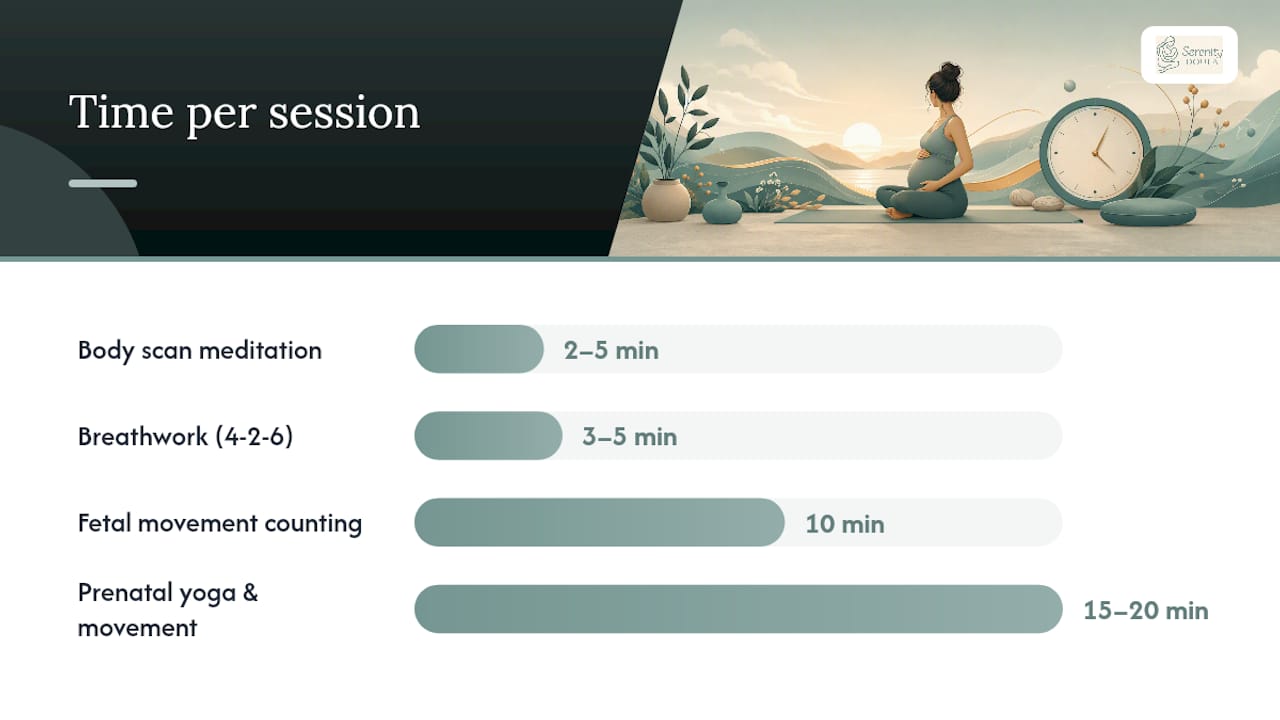
The table below compares four common body-awareness practices by time commitment, trimester suitability, and primary benefit.
| Practice | Time per session | Best trimester(s) | Primary benefit |
|---|---|---|---|
| Body scan meditation | 2–5 minutes | All trimesters | Reduces anxiety; builds interoceptive attention |
| Breathwork (4-2-6 pattern) | 3–5 minutes | All trimesters | Calms nervous system; useful before appointments |
| Fetal movement counting | 10 minutes | Third trimester (28+ weeks) | Safety monitoring; strengthens maternal signal awareness |
| Prenatal yoga / gentle movement | 15–20 minutes | Second and third trimester | Physical comfort; improves body confidence |
How to talk with your OB or midwife about what you’re feeling
Shared decision-making is not just a nice idea. ACOG’s committee opinion on informed consent states that adult pregnant patients are presumed to have decision-making capacity and have the right to refuse or choose treatments. Your provider is obligated to support that process, not just deliver instructions.
Knowing your rights is one thing. Walking into a 15-minute appointment and using them is another. These scripts help.
To assert a preference: “I’d like to understand my options before we decide. Can you walk me through what happens if we wait versus acting now?”
To report a concern: “I know this might sound like normal pregnancy worry, but something feels different to me today. I’d like you to check it out.”
To ask for time: “I want to make an informed choice here. Can I have until tomorrow to think about this and call you back?”
To document your plan: “Can we note in my chart that I’ve asked for [specific preference] so the whole team knows?”
Bring a written list of questions to every appointment. Patient advocacy resources consistently show that patients who arrive with written notes get more of their concerns addressed. Bring your partner or a trusted friend, in person or by phone, as a second set of ears. At Trinity Health St. Mary in Langhorne or any Bucks County practice, you are allowed to have a support person with you. Use that right.
For documentation, ask your provider to note your preferences in your chart at each visit. If you have a birth plan, bring a printed copy and ask that it be scanned into your record.
What partners can do to help (and what to avoid)
A partner’s role in building body trust is mostly about creating safety, not solving problems. Here’s what that looks like in practice.
Do:
- Listen without immediately offering solutions. “That sounds really uncomfortable — what do you need right now?” goes further than “Have you tried sleeping on your left side?”
- Mirror the language your pregnant partner uses. If they say “something feels off,” don’t translate it to “she’s just anxious.” Take the words at face value.
- Remind them of the safety plan you made together (the list of red-flag signs, the provider’s after-hours number).
- At appointments, let your partner speak first. Your job is to listen, take notes, and ask follow-up questions, not to answer for them.
Don’t:
- Compare their experience to other pregnancies (“My sister felt that way and it was nothing”).
- Dismiss intuition (“You’re overthinking it”).
- Minimize symptoms to avoid worrying (“I’m sure it’s fine”).
- Take over the conversation with the provider.
Sample phrases for home:
“I believe you that something feels different. Let’s look at the list and decide together whether to call.”
“You know your body better than anyone. What does your gut say?”
At the clinic visit: Sit beside your partner, not across the room. Write down what the provider says. Ask, “Is there anything else we should know?” before leaving. That one question often surfaces information the provider assumed you already had.
What gets in the way of trusting your body, and when to ask for more help
Several common barriers make body trust harder to build, and recognizing them is the first step.
Body image concerns. Pregnancy changes your body faster than your mind can adjust. Stretch marks, weight gain, and a shifting center of gravity can feel disorienting. The research linking positive body image to lower psychological distress during the second trimester suggests that working on body acceptance, not perfection, has measurable mental health benefits.
Prior birth trauma. If a previous pregnancy or birth was frightening or traumatic, your nervous system may interpret normal sensations as threats. This is not weakness; it’s a learned protective response. A trauma-informed therapist or a perinatal mental health specialist can help you distinguish between a trauma response and a genuine physical signal. Ask your provider: “Can you refer me to someone who specializes in perinatal mental health or birth trauma?”
Perinatal anxiety and OCD. Intrusive thoughts and hypervigilance about fetal wellbeing are more common than most people realize. If your worry feels uncontrollable or is interfering with daily life, that’s a signal to seek support, not to push through alone. Postpartum Support International (PSI) maintains a provider directory specifically for perinatal mental health.
Comparison and information overload. Social media and pregnancy forums can flood you with other people’s symptoms, fears, and outcomes. Self-care tips for pregnancy often include limiting screen time for exactly this reason: your body’s signals are harder to hear when you’re constantly filtering them through someone else’s story.
When maternal intuition becomes a clinical signal. Case-control and qualitative research found that many mothers who experienced stillbirth recalled a gut feeling that something was wrong before the loss was confirmed. The authors recommend that clinicians ask about and investigate maternal concerns about fetal wellbeing. If you have a persistent sense that something is off, call your provider. You are not being dramatic.
Medical red flags — contact your provider or go to urgent care immediately for:
- Decreased or absent fetal movement
- Heavy vaginal bleeding
- Severe or sudden headache, vision changes, or upper-right abdominal pain (possible preeclampsia signs)
- Fever above 100.4°F
- Chest pain or difficulty breathing
- Sudden severe swelling in face, hands, or feet
- Painful, burning urination with fever (possible kidney infection)
What the research actually says about interoception and maternal intuition
The evidence base here is growing but still has real limits. Here’s an honest snapshot.
| Study type | Key finding | Limitation |
|---|---|---|
| Longitudinal network analysis (N=253) | Lower antenatal body trusting linked to higher anxiety, depression, and weaker postnatal bonding | Associative, not causal; relatively small sample |
| Cross-sectional study (N=468, Japan) | Higher positive body image associated with lower adjusted odds of psychological distress (OR ~0.65) and serious mental illness (OR ~0.68) | Single country; second trimester only; cross-sectional design |
| Comparative interoception study | Body trusting predicts body satisfaction and mediates pregnant/non-pregnant differences | Does not establish directionality of the relationship |
| Case-control and qualitative research | Many stillbirth-affected mothers recalled a gut feeling something was wrong; clinicians advised to investigate maternal concerns | Recall bias; cannot quantify predictive accuracy of intuition |
What’s well-supported: Body trust and positive body image are consistently associated with better mental health outcomes during pregnancy. Shared decision-making is both ethically required and practically beneficial. Maternal concerns about fetal movement deserve clinical attention.
What’s promising but not yet definitive: Whether specific mindfulness or interoception practices directly improve birth outcomes is still being studied. Cultural differences in how maternal intuition is expressed and reported add complexity to the research picture.
Practical takeaway: You don’t need to wait for a perfect evidence base to start a daily body-awareness practice. The risk is low, the potential benefit is real, and your care team can help you calibrate what you’re noticing.
A simple 4-week plan to build body trust
This plan is designed for any trimester. Adjust the fetal movement counting to after 28 weeks.
- Week 1: Body awareness. Each morning, spend two minutes noticing five physical sensations before you get up. Keep a simple notes-app log: what you noticed, whether it was familiar or new. Visit first trimester self-care strategies for trimester-specific habits to layer in. Micro-goal: seven consecutive days of morning check-ins.
- Week 2: Breath and movement. Add the 4-2-6 breath exercise once daily and one 15-minute gentle movement session. If anything causes pain or discomfort, note it and rest. Micro-goal: complete five breath sessions and three movement sessions.
- Week 3: Fetal movement check-ins (28+ weeks) or deepened body scan. If you’re past 28 weeks, begin daily fetal movement counts after a meal. If earlier, extend your morning body scan to five minutes and add the evening visualization. Micro-goal: consistent daily check-in with one written note about what you observed.
- Week 4: Integrate with your care team. Bring your notes-app log to your next appointment. Use one of the scripts from the care-team section to share what you’ve been noticing. Ask your provider to confirm which signals to monitor and which to report immediately. Micro-goal: leave the appointment with a written personal safety map.
If any week feels unsafe or a practice triggers anxiety rather than calming it, skip it and mention it to your provider or a perinatal mental health specialist. Progress is not linear, and adjusting the plan is part of trusting yourself.
Your next three steps, right now
Body trust builds one small action at a time. Here’s your compact checklist:
- Daily micro-practice: Choose one practice from the plan above and do it today, even for two minutes.
- One clinic question: At your next appointment, ask: “What physical changes should I call about right away, and what can I monitor at home?”
- Partner ask: Tell your support person: “When I say something feels off, please take it seriously and help me decide whether to call.”
One-line partner prompt: “Your job is to believe me first, then help me figure out the next step.”
Safety reminder: Decreased fetal movement, heavy bleeding, severe headache, vision changes, or a persistent gut feeling that something is seriously wrong are all reasons to call your provider now, not tomorrow.
A doula’s perspective: what I’ve seen body trust do for families
The clients who arrive at birth feeling most prepared are rarely the ones who read the most books. They’re the ones who spent their pregnancy actually listening to their bodies, checking in daily, and learning to distinguish between “this is new and I should mention it” and “this is the round ligament pain I’ve felt before.”
One thing I return to again and again in my work: body trust is not about being certain. It’s about being willing to pay attention and to speak up. The pregnant person who calls her midwife at 2 AM because the baby hasn’t moved the way it usually does is not being anxious. She’s being a good advocate for her child. That call matters.
A practical tip I share with every client: keep a simple running note on your phone titled “Things to ask at my next appointment.” Every time something feels unfamiliar, add it. You don’t have to decide in the moment whether it’s important. You just have to write it down. By the time you walk into your appointment at Doylestown Hospital or Trinity Health St. Mary, you have a real record, not a vague memory of something that felt off two weeks ago.
Bucks County families have excellent care available to them. The goal is to make sure you’re walking into those appointments as an informed, confident participant, not just a passenger. That’s what this work is really about.
How Serenity Doula helps you build confidence in your body
Feeling grounded in your body during pregnancy is something you can practice alone, and it’s also something you don’t have to figure out alone.
Serenity Doula offers prenatal emotional support and birth doula services for families throughout Bucks County, including Newtown, Doylestown, and the surrounding communities, with coverage at Trinity Health St. Mary. The work includes one-on-one prenatal visits where you practice breathwork, body-scan techniques, and birth visualization together; partner coaching so your support person knows exactly how to show up; and private childbirth education that teaches you the shared decision-making skills to use with your OB or midwife. Every service is personalized, evidence-informed, and built around your specific concerns, not a generic curriculum.
Ready to feel genuinely prepared? Schedule a complimentary consultation with Serenity Doula and bring your questions, your notes, and whatever is on your mind.
Sources
- Informed Consent and Shared Decision Making in Obstetrics and Gynecology | ACOG
- They told me all mothers have worries — stillborn mother’s experiences (eprints.whiterose)
- PMC9515153
This article is general information, not a substitute for advice from a qualified doctor. Consult a qualified healthcare professional about your own circumstances before acting on anything here.
FAQ
How do you trust your body during pregnancy?
Start with brief daily check-ins: notice your breath, fetal movement, hunger, and any unfamiliar sensations for two to five minutes each morning. Pair that practice with clear communication at your prenatal appointments, using written notes and the scripts in this guide to share what you’re observing with your provider.
What should partners avoid saying during pregnancy?
Partners should avoid dismissing physical concerns (“I’m sure it’s nothing”), comparing the pregnancy to others’ experiences, or overriding the pregnant person’s instincts. Taking concerns at face value and helping decide whether to call the provider is far more supportive than reassuring someone out of their worry.
What is the 5-5-1 rule in pregnancy?
The 5-5-1 rule is a guideline for recognizing active labor: contractions lasting about 1 minute, occurring every 5 minutes, for at least 1 hour. At that point, most providers recommend heading to the hospital or birth center. Confirm the specific threshold with your own provider, as recommendations can vary.
Can you get a deep tissue massage while pregnant?
Deep tissue massage is generally not recommended during pregnancy, particularly in the first trimester and over the abdomen. Prenatal massage by a certified therapist using appropriate positioning and pressure is considered safe for most pregnancies. Ask your provider whether prenatal massage is appropriate for your specific situation before booking.
When should I call my provider about a gut feeling something is wrong?
Call your provider any time you have a persistent sense that something is off, especially if it accompanies decreased fetal movement, unusual pain, or any of the red-flag symptoms listed in this guide. Research on maternal intuition supports taking these concerns seriously rather than waiting.