

Inclusive doula services provide continuous, non-clinical support during pregnancy, birth, and the postpartum period, with a specific commitment to meeting each person where they are — culturally, linguistically, physically, and emotionally. For families who have experienced discrimination, language barriers, or simply felt unseen in a clinical setting, this kind of care can change everything.
Here is what equity-focused doula support typically offers:
- Better outcomes for underserved families: Research links doula care to lower cesarean rates, fewer preterm births, and higher patient satisfaction, with the strongest benefits seen among historically marginalized groups.
- Advocacy and navigation: A skilled doula helps you understand your options, ask the right questions, and access community resources — especially when the medical system feels fast-moving or hard to read.
- Culturally safe, trauma-informed support: Inclusive doulas bring cultural humility, language access, and a commitment to honoring your specific traditions, identity, and history.
If any of this resonates, a free consultation with Serenity Doula is a gentle, no-pressure first step.
Key Takeaways
Inclusive doula services are most effective when they combine cultural competence, trauma-informed practice, and active advocacy — not just a welcoming attitude.
| Point | Details |
|---|---|
| Definition matters | Inclusive doulas go beyond friendliness; they bring cultural competence, language access, and SDoH navigation. |
| Evidence is encouraging | ASPE links doula support to lower cesarean rates and higher satisfaction, with the strongest gains for underserved families. |
| Cost barriers are real but solvable | Medicaid pilots in Oregon, Minnesota, and California, plus community programs, can reduce or eliminate out-of-pocket costs. |
| Ask specific questions | Contract terms, backup coverage, advocacy style, and cultural training are the four areas most families forget to ask about. |
| Serenity Doula serves Bucks County | High-touch, evidence-informed inclusive care is available across Bucks, Montgomery, Philadelphia, and Burlington Counties. |
Table of Contents
- What do inclusive doula services actually look like?
- What does the research say about equity-focused doula care?
- What services does an inclusive doula package include?
- How much does doula care cost, and who can help pay for it?
- How are doulas trained, and what signals cultural competence?
- How do you choose an inclusive doula? A practical checklist
- Real programs that expand access to inclusive doula care
- What inclusive care looks like day to day
- Why Serenity Doula centers high-touch, inclusive care
- Ready to take the next step with Serenity Doula?
- Sources
- FAQ
What do inclusive doula services actually look like?
The word “inclusive” gets used loosely, so it helps to be specific. An inclusive doula is one who has actively trained to serve clients across differences in race, ethnicity, language, disability, gender identity, sexual orientation, and socioeconomic status. The industry term you will often see alongside this is culturally competent care, which means the doula understands how identity and lived experience shape a person’s relationship with the healthcare system — and adjusts their support accordingly.
Doulas are nonclinical perinatal professionals who provide emotional, physical, and informational support. What makes a doula inclusive goes beyond friendliness. It requires knowledge of social determinants of health, local resources, and a genuine commitment to addressing structural barriers — not just being “open to everyone.”
Three common delivery models exist, and they differ in meaningful ways:
| Feature | Private/Self-Employed Doula | Community-Based Doula | Hospital-Embedded Program |
|---|---|---|---|
| Prenatal visits | 2–3 scheduled visits | 4–6+ home visits, often extended | Varies; often 1–2 in-hospital |
| Postpartum support | 1–2 visits typical | Multiple home visits, resource navigation | Limited; may refer out |
| Navigation/SDoH work | Informal, referral-based | Core function; resource-mining, case-management adjacent | Varies by program |
| Payment model | Out-of-pocket, sliding scale | Free, grant-funded, or subsidized | Hospital-funded or Medicaid-billed |
| Cultural concordance | Depends on individual doula | Often shared lived experience | Depends on program design |
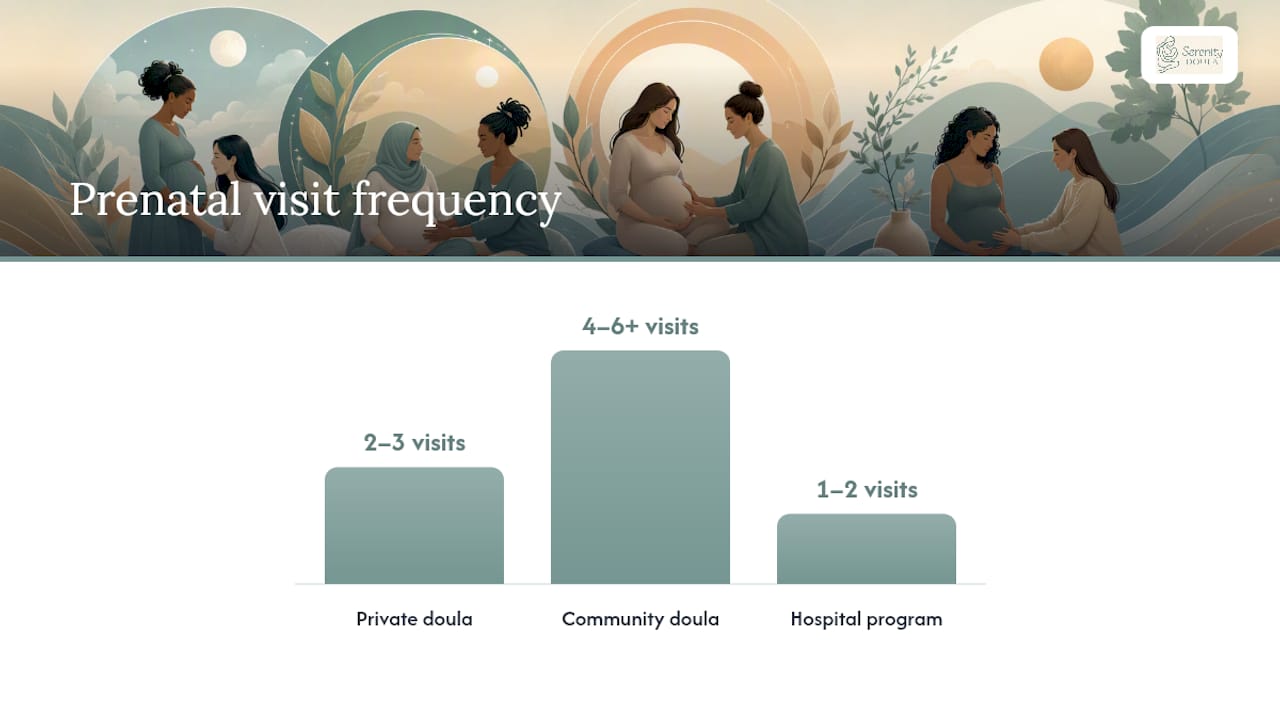
Some doulas blend these models — a community doula might accept a hospital stipend, or a private doula might partner with a local health department program. The types of childbirth support available to you are wider than most families realize.
What does the research say about equity-focused doula care?
The evidence is genuinely encouraging, though it is still growing. The ASPE issue brief on doula care and maternal health synthesizes multiple studies and finds associations between doula support and lower cesarean rates, fewer preterm births, and higher patient satisfaction. Critically, the brief also notes that historically only a small proportion of births in the U.S. have involved a doula — and that access barriers fall hardest on the communities that stand to benefit most.
Statistic Spotlight: The ASPE review found doula utilization has historically hovered around 6% of U.S. births, despite documented associations with improved outcomes — a gap driven by cost, workforce shortages, and limited awareness.
A pragmatic randomized controlled trial at an urban safety-net hospital tested enhanced community doula support against standard care and found promising signals for reduced cesarean births and equity-related improvements. The authors are careful to note that larger trials are needed before drawing firm conclusions — which is honest science, not a reason to dismiss the findings.
Program-level evidence adds texture. The Healthy Start Brooklyn By My Side program offered free and subsidized doula services in high-poverty neighborhoods, with multiple prenatal and postpartum home visits. Client feedback was strongly positive, and the program demonstrated meaningful access benefits for Black and Latina families who had few other options.
Research on innovative models of doula services also frames community doulas as a structural intervention — not just a personal preference — for reducing racial disparities through culturally congruent, continuous support.
One honest limitation: most studies are small, and implementation varies widely. The evidence base is building, not settled. What is clear is that for people who have experienced discrimination in healthcare, having a trusted, knowledgeable advocate present during labor can reduce stress and amplify their voice in ways that matter.
What services does an inclusive doula package include?
Core birth doula services look similar across most models:
- Prenatal visits: Several prenatal sessions covering birth preferences, comfort measures, and relationship-building.
- Continuous labor support: Physical comfort techniques, emotional reassurance, and communication support throughout active labor.
- Postpartum visits: Check-ins on physical recovery, infant feeding, and emotional well-being.
- Birth planning and advocacy: Helping you articulate your preferences and understand your options before and during labor.
Community-based and inclusive doulas often extend well beyond this core. The Berkeley SHARE primer on community doulas describes these providers as “resource-miners” — trusted community members who conduct prenatal and postpartum home visits, screen for social determinants of health, connect families to housing, food, and mental health resources, and provide culturally specific postpartum care.
That might look like:
- Facilitating interpretation or helping you find a provider who speaks your language.
- Supporting traditional postpartum practices like cuarentena — the culturally rooted recovery period observed in many Latin American communities.
- Accompanying you to prenatal appointments when you need an extra set of ears.
- Connecting you with WIC, Medicaid enrollment, or local mental health services.
- Providing disability accommodations — adjusted positioning, communication supports, or modified visit formats.
For families with higher social needs, a community doula’s work can resemble case management. For families with fewer barriers, the same doula provides the same warmth and advocacy with a lighter navigation load. The benefits of childbirth education pair naturally with doula support, giving you both knowledge and a person to help you use it.
How much does doula care cost, and who can help pay for it?
Cost is the most common barrier. Private birth doulas in the U.S. typically charge several hundred to several thousand dollars for a full package, paid out of pocket. That price point excludes many of the families who need support most.
Several pathways exist to reduce or eliminate that cost:
- Sliding-scale fees: Many independent doulas adjust their rates based on income. Ask directly — most are willing to discuss it.
- Community programs: Free or subsidized doula care through public health initiatives, Federally Qualified Health Centers, or nonprofits.
- Hospital-funded programs: Some hospital systems, including Denver Health, have embedded doula programs that serve patients at no direct cost.
- Medicaid reimbursement pilots: A growing number of states now reimburse doula services through Medicaid.
State-level momentum is real. Oregon and Minnesota have both established Medicaid reimbursement pathways for doulas, expanding access for low-income families. In California, Medi-Cal began reimbursing doula services in 2023, creating new workforce pathways and increasing doula-attended births among Medicaid enrollees. The ASPE review confirms that cost, workforce shortages, and administrative complexity remain the primary barriers to broader Medicaid uptake nationally.
Practical steps to find lower-cost support:
- Search your county public health department for community doula programs.
- Ask your OB or midwife whether your hospital has an embedded doula program.
- Check whether your state has a Medicaid doula reimbursement pilot and whether you qualify.
- Ask any doula you interview about scholarships, payment plans, or sliding-scale availability.
- Contact local community-based organizations serving your cultural community — many have doula referral networks.
How are doulas trained, and what signals cultural competence?
Doula certification is not standardized nationally. Multiple certifying organizations exist, each with different curricula, hour requirements, and renewal standards. This means two doulas can both call themselves “certified” while having very different training backgrounds.
What matters more than the certifying body is what the training actually covered. Look for these signals:
- Trauma-informed care training: Has the doula completed coursework on how trauma affects labor and communication?
- Cultural humility and anti-bias education: Ongoing, not a one-time workshop. Ask when they last completed this training.
- Language access: Can they communicate in your language, or do they have a reliable interpretation protocol?
- Disability accommodations: Have they supported clients with physical, sensory, or cognitive disabilities? What did that look like?
- Community doula-specific curricula: Programs like those developed through Healthy Start or community health worker frameworks often include SDoH screening and navigation training that standard birth doula programs skip.
The HHS Office of Minority Health’s Think Cultural Health platform offers training in Culturally and Linguistically Appropriate Services (CLAS) standards — a useful benchmark for what culturally competent perinatal care should include.
Shared lived experience is also a meaningful indicator. A doula who has navigated the same healthcare system, speaks your language, or comes from your community brings a form of knowledge that no curriculum fully replicates. That said, lived experience alone is not sufficient — training, referral networks, and a clear scope of practice matter too.
An NIH study on women with disabilities found higher rates of birth complications and adverse outcomes in this population, underscoring why disability-competent doula care is not optional for families who need it. Ask any prospective doula directly: “Have you supported clients with disabilities? What accommodations have you made?”
Some states are developing doula registries or certification standards tied to Medicaid reimbursement. If your state has one, a registry-listed doula has met a minimum training threshold — a useful but not exhaustive filter.
How do you choose an inclusive doula? A practical checklist
Finding the right fit takes more than reading a website bio. Here is a structured approach to evaluating any doula you are considering.
Interview questions to ask:
- Have you supported clients from my cultural background, or with my specific identity or needs? Can you give me an example?
- What does your advocacy style look like during labor — especially if things move quickly or I feel pressured?
- What is your on-call window, and who is your backup if you are unavailable?
- How many prenatal and postpartum visits are included, and what do those visits cover?
- Do you offer home visits, and can you accommodate any accessibility needs I have?
- What languages do you speak or have access to through interpretation?
- What is your fee, and do you offer sliding-scale pricing, payment plans, or scholarships?
- Do you carry liability insurance?
- What does your contract cover, and can I see a sample?
Red flags to watch for:
- No written contract offered.
- Vague or evasive answers about backup coverage.
- Promises about medical outcomes (“I’ll make sure you don’t have a C-section”).
- Reluctance to discuss referrals or the limits of their scope.
- No clear on-call policy.
Trust signals:
- A clear, written contract with defined scope, cancellation policy, and confidentiality terms.
- References from past clients, especially from communities similar to yours.
- Transparent pricing with options for different budgets.
- Documented training in trauma-informed and culturally competent care.
- A referral network they can describe specifically.
Contract items to confirm before signing:
- On-call start and end window (e.g., 38–42 weeks).
- Backup doula name and contact.
- Cancellation and refund policy.
- Scope of prenatal and postpartum visits.
- Confidentiality and data privacy terms.
- What happens if labor is very long or very fast.
The doula considerations guide at Serenity Doula walks through many of these questions in detail and is worth reading before any interview.
Real programs that expand access to inclusive doula care
Three program models show what equity-focused doula care looks like in practice.
Healthy Start Brooklyn — By My Side Birth Support Program offered free doula services in high-poverty Brooklyn neighborhoods, pairing multiple prenatal home visits with labor support and postpartum follow-up. The program specifically targeted Black and Latina families with limited access to private doulas. Client feedback was strongly positive, and the evaluation highlighted both the access value and the sustainability challenges that community programs commonly face.
Denver Health’s embedded doula program placed doulas within a safety-net hospital system, making support available to patients regardless of ability to pay. Hospital-embedded models remove the cost barrier entirely for patients who deliver at that facility, though the depth of prenatal and postpartum support varies by program design.
Oregon and Minnesota’s Medicaid reimbursement pilots represent the policy lever with the widest potential reach. By allowing doulas to bill Medicaid directly, these states created a pathway for low-income families to access doulas without relying on grant funding or hospital goodwill. Administrative burden on doulas remains a real challenge, but the framework is expanding.
How to find programs near you:
- Search “[your county] community doula program” or “[your city] Healthy Start.”
- Ask your hospital’s maternity unit whether they have an embedded or partnered doula program.
- Contact your county public health department’s maternal and child health division.
- Ask your Medicaid managed care plan whether doula services are a covered benefit in your state.
- Reach out to community-based organizations serving your cultural community — many maintain informal doula referral lists.
For families in Bucks County, doula care benefits in Pennsylvania are worth exploring as the state’s reimbursement landscape continues to evolve.
What inclusive care looks like day to day
One of the things I hear most often from new clients is that they did not realize how much they needed someone in their corner until they had one. Inclusive doula care is not about performing a checklist of cultural competencies. It is about showing up prepared to meet a real person — with their history, their fears, their family, and their specific relationship with the medical system — and staying present through all of it.
In practice, that might mean spending a prenatal visit talking through a past traumatic birth before we ever discuss comfort measures. It might mean helping a queer couple navigate a hospital intake form that was not designed with them in mind. It might mean sitting quietly with a client who does not want to talk, because what she needs is simply not to be alone.

The advocacy piece is where I see the biggest gap between what families expect and what they actually need. Labor can move fast. Decisions get made quickly, and it is easy to feel like you have no choice. My role is to create a pause — to ask the nurse or provider to slow down for just a moment so my client can hear the options, ask a question, and make an informed decision. That is not undermining clinical authority. It is protecting informed consent.
Pro Tip: Before your first prenatal visit with any doula, write down three things: your biggest fear about labor, one cultural or personal tradition that matters to you postpartum, and any past experience with the healthcare system that felt difficult. Sharing these early gives your doula the context to actually support you, not just attend your birth.
A few things worth sharing with your doula early in pregnancy:
- Any prior birth experiences, including losses or traumatic deliveries.
- Your cultural or religious postpartum traditions.
- Any disabilities, chronic conditions, or sensory needs that affect how you receive support.
- Your preferences around who is in the room and how decisions get made.
- Your comfort level with advocacy — some clients want their doula to speak up; others prefer to lead.
Why Serenity Doula centers high-touch, inclusive care
Serving families across Bucks County, including Newtown, Doylestown, and the communities around Trinity Health St. Mary, means working with people whose needs and backgrounds are genuinely varied. Some clients come to me with very specific cultural traditions they want honored. Others are navigating a first pregnancy after a loss, or a birth experience that left them feeling unheard. Queer-friendly doula care, disability accommodations, and language access are not add-ons at Serenity Doula — they are part of how I approach every client relationship.
My training includes trauma-informed care and ongoing education in culturally competent practice. I maintain referral networks across Bucks, Montgomery, Philadelphia, and Burlington Counties so that when a client needs a resource I cannot provide directly, I know exactly where to send them.
If you are wondering whether inclusive, evidence-informed birth doula support is the right fit for your family, I would love to talk.
Ready to take the next step with Serenity Doula?
Choosing a doula is a personal decision, and the best way to know whether it is the right fit is a real conversation. Serenity Doula offers a free, no-obligation consultation where you can ask every question on your list, share what matters most to you, and get a clear sense of how support would actually work for your family.
Booking is straightforward through the pregnancy and birth support page, where you can also review the full scope of services. Your information stays private, and there is no pressure to commit. For families who want postpartum support alongside birth care, postpartum supplies and recovery products from SweeTee Beauty are worth exploring as you plan ahead. Reach out whenever you are ready — early in pregnancy is ideal, but it is never too late to ask.
Sources
- Doula Care and Maternal Health: An Evidence Review (ASPE issue brief)
- Effectiveness of an Enhanced Community Doula Intervention in a Safety Net Setting: A Randomized Controlled Trial
- What Is a Doula? — Policy at a Glance (California Health Care Foundation)
- NIH study suggests women with disabilities have higher risk of birth complications, death
FAQ
What does a doula package typically include?
Most birth doula packages include 2–6 prenatal visits, continuous labor support, and 1–2 postpartum check-ins. Community-based and inclusive packages often add home visits, resource navigation, and culturally specific postpartum support.
What is a community-based doula?
A community doula is a trusted, often grassroots birth worker embedded in a specific community who provides extended prenatal and postpartum home visits, social-service navigation, and culturally congruent support — typically free or subsidized for families with limited resources.
Are doula services covered by insurance or Medicaid?
Coverage varies by state. Oregon, Minnesota, and California have established Medicaid reimbursement pathways for doulas. Private insurance coverage remains rare, though some HSA/FSA plans allow doula expenses. Always ask your insurer and check your state’s Medicaid plan directly.
How do I find an inclusive doula near me?
Start with your county public health department, your hospital’s maternity program, and community-based organizations serving your cultural community. You can also learn more about what to look for before your first interview.
Can a doula help if I have a disability or specific accessibility needs?
Yes. Inclusive doulas can adapt visit formats, communication styles, and physical support techniques for clients with disabilities. Ask any prospective doula directly about their experience with accessibility accommodations, and reference the NIH findings on higher birth complication risks for women with disabilities as context for why this support matters.